
IRW-210 · Lesson 1 of 12 · 26 min
Structural steel shapes and grades
▶ Video coming soon A video version of this lesson is on the way.
On the last Wednesday of September, Nate Okonkwo stood in the Crossbeam yard beside a rack of offcuts and short pieces that the shop had sent back from the Ashcroft job. It was the first of his Wednesday-evening steel nights, a series he ran every fall for the first- and second-year apprentices. "Before you bolt anything, you have to know what you are holding," he said, and handed Shay Donnelly a short length of wide-flange beam. "Tell me what that is, what it weighs and what it is made of, without looking at the tag." Shay turned it over, measured it with his tape, looked for the mill marks and got two of the three right. By the end of the night he could do all three, and that is the aim of this lesson.
This lesson covers the steel shapes that ironworkers erect, how they are named on drawings in Canada and the United States, how to work out their weight, which steel grades they are made from and how grades and heat numbers are traced from the mill to the job.
Why shape matters
A steel member carries load by its shape as much as by its steel. A beam bends under load: its top is squeezed and its bottom is stretched, and the steel far from the middle does most of the work. That is why a beam is shaped like a capital I, with most of its steel in two wide flanges held apart by a thin web. A column is squeezed along its length and wants to buckle sideways, so it needs steel spread out in every direction, which is why columns are often square or nearly square wide-flange shapes or hollow sections. A brace is pulled or pushed along its length and only needs a modest cross-section, so small angles, rods and hollow sections are used.
An ironworker does not design these members, but knowing why each shape is used helps in three ways. It tells you which way a member goes: a beam set on its side, or a channel facing the wrong way, will carry far less than it was designed to. It tells you how a member will behave while it is being erected: a long, slender beam can twist and roll before it is braced, and a column standing on its base plate can tip. And it helps you read a drawing quickly, because the shape and size tell you a great deal about what a member is doing in the frame.
The common shapes
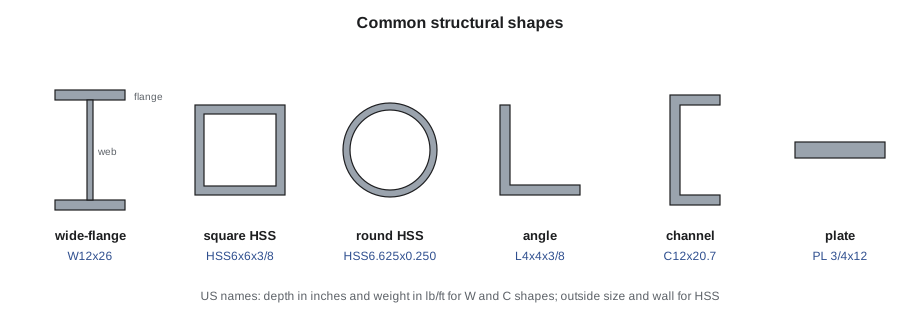
- Wide-flange shapes (W shapes). The workhorse of building steel: beams, girders and most columns. The flanges are wide and parallel, unlike the older tapered-flange I-beams.
- Hollow structural sections (HSS). Square, rectangular and round tubes, used for columns, braces, trusses and frames where a clean look or strength in every direction is wanted. They are closed, so they are hard to connect to from the inside, and their connections are usually plates welded on in the shop.
- Angles. L-shaped pieces with equal or unequal legs, used for braces, lintels, clip angles at beam ends, and many small pieces of miscellaneous steel.
- Channels. C-shaped pieces with one flat back and two flanges, used for stair stringers, lintels, edge members and light framing. A channel is not symmetrical, so it twists under load unless it is braced or paired.
- Plates and bars. Flat steel for base plates, gusset plates, shear tabs, stiffeners and splice plates. Plates are the pieces most often welded to other members in the shop.
- Other shapes. Tees cut from wide-flange shapes, standard I-beams (S shapes), pipe, and the joists and decking covered in IRW-230.
Reading a designation
In the United States, structural shapes are named in inches and pounds. A wide-flange shape is written W, then its nominal depth in inches, then its weight in pounds per foot: W12x26 is a wide-flange about 12 in deep weighing 26 lb for every foot of length. The nominal depth is a family name, not an exact dimension: a W12x26 is actually about 12.2 in deep, but a W12x96 in the same family is about 12.7 in deep, because heavier shapes in a family have thicker flanges added to the outside. Hollow sections are named by their outside dimensions and wall thickness, so HSS6x6x3/8 is a square tube 6 in on a side with a 3/8 in wall. Angles are named by their two legs and thickness, L4x4x3/8, and channels by their depth and weight, C12x20.7.
Some drawings from Canadian fabricators, and some mill paperwork, show the metric name beside the imperial one, because mills across North America roll the same shapes. A W12x26 and a W310x39 are the same piece of steel described in two systems.
Worked problem
Reading designations
A drawing calls for a W10x49 column, an HSS6x6x3/8 brace and an L4x4x3/8 clip. What does each name tell you?
Show solution
- W10x49: a wide-flange shape about 10 in deep (actually about 10 in) weighing 49 lb per foot.
- HSS6x6x3/8: a square hollow section 6 in by 6 in on the outside with a 3/8 in wall.
- L4x4x3/8: an equal-leg angle with two 4 in legs, 3/8 in thick.
Answer: The designation tells you the shape, its size and, for W shapes and channels, its weight. For hollow sections and angles, the weight comes from a table or the shop ticket.
Working out weights
Because a W shape's designation includes its weight per unit length, its weight is easy to work out: multiply the weight per unit length by the length. Shop tickets and erection drawings usually show the weight of each piece, including the clip angles, shear tabs and plates welded to it, so the shipping weight is a little more than the bare shape. Knowing how to check a weight matters for rigging (IRW-120), for loading the floor below with bundles of steel, and for spotting a piece that has been mislabeled.
Worked problem
The weight of a beam and a column
At Ashcroft, beam B2-14 is a W12x26, 30 ft long, and the first-tier columns are W10x49, 28 ft long. What are the bare weights?
Show solution
- Beam: 26 × 30 = 780 lb.
- Column: 49 × 28 = 1,372 lb.
Answer: About 780 lb for the beam and 1,372 lb for the column. The shop tickets show 808 lb and about 1,573 lb, because the beam has clip angles and the column has a base plate, cap plate and connection plates welded on. The rigging plans in IRW-120 used the shipping weights.
Worked problem
A bundle of braces
The sixteen chevron braces for the Linwood frame are L4x4x3/8 angles, each 21 ft long. The angle weighs about 9.8 lb/ft. What does the bundle weigh?
Show solution
- One brace: 9.8 × 21 = 205.8 lb.
- Sixteen braces: 16 × 21 × 9.8 = 3,292.8 lb, about 3,300 lb.
Answer: About 3,300 lb before the gusset plates and bolts, which is more than a small forklift can lift at full reach and more than some floors should carry in one spot. Bundles are landed where the erection plan allows, on beams and not on deck between them.
Steel grades
Steel is made to a standard that sets its strength, its chemistry and how it is tested. The key number for an ironworker is the yield strength, the stress at which the steel starts to stretch permanently. Designers choose the grade, and the shop drawings and mill certificates show it. An ironworker never substitutes one grade for another, because two pieces that look identical may have very different strengths.
In the United States, structural steel is made to ASTM standards. Wide-flange shapes are almost always ASTM A992, with a minimum yield strength of 50 ksi. Plates, angles and channels are often ASTM A36, with a yield strength of 36 ksi, or ASTM A572 Grade 50. Square and rectangular hollow sections are usually ASTM A500 Grade C or the newer ASTM A1085, both about 50 ksi for rectangular tubes. Higher-strength grades exist for special uses, and the designer will show them.
| Shape | Usual US grade | Yield strength |
|---|---|---|
| Wide-flange shapes | ASTM A992 | 50 ksi |
| Angles, channels and plates | ASTM A36 or A572 Grade 50 | 36 or 50 ksi |
| Hollow structural sections | ASTM A500 Grade C or A1085 | about 50 ksi |
| Anchor rods | ASTM F1554 Grade 36, 55 or 105 | Per the grade |
Marks, heat numbers and traceability
Every piece of steel that leaves a mill belongs to a heat, a batch of steel melted together, and the mill issues a certificate for each heat showing the chemistry and test results. The fabricator keeps the link between each heat and the pieces cut from it, and marks the pieces with a piece mark and, for many jobs, a heat number or a code that leads back to it. This chain from mill to job is called traceability, and on most building jobs the engineer or the inspector can ask for it at any time.
For the ironworker, the important marks are the piece mark, which says which piece it is (lesson 2), the orientation marks that show which end goes where, and any special marks such as a stamped grade on high-strength steel or a painted end color that the fabricator uses to separate grades in the yard. A piece with no mark, or a mark that does not match the drawing, is set aside and reported. It is not erected on a guess.
Handling and storing steel
Steel is heavy, but it is also easy to damage. Beams stored on uneven ground can bend; long slender pieces can bend permanently if they are lifted from one point; galvanized and painted surfaces can be scraped; and the faying surfaces of slip-critical connections, which must stay clean and uncoated or coated with an approved coating, can be ruined by paint overspray, oil or mud. In the yard and on site, steel is stored on blocking clear of the ground and water, sorted by sequence, with the piece marks facing out where they can be read. Pieces are lifted at the points shown or with spreader bars, never by one end of a long member, and tag lines control them as in IRW-120.
Shay learned this on the Ashcroft shakeout on his first day, when Andy showed him how to set the blocking so that a stack of beams would not roll and how to sort them so the first ones needed were on top. "An hour of shakeout," Andy said, "saves a day of hunting for pieces with the crane waiting."
Checking a piece against its ticket
When a piece is in doubt, Nate checks it the way he taught Shay on the first steel night. First, the mark: is it painted where the fabricator's system puts it, and does it match a mark on the erection drawing? Second, the shape: measure the depth, the flange width and the flange and web thickness, and compare them with a shape table or the shop drawing. Two shapes from the same family can have the same nominal depth and look alike from a distance, but their flange thicknesses and widths differ, and a tape and a pair of calipers will tell them apart in a minute. Third, the length: measure from end to end, or between the end connections, and compare with the ticket. Fourth, the fittings: count the clip angles, the shear tabs, the stiffeners and the holes, and compare their positions with the shop drawing. A piece that passes all four is the piece on the drawing. A piece that fails any one is set aside and reported to the foreperson, who calls the fabricator.
Mistakes in the shop are rare, but they happen, and the field is the last place to catch them before they are bolted into the building. A beam with a missing hole for a pipe hanger, a column with its connection plates on the wrong face, or a brace a little short will each cost an hour to fix on the ground and a day to fix in the air. The fabricator would far rather hear about it from the shakeout crew than from the inspector.
Coatings and special steel
Many pieces arrive with a shop primer, and some with a full paint system or hot-dip galvanizing. Coated steel needs gentler handling: nylon slings or softeners at the pick points, no dragging over the ground, and touch-up of any damage with the paint the specification calls for, after the inspector has seen it if the job requires that. Galvanized pieces are handled with care at the connections, because zinc on the faying surfaces and in the holes changes how the joint behaves, and galvanized bolts are used only where the drawings call for them. Weathering steel, which is left to rust to a protective patina, is kept free of paint marks and grease that would leave permanent stains. Stainless steel, occasionally used for canopies and exposed details, is kept away from carbon steel tools and wire brushes that can leave rust spots on it.
Common mistakes
MistakeReading the nominal depth as the exact depth of the shape.
InsteadUse the table or the shop drawing for actual dimensions; the nominal depth is a family name.
MistakeErecting a channel or an angle the wrong way round because it looked like it fit.
InsteadCheck the drawing for orientation; unsymmetrical shapes carry load only one way.
MistakeSubstituting a piece that looks the same.
InsteadMatch the piece mark and the grade; identical-looking steel can differ in strength.
MistakeLifting a long beam from one point at its middle.
InsteadUse the pick points or a spreader shown in the plan.
MistakeStoring steel on the ground in the mud.
InsteadBlock it clear of the ground and water, sorted by sequence, marks out.
Summary and key terms
- Shapes carry load by their form: beams put steel in the flanges, columns spread it in every direction, braces work along their length.
- W shapes are named by nominal depth in inches and weight in pounds per foot; HSS, angles and channels by their dimensions.
- Weight is weight per unit length times length; shipping weight includes the plates and clips welded on.
- The usual grade for W shapes is ASTM A992, 50 ksi; angles and plates are often A36 or A572 Grade 50.
- Heat numbers and mill certificates trace each piece back to the steel it was made from.
- Steel is stored blocked and sorted, lifted at the right points and never substituted.
- Wide-flange shape
- An I-shaped member with wide, parallel flanges, named W.
- Hollow structural section
- A square, rectangular or round steel tube, named HSS.
- Nominal depth
- The family depth in a shape name; the actual depth varies with the weight.
- Yield strength
- The stress at which steel begins to stretch permanently.
- Heat
- A batch of steel melted together, with its own mill certificate.
- Mill certificate
- The mill's report of the chemistry and test results for a heat.
- Traceability
- The chain of records linking each piece to its heat and certificate.
- Faying surface
- The surfaces of plies in contact in a bolted joint.
Practice problems
Work each problem on paper first, then reveal the answer to check.
What does W14x22 mean?
Show answer
A wide-flange about 14 in deep weighing 22 lb per foot.
What does a 25 ft W14x22 weigh?
Show answer
22 × 25 = 550 lb.
What is the usual US grade for wide-flange shapes?
Show answer
ASTM A992, 50 ksi.
A shop ticket shows 905 lb for a beam whose bare weight is 855 lb. Why the difference?
Show answer
Clip angles, plates or stiffeners welded on in the shop.
What does a heat number let you do?
Show answer
Trace the piece back to its mill certificate.
Lesson quiz · 5 questions
Score 60% or more to complete this lesson.
Create a free account to save your progress, take quizzes and earn a certificate.