
IRW-210 · Lesson 4 of 12 · 23 min
Setting and plumbing columns
▶ Video coming soon A video version of this lesson is on the way.
The first column at Ashcroft went up a little after nine on the morning of September 15, once the rod survey was done. Dwayne Mercer lifted it off the shakeout blocking with the hitch from the rigging plan, swung it slowly over the pier and held it there while Andy Pruszynski and Marco Bellini, standing on the ground, turned it by its tag lines until the column mark faced north as the erection notes said. "Down slow," Andy said on the radio, and the base plate came down over the four rods, a little at a time, until it sat on the leveling nuts. Marco spun the top nuts on by hand, Andy checked the column with a long level on two faces, and only then did Carla give the signal for the crane to come off the hook. The whole set took eleven minutes. Shay timed it on his phone.
This lesson explains how a column is set on its base, how it is checked and held plumb before and after the crane lets go, the tools used to check plumb, and how a column is adjusted at the base.
Before the pick
A column is set only when its base is ready and its rods have passed the survey (lesson 3). Before the pick, the crew checks the following.
- The piece mark matches the drawing and the column mark faces the way the notes require.
- The leveling nuts or shims are set to the plate elevation, with washers on the nuts, and the threads above them are clean.
- The connection material for the first beams is on hand, along with the bolts, drift pins and wrenches.
- Any perimeter cable holes, safety attachments or ladders that go on the column are fitted on the ground, where it is safe to do it.
- The column is checked for straightness and for damage to the base plate and connection plates.
- Guy cables or braces are ready if the erection plan calls for them, with anchors already in place.
IRW-120 covered how the column is rigged and lifted. A column is usually lifted from a lifting lug or a shackle through a hole near the top, or with a choker under a connection plate, so that it hangs plumb from the hook. A column that hangs plumb lands square on its rods; one that hangs tilted has to be forced.
Landing the column
The column is lowered slowly over the rods while the crew on the ground guides it with tag lines and their hands on the steel, never with their hands or feet under the base plate. The holes in the base plate are larger than the rods, so the plate can drop over them if the column is plumb and in the right rotation. The crew watches all four rods enter their holes before the plate is set down. Once the plate is on the leveling nuts, the top nuts and washers go on and are run down snug against the plate, so that the column cannot rock or lift.
If a rod will not enter its hole, the crew stops, lifts the column a little and looks for the reason. Hammering the plate down over a rod, or bending the rod with a bar to make it fit, damages the rod and may hide a layout error that will cause trouble at every beam above.
A column standing on its base plate with snug top nuts and nothing at the top is held up only by its rods and its base. The rods and the base are designed to hold a column in this condition against the small loads of erection, but not against a beam swung into it, a worker climbing it in wind, or a strong gust. Columns are not left standing alone at the end of a shift unless the erection plan allows it, and many plans require guy cables or braces on any column standing without beams.
Checking plumb
Plumb means vertical. A column must be set plumb, or close enough that the frame can be brought to its final tolerance during plumb-up (lesson 10). The crew uses several tools.
- A long level, often 4 ft or 6 ft long, placed against the web and against a flange, so that the column is checked in both directions. Quick and good enough for the first check on a short column.
- A plumb bob on a line, hung from an offset near the top and measured near the bottom. Slower but accurate on tall columns in calm air.
- A transit, laser or total station set up on the ground, sighting up the column from two directions at right angles. This is how the final plumb is checked on most jobs (lesson 10).
However the column is checked, it is checked in two directions, along each column line, because a column can be plumb in one direction and leaning in the other.
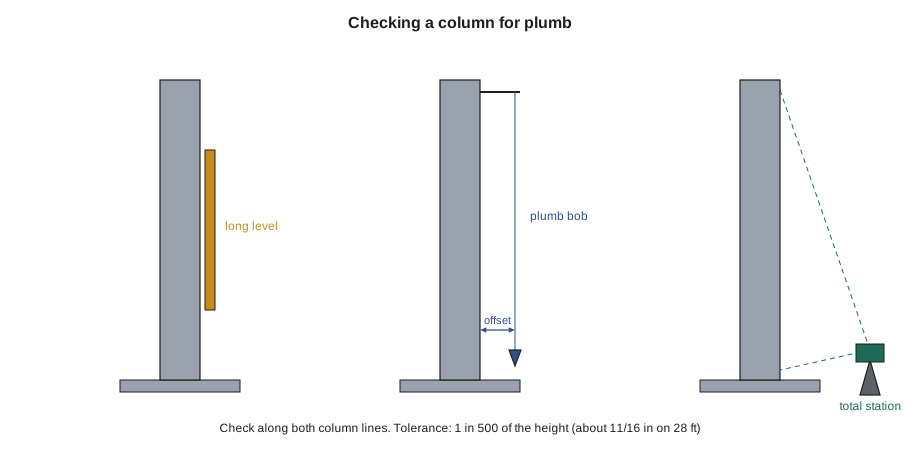
How plumb is plumb enough
The tolerance for plumb is set by the steel standards and the project specification. In both countries, the usual tolerance for an individual column is 1 part in 500 of its height, measured between working points, with extra limits on how far the columns at the building edge may lean in total over many stories. For a column in a small building, the 1 in 500 rule is the one that matters.
In the United States the tolerances come from the AISC Code of Standard Practice (AISC 303), and the project specification may tighten them.
Worked problem
The plumb tolerance for a column
The first-tier columns at Ashcroft are 28 ft long, two stories of about 14 ft. What is the plumb tolerance for the whole column at 1 in 500, and for one story? Andy's check shows the top 1/2 in out from the base. Is it within tolerance?
Show solution
- Whole column: 28 ft = 336 in; 336 ÷ 500 = 0.672 in, about 11/16 in.
- One story: 168 ÷ 500 = 0.336 in, about 5/16 in.
- Measured 1/2 in is less than 11/16 in.
Answer: About 11/16 in over the column and 5/16 in per story; the 1/2 in reading is within tolerance, but it uses most of it. The final plumb is set during plumb-up, when the beams and braces are in.
Adjusting at the base
Small corrections in plumb are made at the base, by raising or lowering the leveling nuts on one side of the plate. Because the column is long and the base is small, a tiny change at the base makes a large change at the top. This is why leveling nuts are set with care and why they must not be moved with a load on them.
Worked problem
How much to move a leveling nut
A column 28 ft tall leans 3/8 in at the top toward the east. Its anchor rods are 12 in apart east to west. How much must the nuts on the west side be lowered, or the east side raised, to bring the top back?
Show solution
- The lean is 0.375 in in 336 in.
- Over 12 in the same slope is 0.375 × 12 ÷ 336 = 0.0134 in.
Answer: About 1/64 in, less than a tenth of a turn on a typical rod thread. That is why plumb is rarely corrected at the nuts once the column is set: the adjustment is too fine, and the frame is plumbed later with cables, beams and braces. The leveling nuts set the elevation and get the column close; plumb-up does the rest.
What the base adjustments do matter for is elevation and the column's twist. A column set too high or too low puts every beam connection out of elevation, and a column rotated on its rods puts its connection plates out of line with the beams. Both are checked when the column is set, and both are much harder to fix later.
Releasing the load
The crane does not let go of a column until the column is secured as the erection plan requires: top nuts snug on all rods, and guy cables or braces attached and tightened if the plan calls for them. On a two-tier column, or one that will stand alone for some time, the plan almost always calls for them. Carla's rule at Ashcroft was simple: a column standing on its own got two cables at right angles before the hook came off, unless the next beam was going in within the same crane cycle and the plan allowed it.
Climbing a freshly set column is one of the riskiest moments in steel erection. The connector who climbs it to receive a beam is tied off as IRW-110 describes, and the column must be secure enough to take the connector's weight, the ladder and the push of the beam landing on its connection. Columns are never climbed while they are still on the hook and not yet nutted down.
Columns with splices
Tall buildings are erected in tiers, usually two stories per column length, and the column above is spliced to the column below. The splice is designed to hold the upper column during erection, including a small eccentric load from workers and connections at the top of the column, as the rules in each country require. At Ashcroft, the second-tier columns were spliced to the first tier above the second floor. Column splices, and the field welding that some of them need, are covered in IRW-310.
Getting the elevation right
Elevation is set before the column arrives, when the leveling nuts or shims are set to the underside of the base plate. The surveyor or the foreperson reads the top of each pier with a level or a total station, works out the plate elevation from the drawings, and sets the nuts on each rod to that height, checking them with the instrument rather than by eye. A column whose base is 1/8 in low puts every beam on it 1/8 in low, and the error shows up at the deck and the cladding. Setting nuts carefully before the pick is far easier than shimming a column later.
Rotation is set when the column lands. The column's connection plates must face the beams that will frame into them, which is why the column mark and its orientation note matter. A column set a few degrees off its rotation will still look straight, but its shear tabs will not line up with the beams, and the connectors will be fighting every piece on that column. Crews check rotation by sighting along the connection plates to the next column or by measuring from the plates to the grid lines.
Single columns and wind
A single column standing on its rods catches very little wind, but it is also held by very little. The danger is greatest at the end of a shift, when columns have been set ahead of the beams, and in changeable weather. Erection plans usually limit how many columns may stand without beams connecting them, require cables on any that do, and require the beams or cables to be in before the crew leaves. At Ashcroft, Carla's rule was that no column was left overnight without at least two beams or two cables, and on September 16, when the morning brought gusts to 45 mph, no columns were set until the wind dropped in the afternoon.
The view from the ground
Much of a column set is done by the crew on the ground: guiding the column with tag lines, watching the rods enter the holes, spinning the nuts and checking plumb. It is a good place for an apprentice to learn, because the whole operation is visible and the risks are clear. Shay's job on his first columns was the second tag line and the nuts on the far side of the plate. He learned to keep his feet clear of the plate's footprint, to stand where the column could not fall on him if the rigging failed, and to watch Andy, not the column, for the signals.
Columns and other trades
Once columns are standing, other trades often want to use them: electricians to run temporary power, the general contractor to hang lights or signs, or a mason to brace a wall against them. Nothing is attached to a column under erection without the foreperson's agreement, because the erection plan has not allowed for those loads and the attachment may block a connection or a cable. The same goes for ladders: a ladder leaned against a freshly set column pushes on its top, and only ladders the plan allows, secured at the top, are used. The rule protects the steel crew and the other trades alike.
Common mistakes
MistakeLetting the crane come off a column before the top nuts are on.
InsteadRun the top nuts down snug on all rods first.
MistakeHammering a base plate down over a rod that will not enter its hole.
InsteadLift, find the reason and report a layout problem.
MistakeChecking plumb in one direction only.
InsteadCheck along both column lines.
MistakeTrying to correct a lean by turning leveling nuts under load.
InsteadSet nuts carefully before the pick; correct plumb during plumb-up.
MistakeClimbing a column that is not yet secure.
InsteadClimb only when the column is nutted, guyed or braced as the plan requires.
Summary and key terms
- A column is set only on a base whose rods have passed the survey.
- It is lowered slowly over the rods, guided by tag lines and hands on the steel, never with hands under the plate.
- Top nuts go on snug before the crane lets go; guy cables or braces go on if the plan requires.
- Plumb is checked in two directions with a level, a plumb bob or an instrument.
- The usual tolerance is 1 in 500 of the height between working points.
- Base adjustments set elevation and rotation; plumb is set during plumb-up.
- Plumb
- Truly vertical.
- Working point
- The point on a member from which its position and plumb are measured.
- Guy cable
- A wire rope that holds a column or frame against tipping during erection.
- Tier
- A length of column, usually two stories, erected as one piece.
- Column splice
- The connection joining one column tier to the next.
- Total station
- A surveying instrument that measures angles and distances.
- Offset
- A measured distance from a reference line, used to check plumb and line.
- Rotation
- Twist of a column about its own vertical axis.
Practice problems
Work each problem on paper first, then reveal the answer to check.
What is the 1 in 500 tolerance for a 20 ft column?
Show answer
240 ÷ 500 = 0.48 in, just under 1/2 in.
A 20 ft column reads 3/8 in out at the top. Is it within 1 in 500?
Show answer
Yes, 0.375 in is less than 0.48 in.
Why check plumb in two directions?
Show answer
A column can be plumb one way and leaning the other.
What must be done before the crane releases a column?
Show answer
Top nuts snug, and cables or braces if the plan requires.
Where are small plumb errors usually corrected?
Show answer
During plumb-up of the frame, not at the nuts.
Lesson quiz · 5 questions
Score 60% or more to complete this lesson.
Create a free account to save your progress, take quizzes and earn a certificate.