
IRW-210 · Lesson 5 of 12 · 21 min
Connecting beams and girders
▶ Video coming soon A video version of this lesson is on the way.
Andy Pruszynski has been connecting steel for 28 years, and he still says the same thing to himself every time a beam swings toward him: "Let it come to me." On the afternoon of September 16 at Ashcroft, Shay watched from the boom lift as Andy and Marco Bellini, each tied off at a column top on line B, waited for beam B2-14 to arrive. Dwayne brought it in level and slow, a tag line on each end. Andy reached for the end of the beam only when it was within arm's length and nearly stopped, guided its clip angles against the column's shear tab, drove a drift pin through the first hole, then a second, and put in two bolts with nuts run up tight with his spud wrench. Marco did the same at the other end. Only when both ends had two bolts did Andy give the signal to release. "Two bolts, both ends, every time," he said afterwards. "The beam does not care that you are in a hurry."
This lesson explains the connector's job, the tools and steps for making a connection in the air, the rules on how many bolts go in before the load is released, double connections at columns, and how girders and heavier members are connected.
The connector's job
Connectors are the ironworkers who receive each piece of steel as the crane brings it in and make the first connection. They work at the top of the steel, often at the highest point on the job, with the piece swinging toward them on the hook. It is skilled, physical and dangerous work, and on most crews it is done by experienced journeyworkers. An apprentice learns it by watching, by working as a second connector beside an experienced one, and by bolting up behind the connectors on a lift or float before ever connecting a piece.
A good connection depends on three people working together: the signal person and the crane operator, who bring the piece in level, slow and close; and the connector, who takes control of the piece only when it is in reach and stable. The connector never pulls a swinging piece toward the connection, never stands between a moving piece and fixed steel and never puts a hand or a finger between the plies of a connection while the piece can move.
Fall protection for connectors follows IRW-110. OSHA's steel erection standard lets connectors work without fall protection between 15 and 30 ft, or two stories, if certain conditions are met, but Crossbeam does not use that allowance: its rule is full tie-off above 6 ft wherever there is no guardrail. Connectors are tied off to the column, a beam clamp or an anchor the erection plan provides, with an anchor high enough to keep the free fall short.
Tools of the connection
- Spud wrench. An open-end wrench with a tapered handle. The wrench end tightens bolts; the tapered end lines up holes.
- Drift pins and bull pins. Tapered steel pins driven through two holes to bring them into line. They are for alignment only and must never be used to enlarge a hole.
- Sleever bar. A long bar with a tapered end used to pry and line up members.
- Connecting bar or beater. A heavy hammer-like tool for persuading steel into place, used with care.
- Bolt bag. A bag holding the erection bolts, nuts and washers the connector needs for each piece, tied to the connector's belt so nothing falls.
Every tool a connector carries is tied off with a lanyard or held in a tethered bag. A spud wrench dropped from the third floor will kill someone on the ground, and the controlled area below the connectors (IRW-110) exists partly for that reason.
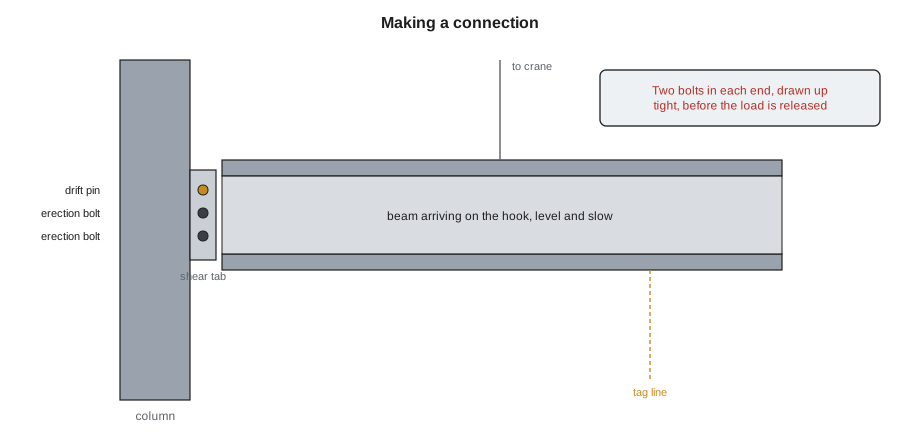
The sequence of a connection
- The piece is brought in level and slow, with tag lines controlled from below.
- The connector waits until the end is within reach and nearly still, then takes hold of the steel, not the rigging.
- The end is guided onto its seat or against its shear tab or clip, keeping hands out of the gap.
- A drift pin or the spud wrench handle is driven through to line up the first holes.
- Bolts are installed in the holes that are lined up, and nuts are run up tight with the spud wrench.
- The other end is connected the same way.
- When each end has the number of bolts the rules and the erection plan require, the connector signals the release.
- The crane slacks off, the connector unhooks the rigging and sends it down or back on the hook, and the next piece comes.
The bolts the connector puts in are erection bolts: they hold the piece safely until the bolt-up crew installs and tightens all the final bolts (lessons 6 and 7). Erection bolts are the same size and grade as the final bolts and become part of the connection when they are tightened properly, unless the drawings say otherwise.
How many bolts before release
OSHA's steel erection standard requires at least two bolts per connection, of the size and strength shown on the erection drawings and drawn up wrench-tight or the equivalent the engineer of record specifies, before the load is released from a solid web member such as a beam. A competent person decides whether more are needed for a cantilevered member, and those bolts must be installed. Diagonal braces need at least one bolt per connection, drawn up wrench-tight. Crossbeam applies the rule to every beam end, and the erection plan or the foreperson may require more.
Two bolts is a minimum, not a target. Heavy girders, beams carrying a column or a truss (IRW-120), cantilevers and pieces that will carry loads before the bolt-up crew reaches them get more. At Ashcroft, truss T-1 got four bolts at each end and its bracing before release.
Worked problem
Erection bolts for a floor
A floor has 38 beams, each with a shear connection of three bolts at each end. The connectors put in two erection bolts at each end, and the bolt-up crew installs the rest. How many erection bolts do the connectors install, and how many final bolts will the floor have?
Show solution
- Erection bolts: 38 beams × 2 ends × 2 bolts = 152.
- Final bolts: 38 × 2 × 3 = 228.
- Bolts left for the bolt-up crew: 228 − 152 = 76.
Answer: 152 erection bolts and 228 final bolts, so the bolt-up crew adds 76 and then brings all 228 to their specified tightness. Nate counts the bolt bags he sends up against these numbers, because extra bolts left on the floor are a tripping and dropping hazard and missing ones mean a connection left short.
Double connections
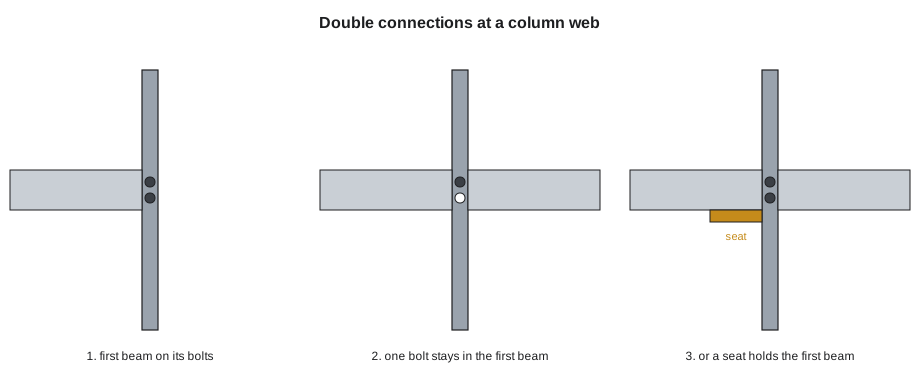
A double connection is one where two beams frame into opposite sides of a column web, or of a girder web, and share the same bolts through the web. The difficulty is that when the second beam arrives, its holes must line up with the bolts already holding the first beam, and the obvious way to do that, taking the nuts off the first beam's bolts, leaves the first beam hanging on nothing.
OSHA addresses this directly: at least one bolt with its wrench-tight nut must stay connected to the first member unless a seat or similar device, bolted or welded to the supporting member and the first member, holds the first member while the shared bolts are removed. The seat must carry the load during the whole double connection process.
Detailers make double connections safer by staggering the clip angles so that one beam has holes the other does not use, by adding an erection seat or by using a stiffened seat. The erection drawings show which method is used, and the connector follows it exactly.
Girders and heavier members
Girders are the larger beams that carry other beams. They are usually set before the beams that frame into them, often from column to column along a column line, and their connections may be heavier: more bolts, end plates, seated connections or moment connections that will be welded or pretensioned later. Because a girder carries other beams, it gets its connections secured before anything is hung from it.
Heavy pieces bring more risk at the connection. A heavy girder that swings has more momentum, and it can crush a hand or knock a connector off balance even when it is moving slowly. The crane is brought in slower, the tag lines are worked harder and the connectors take more time. At Ashcroft, the far-end moment-frame girders, the heaviest pieces after the truss, were set from a second crane position as IRW-120 describes, and each got four erection bolts before release.
When holes do not line up
Holes that are slightly out of line are brought together with drift pins. Holes that are out by more than a drift pin can fix, or a member that does not reach its connection, means something is wrong: a column is out of plumb, a piece is in the wrong place or turned end for end, or there is a shop error. The connector does not ream the holes, cut the steel or weld a piece in place to make it fit. The piece is set down safely or held with what bolts can be placed, the foreperson is told, and the engineer decides the fix. Reaming holes larger or slotting them changes the connection and needs the engineer of record's approval.
Communication at the connection
Connecting is a conversation between the connectors, the signal person and the crane operator. Most crews use radios with a dedicated channel, and the signal person, not the connector, gives the crane its signals, as IRW-120 explains. The connector tells the signal person what is needed: "a little south", "down slow", "hold", "all stop". The signal person passes it to the operator in the standard form. When the connector is satisfied that the piece is secured, the connector says so clearly, and only then does the signal person tell the operator to slack off. Any person on the crew can call an emergency stop.
Good connectors also talk to each other. The connector at one end of a beam cannot see the other end, and both ends have to be connected before the release. A simple "two in, north" and "two in, south" across the beam avoids a release with one end on a single bolt. Andy and Marco used it on every piece at Ashcroft and at Linwood.
Pacing and fatigue
Connecting is hard physical work done at height, often in heat, cold or wind. A connector who is tired or rushed is more likely to reach for a swinging piece, skip a tie-off transfer or drop a tool. Crews rotate connectors when the work is heavy, take breaks out of the wind, and keep water and warm clothing at hand. The pace of the job is set by the crane cycle, but the crane should wait for the connectors, never the other way round. Carla's instruction to Dwayne on every job is the same: "If my connectors are not ready, the piece waits in the air."
Beams that arrive cambered or curved
Long beams are sometimes cambered in the shop (lesson 2), and some beams arrive with a slight sweep, a sideways curve within the mill tolerance. A cambered beam is set crown up, and its connections may need a little more persuasion because the ends sit slightly lower than a straight beam's. A beam with sweep may need to be pulled into line with a come-along before its deck goes on. Neither is a reason to reject a piece, but a beam bent beyond the tolerance, for example from rough handling, is reported.
Releasing the rigging
Once the connector signals that the piece is secured, the crane slacks off and the connector unhooks the rigging. The rigging is never thrown or dropped; it is sent back on the hook or lowered on a tag line, and the connector keeps a hand on the steel and stays tied off while doing it. A choker that will not come free is not yanked loose with the crane, which can pull the piece off its bolts; the connector frees it by hand, and if that is not possible, the piece is lifted again under control and the rigging is changed.
Common mistakes
MistakeReaching for a piece while it is still swinging.
InsteadLet it come to you; take hold only when it is in reach and nearly still.
MistakeUsing a drift pin to enlarge a hole.
InsteadDrift pins align holes; reaming needs the engineer's approval.
MistakeReleasing a beam with one bolt in each end.
InsteadInstall at least two bolts at each end, drawn up tight, or more if the plan says so.
MistakeRemoving all the nuts from the first beam in a double connection.
InsteadKeep a bolt in the first beam or use the seat provided.
MistakeCarrying untethered tools at the connection.
InsteadTether every tool and keep bolts in a tied bag.
Summary and key terms
- Connectors receive each piece and make the first connection, working tied off at the top of the steel.
- Let the piece come to you, take hold of the steel and keep hands out of the gap.
- Drift pins align holes; they never enlarge them.
- OSHA requires at least two bolts per connection, wrench-tight, before release; one for diagonal braces.
- In a double connection, keep a bolt in the first member or use the seat.
- Holes that will not line up are reported, not reamed or cut.
- Connector
- An ironworker who receives steel from the crane and makes the first connection.
- Spud wrench
- An open-end wrench with a tapered handle used to tighten bolts and align holes.
- Drift pin
- A tapered pin driven through holes to line them up.
- Erection bolt
- A bolt installed by the connectors to hold a piece until final bolting.
- Double connection
- Two members sharing bolts through a column or girder web.
- Erection seat
- A small seat on the support that holds a member while bolts are fitted.
- Girder
- A large beam that carries other beams.
- Cantilever
- A member supported at one end only, projecting past its support.
Practice problems
Work each problem on paper first, then reveal the answer to check.
How many bolts must be in each end of a beam before it is released?
Show answer
At least two, wrench-tight.
A floor has 24 beams with four-bolt end connections. How many erection bolts at two per end?
Show answer
24 × 2 × 2 = 96.
May a drift pin be used to enlarge a hole?
Show answer
No, only to align holes.
What holds the first beam during a double connection if all its bolts must come out?
Show answer
A seat or similar device fixed to the support and the beam.
A beam end is 3/4 in short of its connection. What does the connector do?
Show answer
Secure the piece safely and report it; the engineer decides the fix.
Lesson quiz · 5 questions
Score 60% or more to complete this lesson.
Create a free account to save your progress, take quizzes and earn a certificate.