
INS-430 · Lesson 3 of 12 · 21 min
Review: safety and hazardous materials
▶ Video coming soon A video version of this lesson is on the way.
The second session, on Sunday, October 25, started with a photo. Mei Zhou had lent Bernie a picture from an incident file: an apprentice on a mobile scaffold, reaching out past the guardrail to band a jacket, one wheel unlocked. Nobody had been hurt. "Find six things wrong," Bernie said. Erik found five. Devon found the sixth, the missing toe board, and was pleased for the rest of the afternoon.
Safety questions appear in every area of the exam, not only in area A. A question about duct liner can turn on silica dust from the cutting, and a question about a cold line in a machinery room can turn on ammonia. This lesson reviews the safety and hazardous materials content of INS-110 and INS-230, together with the common occupational skills of area A: tools, organizing work and mentoring. As in every review lesson, the point is to bring back what was taught, in the form the exam asks for it.
The rules and who must follow them
In Ohio, private employers are covered by federal OSHA, because Ohio has no state plan for private workplaces. The construction standards are in 29 CFR 1926, and some general industry rules in 1910 also apply on construction work, such as respiratory protection. The employer must provide a workplace free of recognized serious hazards and follow the standards; workers must follow the employer's safety rules and the standards that apply to their own actions. Workers have the right to information and training about the hazards of their work, the right to report hazards and file a complaint without retaliation, and the right to refuse work that presents an imminent danger when there is no time to get it corrected through normal channels.
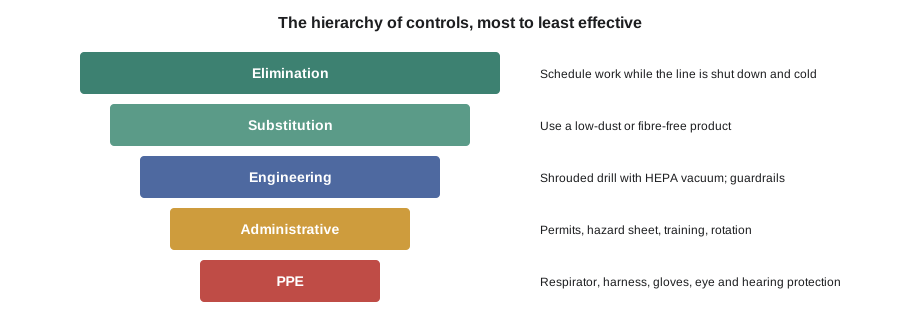
Every job starts with a hazard assessment. On Coldstream jobs that is the hazard sheet Bernie fills in before work starts and reviews whenever the work changes. Her saying from INS-110 is the summary: "If you didn't put it on the hazard sheet, it isn't controlled." The controls on the sheet follow the hierarchy of controls: eliminate the hazard, substitute something less hazardous, use engineering controls, use administrative controls, and only then rely on personal protective equipment. Exam questions about the best way to control a hazard almost always want the highest level that is practical.
Working at heights and access
Falls are the leading cause of serious injury on construction sites, and insulators spend much of their day at height. Under OSHA's construction rules, fall protection is generally required at 6 ft above a lower level, with different trigger heights for scaffolds (10 ft) and some other work, and at any height over dangerous equipment. Employers must train workers who may be exposed to fall hazards to recognize them and use the protection provided. A fall restraint system, which keeps the worker from reaching the edge, is preferred over personal fall arrest, which stops a fall already happening.
The fall arrest calculation from INS-110 is a favorite exam item: the clearance below the anchor must take in the free fall, the deceleration distance of the lanyard, the stretch of the harness and the worker's height below the D-ring, plus a safety margin. A rescue plan must be in place before anyone works in fall arrest, because a worker hanging in a harness can lose consciousness within minutes as blood pools in the legs.
Access equipment has its own short rules. Ladders are set at about one out for every four up, extend 3 ft above a landing, and are used with three points of contact; a ladder is for access and short work, not for a day of jacketing. Rolling scaffolds have their wheels locked, guardrails and toe boards on the platform, and nobody on them when they move. Elevating work platforms are used only by trained operators, with a harness and lanyard clipped to the anchor in a boom-type platform.
Heat, cold and the work environment
Insulators work beside hot pipes and cold ones. A bare steam line at 366 °F burns instantly; even a surface at about 140 °F can burn skin in a few seconds of contact, which is why personal protection insulation is designed to keep surfaces below that level (INS-120, INS-410). Cold surfaces below about −4 °F can freeze skin to metal. Gloves, sleeves and face protection are matched to the job.
Heat stress is a real risk in boiler houses and on summer roofs. The controls are water, rest in a cooler place, acclimatization for new workers, and a buddy who watches for confusion or a stop in sweating, which are signs of heat stroke, a medical emergency. Noise is another environmental hazard, reviewed with the acoustics material in lesson 9.
Confined spaces such as tanks, vessels, pits and some tunnels need a permit system when they hold or could hold a hazardous atmosphere or other serious hazards. The Kellerton condensate tunnel in INS-410 is a permit confined space at that plant. The key facts for the exam are that the atmosphere is tested before entry and monitored during it, that an attendant stays outside, and that a rescue plan exists before anyone goes in. Hot work such as welding pins or cutting with a torch needs a hot work permit, a fire watch and a cleared area.
Hazardous products: labels and safety data sheets
Under OSHA's Hazard Communication Standard, aligned with the Globally Harmonized System, every hazardous chemical on site comes with a label and a 16-section safety data sheet, and workers must be trained on the hazards of the chemicals they use. Insulators meet adhesives, mastics, coatings, solvents, foam components and fibrous products. The safety data sheet tells you the hazards, the protective equipment, first aid, safe storage and what to do in a spill.
Asbestos: recognize, stop, report
Asbestos is the hazard that shaped this trade. Insulators of earlier generations installed it, and many died of it: mesothelioma, asbestosis and lung cancer, diseases that appear twenty to fifty years after exposure. Bernie's uncle Gerard, whose story INS-230 told, was one of them. Any pipe covering, block, cement or fitting insulation installed before the 1980s is suspect until the owner's survey or a sample says otherwise. Bernie's line from INS-230 is the rule: "Old mud is guilty until the survey says it isn't."
Under OSHA's construction asbestos standard, 29 CFR 1926.1101, asbestos work is sorted into four classes. Class I is removal of thermal system insulation and surfacing material, the highest-risk work, and needs regulated areas, negative-pressure enclosures or other approved methods, and trained, supervised workers. Class II is removal of other asbestos-containing material such as floor tile or roofing. Class III is repair and maintenance work where asbestos may be disturbed, and Class IV is custodial work. The permissible exposure limit is 0.1 fiber per cubic centimeter as an eight-hour time-weighted average, with an excursion limit of 1.0 over 30 minutes. Building owners must identify presumed asbestos-containing material, and in Ohio, abatement contractors and workers must be licensed by the state.
Coldstream's own rule is stricter than the law in one way: its crews do no asbestos removal of any kind. Walt's line from INS-230 says it: "We insulate. We don't abate." When Devon found an unlabeled cement cover on a tee at Kellerton (INS-110) and when Tessa found the abandoned aircell line in Mountview's corridor C (INS-230), they did the same four things: stop, keep others away, tell the foreperson, and leave it for the owner's abatement contractor. Mei's summary on the whiteboard was: "Didn't know. Not on the sheet. Stopped. Told others. Called."
Area F of Coldstream's test goes further than Coldstream's work, into preparing for and carrying out abatement. Study it from the task list and your classroom material, aiming to recognize the classes of work, the controls each needs and who is allowed to do it. The step-by-step procedures are taught in the licensed abatement training, which is the place to learn them.
Worked problem
Is the exposure over the limit?
Air sampling during a repair shows a worker exposed to 0.15 fibers per cubic centimeter for 3 hours and 0.02 for the other 5 hours of the shift. What is the eight-hour time-weighted average, and is it over the 0.1 limit?
Show solution
- TWA = (0.15 × 3 + 0.02 × 5) ÷ 8.
- = (0.45 + 0.10) ÷ 8 = 0.55 ÷ 8 = 0.069 f/cc.
- 0.069 is below 0.1, but the three hours at 0.15 show that the work itself needs controls: the average hides a high-exposure task.
Answer: About 0.069 f/cc, below the limit, but the task needs better controls.
Silica, fibers and lead
Crystalline silica comes from cutting, drilling and grinding concrete, masonry and some board products, such as when anchor holes are drilled for firestopping or supports. It causes silicosis and lung cancer. OSHA's construction silica standard, 29 CFR 1926.1153, sets a permissible exposure limit of 50 micrograms per cubic meter as an eight-hour average and lets employers follow the methods in its Table 1, such as a shrouded drill with dust collection, instead of measuring. Man-made mineral fibers in glass and mineral wool irritate the skin, eyes and throat; loose clothing, gloves, eye protection and a dust mask for cutting are the usual controls. Refractory ceramic fibers are more hazardous and are handled with tighter controls. Lead is found in old paint on tanks and steel, as on the Kellerton engine room tank in INS-230, and is covered by OSHA's construction lead standard; it is controlled by avoiding disturbance, by trained workers for any removal, and by hygiene: wash before eating, and leave work clothes at work.
Respirators
A respirator works only if it fits, is the right type and is maintained. OSHA's respiratory protection standard, 29 CFR 1910.134, requires a written program, a medical evaluation, training, and a fit test before first use and every year after. A tight-fitting respirator cannot seal over a beard or stubble, which is why Devon failed his first fit test in INS-230 and passed after shaving, and why Wendell, who wears a beard, uses a loose-fitting hood with a powered air supply.
The assigned protection factor of a half-face air-purifying respirator is 10: used correctly, it keeps the concentration inside at no more than one tenth of the concentration outside. A quantitative fit test measures the actual ratio for one person; Tessa's 12,000 particles a cubic centimeter outside against 80 inside is a fit factor of 150, a pass for a half mask, which needs at least 100.
Area A: tools, work organization and mentoring
The rest of area A is everyday practice. Hand and power tools are inspected before use, guarded, and used for their purpose; a grinder with the guard removed or the wrong disc for its speed is a classic exam distractor. Material is stored dry and off the floor, and staged so that it reaches the work in the right order. Drawings, specifications and the hazard sheet are read before the work starts. And journeyworkers are expected to mentor: to demonstrate, watch the apprentice do it, give feedback and check again. Bernie's way of putting it is that mentoring is part of the job, not a favor.
Reporting incidents and first aid
Every injury, near miss and dangerous occurrence is reported to the supervisor at once, however small it seems. Under OSHA rules, a work-related death must be reported to OSHA within 8 hours, and an in-patient hospitalization, amputation or loss of an eye within 24 hours; the employer also keeps injury records and reports claims to the Ohio Bureau of Workers' Compensation. Every site has first aid kits and trained first aiders, and every worker should know where they are, where the eyewash station is, and how to call for help on that site, which on a plant site may be a plant number rather than 911.
Near misses deserve the same attention as injuries. The scaffold photo that opened this session was a near miss, and the reason Mei kept it on file was that nobody had been hurt: the lesson was free.
Common mistakes
MistakeChoosing personal protective equipment as the first control.
InsteadWork down the hierarchy: eliminate, substitute and engineer the hazard out before relying on PPE.
MistakeUsing fall arrest when fall restraint is possible.
InsteadKeep the worker from reaching the edge whenever that is practical.
MistakeDisturbing an old fitting cover to check what it is.
InsteadStop, keep others away, tell the foreperson and leave it for the owner's survey and abatement contractor.
MistakeTrusting an eight-hour average alone.
InsteadLook at the task exposures too; a short high-exposure task needs its own controls.
MistakeWearing a tight-fitting respirator over stubble.
InsteadShave, or use a loose-fitting powered hood; a tight mask cannot seal over hair.
Summary and key terms
- Every job starts with a hazard assessment, and controls follow the hierarchy from elimination to PPE.
- OSHA generally requires fall protection at 6 ft on construction (10 ft on scaffolds); restraint is preferred over arrest.
- Surfaces at about 140 °F can burn skin in seconds; confined spaces and hot work need permits.
- OSHA sorts asbestos work into Classes I to IV, with a limit of 0.1 f/cc; Ohio licenses abatement contractors and workers. Coldstream crews do no removal.
- Respirators need a program, a medical evaluation, training and annual fit testing; a half mask has a protection factor of 10.
- Hierarchy of controls
- The order of hazard controls from most to least effective: elimination, substitution, engineering, administrative, PPE.
- Travel restraint
- A system that keeps a worker from reaching an edge where a fall could happen.
- Fall arrest
- A system that stops a fall that has already started.
- Permit confined space
- A confined space that needs a written entry permit because of serious hazards.
- Time-weighted average
- An exposure averaged over a shift, usually eight hours.
- Assigned protection factor
- The level of protection a correctly used respirator type is expected to give.
- Fit factor
- The measured ratio of contaminant outside a respirator to inside it during a fit test.
Practice problems
Work each problem on paper first, then reveal the answer to check.
What is the first step in controlling a hazard?
Show answer
Try to eliminate it; personal protective equipment comes last.
At what height does OSHA generally require fall protection on construction?
Show answer
6 ft (10 ft on scaffolds).
You find an old, unlabeled cement cover on a tee. What do you do?
Show answer
Stop, keep others away, tell the foreperson, and leave it for the owner's survey and abatement contractor.
A worker is at 0.12 f/cc for 4 h and 0.03 for 4 h. What is the TWA?
Show answer
(0.48 + 0.12) ÷ 8 = 0.075 f/cc.
What protection factor does a half-face air-purifying respirator have?
Show answer
10.
Lesson quiz · 5 questions
Score 60% or more to complete this lesson.
Create a free account to save your progress, take quizzes and earn a certificate.