
INS-430 · Lesson 4 of 12 · 24 min
Review: heat transfer and materials
▶ Video coming soon A video version of this lesson is on the way.
Bernie opened the heat transfer review, on Sunday, November 1, with the question she had asked Devon in the first week of INS-120: "Why 3 in on the Kellerton header?" Devon had answered it at the end of that course, and he answered it again for the group, faster this time: the thickness keeps the heat loss and the surface temperature where the plant wants them at a reasonable cost, and below it the payback falls apart. Erik added the part Devon had left out: "And the k-value at the mean temperature, not at room temperature." Bernie wrote both answers on the board. "That's the whole of this lesson in two sentences."
Heat transfer and materials do not have an area of the exam to themselves. They sit underneath almost every question in areas B, C, D and E: choosing a material for a temperature, explaining why a thickness was specified, picking a jacket, or reasoning about condensation. This lesson reviews INS-120 and the calculation side of INS-410, with the numbers those courses used.
Heat, temperature and units
Temperature measures how hot something is; heat is energy moving because of a temperature difference. Heat always moves from hot to cold, and insulation slows it down; it never stops it. The heat flow through insulation is proportional to the temperature difference across it, so a line at 366 °F in a 50 °F room loses heat much faster than a heating water line at 180 °F in the same room.
US work is done in customary units. Heat flow is in Btu per hour, heat loss per length of pipe in Btu per hour per foot, energy over a year in millions of Btu (MMBtu) or therms, and thermal conductivity in Btu·in per hour per square foot per °F. A temperature difference of 1 °F is the same as 1 °R. Some manufacturers' data and many international standards are in SI units, so you must be able to convert: 1 W/(m·K) is about 6.93 Btu·in/(h·ft²·°F), 1 RSI is about 5.68 R, and a 150 psig steam header is about 1,035 kPa.
Conduction, convection and radiation
Heat moves in three ways, and an insulated pipe uses all three. Heat passes through the pipe wall and the insulation by conduction, from molecule to molecule. At the outer surface it leaves by convection, carried away by the moving air, and by radiation, given off as infrared energy to everything cooler that the surface can see. Insulation works by trapping still air or gas in tiny cells or between fibers, because still gas conducts poorly; it also blocks radiation inside the material.
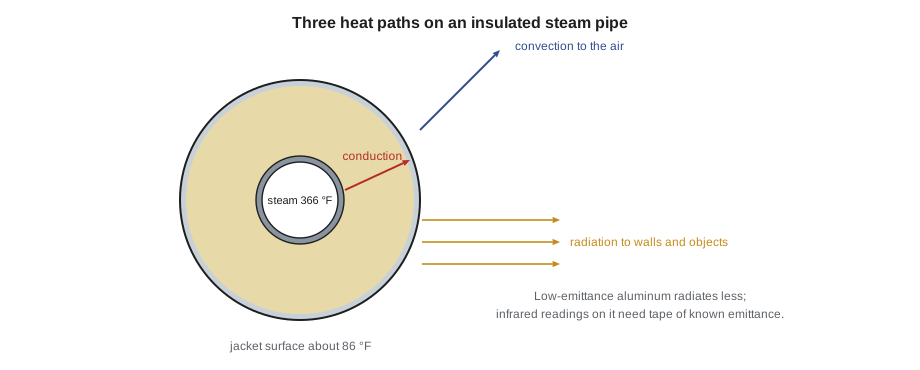
The surface matters more than people expect. A shiny aluminum jacket has a low emittance, so it radiates less than a painted or dull surface; the same insulation under it therefore runs a little warmer at the surface but loses a little less heat. On a bare pipe the effect is large. INS-410 showed that the heat loss from a bare NPS 4 steam pipe works out anywhere from about 1,020 to 1,110 Btu/h·ft depending only on the emittance assumed, which is why the earlier courses' figures differ slightly. All of them are right for their assumptions.
Emittance also explains why an infrared camera can be fooled. A bare aluminum jacket reads far cooler on the camera than it really is, as Thea Okerlund's survey showed in INS-410, so infrared readings on metal jackets are taken from electrical tape or a painted spot with a known emittance.
Conductivity, resistance and mean temperature
Thermal conductivity, k, is the rate at which a material conducts heat: the lower the k, the better the insulation. Thermal resistance is thickness divided by k, written RSI in SI and R in US units; resistances add when layers are stacked. For a flat surface the heat flow per unit area is simply k times the temperature difference divided by the thickness. For a pipe, the insulation's area grows as you move outward, so the heat flow uses the logarithm of the ratio of the outer and inner radii.
The k of every insulation rises with temperature, so a k-value means nothing without the mean temperature at which it was measured: the average of the hot and cold face temperatures. The k for a cellular glass product in INS-120 rose from about 0.29 Btu·in/(h·ft²·°F) at a 75 °F mean to about 0.54 at 400 °F. Using a room-temperature k for a steam line understates the heat loss, and that is a standard exam trap.
Worked problem
Mean temperature on the header
The Kellerton header runs at 366 °F and the jacket surface at about 86 °F. At what mean temperature should the insulation's k be taken?
Show solution
- Mean = (hot face + cold face) ÷ 2.
- = (366 + 86) ÷ 2 = 226 °F.
- Read the k from the data sheet at that mean, not at room temperature.
Answer: 226 °F.
The materials and their limits
The exam expects you to match a material to a service. The table brings together the limits used in INS-120, INS-320 and INS-330. They are typical figures; the product data sheet always governs.
| Material | Standard | Typical service range | Where Coldstream uses it |
|---|---|---|---|
| Mineral wool pipe | ASTM C547 Type II | to 1,200 °F | Steam and condensate at Kellerton |
| Glass fiber pipe | ASTM C547 Type I | to 850 °F | Heating water, domestic water, commercial steam |
| Calcium silicate | ASTM C533 Type I | to 1,200 °F | Where strength is needed; inserts and walkable lines |
| Expanded perlite | ASTM C610 | to about 1,200 °F | Kellerton kettle room indoor line (with C795) |
| Cellular glass | ASTM C552 | about −450 to 800 °F | Ammonia suction lines, cold inserts |
| Flexible elastomeric | ASTM C534 Grade 1 | to 220 °F | Chilled water, refrigerant, condensate drains |
| Polyisocyanurate | ASTM C591 | about −297 to 300 °F | Cold lines and low-temperature suction |
| Phenolic foam | ASTM C1126 | cold to moderate temperatures | Chilled water where a low k is wanted |
Three further properties come up often. Compressive strength decides whether a material can carry a pipe at a support or stand foot traffic; calcium silicate and cellular glass are strong, fibrous materials are not. Water resistance decides how a material behaves if the jacket fails; wet insulation conducts many times faster than dry, as the wet header section at Kellerton showed. And chemical compatibility matters on austenitic stainless steel: insulation that touches it, or that can be wetted and drip onto it, must meet ASTM C795, which limits the chlorides that can leach out and cause stress corrosion cracking.
The Kellerton kettle room choice in INS-120 used all of these. Outdoors, the NPS 6 steam line got 3 in of mineral wool under an aluminum jacket with a moisture barrier, because it needed heat resistance and a good jacket against the weather. Indoors, in the washdown area above stainless kettles, it got perlite certified to C795 under a sealed stainless jacket, because water and chlorides were the hazard.
Why a thickness is chosen
A specification sets an insulation thickness for one or more of five reasons: to save energy, to protect people from burns, to prevent condensation, to hold a process temperature, or to prevent freezing. INS-410 showed how each is calculated. For the exam, the important idea is that different reasons give different answers, and the largest thickness wins. A chilled water line might need more insulation to stay above the dew point than it needs for energy; a hot line beside a walkway might need more for personnel protection than for economics.
The economic thickness is the one where the total of the installed cost and the cost of the heat lost over the life of the system is lowest. INS-410 worked it for the kettle line and found the minimum at 3 in, matching the thickness chosen in INS-120. Thinner insulation is cheaper to install but loses much more heat; thicker insulation saves a little more heat but costs more than it saves. The energy codes set minimum thicknesses for commercial buildings that are close to economic values.
Worked problem
What the kettle line loses in a year
INS-120 gave the outdoor kettle line a loss of 76.2 Btu/h·ft with 3 in of mineral wool. The run is 210 ft, the steam is at full pressure 7,550 hours a year (INS-410), and steam heat costs 13.75 dollars per MMBtu at sample prices. What does the line lose in a year?
Show solution
- Loss = 76.2 × 210 = 16,002 Btu/h.
- Energy = 16,002 × 7,550 = 120.8 × 10⁶ Btu = 120.8 MMBtu.
- Cost = 120.8 × 13.75 = about 1,661 dollars a year.
Answer: About 121 MMBtu, roughly 1,660 dollars a year at sample prices.
Erik asked why the boiler hours from INS-120, about 8,400 a year, were not used. Bernie pointed to INS-410: the boilers are fired about 8,400 hours, but the steam system is at full pressure only about 7,550, and the heat loss depends on the line being hot. Exam questions are usually simpler, but they reward the same care: use the hours the line is actually at temperature.
Reading a product data sheet
Most material questions on the exam can be answered from a data sheet, and so can most material decisions on the job. Bernie made the group read a real mineral wool pipe insulation data sheet line by line. The useful parts are the same on every sheet.
- Standards met: the ASTM or CAN/ULC specification and type, which tell you the service range and properties have been tested to a recognized method.
- Maximum use temperature: the highest temperature the product can be used at; some sheets also give a minimum.
- Thermal conductivity table: k at several mean temperatures, so you can read the value for your service.
- Surface burning characteristics: flame spread and smoke developed ratings, which matter in buildings.
- Compressive strength, density and water absorption, which tell you how the material behaves at supports and if it gets wet.
- Stainless steel compatibility: whether the product meets ASTM C795.
Exam questions often hide a data sheet in the stem: a table of k-values and a mean temperature, and four options. Read the table at the right mean, and interpolate between rows if the mean falls between them.
Worked problem
Reading k between two rows
A data sheet gives k = 0.34 Btu·in/(h·ft²·°F) at a 200 °F mean and 0.40 at 300 °F. What k should be used at a 226 °F mean?
Show solution
- The mean is 26 of the 100 degrees between the rows: 26 ÷ 100 = 0.26.
- k = 0.34 + 0.26 × (0.40 − 0.34) = 0.34 + 0.016 = 0.356 Btu·in/(h·ft²·°F).
Answer: About 0.356 Btu·in/(h·ft²·°F).
Wind and outdoor lines
Outdoors, wind strips heat from the jacket surface by convection much faster than still air does, so a bare outdoor pipe loses far more heat than the same pipe indoors. Once the pipe is insulated, the effect on the total heat loss is small, because the insulation, not the surface, controls the rate. That is why the energy saved by insulating an outdoor line is larger than the indoor figure suggests, and why audit software asks for the wind speed.
Heat gain on cold lines
Everything in this lesson works in reverse on cold lines: heat flows in from the warmer air, the temperature difference is smaller, and the same formulas give the heat gain. A small heat gain still matters, because a refrigeration plant must remove it, using energy, and because the surface temperature decides whether the line sweats. That is why cold-line thickness is usually set by condensation control rather than by economics, a point lesson 8 returns to, and why a low-conductivity material is worth more on a cold line than on a warm one of the same size.
On the exam, a question that gives a heat loss in one unit and asks for another is common. Keep the conversions from lesson 10 on your scrap paper before you start, so that a units question costs seconds rather than minutes.
Common mistakes
MistakeUsing a room-temperature k for a hot line.
InsteadTake k at the mean temperature of the hot and cold faces.
MistakeThinking insulation stops heat flow.
InsteadIt slows heat flow; the loss is proportional to the temperature difference.
MistakeReading an infrared camera on bare aluminum jacket.
InsteadMeasure on tape or a painted spot of known emittance.
MistakeChoosing a material by temperature alone.
InsteadCheck strength, water resistance and, on stainless steel, ASTM C795 compatibility as well.
MistakeAssuming the energy thickness is always the governing one.
InsteadCheck personnel protection, condensation, process and freeze needs; the largest wins.
Summary and key terms
- Heat moves by conduction through insulation and by convection and radiation from the surface; emittance changes the surface loss.
- Resistance is thickness divided by k, and resistances add in layers; pipe heat flow uses the logarithm of the radius ratio.
- A k-value is meaningful only at a stated mean temperature, and k rises with temperature.
- Each material has a standard and a service range; strength, water resistance and C795 compatibility also decide the choice.
- Thickness is set by energy, personnel protection, condensation, process or freeze needs, and the largest requirement governs.
- Thermal conductivity
- The rate at which a material conducts heat; lower is better for insulation.
- Thermal resistance
- Thickness divided by thermal conductivity; RSI in SI units, R in US units.
- Mean temperature
- The average of the hot and cold face temperatures of an insulation layer.
- Emittance
- How readily a surface gives off radiant heat, from 0 to 1.
- Economic thickness
- The thickness at which installed cost plus the cost of lost heat over the life is lowest.
- ASTM C795
- The specification limiting leachable chlorides in insulation used on austenitic stainless steel.
Practice problems
Work each problem on paper first, then reveal the answer to check.
Which way does heat always move?
Show answer
From hot to cold.
Insulation 2 in thick has k = 0.28 Btu·in/(h·ft²·°F). What is its R-value?
Show answer
2 ÷ 0.28 = 7.1.
Why does a bare aluminum jacket read cool on an infrared camera?
Show answer
Its emittance is low, so the camera underestimates its temperature.
What does ASTM C795 control, and why?
Show answer
Leachable chlorides, which can cause stress corrosion cracking of austenitic stainless steel.
Name the five reasons a thickness may be specified.
Show answer
Energy, personnel protection, condensation control, process temperature and freeze protection.
Lesson quiz · 5 questions
Score 60% or more to complete this lesson.
Create a free account to save your progress, take quizzes and earn a certificate.