
INS-430 · Lesson 11 of 12 · 20 min
Practice exam and review
▶ Video coming soon A video version of this lesson is on the way.
The last group session, on Sunday, November 15, was a full practice test under real conditions. Bernie had built it from original questions in the test's proportions: 100 questions, three hours, phones in a box by the door, a basic calculator, nobody talking. Erik, Priya and Tessa sat it; Devon sat the first hour and then helped Bernie mark. At four o'clock Bernie had the scores sorted by area on the whiteboard.
A practice exam does two jobs. It measures where you stand, and it rehearses the day itself, so that the format, the timing and the nerves are familiar. Both jobs matter, and the second is often the one people skip. This lesson covers how to take the exam, how Erik's practice result was read, and how the result turned into a plan for the remaining weeks. The course exam that follows this lesson is a shorter practice of the same kind.
Pacing
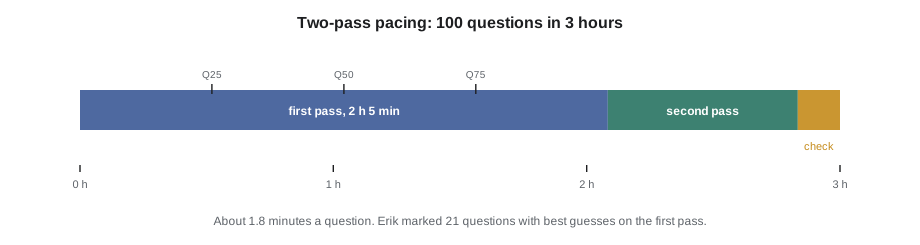
Three hours for 100 questions is about 1.8 minutes each. Bernie's pacing plan has two passes. On the first pass, answer every question you can answer in about a minute and a half, and mark the rest for later with your best guess entered, so that nothing is blank if time runs out. On the second pass, go back to the marked questions with the time that is left. Most people finish the first pass with between 45 minutes and an hour in hand. Erik finished his in 2 hours and 5 minutes, with 21 questions marked.
- Check the clock at fixed points, such as every 30 questions, and compare it with the plan.
- Do not spend five minutes on one question in the first pass; it costs two or three easier questions later.
- Calculations are often faster on the second pass, when the pressure is lower.
- Leave ten minutes at the end to check that every question has an answer.
Reading the question
Most wrong answers on a trade exam are not caused by not knowing; they are caused by misreading. Erik's error log in lesson 2 had already shown his habit of missing "not". Bernie's reading rules are simple, and every one of them is aimed at a kind of distractor.
- Read the whole stem, then predict the answer before looking at the options. If your prediction is there, it is probably the key; if not, read the stem again.
- Circle the key words: not, except, first, best, most, least, hot, cold, outdoor, indoor. They decide which of several true statements is the answer.
- Read every option, even when the first one looks right. "Best" questions often have two acceptable answers and one better one.
- Be careful with absolute words such as always, never and only. In this trade they are usually wrong, except in safety rules, where "never" is often exactly right.
- Change an answer only with a reason. A second look that finds a misread word is a good reason; a vague doubt is not.
For judgment questions, Bernie's rule from lesson 1 applies: the key is what a careful journeyworker would do first, following the rules. If an option involves stopping, telling someone, or checking the drawing or the specification before acting, it deserves a hard look.
Erik's result
Erik scored 78 out of 100, a pass with eight questions to spare. Bernie was pleased and not satisfied. "Eight questions is one bad morning," she said. "Look at where you lost them."
| Area | Questions | Erik's score | In 100 |
|---|---|---|---|
| A Common skills | 12 | 10 | 83 |
| B Industrial | 31 | 27 | 87 |
| C Commercial | 30 | 21 | 70 |
| D Industrial and commercial | 12 | 9 | 75 |
| E Specialized | 9 | 7 | 78 |
| F Abatement | 6 | 4 | 67 |
| Total | 100 | 78 | 78 |
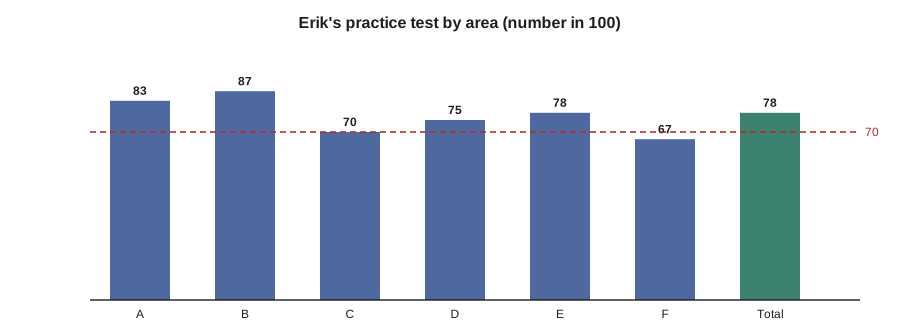
The pattern matched his self-rating from lesson 2, which was reassuring: strongest on industrial work, weakest on commercial work and on the small areas. But the numbers also showed something the rating had not. Area C was the one that mattered: it is three times the size of area F, so lifting C from about 70 to about 80 would add more marks than a perfect score on E and F together.
Worked problem
Where should the remaining hours go?
Erik has about 30 study hours left before January 16. How many more correct answers would he gain by lifting area C from 21 to 25 of 30, compared with lifting area F from 4 to 6 of 6?
Show solution
- Area C: 25 − 21 = 4 more correct answers.
- Area F: 6 − 4 = 2 more, and a perfect score is hard to guarantee.
- Area C also carries the commercial ductwork and plumbing he rated weakest, so hours there improve both his score and his work.
Answer: Area C, worth about 4 marks against 2; Bernie put 14 of the 30 hours there.
Reviewing a practice exam
A practice exam is wasted if it is only marked. Bernie's review has four steps, and Erik did them the same evening while the questions were fresh.
- Every wrong and guessed answer goes into the error log, with its reason, as in lesson 2.
- Group the errors by reason, not by topic. Erik's 22 misses broke down into 10 he did not know, 6 misreadings, 3 calculation slips and 3 distractor traps.
- Fix each group in its own way: re-learn the 10 from the course lessons, practice reading on the 6, redo the 3 calculations with the method in lesson 10, and write the trap beside each of the 3.
- Re-test the same topics a week later with new questions, not the same ones.
The misreadings were the cheapest marks to recover: six questions lost to reading, as many as all of area F. Erik spent one evening re-reading only the stems of the six he had misread and saying aloud which word he had missed. The second practice test, set for early January, would show whether it worked.
Ten questions from the practice exam, explained
These questions are in the style of the practice exam. Try each one before reading the explanation.
- A cold line passes through a pipe clamp at a hanger. What keeps the insulation system sound? A vapor-tight high-density insert under a shield, with the vapor retarder continuous over it. The distractor "extra mastic at the clamp" does nothing about the cold bridge.
- Which insulation must meet ASTM C795? Insulation on austenitic stainless steel. The distractors name other common standards, C547, C534 and C1136, which are about pipe insulation, elastomeric and jackets.
- On a sloped line, which jacket piece laps over the other? The upper over the lower. The trap is the reverse, which looks the same in a drawing until you think about which way water runs.
- A firestop listing names bare steel pipe. The pipe on site is insulated. What now? Find a listed system for that insulated pipe, or get an engineering judgment accepted. Sealing it anyway to the bare-pipe system is the distractor.
- Two equal sources of 82 dBA. The total? 85 dBA. 164 is the trap.
- You find an old fitting cover not on the asbestos survey. First action? Stop work and keep others away. "Wet it and remove it" is the most dangerous distractor on the paper.
- Duct wrap is crushed to half its thickness. Effect? It loses about half its resistance and the duct may sweat. "No effect, the facing still works" is the distractor.
- What sets the joint angle of a mitered elbow? The number of pieces: 90 ÷ (n − 1). The distractors use 90 ÷ n.
- Why leave some steam traps bare? Many trap types need to lose heat to work. "To save insulation" is the distractor.
- Where is the vapor retarder on a cold vessel? On the outside of the insulation, the warm side. "Against the steel" is the trap.
After the practice
Erik's plan for the remaining weeks was short: 14 hours on area C, 4 each on D and E, 3 on F, 3 on calculations and 2 on reading practice, with the second practice test on Sunday, January 3, and nothing new in the last week before January 16. He also asked Raj for a morning in mid-December with Marcel's crew on a commercial plumbing job, because seeing the work again would do more for area C than any reading.
When the start goes badly
Almost everyone hits a run of hard questions somewhere in an exam, and it often comes early, because questions are not in order of difficulty. Bernie's advice is not to read anything into it. Mark the hard ones, keep moving, and let the easier questions later restore your confidence and your pace. Erik's practice exam had five difficult abatement and refractory questions in the first twenty, and he lost ten minutes on them before remembering the plan. He wrote "mark and move" at the top of his scrap paper for the second practice test.
Physical habits help too: a glass of water, a slow breath before each section, and a short stretch at the checkpoint every thirty questions. Tension makes people misread, and misreading was Erik's most expensive habit.
If the result is not a pass
Not everyone passes the first time, and a fail is information, not a verdict. Coldstream's results sheet shows performance by area, which is the best guide to what to study before the retest, and Walt and Mei set the retest date with the apprentice. Bernie's advice to anyone who fails is the same as her advice to everyone else: rebuild the plan from the results by area, put the hours where the marks are, keep the error log, and fix the retest date rather than leaving it open. Several of the best insulators she knows passed on their second attempt.
The second practice exam
The second practice, about two weeks before the real exam, is shorter and has a different purpose: to confirm that the weak areas have moved and that the pacing works. Erik's would be 65 questions in two hours, weighted the same way, with new questions. Bernie's rule for it was simple: if the weak areas are up and the total is comfortably above the pass mark, the last week is review only; if not, the last week goes to the one area that is still low, and nothing else.
What the practice told the others
Priya and Tessa sat the practice too, two and three years early. Neither expected to pass, and neither did, but both scored above 60 in 100, and both found the same thing: the industrial areas they had worked in were already strong, and the commercial and specialized areas were where their own study would need to go. Priya started an error log that night. Tessa asked Raj for a day on a commercial plumbing crew in the spring.
Exam day
Bernie's test-day routine is the same one she used as an apprentice. Eat a normal breakfast, arrive early, leave everything not allowed in the car or the locker, and read the instructions slowly before the clock matters. Use the first minute to write the conversions and formulas you are afraid of forgetting on the scrap paper. Then start the first pass, check the clock at each checkpoint, and trust the plan. When the time is nearly up, make sure every question has an answer. Afterwards, do not replay the questions on the drive home; the result will come, and the work that earned it is already done.
Erik asked whether he should study on the morning of the exam. Bernie's answer was no: a quick look at his one-card lists over breakfast, and nothing more.
Common mistakes
MistakeSpending several minutes on one hard question in the first pass.
InsteadMark it, enter a best guess and come back on the second pass.
MistakeChoosing the first option that looks right.
InsteadRead every option; "best" questions often have a better answer further down.
MistakeChanging answers on a vague doubt.
InsteadChange only when a second look finds a real reason, such as a misread word.
MistakeMarking a practice exam and moving on.
InsteadLog every miss with its reason and fix each kind of error in its own way.
MistakeSpending the last weeks on the smallest areas.
InsteadPut the hours where the most marks can be gained, usually the large areas.
Summary and key terms
- Pace at about 1.8 minutes a question: a first pass with best guesses on marked questions, then a second pass and a final check.
- Read the whole stem, predict the answer, circle key words, read every option and change answers only with a reason.
- Erik scored 78 of 100 on the practice test, strongest in B and weakest in C and F.
- Review a practice exam by sorting errors by reason and fixing each kind in its own way.
- Spend the remaining hours where the most marks can be gained, then re-test with new questions.
- First pass
- Answering every question that can be done quickly, marking the rest with a best guess.
- Second pass
- Returning to the marked questions with the time left.
- Key word
- A word in the stem, such as not, first or best, that decides which option is the answer.
- Absolute word
- A word such as always, never or only that makes a statement true in every case.
- Practice exam
- A full-length test taken under exam conditions to measure readiness and rehearse the day.
Practice problems
Work each problem on paper first, then reveal the answer to check.
About how long should each question take on a 100-question, three-hour test?
Show answer
About 1.8 minutes.
What should you do with a hard question on the first pass?
Show answer
Enter a best guess, mark it and come back.
Erik lost six questions to misreading. What is the fix?
Show answer
Reading practice: circle key words such as not and except.
Why did Bernie put the most hours on area C after the practice?
Show answer
It is a large area with a low score, so it has the most marks to gain.
When is it right to change an answer?
Show answer
When a second look finds a real reason, such as a misread word.
Lesson quiz · 5 questions
Score 60% or more to complete this lesson.
Create a free account to save your progress, take quizzes and earn a certificate.