
INS-430 · Lesson 9 of 12 · 22 min
Review: firestopping and acoustics
▶ Video coming soon A video version of this lesson is on the way.
On Saturday morning, November 14, Erik went to Rhoda Ingersoll's last firestop session of the fall. She had a slide show of mistakes: a pipe collar on the wrong side of a slab, a sealant joint with no backer rod and a bead the thickness of a pencil line, an insulated pipe sealed with a system listed only for bare pipe, mineral wool packed loosely into a hole with daylight showing round it. "Every one of these passed somebody's eye," she said. "None of them would have passed the fire." Erik counted the mistakes he would have caught and the ones he would not, and wrote the second list in his error log.
Area D of the exam brings together work that is common to industrial and commercial jobs: firestop systems, soundproofing, removable covers and underground systems. Area E adds specialized work, including fireproofing, spray-applied products and refractory. This lesson reviews INS-330 and INS-340 and gives short notes on the specialized tasks the program met only in passing. Underground systems were reviewed in lesson 8.
Firestopping: what it does
Fire-resistance-rated walls and floors are built to hold back fire and smoke for a set time, such as one or two hours, so that people can get out and the fire cannot spread. Every hole made through them for a pipe, duct or cable is a weak point. Firestopping seals those holes with a tested system that restores the assembly's rating. INS-330 started with Rhoda's incense box: smoke found the one unsealed hole in seconds, and smoke kills more people in fires than flames do.
In the United States, through-penetration firestop systems are tested to ASTM E814 or UL 1479. The F rating is the time the system stops flame passing through; the T rating adds a limit on the temperature rise on the unexposed side; the L rating measures air leakage, for smoke; and the W rating covers water resistance. The building code requires an F rating at least equal to the rating of the assembly and, for floors, a T rating as well, with some exceptions. Mountview's two-hour floors in INS-330 needed both F and T ratings of two hours.
Reading a listed system
Every firestop installation must match a tested and listed system, and every element of the listing matters: the assembly it was tested in, the penetrating item and its size, the insulation on it, the annular space, the sleeve if any, the materials and their depths, and the ratings. The UL numbering scheme in INS-330 reads in three parts. The first letter is the assembly: F for floors, W for walls, C for either. The next one or two letters give the type of floor or wall, such as A for concrete floors up to 5 in thick. The number range gives the penetrating item; the 5000 series, for example, is for insulated pipe.
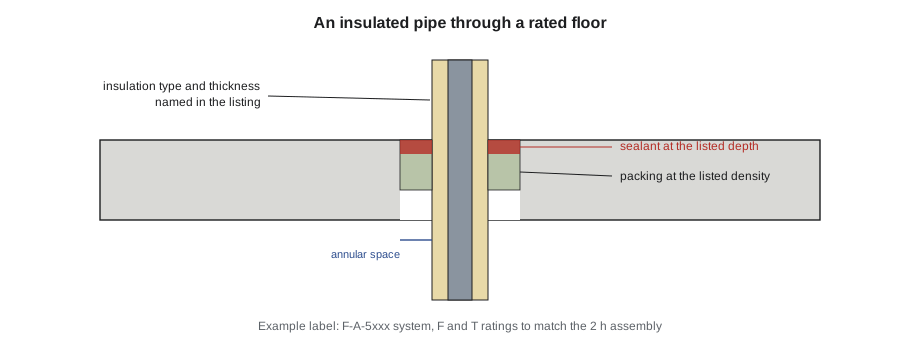
Insulated pipe is where insulators most often go wrong. A system listed for bare metal pipe does not cover the same pipe with insulation through the hole, and the type and thickness of the insulation must be ones the listing names. At Mountview, Coldstream's scope was every mechanical penetration, including the 88 insulated pipes through the Level 2 slab, and the submittal had a listed system for each combination of pipe, insulation and floor.
Worked problem
Is the annular space within the listing?
An NPS 2 pipe (2.375 in outside) passes through a 4 in core in the center of the hole. The listing allows an annular space of 0 to 1 in. Does it comply?
Show solution
- Annular space, pipe centered = (4 − 2.375) ÷ 2 = 0.81 in.
- 0.81 in is within 0 to 1 in, so it complies if the pipe stays centered.
- If the pipe sits against one side, the space on the far side is 4 − 2.375 = 1.625 in, which does not comply. Check the space at its widest point.
Answer: It complies only if the pipe is centered; the widest point is what counts.
Materials, joints and inspection
The materials in INS-330 each have a job. Intumescent sealants, wraps and collars expand when heated, to close the space left when a plastic pipe or combustible insulation burns away; collars go on plastic pipe, on the side or sides the listing says. Elastomeric sealants stay flexible, for joints and penetrations that move. Mortar and pillows fill large openings, the pillows where cables or pipes will be added later. Mineral wool packing is used as the listing states, at the stated density and depth.
Joint systems seal the gaps between assemblies, such as the head of a wall or the gap between a floor slab and a curtain wall, and are tested for movement as well as fire. Perimeter joints at curtain walls have their own test standard. The joint's width when installed must be within the listing's range, and the listing's movement capability must cover how much the building moves.
Firestop work is inspected, often by a third party as Vera Sheffer did at Mountview, against the submittal and the listings, and every item is labeled and recorded. Mountview's Level 2 floor had 212 items, six deficiencies, and a sign-off on October 23. Where no tested system fits, an engineering judgment from the manufacturer, accepted by the authority, may be used, as it was for one oversize core at Mountview.
Fireproofing, spray products and refractory
Area E's specialized tasks carry few questions, but they are worth an hour of study. Spray-applied fire-resistive material (SFRM) protects structural steel; it is applied to the thickness and density the listed design calls for and checked by measurement, and damaged areas are patched with the same product. At Mountview, Bayliss Fireproofing sprayed the steel before Coldstream's work, and insulators who disturb fireproofing to fit supports must report it for repair. Spray-applied sealers, coatings and spray foam insulation follow the maker's limits for surface preparation, temperature and thickness per pass, and the spray foam components need respiratory protection and ventilation. Refractory work lines furnaces, kilns and boiler casings with castable, brick or ceramic fiber materials that work at temperatures far above normal insulation; the key safety point is the handling of refractory ceramic fiber, which needs tighter controls than ordinary mineral wool, as lesson 3 noted.
Sound and the decibel
Sound levels are measured in decibels (dB), a logarithmic scale, and usually A-weighted (dBA) to match how the ear hears. Logarithms make the arithmetic different from ordinary numbers. Two equal sources together are 3 dB louder than one, not twice the number. A source 10 dB or more below another adds almost nothing. And in open space a source's level drops about 6 dB each time the distance doubles.
Worked problem
Adding and spreading sound
Two compressors each produce 85 dBA at a walkway. What is the total? Separately, a valve is 92 dBA at 3 ft. What is it at 12 ft in open space?
Show solution
- Two equal sources: 85 + 3 = 88 dBA.
- Distance: 1 to 2 is one doubling, 2 to 4 is a second. 92 − 6 − 6 = 80 dBA.
Answer: 88 dBA; about 80 dBA.
OSHA's noise rules set a permissible exposure limit of 90 dBA over eight hours with a 5 dB exchange rate, so 95 dBA is allowed for four hours, and an action level of 85 dBA, above which a hearing conservation program is required. Above the limit, the employer must use feasible engineering or administrative controls, and provide hearing protection.
How insulation reduces noise
Materials reduce noise in two ways. Absorbers, such as mineral wool and glass fiber, soak up sound inside their fibers; their effect is rated by the noise reduction coefficient (NRC). Barriers, such as mass-loaded vinyl and metal jacket, block sound from passing through; their effect is set mainly by mass, and the mass law says that doubling the mass adds about 6 dB of loss. Barriers work only if they are sealed: a small gap lets through far more sound than its size suggests.
Acoustic lagging on pipes and valves combines the two: an absorbing layer, then a barrier, then a jacket, with the jacket kept from touching the pipe or its supports, because a hard contact carries vibration straight through. ISO 15665 sets classes A to D for lagging by its insertion loss. The Kellerton Compressor No. 5 job in INS-340 used lagging, a curtain and an enclosure detail, and brought the walkway level down from 95 to 84 dBA, with removable covers on the valves and flanges.
Removable covers
Removable blanket covers go on valves, flanges, strainers, exchanger heads and other items that need regular maintenance, so they can be taken off and put back without damage. They are measured on site, patterned, cut from layers of high-temperature fabric over an insulating mat, sewn with stainless or other high-temperature thread, and fitted with straps and buckles, lacing hooks and wire, or hook-and-loop where the temperature allows. Each cover is tagged with its number and location, like the Kellerton covers KF-BH-031 to 035 being made by Pellam Thermal Covers in INS-210 and INS-340. ASTM C1695 covers the fabrication of removable covers. Covers on hot equipment are designed so the outside stays cool enough to touch, about 140 °F, where people can reach them.
Firestop documentation
A firestop installation is only as good as its records. Each item is identified on a marked-up drawing or schedule with its listed system number, the date and the installer; many projects also require a label beside the penetration giving the system number and the installer's company. The submittal package lists every system used, with the manufacturer's data sheets and any engineering judgments. Third-party inspection, where the specification calls for it, checks a sample of items against these records, including destructive checks of some sealant depths. Rhoda's rule at Coldstream is that a penetration with no label and no record is treated as not done.
Insulators also have to protect firestop work done by others. A pipe moved after it was sealed, a sleeve knocked loose by a ladder, or a sealant joint cut to fit a new hanger breaks the listing. The damage is reported to the general contractor and the firestop installer, not quietly patched.
Common acoustics traps
| The trap | The fact |
|---|---|
| Two equal sources double the decibels | They add 3 dB |
| Doubling the distance halves the level | Outdoors it drops about 6 dB |
| A thicker absorber blocks sound | Absorbers soak up sound; blocking needs mass |
| A small gap in a barrier is harmless | Small gaps let through far more sound than their size suggests |
| The lagging jacket can touch the support | Hard contacts carry vibration and ruin the lagging |
| The noise limit is 85 dBA everywhere | OSHA's limit is 90 dBA with a 5 dB exchange rate and an 85 dBA action level; Canada uses 85 dBA |
Removable covers on the exam
The removable cover task carries about six questions, more than many people expect. The usual topics are why covers are used, what goes on site before fabrication (measurements, a sketch, the item number and the operating temperature), the materials for each temperature range, fastening methods and their temperature limits, tagging, and the touch-temperature design for personnel protection. The Kellerton cover jobs in INS-210, INS-310 and INS-340 covered every one of those points, and Erik used them as his review.
The exam may also ask what to do when a penetration cannot match any listing. The answer is never to improvise: stop, report it, and get an engineering judgment from the manufacturer accepted before the work is done, as Rhoda did for the oversize core at Mountview.
Common mistakes
MistakeUsing a system listed for bare pipe on an insulated pipe.
InsteadPick a listing that names the pipe, the insulation type and thickness and the assembly.
MistakeChecking the annular space only where the pipe is centered.
InsteadCheck it at the widest point; it must be within the listing everywhere.
MistakeAdding decibels like ordinary numbers.
InsteadTwo equal sources add 3 dB; a doubling of distance outdoors subtracts about 6 dB.
MistakeLeaving gaps in an acoustic barrier.
InsteadSeal it; small gaps let through much more sound than their size suggests.
MistakeLetting the lagging jacket touch the pipe support.
InsteadIsolate it; hard contacts carry vibration through.
Summary and key terms
- Firestop systems are tested to ASTM E814 or UL 1479 with F, T, L and W ratings; the installation must match a listed system in every element.
- The UL number gives the assembly, the floor or wall type and the penetrating item; the 5000 series is insulated pipe.
- Intumescent products expand to close gaps; elastomeric sealants allow movement; joint systems are tested for movement.
- SFRM, spray products and refractory work follow the listing or maker's limits; refractory ceramic fiber needs tight controls.
- Two equal sources add 3 dB; distance doubling subtracts about 6 dB; OSHA's limit is 90 dBA for eight hours with a 5 dB exchange rate and an 85 dBA action level.
- Absorbers soak up sound and barriers block it by mass; lagging is isolated from the pipe; removable covers are tagged and kept cool to the touch.
- Firestopping
- Sealing openings in fire-rated assemblies with a tested system that restores the rating.
- Listed system
- A firestop system tested and published by a testing laboratory with its exact elements and limits.
- Annular space
- The gap between a penetrating item and the edge of the opening.
- Intumescent
- A material that expands when heated.
- Engineering judgment
- A manufacturer's written solution for a condition no listed system covers, accepted by the authority.
- Decibel
- A logarithmic unit of sound level.
- Mass law
- The rule that doubling a barrier's mass adds about 6 dB of sound loss.
- Acoustic lagging
- An absorbing layer, a barrier and a jacket applied to pipes and equipment to reduce noise.
Practice problems
Work each problem on paper first, then reveal the answer to check.
What does a T rating limit?
Show answer
The temperature rise on the unexposed side.
What does a 5000-series UL firestop number tell you?
Show answer
The penetrating item is insulated pipe.
Two sources of 80 dBA each. What is the total?
Show answer
83 dBA.
Under OSHA's 5 dB exchange rate, how long is 100 dBA allowed?
Show answer
Two hours.
Why must a removable cover be tagged?
Show answer
So it goes back on the right item in the right place.
Lesson quiz · 5 questions
Score 60% or more to complete this lesson.
Create a free account to save your progress, take quizzes and earn a certificate.