
INS-430 · Lesson 1 of 12 · 23 min
How the exam is built
▶ Video coming soon A video version of this lesson is on the way.
On Sunday, October 18, 2026, Bernie Valois unlocked the training room above the Coldstream shop at one in the afternoon, put a coffee urn on the side table and wrote a single number on the whiteboard: 100. Erik Henningsen, Coldstream's fourth-year apprentice, was the first to arrive. He was in the last year of his registered apprenticeship, his hours were nearly complete, and Coldstream's final completion test was the next thing between him and his certificate of completion as a journey-level insulator. Bernie had finished her own apprenticeship in 2004 and had run a fall study group for Coldstream's final-year apprentices most years since. "That," she said, pointing at the board, "is how many questions you get. By the end of this course you will know where every one of them comes from."
Priya Lam, the third-year apprentice who had been following Raj's estimates that fall, came to sit in, and so did Tessa Moreau and, now and then, Devon Marsh. Bernie welcomed the extra chairs. "Studying for an exam a year or two early is the cheapest insurance there is," she said. "You find out what you don't know while there's still time to learn it on the job."
This course is the last in the insulator program. It does two things. First, it explains how a trade exam is put together and how to prepare for it, so that the preparation matches what is actually tested. Second, it reviews the whole trade, one area at a time, using the same facts, numbers and examples as the earlier courses, so that the review is a second look rather than a new lesson. Lessons 3 to 9 are reviews, lesson 10 is calculation practice, lesson 11 is a full practice exam and its review, and lesson 12 looks past the exam to working as a journeyworker.
What the certificate means
In the United States there is no single national journeyman exam for heat and frost insulators, and Ohio does not license insulators or insulation contractors at the state level. The state's construction licensing board licenses electrical, HVAC, plumbing, hydronics and refrigeration contractors, but not insulation. What marks the end of training is the completion of a registered apprenticeship. Coldstream's apprentices are registered through ApprenticeOhio in a four- to five-year program with related classroom instruction each year. When the hours, the classroom work and the sponsor's requirements are complete, the apprentice receives a certificate of completion, a nationally recognized credential issued through the registered apprenticeship system. Union apprentices follow the same pattern through their local's joint apprenticeship training committee. The Columbus and Dayton local of the International Association of Heat and Frost Insulators and Allied Workers, for example, runs a four-year program with at least 1,600 hours of work and 180 hours of classroom training each year.
Bernie put it plainly: "The certificate doesn't make you a better insulator on Monday morning. But it tells a stranger you've met the standard, and the tests that come with it, like the completion test and the certifications in lesson 12, are how you prove it."
What the tests look like
Because there is no national exam, a US insulator meets several tests over a career, each built from its own standard. The ones in this course are Coldstream's apprenticeship completion test, the classroom and final tests of a union training program, the National Insulation Association's Insulation Energy Appraisal Program exam, the asbestos worker licensing course and exam required in Ohio for anyone doing abatement, and the firestop qualification exams taken by a company's designated responsible individual. Most of them are written multiple-choice tests with a pass mark of 70 in 100, so the same preparation works for all of them. Coldstream's completion test is the one Erik faces first, and Bernie built it, with Walt and Mei, around the same six areas of work that the Canadian national standard uses, because those areas describe the trade well on either side of the border.
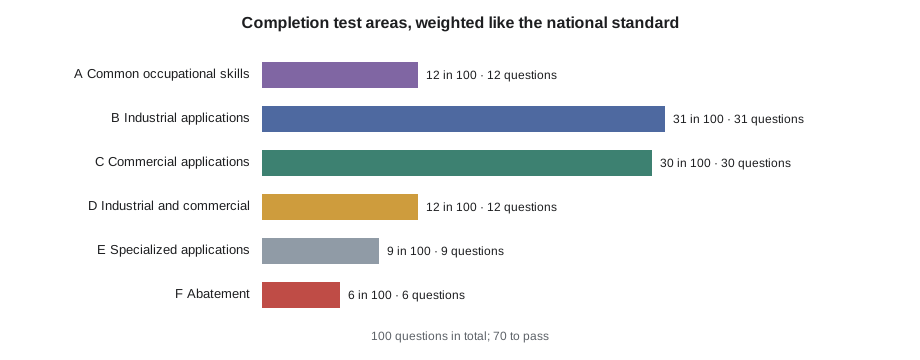
| Area | What it covers | Weight | Questions of 100 |
|---|---|---|---|
| A Common occupational skills | Safety, tools and equipment, organizing work, communication and mentoring, routine trade practices | 12 | 12 |
| B Industrial applications | Preparing industrial work, piping and fittings, tanks, vessels and equipment | 31 | 31 |
| C Commercial applications | Preparing commercial work, plumbing and mechanical piping, ductwork, mechanical equipment | 30 | 30 |
| D Industrial and commercial | Firestop systems, soundproofing, removable covers, underground systems | 12 | 12 |
| E Specialized applications | Spray-applied products, fireproofing, refractory, cryogenic systems | 9 | 9 |
| F Abatement | Asbestos, lead and mold work | 6 | 6 |
Two things stand out in that table. The first is how much of the exam is the everyday work of the trade: industrial and commercial applications together are more than 60 in 100 of the questions. The second is how little is about the rare jobs: refractory, cryogenic and spray work together are less than one question in ten. "Study in proportion," Bernie said. "I've seen people spend a month on cryogenics and walk in shaky on pipe fittings."
Area F, abatement, is on Coldstream's test even though Coldstream does no asbestos removal, because every insulator must recognize asbestos and lead, understand the rules and stop work correctly. INS-230 taught exactly that, and lesson 3 reviews it. Anyone who will do abatement work in Ohio needs the separate licensing course and exam described in lesson 12.
The format on the day
Coldstream's completion test, as Bernie and Walt set it up, is a written multiple-choice test of 100 questions in three hours, followed on another day by a practical assessment in the shop: a fitting cover, a jacketed elbow and a short layout task. The pass mark on the written test is 70, and a basic calculator is allowed. Phones stay in the lunchroom. The rules are written down so that every apprentice is tested the same way, and Erik received a copy of them at the first session.
Three hours for 100 questions is just under two minutes a question. That is enough time for most questions and not enough to agonize over many. Lesson 11 practices the pace.
How a multiple-choice question is written
Every question has the same parts. The stem asks the question or sets up a short situation. One option is the key, the correct answer. The other three are distractors, wrong answers written to look right to someone who half knows the material. Good distractors are not random: each one is built from a real mistake. In a calculation, one distractor is what you get if you forget to double the thickness, another is what you get if you use the radius instead of the diameter, and a third is what you get from a units slip. In a code or practice question, the distractors are usually rules that apply somewhere else, or that used to apply, or that sound sensible but are not what the standard says.
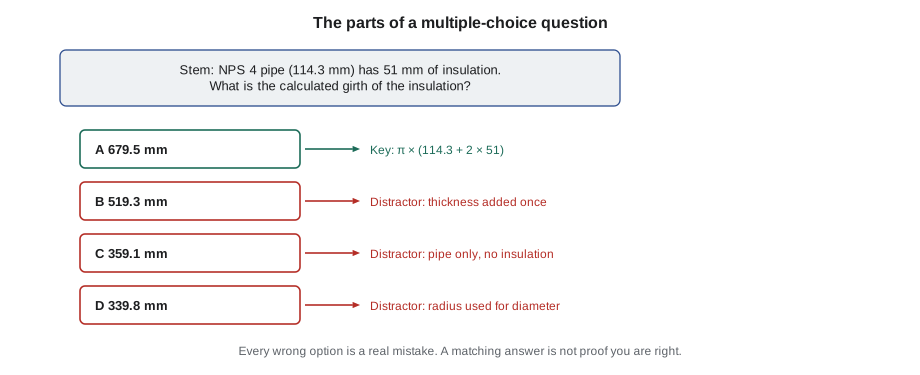
Knowing that changes how you read a question. If you work a calculation and your answer is one of the options, that is not proof you are right; the wrong answers are on the list on purpose. Lesson 10 names the trap behind each wrong answer for exactly this reason. And if two options look nearly the same, the difference between them is usually the point of the question.
Questions are written to test what a journeyworker needs to know, not trivia. Most are one of four kinds:
- Recall: a fact, a term or a rule. "Which jacket material is suitable for a line operating at 200 °F outdoors?"
- Application: using a rule on a situation. "A cold line passes through a hanger clamp. What must be done to keep the vapor retarder continuous?"
- Calculation: a number from a formula or a layout. "What is the cut width of the jacket for this pipe and thickness?"
- Judgment: the best of several possible actions. "You uncover an unlabeled old fitting cover during a repair. What should you do first?"
The judgment questions catch the most people, because more than one option sounds reasonable. The key is the one a careful journeyworker would actually do first, following the rules, and it is almost always the safer and more orderly choice.
Scoring and guessing
The exam score is the number of correct answers. A question left blank earns nothing, so there is no reason to leave one blank: if you cannot work it out, eliminate what you can and choose. Removing two distractors you know are wrong turns a one-in-four guess into a one-in-two guess. Across the handful of questions most candidates are unsure of, that is the difference between a fail and a pass.
Worked problem
How many can Erik miss?
The completion test has 100 questions and the pass mark is 70. How many correct answers does Erik need, and how many can he miss?
Show solution
- Correct answers needed = 100 × 0.70 = 70.
- Questions he can miss = 100 − 70 = 30.
- That is 30 in 100 of the test, but it is not spread evenly: missing most of area B alone would use it all.
Answer: 70 correct; he can miss 30.
Worked problem
Where are the points?
Using the weightings, how many questions come from areas B and C together, and how many from E and F together?
Show solution
- B and C: 31 + 30 = 61 questions.
- E and F: 9 + 6 = 15 questions.
- B and C carry about four times as many questions as E and F.
Answer: 61 from B and C; 15 from E and F.
What the exam does not test
The written test cannot test how neatly you band a jacket or how well you read a crew; the practical assessment covers some of that, and the rest is judged on the job. The written part tests knowledge: what to do, why, and in what order. That is why the review lessons in this course concentrate on the reasons behind the practices taught earlier, and why each one ends with practice questions in the same style. It also means the test is fair to someone who has worked mostly commercial or mostly industrial: the standard expects both, and the study plan in lesson 2 fills the gap.
Erik had spent most of his four years on industrial work, mainly steam and condensate at Kellerton and a steel-mill utilities contract on the waterfront. He had done less commercial ductwork and plumbing than the weightings expected. Bernie circled area C on his printout. "Thirty in a hundred," she said. "That's where your hours go first."
Reading the standard for yourself
Bernie's last piece of advice in the first session was to read the task list itself, not just the weightings page. Each task in the national occupational standard that Coldstream's test follows has a list of performance criteria, saying what a competent journeyworker does, and a list of knowledge and skills, saying what they must understand. Those lists are where question writers start. If a task says a journeyworker "selects insulation based on service temperature, location and application", a question about choosing between mineral wool, cellular glass and elastomeric for a given line is coming. Erik read the list one area at a time, ticking the items he could explain, and found that most of them simply described work he had done. The unticked items went straight into his study plan.
Coldstream's test can be taken with an accommodation, such as extra time for a documented learning disability or a reader, if the apprentice asks for it in advance; union training programs and certification bodies have similar processes. The request has to be made early, with supporting documents, so anyone who may need it should ask well before the test date.
Erik kept his printed standard in the front of his binder for the rest of the fall, and by January its margins were full of notes pointing to the earlier courses.
Common mistakes
MistakeStudying every topic for the same length of time.
InsteadStudy in proportion to the weightings: industrial and commercial applications together are more than 60 in 100 of the questions.
MistakeTaking a matching answer as proof a calculation is right.
InsteadDistractors are built from common mistakes; check the method, not just whether the number is on the list.
MistakeLeaving hard questions blank.
InsteadA blank earns nothing; eliminate what you can and choose.
MistakeSkipping area F because the company does not do abatement.
InsteadRecognition, the law and stopping work are tested; study them from INS-230 and the standard.
MistakeArriving without reading the exam rules.
InsteadRead the booking confirmation for what you may bring, the time allowed and the rewrite rules before exam day.
Summary and key terms
- In Ohio there is no state insulator license; a registered apprenticeship ends with a certificate of completion, and other tests follow during a career.
- Coldstream's completion test uses the same six areas and weightings: A 12, B 31, C 30, D 12, E 9 and F 6 in 100.
- The written completion test has 100 questions in three hours, with 70 to pass, followed by a practical.
- Each question has a stem, a key and three distractors built from real mistakes.
- The score is the number correct, so no question should be left blank.
- Certificate of Qualification
- The provincial certificate that shows a person has met the standard of a trade.
- Red Seal Occupational Standard
- The national description of a trade's work, tasks, skills and knowledge from which the Red Seal exam is built.
- Major work activity
- One of the main divisions of a trade's work in an occupational standard.
- Exam weighting
- The share of exam questions drawn from each part of the standard.
- Certificate of completion
- The credential issued when a registered apprenticeship is finished.
- Stem
- The part of a multiple-choice question that asks the question.
- Key
- The correct option in a multiple-choice question.
- Distractor
- A wrong option written to look right to someone who half knows the material.
Practice problems
Work each problem on paper first, then reveal the answer to check.
How many correct answers are needed to pass a 100-question test at 70?
Show answer
70.
Which two areas carry the most questions?
Show answer
B, industrial applications (31 in 100), and C, commercial applications (30 in 100).
Why is a distractor not random?
Show answer
It is built from a real mistake, such as using the radius instead of the diameter.
Should a question you cannot work out be left blank?
Show answer
No. Eliminate what you can and choose; a blank earns nothing.
Does Ohio license insulators at the state level?
Show answer
No. The state licensing board does not license insulation; apprenticeship completion is the credential.
Lesson quiz · 5 questions
Score 60% or more to complete this lesson.
Create a free account to save your progress, take quizzes and earn a certificate.