
INS-430 · Lesson 7 of 12 · 24 min
Review: equipment and ductwork
▶ Video coming soon A video version of this lesson is on the way.
Wendell Ashby joined the second half of the session on Sunday, November 8, and brought the sketchbook he keeps for every vessel his crew insulates. He opened it at the liquid sugar tank, T-14, from INS-310: elevations, ring positions, the number of pins on each face, the gore pattern for the top head, the access plug positions. "The exam won't ask you to draw this," he said. "But every question about equipment is a question about something in this drawing."
Tanks, vessels and equipment are a full task of area B, and mechanical ducting and equipment are two tasks of area C. Together they carry roughly a quarter of the test's questions. This lesson reviews INS-310, along with the duct and equipment content of the earlier courses.
Large surfaces
Flat and gently curved surfaces are insulated with board, block or blanket. Rigid board is used on flat walls and on curved shells where it can be scored or bought as curved segments; blanket follows irregular shapes and large curves. Joints are butted tight, and in multiple layers every joint is staggered from the joints in the layer below. On hot equipment, a gap between pieces is a line of heat loss that the jacket will show as a hot stripe on an infrared camera; on cold equipment it is a line of condensation.
The insulation is held to the surface by pins, studs, clips and support rings, and the order matters: fasteners first, then insulation, then the finish. On a vessel with lead paint, as on the Kellerton engine room tank in INS-230, nothing is welded to the steel until the paint question is settled, and the plan uses clamp-on rings and banding instead.
Pins, studs and support rings
Pins are spaced so that the insulation cannot sag or move. The typical spacings from INS-310 are closer on undersides than on walls, because the insulation hangs from the pins there, and every edge has a pin within about 3 in. Pins are welded with a capacitor-discharge stud welder or fixed with adhesive bases on surfaces that must not be welded, and every pin gets a speed washer pressed down to the insulation's surface. On cold equipment, every pin is a cold bridge, so pin heads are sealed with vapor-retarder mastic or patches.
| Surface | Typical pin spacing | Edge distance |
|---|---|---|
| Vertical walls | 12 to 18 in | within about 3 in |
| Undersides and bottoms | 10 to 12 in | within about 3 in |
| Tops | about 18 in, or as needed | within about 3 in |
| Duct bottoms wider than about 24 in | about 18 in | as the maker states |
When working out how many pins a surface needs, round the number of spaces up, never down, because rounding down stretches the spacing beyond the maximum. Support rings on vertical vessels carry the weight of the insulation and jacket and stop them sliding down; they are spaced up the shell and, like pins, must not be welded on without the owner's approval, because welding to a pressure vessel can affect its certification.
Heads, exchangers and removable sections
Vessel heads are insulated with board segments cut to gores, with blanket, or with a combination, and jacketed with gored metal laid out from the head's shape. The gores meet at a cap in the center. On horizontal vessels the heads are often where maintenance is needed, so they are fitted with removable sections.
Heat exchanger channels, bonnets and manways are opened for cleaning and inspection, sometimes every year. Insulation on them is made removable: either insulated metal box sections bolted or latched in place, or fabric blanket covers like the Kellerton exchanger covers KF-HX-01 and 02 ordered in INS-310. Removable covers are reviewed with the acoustics material in lesson 9.
Boilers, breeching and stacks
Breeching and stacks carry flue gas, often well above the temperature of the steam. The Kellerton No. 2 boiler breeching in INS-310 ran at about 400 °F and was re-insulated with a layer of high-temperature mineral wool under a layer of standard mineral wool, held on stainless pins, with a ribbed aluminum jacket and a slip joint. The points the exam likes are these: use a material rated well above the operating temperature; allow for expansion, because a hot breeching grows noticeably; never insulate over a fabric expansion joint in a way that stops it moving; and keep the flue gas side dry, because on some fuels the gas can condense acid if the steel is kept too cool on the inside.
Worked problem
How much does the breeching grow?
A steel breeching run of 40 ft heats from 60 °F to 400 °F. Steel grows about 6.5 millionths of its length for each degree Fahrenheit. How much longer does it get?
Show solution
- Temperature rise = 400 − 60 = 340 °F.
- Growth = 40 × 12 × 340 × 0.0000065 = 1.06 in.
- About 1 in, which a slip joint or expansion joint must take up.
Answer: About 1 in.
Tanks and storage vessels
Storage tanks have large flat or gently curved walls, a roof, and often heating coils, nozzles and ladders. Insulation is held by pins or bands on the shell and by a support structure on the roof, and the finish must shed water: roof jacket laps over the shell jacket, every nozzle is flashed, and the bottom edge is closed so rain cannot run in behind the jacket. The outdoor hot water tank in INS-310, with its cut and caulked rain collar letting water in, was a classic example of a finish that did not shed water. Area calculations are a common exam item.
Worked problem
Shell area for jacketing
A vertical tank is 5 ft in diameter and 10 ft high, insulated with 2 in of board. What is the area of the outer insulated shell?
Show solution
- Outside diameter of insulation = 5 + 2 × 2/12 = 5.333 ft.
- Shell area = π × D × H = π × 5.333 × 10 = 167.6 ft².
- Add the heads or roof separately, and waste for the jacket laps.
Answer: About 168 ft².
Ductwork: wrap, board and liner
Duct insulation keeps conditioned air at the right temperature and, on supply ducts that carry cooled air, stops condensation on the outside. Duct wrap is a flexible blanket with a factory facing, usually foil-scrim-kraft, that serves as the vapor retarder. It is cut to a stretch-out: the duct perimeter plus the maker's allowance for the corners and the overlap, so that the wrap is not crushed. Makers' installed R-values assume compression of no more than about 25 in 100; INS-310 showed a 2 in wrap installed at about 1 1/2 in, and wrap crushed further than that losing a third of its value.
Worked problem
Cutting wrap for the Mountview supply main
The supply main is 36 × 18 in. The maker's allowance for this wrap is 8 in. What is the stretch-out?
Show solution
- Perimeter = 2 × (36 + 18) = 108 in.
- Stretch-out = 108 + 8 = 116 in per piece.
Answer: 116 in.
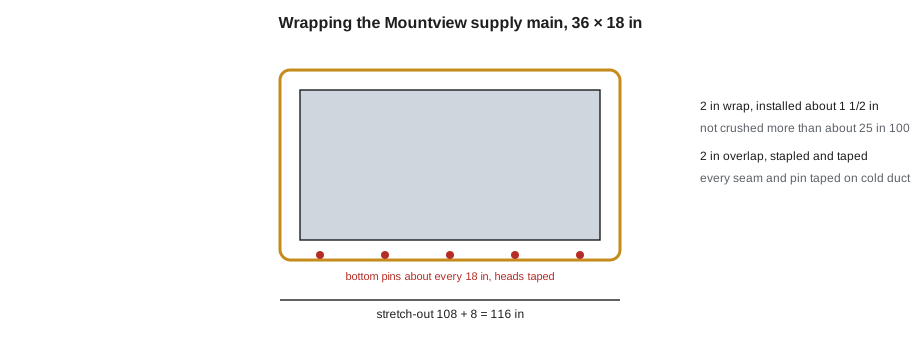
The wrap's overlap is stapled and taped, every seam and penetration is taped, and on wide ducts the bottom is pinned, about every 18 in at Mountview, with each pin head patched on a cold duct. Duct board is rigid and used where a harder finish is wanted, such as exposed ducts in plant rooms.
Duct liner goes inside the duct, mainly for sound, and is installed by the sheet metal contractor in most commercial work, though insulators check and repair it. It must meet ASTM C1071, be fastened with adhesive and mechanical fasteners, and have its leading edges protected with metal nosing above a stated air velocity; the liner in INS-310 was rated to about 6,000 fpm, with nosing above about 4,000 fpm. In hospitals and other health-care buildings, liner is restricted downstream of the final filters, as at Mountview, so that fibers and dirt cannot reach clean areas.
Insulation materials used in ducts and plenums, and their facings, adhesives and tapes, must meet the fire requirements of the mechanical code and NFPA 90A: in general a flame spread index of no more than 25 and a smoke-developed index of no more than 50, tested to ASTM E84 or UL 723.
Cold equipment, finishing and access
Cold equipment such as the Mountview chilled water buffer tank in INS-310 is insulated with closed-cell materials, every joint and fastener sealed, and a continuous vapor retarder with no punctures. Lesson 8 reviews cold work in detail. On all equipment, the finish includes access: inspection plugs where the owner wants to check for corrosion, removable sections at manways, and nameplates left visible or framed. A nameplate covered with insulation is a finding on almost every inspection.
The order of work on equipment
Questions about equipment often turn on sequence. Wendell's order for a vessel, from his sketchbook, is the same on every job.
- Check the surface: dry, clean, any coating the specification requires, and no lead paint or asbestos questions open.
- Install supports, rings, pins and clips, with the owner's approval for anything welded.
- Install the insulation, inner layer first with joints staggered in each layer after it, around nozzles and supports.
- Fit the heads, then the shell, so the shell jacket can lap over the head jacket where water would run.
- Install the vapor retarder on cold equipment before any metal finish.
- Jacket from the bottom up on vertical surfaces, so each upper sheet laps outside the one below.
- Fit removable sections, inspection plugs and nameplate frames, then seal every termination.
On T-14 in INS-310 the order paid off: because Raj had the fabricator weld the support ring and clips in the shop, the field work started at step 3 and finished on time, and no welding was needed on a vessel in a food area.
What duct questions usually test
Duct questions on the exam come back to a few points again and again: whether the wrap is crushed, whether the vapor retarder facing is continuous on a cold duct, whether pins and seams are taped, whether liner is allowed where it is used, and whether the materials meet the flame spread and smoke ratings. The sheet metal contractor's work also appears: access doors and fire dampers must stay reachable and must not be insulated shut, and the insulator leaves openings and labels at each one. A fire damper or a duct access door covered with wrap is a finding on any inspection, and an exam favorite.
Duct board and exposed work
Duct board is a rigid glass fiber board with a factory facing, used where ductwork is exposed in plant rooms and needs a firmer finish than wrap. It is cut to fit the duct faces, fastened with pins or adhesive, and its joints are sealed with the facing's tape. Exposed ductwork and equipment in mechanical rooms are often finished with a canvas or glass cloth over the insulation, coated with a lagging adhesive, so that the surface can be painted and cleaned. The specification decides; the exam usually asks only which finish suits an exposed location.
Questions about removable sections
A removable section on a hot exchanger head or manway has to come off and go back on without tools that damage it and without the insulation falling out. The usual design is a metal box lined with insulation, held by latches or bolts, with its edges lapped over the fixed insulation so water cannot enter at the joint. Each section is marked so it goes back on the right place. The exam asks why they are used, where, and how they are sealed against the weather; the answers are maintenance access, at heads and manways, and with lapped, flashed edges.
Common mistakes
MistakeRounding the number of pin spaces down.
InsteadRound up, so the spacing stays at or below the maximum.
MistakeWelding clips to a pressure vessel without approval.
InsteadGet the owner's approval; welding can affect the vessel's certification. Use clamp-on rings where needed.
MistakeInsulating over a breeching expansion joint so it cannot move.
InsteadUse a removable blanket or pillow that lets the joint work.
MistakeWrapping duct tight so the wrap is crushed.
InsteadCut the wrap to the stretch-out so it is not compressed more than about 25 in 100.
MistakeCovering vessel nameplates.
InsteadLeave nameplates visible or framed, and fit inspection plugs where the owner asks.
Summary and key terms
- Board, block and blanket go on with tight, staggered joints, held by pins, studs, clips and rings installed first.
- Pins are closer on undersides than on walls, with one near every edge; round the number of spaces up.
- Heads use gores; exchangers and manways get removable sections; breeching needs high-temperature material and room to expand.
- Duct wrap is cut to a stretch-out so it is not crushed; seams, pins and penetrations are taped on cold ducts.
- Duct liner meets ASTM C1071 and is restricted in health-care air downstream of final filters; duct materials meet flame spread 25 and smoke developed 50 under ASTM E84.
- Stud welder
- A capacitor-discharge welder used to attach insulation pins to steel.
- Speed washer
- A self-locking washer pressed onto a pin to hold insulation.
- Support ring
- A ring on a vertical vessel that carries the weight of the insulation and jacket.
- Breeching
- The duct that carries flue gas from a boiler to the stack.
- Stretch-out
- The length of duct wrap needed to go round a duct without crushing it, plus the overlap.
- Duct liner
- Insulation fixed inside a duct, mainly to absorb sound.
- Nosing
- Metal edging that protects the leading edge of duct liner from the air stream.
Practice problems
Work each problem on paper first, then reveal the answer to check.
On which surfaces are pins spaced closest?
Show answer
Undersides and bottoms, because the insulation hangs from the pins there.
A wall is 80 in wide with pins at a maximum of 18 in. How many spaces?
Show answer
80 ÷ 18 = 4.4, so 5 spaces.
Duct 24 × 16 in, allowance 8 in. Stretch-out?
Show answer
2 × 40 + 8 = 88 in.
Why is duct liner restricted in hospitals?
Show answer
To keep fibers and dirt from reaching clean areas downstream of the final filters.
What must be done with a vessel nameplate?
Show answer
Leave it visible or frame it in the insulation.
Lesson quiz · 5 questions
Score 60% or more to complete this lesson.
Create a free account to save your progress, take quizzes and earn a certificate.