
INS-120 · Lesson 2 of 12 · 30 min
Heat, temperature and units
▶ Video coming soon A video version of this lesson is on the way.
At the second Friday session, Tomasz wrote two words on the whiteboard, HEAT and TEMPERATURE, and asked the apprentices what the difference was. Tessa said heat was how hot something is. Devon said temperature was how hot something is and heat was "the stuff that moves." Tomasz pointed at Devon. "Closer. Today we sort that out properly, because every number on an insulation data sheet uses one or the other, and mixing them up is how people order the wrong product."
This lesson covers the basic ideas and units of heat. Insulators do not need a physics degree, but they do need to read data sheets, specifications, thickness tables and the occasional engineering calculation, and to understand what the numbers mean. Insulators on both sides of the border also see both metric and US customary units on the same job, so converting between them is a daily skill.
Temperature and heat are different things
Temperature is a measure of how hot or cold something is. It tells you how fast the tiny particles in a material are moving on average: the faster they move, the higher the temperature. A thermometer measures temperature. Temperature does not depend on how much material there is. A cup of boiling water and a kettle of boiling water have the same temperature.
Heat is energy in transit. It is energy that moves from one place to another because of a temperature difference, always from the hotter place to the colder place. The kettle holds far more energy than the cup, even at the same temperature, because there is more water. Heat flows out of both into the cooler room, and the kettle can keep giving off heat for much longer.
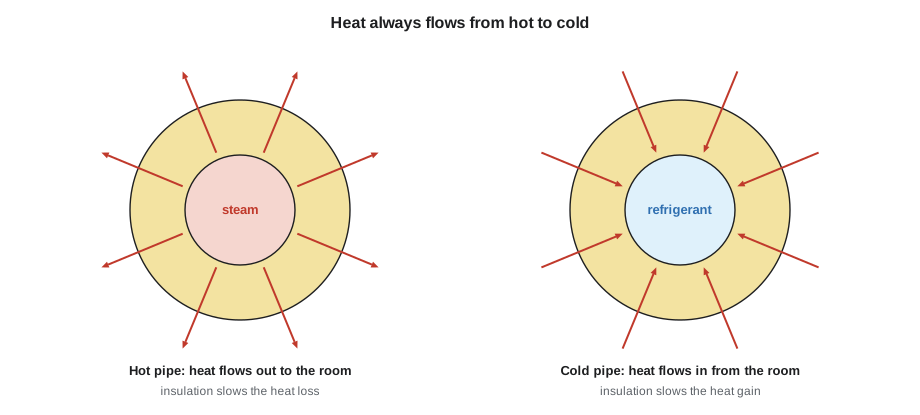
This leads to the most important rule in insulation work: heat always flows from hot to cold, and the bigger the temperature difference, the faster it flows. A steam line at 366 °F in a room at 68 °F loses heat to the room. An ammonia suction line at −30 °F in the same room gains heat from it. Insulators sometimes speak of "keeping the cold in," but there is no such thing as cold flowing out. On a cold line, the insulation keeps heat from flowing in.
Temperature scales
Four temperature scales appear in insulation work.
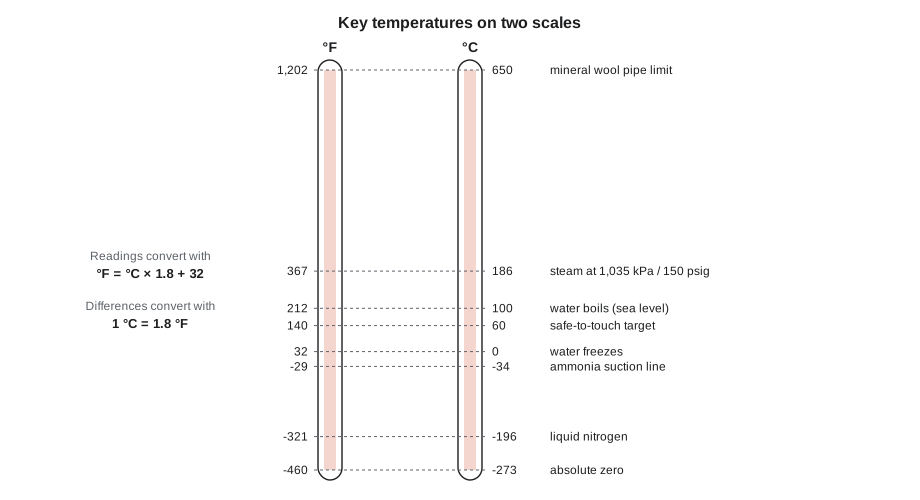
- Celsius (°C): water freezes at 0 °C and boils at 100 °C at sea level. Used in Canada and in most of the world, and in most engineering work.
- Fahrenheit (°F): water freezes at 32 °F and boils at 212 °F. Used for most work in the United States and on many US-made data sheets sold in Canada.
- Kelvin (K): an absolute scale that starts at absolute zero, the coldest possible temperature, where particle motion is at its minimum. A kelvin is the same size as a degree Celsius, and 0 °C is 273.15 K. Kelvin is used in some formulas, especially for radiation.
- Rankine (°R): the absolute scale with Fahrenheit-sized degrees. Absolute zero is 0 °R, and 0 °F is about 459.67 °R. It appears in some older US engineering references.
To convert a temperature reading between Celsius and Fahrenheit, use these formulas:
Worked problem
Converting temperatures from a job
The Kellerton steam header runs at 366 °F, the ammonia suction line at −30 °F and the safe-to-touch target is 140 °F. Convert each to Celsius for a European-made data sheet.
Show solution
- Steam: (366 − 32) ÷ 1.8 = 334 ÷ 1.8 ≈ 185.6 °C, usually given as 186 °C.
- Ammonia: (−30 − 32) ÷ 1.8 = −62 ÷ 1.8 ≈ −34.4 °C, about −34 °C.
- Safe to touch: (140 − 32) ÷ 1.8 = 108 ÷ 1.8 = 60 °C.
Answer: About 186 °C, −34 °C and 60 °C.
Temperature differences are converted differently
A temperature difference is not a temperature reading, and it converts without the 32. A difference of 1 °C is the same as a difference of 1.8 °F, and a difference of 1 K is the same as 1 °C. Many data sheet values, such as thermal conductivity, are given "per degree" of temperature difference, and heat-loss formulas use the difference between the inside and outside surfaces.
Worked problem
Converting a temperature difference
A steam pipe at 366 °F sits in a room at 104 °F. What is the temperature difference in Fahrenheit degrees and in Celsius degrees?
Show solution
- Difference in Fahrenheit: 366 − 104 = 262 °F.
- Difference in Celsius: 262 ÷ 1.8 ≈ 145.6 °C. Do not subtract 32.
- Check: 366 °F is about 185.6 °C and 104 °F is 40 °C, and 185.6 − 40 = 145.6 °C.
Answer: 262 °F, or about 146 °C, of difference.
The most common mistake apprentices make with units is adding or subtracting 32 when converting a temperature difference. Tomasz's rule: "If the number is a reading on a thermometer, use the 32. If it's a difference between two readings, don't."
Mean temperature
Insulation data sheets list thermal conductivity at a mean temperature, not at the pipe temperature. The mean temperature is the average of the temperatures on the two faces of the insulation: the hot (or cold) face against the pipe and the outer face against the jacket. Lesson 4 explains why this matters. For now, here is how to calculate it.
Worked problem
Mean temperature of steam pipe insulation
The insulation on the Kellerton header has 366 °F on its inner face and about 60 °F on its outer face under the jacket. What is the mean temperature?
Show solution
- Mean = (366 + 60) ÷ 2 = 426 ÷ 2 = 213 °F.
Answer: About 213 °F. The k-value to use comes from the data sheet line for a mean of about 200 °F, not 366 °F.
Units of heat energy
Heat is energy, so it is measured in energy units. The units you will meet most often are:
| Unit | Where it is used | Size |
|---|---|---|
| Joule (J), kilojoule (kJ), megajoule (MJ), gigajoule (GJ) | SI unit of energy; Canadian gas bills are in gigajoules | 1 kJ = 1,000 J; 1 GJ = 1,000,000 kJ |
| Kilowatt-hour (kWh) | Electricity bills; energy savings reports | 1 kWh = 3,600 kJ = 3.6 MJ |
| British thermal unit (Btu) | US data sheets, US energy calculations | 1 Btu ≈ 1.055 kJ; it is roughly the heat to warm 1 lb of water by 1 °F |
| Therm | US natural gas bills | 1 therm = 100,000 Btu ≈ 29.3 kWh |
| MMBtu | Large US energy quantities | 1 MMBtu = 1,000,000 Btu = 10 therms ≈ 1.055 GJ |
The kilocalorie still appears on some older European documents. One kilocalorie is about 4.19 kJ, the heat needed to warm a kilogram of water by one degree Celsius.
Units of heat flow
Insulators deal less with total energy than with the rate at which heat flows: how much heat passes through the insulation each second or each hour. A rate of heat flow is a power.
| Unit | Where it is used | Conversion |
|---|---|---|
| Watt (W), kilowatt (kW) | SI unit of heat flow; heat loss per meter of pipe is given in W/m | 1 W = 1 J/s; 1 kW = 1,000 W |
| Btu per hour (Btu/h) | US unit of heat flow; heat loss per foot of pipe is given in Btu/h·ft | 1 W ≈ 3.412 Btu/h; 1 kW ≈ 3,412 Btu/h |
| Ton of refrigeration | Size of chillers and refrigeration plants in both countries | 1 ton = 12,000 Btu/h ≈ 3.517 kW |
| Boiler horsepower | Size of some steam boilers | 1 boiler hp ≈ 33,475 Btu/h ≈ 9.81 kW |
Look at how the units fit together. Energy equals power multiplied by time. A pipe losing 1 kW for 10 hours loses 10 kWh. A pipe losing 1,000 Btu/h for 10 hours loses 10,000 Btu. Lesson 1 used exactly this step to turn a heat loss into a yearly energy cost.
Worked problem
Heat gain on a refrigeration line
A 130 ft run of insulated ammonia suction line at Kellerton gains about 26 Btu/h of heat per foot. How much refrigeration capacity does this heat gain use, in Btu/h and in tons?
Show solution
- Heat gain = 26 Btu/h per ft × 130 ft = 3,380 Btu/h.
- In tons: 3,380 ÷ 12,000 ≈ 0.28 tons.
Answer: About 3,400 Btu/h, or 0.28 tons. That is good insulation. The iced, wet section before the repair was gaining several times as much.
Sensible heat and latent heat
When heat flows into or out of a material, one of two things happens. Either the temperature changes, or the material changes state, for example from water to steam or from water to ice, without changing temperature.
- Sensible heat changes the temperature. You can sense it with a thermometer. The amount depends on the mass, the temperature change and the specific heat of the material, which is the heat needed to raise one unit of mass by one degree.
- Latent heat changes the state at a fixed temperature. It is large. Melting ice takes about 144 Btu per pound, and turning water into steam at atmospheric pressure takes about 970 Btu per pound.
The sensible heat formula is simple:
Here Q is the heat, m is the mass, c is the specific heat and ΔT ("delta T") is the temperature change. Water has a specific heat of about 1 Btu per pound per degree Fahrenheit, which is high: water stores a lot of heat for its weight. That is why hot water systems carry heat so well and why a tank of hot water stays hot for a long time if it is insulated.
Worked problem
Heating a tank of domestic hot water
A 250 gal domestic hot water tank at Mountview is heated from 50 °F to 140 °F. A gallon of water weighs about 8.34 lb. How much heat is needed?
Show solution
- Weight: 250 gal × 8.34 lb/gal = 2,085 lb.
- Temperature rise: 140 − 50 = 90 °F.
- Q = 2,085 lb × 1 Btu/(lb·°F) × 90 °F = 187,650 Btu.
Answer: About 188,000 Btu. Insulation on the tank and its piping keeps that heat from leaking away between uses.
Latent heat explains two things insulators see on the job. First, steam carries enormous energy in its latent heat, and when a steam line loses heat, the steam condenses and gives up that latent heat. Second, ice on a cold line represents a lot of heat that leaked in and froze water vapor out of the air. When the Kellerton crew removed about 520 lb of ice from the ammonia suction line, Marcel Ouellet pointed out that the ice had taken a great deal of refrigeration to make.
Worked problem
The heat locked in ice
Freezing water releases about 144 Btu per pound, which the refrigeration system must remove. How much heat was removed to freeze 520 lb of ice, ignoring the cooling of the water first?
Show solution
- Q = 520 lb × 144 Btu/lb = 74,880 Btu.
Answer: About 75,000 Btu of refrigeration, plus the heat to cool the moisture first, all wasted because of one wet section.
Metric and US customary on the same job
US specifications are usually written in US customary units, but insulators in the United States meet metric units more often than many expect. Some insulation products, especially European-made cellular glass, aerogel and elastomeric products, are made in millimeter thicknesses and list conductivity in W/(m·K); some international project specifications are metric; and ASTM standards often give both. A careful insulator checks which units a number uses before relying on it.
| Quantity | SI unit | US customary unit | Conversion |
|---|---|---|---|
| Length, thickness | mm, m | in, ft | 25.4 mm = 1 in; 0.3048 m = 1 ft |
| Temperature reading | °C | °F | °F = °C × 1.8 + 32 |
| Temperature difference | °C or K | °F | 1 °C = 1.8 °F |
| Energy | kJ, kWh, GJ | Btu, therm | 1 Btu ≈ 1.055 kJ; 1 kWh ≈ 3,412 Btu |
| Heat flow | W, kW | Btu/h | 1 W ≈ 3.412 Btu/h |
| Heat loss per length | W/m | Btu/h·ft | 1 W/m ≈ 1.04 Btu/h·ft |
| Thermal conductivity | W/(m·K) | Btu·in/(h·ft²·°F) | 1 Btu·in/(h·ft²·°F) ≈ 0.1442 W/(m·K) |
| Thermal resistance | RSI (m²·K/W) | R (h·ft²·°F/Btu) | RSI 1 ≈ R-5.678; R-1 ≈ RSI 0.176 |
Common mistakes
MistakeAdding 32 when converting a temperature difference.
InsteadA difference converts by multiplying or dividing by 1.8 only.
MistakeUsing a k-value listed at the pipe temperature instead of the mean temperature.
InsteadFind the mean of the inner and outer face temperatures and use the data sheet value for that mean.
MistakeConfusing kW with kWh, or Btu/h with Btu.
InsteadkW and Btu/h are rates of heat flow; kWh and Btu are amounts of energy. Energy = rate × time.
MistakeTalking about cold flowing out of a cold line.
InsteadHeat flows in from the warmer surroundings. Insulation on a cold line slows that heat gain.
MistakeAssuming every number on a data sheet uses the same units.
InsteadRead the units beside every value. Many data sheets mix SI and US customary units.
Summary and key terms
- Temperature measures how hot something is; heat is energy flowing because of a temperature difference.
- Heat always flows from hot to cold, and a bigger temperature difference drives it faster.
- Convert temperature readings with °F = °C × 1.8 + 32, but convert temperature differences by the factor 1.8 alone.
- The mean temperature of insulation is the average of its inner and outer face temperatures.
- Energy is measured in joules, kilowatt-hours, Btu and therms; heat flow in watts, Btu per hour and tons of refrigeration.
- Sensible heat changes temperature (Q = m × c × ΔT); latent heat changes state at a constant temperature and is large.
- Insulators in both countries work with both SI and US customary units, so always check the units of a number.
- Temperature
- A measure of how hot or cold something is.
- Heat
- Energy that flows from one place to another because of a temperature difference.
- Absolute zero
- The lowest possible temperature: 0 K, −273.15 °C or −459.67 °F.
- Mean temperature
- The average of the temperatures on the two faces of an insulation layer.
- Btu
- British thermal unit, about the heat needed to warm one pound of water by one degree Fahrenheit.
- Ton of refrigeration
- A rate of heat removal equal to 12,000 Btu/h, about 3.517 kW.
- Specific heat
- The heat needed to raise the temperature of one unit of mass of a material by one degree.
- Latent heat
- Heat absorbed or released when a material changes state without changing temperature.
Practice problems
Work each problem on paper first, then reveal the answer to check.
Convert 250 °F to Celsius.
Show answer
(250 − 32) ÷ 1.8 ≈ 121 °C.
A pipe is at 40 °F and the room at 75 °F. What is the difference in Celsius degrees?
Show answer
35 ÷ 1.8 ≈ 19.4 °C.
The insulation faces are at 300 °F and 80 °F. What is the mean temperature?
Show answer
(300 + 80) ÷ 2 = 190 °F.
A pipe loses 8,000 Btu/h for 400 hours. How much energy is that?
Show answer
8,000 × 400 = 3,200,000 Btu, or 32 therms.
How much heat raises 1,000 lb of water by 30 °F?
Show answer
1,000 × 1 × 30 = 30,000 Btu.
Lesson quiz · 5 questions
Score 60% or more to complete this lesson.
Create a free account to save your progress, take quizzes and earn a certificate.