
INS-120 · Lesson 10 of 12 · 23 min
Adhesives, sealants and fasteners
▶ Video coming soon A video version of this lesson is on the way.
Tomasz keeps a shelf in the Groveport shop that the apprentices call the museum. On it are pieces of insulation pulled off jobs over the years, each with a tag: a duct wrap held on with the wrong adhesive that had peeled off in one sheet; an elastomeric tube whose glued seams had opened like a zipper; an aluminum jacket with rust streaks around each carbon steel screw; a cellular glass elbow whose bands had snapped from cold contraction. "None of these failed because of the insulation," he told the apprentices. "They failed because of the little things that hold it together."
Adhesives, sealants, tapes and fasteners make up a small part of the cost of an insulation job but cause a large share of its failures. This lesson describes the main products, how they are chosen and the rules for using them. Each must suit the insulation, the jacket, the surface, the temperature and the environment.
Adhesives
Insulation adhesives bond insulation to a surface, insulation to insulation, or a facing or lagging to the insulation. They are formulated for particular materials and temperatures, and the wrong one can dissolve a foam, fail when hot or cold, or give off fumes in an occupied building.
| Adhesive type | Typical use | Notes |
|---|---|---|
| Contact adhesive for elastomeric foam | Sealing seams and butt joints of elastomeric tube and sheet; bonding sheet to metal | Applied to both surfaces, allowed to become tacky, then pressed together; solvent-based types are flammable |
| Insulation adhesive for boards and blankets | Bonding mineral fiber board or duct wrap to ducts and equipment | Water-based and solvent-based types; often used with pins |
| Lagging adhesive | Bonding and sealing canvas or glass cloth over insulation | Also forms part of the finish coat |
| Joint sealant and bore coating for cellular glass | Sealing joints and coating the bore on cold and vibrating lines | Must be the type the cellular glass maker specifies |
| Spray adhesive | Holding liners or light facings in place during installation | Not a substitute for mechanical fasteners where they are required |
| High-temperature cements and adhesives | Bonding refractory fiber and high-temperature board | Rated for the service temperature |
Four rules apply to every adhesive. Use the adhesive the insulation manufacturer recommends, because adhesive and foam chemistry must match. Apply it within the temperature range on the label, because most adhesives will not bond below a minimum temperature and some lose strength above a maximum. Respect the open time and the cure time: contact adhesive that is joined too wet or too dry fails, and a joint disturbed before it cures will not hold. Check the shelf life and storage conditions; water-based adhesives ruined by freezing in a truck overnight will not bond the next day.
Solvent-based adhesives give off flammable, often irritating vapors. Use them with good ventilation, keep ignition sources and hot work away, close containers, follow the safety data sheet and wear the gloves and respiratory protection it lists. In occupied buildings such as Mountview, specifications often require low-emitting water-based products for indoor use.
Tapes
Pressure-sensitive tapes seal the laps and butt joints of factory-faced insulation and repair facings. The common ones are ASJ tape and butt strips, FSK tape, plain aluminum foil tape and the matching tapes for polymer jackets.
- Use the tape that matches the facing, so the vapor retarder and fire rating of the system are kept.
- Apply tapes only to clean, dry, dust-free surfaces, within the application temperature range, which for many tapes starts around 25 °F to 50 °F depending on the product.
- Rub every tape down firmly with a plastic squeegee or sealing tool to activate the adhesive and squeeze out air. A tape that is just laid on will lift.
- Do not stretch tape around a pipe; let it lie naturally, with laps as the manufacturer specifies.
- On cold lines, do not rely on staples through the facing. Staples puncture the vapor retarder. If staples are used to hold a lap on cold work, they must be covered with tape or vapor retarder mastic, as the specification requires.
Sealants
Sealants close gaps and joints in jackets and at terminations, where the insulation ends at a flange, valve, wall or piece of equipment. Common types include silicone, polyurethane, butyl and the manufacturers' own jacket sealants. On outdoor jackets, a bead of sealant along a circumferential lap or around a penetration, such as a pipe support or a thermowell, keeps water from running in behind the jacket.
Sealant is not a substitute for proper lapping. A jacket that is lapped correctly sheds water by gravity; sealant is the second line of defense. Sealant applied in the wrong place can also trap water: on hot outdoor lines, the specification may leave small weep holes or unsealed drain points at the low points of the jacket so water that does get in can escape.
Sealants and tapes used on austenitic stainless steel piping, or on insulation in contact with it, must be low in chlorides and halogens, for the same reason the insulation must meet ASTM C795. The manufacturer's data sheet states whether a product is suitable.
Bands, seals and wire
Bands and wire hold insulation and jackets in place mechanically. Insulation is usually secured first with wire or bands, then the jacket is applied and secured with its own bands, screws or rivets.
| Fastener | Typical sizes and materials | Typical use |
|---|---|---|
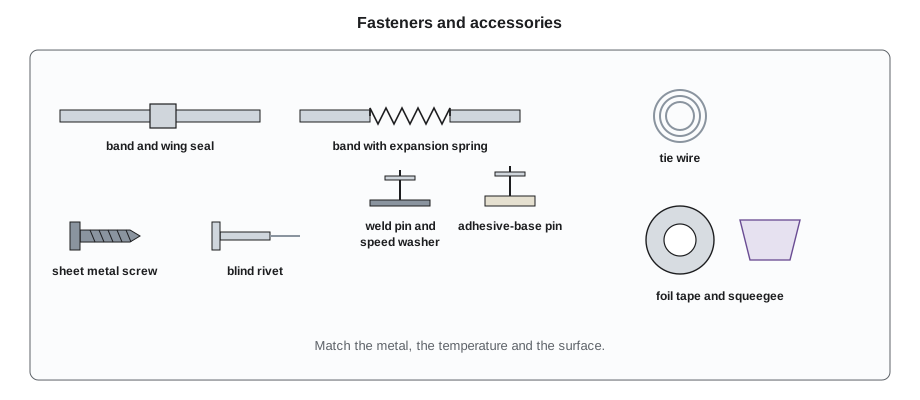
| Bands | 1/2 in or 3/4 in wide, about 0.015 to 0.020 in thick; stainless steel or aluminum | Securing insulation layers and metal jackets on pipe and equipment |
| Seals and wing seals | Stainless steel or aluminum to match the band | Closing bands after tensioning |
| Expansion springs | Stainless steel springs in the band | Allowing for growth of large hot vessels or contraction of cold ones |
| Tie wire | Stainless steel or galvanized annealed wire, about 16 to 18 gauge | Securing insulation sections and blankets under the jacket |
| Hexagonal or metal mesh | Galvanized or stainless steel | Holding blanket and supporting cement finishes on equipment |
Band spacing and material are set by the specification. Bands must be tensioned enough to hold firmly but not so tight that they cut into soft insulation or crush the jacket. On cold service with rigid insulation, bands must be stainless steel or a material compatible with the jacket, and some systems use springs or fiber-reinforced tape bands that allow for contraction without snapping.
Worked problem
Ordering banding for a run
On the 210 ft run of 6 in steam line, the 3 in insulation (outside diameter 12.625 in) is secured with stainless steel bands at 9 in centers. Each band needs 3 in extra for the seal. Banding comes in 100 ft coils. How many coils are needed?
Show solution
- Spaces: 210 × 12 ÷ 9 = 280 spaces, and one more band to close the last space: 281 bands.
- Length of one band: π × 12.625 + 3 ≈ 39.66 + 3 = 42.66 in, or 3.555 ft.
- Total banding: 281 × 3.555 ≈ 999 ft.
- Coils: 999 ÷ 100 ≈ 9.99, so 10 coils.
Answer: 10 coils, with almost nothing to spare. Raj would order 11 to allow for waste and the fittings, plus 281 seals and some spares.
Screws and rivets
Metal jackets are fastened along their seams and laps with sheet metal screws or blind (pop) rivets, or held by bands alone, depending on the specification.
- Screws are usually self-tapping, of stainless steel or aluminum to match the jacket, with a length chosen so they cannot reach a vapor retarder, heat tracing or the pipe.
- Rivets are aluminum for aluminum jacket and stainless steel for stainless jacket.
- On cold service, screws and rivets through the jacket must not penetrate the vapor retarder underneath. Many cold specifications use bands only, or require the vapor retarder to be a separate layer below a jacket that is fastened in ways that cannot reach it.
- Match the metal: carbon steel screws in aluminum jacket rust and cause galvanic corrosion, as the museum shelf showed.
Pins, clips and washers
On ducts, flat equipment and vessel walls, insulation is held by pins with retaining washers, by welded studs or by clips, often together with adhesive.
| Fastener | How it is attached | Typical use |
|---|---|---|
| Weld pins (stud pins) | Welded to the steel surface with a capacitor-discharge or resistance welder | Ducts, equipment and vessels; strongest attachment |
| Adhesive-base pins (stick pins) | Perforated base bonded to the surface with adhesive | Ducts and equipment where welding is not allowed |
| Cupped-head pins | Welded through the insulation with a cup-shaped head as the washer | Faster installation on ducts |
| Speed washers (self-locking washers) | Pushed onto the pin over the insulation | Holding insulation on pins |
| Clips and J-hooks | Welded or bolted to equipment | Holding wire or bands on large equipment |
Pins must be long enough to pass through the insulation with a little to spare but not so long that they stick out through the facing. After the washer is in place, the excess pin is clipped off or bent over, and on cold work the pin, washer and any puncture in the facing are sealed with tape or vapor retarder mastic, because each pin is a small thermal bridge and a vapor path.
Worked problem
Counting pins on a duct side
The specification for the supply ducts at Mountview calls for pins at a maximum of 12 in centers in both directions and no more than 3 in from any edge. How many pins are needed on one duct side 4 ft wide and 10 ft long?
Show solution
- Across the width: the pins at the edges are 3 in from each edge, so the distance between the outer pins is 48 − 6 = 42 in. Spaces: 42 ÷ 12 = 3.5, so 4 spaces and 5 rows.
- Along the length: 120 − 6 = 114 in. Spaces: 114 ÷ 12 = 9.5, so 10 spaces and 11 pins per row.
- Total: 5 × 11 = 55 pins.
Answer: 55 pins for that side, about 1.4 per square foot. Rounding the number of spaces up keeps every spacing within the 12 in maximum.
Choosing the right product: a checklist
Before using any adhesive, sealant, tape or fastener, an insulator should be able to answer these questions. The answers come from the specification, the manufacturer's data sheet and the safety data sheet.
| Question | Why it matters |
|---|---|
| Is it the product the specification and the insulation maker call for? | Compatibility with the insulation and the fire rating of the system |
| Is it rated for the surface temperature, hot or cold? | Adhesives and tapes fail outside their range; fasteners lose strength |
| Is it within its application temperature range today? | Many adhesives, tapes and mastics will not bond in the cold |
| Is it compatible with the metals involved? | Avoid galvanic corrosion between bands, screws and jackets |
| Is it suitable for stainless steel, if any is nearby? | Low-chloride products prevent stress corrosion cracking |
| Will it puncture a vapor retarder? | Screws, staples and pins on cold work must be avoided or sealed |
| Is it within its shelf life and stored correctly? | Expired or frozen products fail |
| What does the safety data sheet require? | Ventilation, ignition control, gloves and respirators |
A story from Mountview
In mid-October, Devon and Tessa were finishing duct wrap on the third floor at Mountview when the building's temporary heat failed overnight and the floor dropped to about 39 °F. The foil tape they had put on that morning had looked fine, but by the next afternoon, as the floor warmed up, the tape at dozens of seams had lifted. Bernie found the label on the roll: minimum application temperature 50 °F, and the duct metal had been colder than that. The tape came off, the seams were cleaned, and the work was redone once the heat was back. "The label is the cheapest training you'll ever get," Bernie said. "Read it before you peel."
Common mistakes
MistakeUsing a general-purpose adhesive on elastomeric foam.
InsteadUse the foam maker's contact adhesive; others can dissolve or fail to bond the foam.
MistakeApplying tape to a cold, dusty or damp surface.
InsteadClean and dry the surface, check the application temperature and rub the tape down firmly.
MistakeStapling the laps of a cold line's facing and leaving the staples exposed.
InsteadAvoid staples on cold work, or cover them with tape or vapor retarder mastic as specified.
MistakeScrewing through a jacket into the vapor retarder or heat tracing.
InsteadChoose screw lengths and fastening methods that cannot reach what is underneath.
MistakeUsing carbon steel fasteners on aluminum or stainless jacket.
InsteadMatch the fastener metal to the jacket.
MistakeOvertightening bands on soft insulation.
InsteadTension bands to hold firmly without cutting into the insulation or crushing the jacket.
Summary and key terms
- Adhesives, sealants, tapes and fasteners cause a large share of insulation failures when chosen or used wrongly.
- Use the adhesive the insulation maker recommends, within its temperature range, open time, cure time and shelf life.
- Tapes must match the facing, go on clean dry surfaces within their temperature range and be rubbed down firmly.
- Sealants back up correct lapping; products near stainless steel must be low in chlorides.
- Bands, seals and wire hold insulation and jackets; spacing and material come from the specification.
- Screws, rivets and pins must match the metal and must not puncture a vapor retarder on cold work.
- Read the data sheet and safety data sheet before using any product.
- Contact adhesive
- An adhesive applied to both surfaces and allowed to become tacky before they are joined.
- Open time
- The time after application during which an adhesive can still be joined successfully.
- Cure time
- The time an adhesive or sealant needs to reach its full strength.
- Butt strip
- A strip of facing material taped over the joint between two sections of faced pipe insulation.
- Wing seal
- A seal with tabs that is crimped around a band to close it after tensioning.
- Weld pin
- A pin welded to a steel surface to hold insulation, with a washer pushed on over the insulation.
- Speed washer
- A self-locking washer pushed onto a pin to hold insulation in place.
- Expansion spring
- A spring in a band that allows the band to follow thermal growth or contraction.
Practice problems
Work each problem on paper first, then reveal the answer to check.
What three things should you check on a tape label before using it?
Show answer
Any three of: that it matches the facing, its application temperature range, its service temperature range, its shelf life.
Why are staples a problem on cold lines?
Show answer
They puncture the vapor retarder.
Bands go at 10 in centers on a 30 ft run. How many bands are needed?
Show answer
360 ÷ 10 = 36 spaces, so 37 bands.
Pins at a maximum of 12 in centers, 3 in from the edges, on a side 3 ft × 6 ft. How many pins?
Show answer
Width 30 in ÷ 12 = 2.5, so 3 spaces, 4 rows; length 66 ÷ 12 = 5.5, so 6 spaces, 7 pins; 4 × 7 = 28 pins.
Why must fasteners match the jacket metal?
Show answer
Different metals touching in moisture cause galvanic corrosion.
Lesson quiz · 5 questions
Score 60% or more to complete this lesson.
Create a free account to save your progress, take quizzes and earn a certificate.