
INS-120 · Lesson 3 of 12 · 26 min
Conduction, convection and radiation
▶ Video coming soon A video version of this lesson is on the way.
In the third week of the material school, Tomasz brought a cast iron frying pan, a camp stove, a thermos and a sheet of aluminum foil into the shop. He heated the pan until the handle was too hot to hold, held his hand above the pan without touching it, and then wrapped a hot mug in foil and another in a towel. "Three ways heat gets out," he said. "Insulation has to fight all three. If you understand these, you'll understand why every product in this shop is built the way it is."
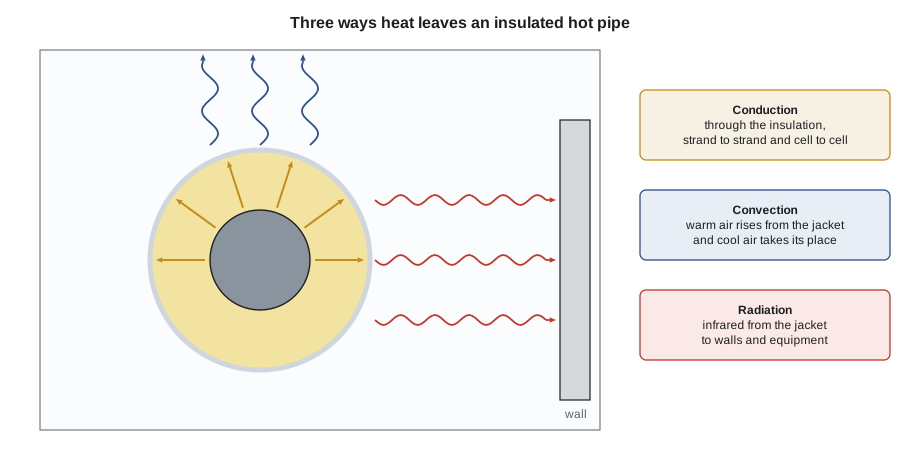
Heat moves by three mechanisms: conduction, convection and radiation. In a real insulated pipe, all three happen at once, in different places. Heat conducts through the pipe wall and the insulation, moves by convection in the air spaces inside the insulation and in the room outside it, and radiates from the outer surface to the walls, ceiling and equipment around it. This lesson describes each mechanism and how insulation materials slow it.
Conduction
Conduction is the transfer of heat through a material, or between materials in contact, by the direct passing of energy from particle to particle. When one end of a metal bar is heated, the fast-moving particles at the hot end bump into their neighbors and pass energy along, and soon the far end is hot too. The frying pan handle got hot by conduction.
Materials conduct heat at very different rates. Metals conduct heat well, which is why a pan heats evenly and why a metal hanger clamped directly to a cold pipe becomes a thermal bridge. Still air conducts heat poorly. Most insulation materials work by trapping air, or another gas, in tiny spaces so that heat has to conduct through the gas and along the thin solid walls or fibers around it. The less solid material there is, and the smaller the gas spaces, the slower the heat flows.
The ability of a material to conduct heat is its thermal conductivity, written k or λ (the Greek letter lambda). Lesson 4 covers k in detail. For a flat layer of material, the rate of conduction is given by Fourier's law, named after the French scientist who described it in the early 1800s:
Here q is the heat flow per square foot of surface in Btu/h·ft², k is the thermal conductivity in Btu·in/(h·ft²·°F), ΔT is the temperature difference across the layer in °F and L is the thickness in inches. Doubling the thickness halves the heat flow; doubling the temperature difference doubles it.
Worked problem
Conduction through a board on a boiler casing
A flat boiler casing at Kellerton is covered with 2 in of mineral wool board. The hot face is at 300 °F and the cold face under the jacket at 95 °F. At the mean temperature, the board's k is 0.28 Btu·in/(h·ft²·°F). What is the heat flow per square foot, and how much heat passes through 130 ft² of casing?
Show solution
- Temperature difference: 300 − 95 = 205 °F.
- q = 0.28 × 205 ÷ 2 = 57.4 ÷ 2 = 28.7 Btu/h·ft².
- Total: 28.7 × 130 = 3,731 Btu/h.
Answer: 28.7 Btu/h·ft², or about 3,730 Btu/h through the whole casing.
Conduction through the solid parts of an insulation explains why density matters. A denser board has more solid material and conducts more heat through its fibers or cell walls, but a very light board lets the air inside move and carry heat by convection and lets more radiation through. Each material has a density range where its conductivity is lowest, and manufacturers design products around it.
Convection
Convection is the transfer of heat by a moving fluid, such as air or water. When air touches a hot surface, it warms, becomes less dense and rises, and cooler air flows in to take its place. That moving air carries heat away. When Tomasz held his hand above the pan, he felt the rising warm air: convection.
There are two kinds of convection:
- Natural convection, also called free convection, is driven only by the difference in density between warm and cool fluid. Air rising from a hot pipe in a still room is natural convection.
- Forced convection is driven by a fan, a pump or the wind. Air blowing across an outdoor pipe rack in winter, or the supply air moving through a duct, is forced convection. It removes heat far faster than natural convection.
Convection matters to insulators in three places. First, it carries heat from the outer surface of the insulation to the surrounding air, so an outdoor pipe in the wind loses more heat than the same pipe indoors. Second, convection inside the insulation is what fibrous and cellular insulations are designed to stop: their fibers and cells divide the air into spaces too small for it to circulate. Third, convection through gaps is a major source of heat loss in installed systems. An open joint or a loose jacket lets air move along the pipe surface, and on a vertical pipe a gap between the pipe and the insulation can act like a chimney, drawing cool air in at the bottom and pushing hot air out at the top.
This chimney effect is why insulators fit pipe covering snugly and stagger and seal joints, and why vertical runs often have the insulation supported and sealed at intervals. Bernie showed Devon a vertical riser at Mountview where an earlier crew had used one size too large of pipe covering. A thermal imaging camera showed a bright band at every joint, where warm air was escaping.
Radiation
Radiation is the transfer of heat by electromagnetic waves, mostly infrared, from one surface to another. It needs no material in between; it travels through air and even through a vacuum. That is how the sun heats the earth. Every surface warmer than absolute zero gives off thermal radiation, and the hotter it is, the more it gives off. A hot pipe radiates heat to the cooler walls, ceiling and equipment around it, and those surfaces radiate some back.
The amount of heat a surface radiates depends strongly on its temperature, because radiation rises with the fourth power of the absolute temperature, and on its emittance. Emittance, also called emissivity, is a number from 0 to 1 that describes how well a surface gives off radiation compared with a perfect radiator. Dull, dark and painted surfaces have high emittance, around 0.8 to 0.95. Shiny metal surfaces have low emittance: new aluminum jacketing may be about 0.1 or less, and stainless steel jacketing about 0.1 to 0.3, depending on its finish. A surface that emits radiation poorly also absorbs it poorly and reflects most of what falls on it. The foil that Tomasz wrapped around the mug kept it hot longer than the towel partly because the foil radiated so little.
| Surface | Typical emittance |
|---|---|
| New, bright aluminum jacket | about 0.04 to 0.1 |
| Weathered or dirty aluminum jacket | about 0.1 to 0.2 |
| Stainless steel jacket | about 0.1 to 0.3 |
| Galvanized steel, new | about 0.1 to 0.3 |
| All-service jacket (white paper or film) | about 0.85 to 0.9 |
| PVC jacket and painted surfaces | about 0.9 |
| Canvas or mastic finish | about 0.9 |
| Bare oxidized steel pipe | about 0.8 |
Worked problem
Radiation from two jacket surfaces
Two insulated pipes have an outer surface temperature of 104 °F in a room whose walls are at 68 °F. One has a painted canvas finish with an emittance of 0.9, the other a bright aluminum jacket with an emittance of 0.1. How much heat does each radiate per square foot? Use the Stefan-Boltzmann constant, 0.1714 × 10⁻⁸ Btu/(h·ft²·°R⁴), and absolute temperatures.
Show solution
- Absolute temperatures: 104 + 459.67 = 563.67 °R and 68 + 459.67 = 527.67 °R.
- Fourth powers: 563.67⁴ ≈ 1.0095 × 10¹¹ and 527.67⁴ ≈ 0.7753 × 10¹¹. The difference is about 2.342 × 10¹⁰.
- Canvas: 0.9 × 0.1714 × 10⁻⁸ × 2.342 × 10¹⁰ ≈ 36.1 Btu/h·ft².
- Aluminum: 0.1 × 0.1714 × 10⁻⁸ × 2.342 × 10¹⁰ ≈ 4.0 Btu/h·ft².
Answer: About 36 Btu/h·ft² from the canvas and only about 4 Btu/h·ft² from the aluminum, nine times less.
This has a surprising consequence that every insulator should understand. Because a shiny jacket gives off heat poorly, its surface has to get hotter before it can pass on the heat that conducts through the insulation. On the same pipe with the same insulation, an aluminum jacket runs warmer to the touch than a painted canvas finish, even though the heat loss is only slightly lower. When a specification calls for a maximum surface temperature for personnel protection, the designer must use the emittance of the actual jacket, and a change from canvas to aluminum can mean the insulation needs to be thicker. Lesson 9 returns to this point.
Radiation also matters inside insulation. At high temperatures, radiation through the spaces between fibers becomes a large part of the heat flow, which is why high-temperature products are often denser and why some contain opacifiers, additives that block infrared radiation. Reflective multi-layer insulation used on cryogenic equipment, described in INS-320, works almost entirely by stopping radiation.
Thermal resistance in series
Heat leaving a hot pipe passes through several layers one after another: from the steam to the pipe wall, through the steel, through the insulation, through the jacket and finally from the jacket surface to the room by convection and radiation together. Each layer resists the heat flow, and their resistances add up, the way the resistances of electrical components in series add up.
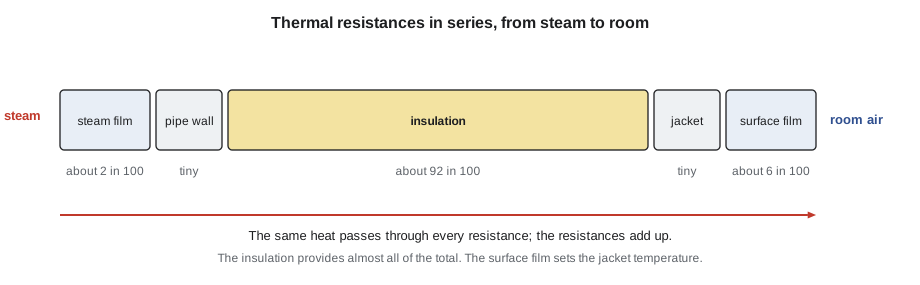
In practice, the steam film, the steel wall and a thin metal jacket offer almost no resistance compared with the insulation, so they are usually ignored. The surface film, the combined effect of convection and radiation at the outer surface, is small but not negligible. Its resistance is the inverse of the surface coefficient, h, which combines convection and radiation. For still indoor air, typical combined surface coefficients are about 1 to 1.8 Btu/(h·ft²·°F), higher for painted surfaces and in wind, lower for shiny jackets in still air.
Worked problem
The surface film on a flat surface
A flat casing at 300 °F is insulated with 2 in of board with k = 0.28 Btu·in/(h·ft²·°F). The room is at 68 °F, and the surface coefficient is 1.76 Btu/(h·ft²·°F). Find the total resistance, the heat flow and the surface temperature of the jacket.
Show solution
- Insulation resistance: L ÷ k = 2 ÷ 0.28 ≈ 7.14 h·ft²·°F/Btu.
- Surface film resistance: 1 ÷ 1.76 ≈ 0.57 h·ft²·°F/Btu.
- Total: 7.14 + 0.57 ≈ 7.71 h·ft²·°F/Btu.
- Heat flow: q = (300 − 68) ÷ 7.71 = 232 ÷ 7.71 ≈ 30.1 Btu/h·ft².
- Temperature drop across the film: 30.1 × 0.57 ≈ 17 °F.
- Surface temperature: 68 + 17 ≈ 85 °F.
Answer: About 30 Btu/h·ft², with the jacket at about 85 °F. The film provides only about 7 in 100 of the total resistance, but it sets the surface temperature.
This simple series model is the basis of the heat-loss tables in specifications and of the calculation programs insulators may use, such as NAIMA's free 3E Plus program. Real calculations for pipe use the cylindrical form of the equation, which lesson 4 introduces, and calculate the surface coefficient from the jacket emittance, the pipe size and the wind speed.
How insulation materials fight the three mechanisms
| Mechanism | How insulation slows it | What defeats it on the job |
|---|---|---|
| Conduction | Little solid material; gas or air trapped in small spaces; low-conductivity gases in some foams | Wet insulation, compressed insulation, metal hangers and supports touching the pipe (thermal bridges) |
| Convection | Fibers and cells too small for air to circulate in; tight joints; sealed jacket | Open joints, oversized covering, gaps behind the insulation, wind through loose jackets |
| Radiation | Fibers and cell walls that absorb and scatter infrared; opacifiers in high-temperature products; reflective foils | Very low-density products at high temperatures; missing layers |
Water deserves special mention. Water conducts heat about 20 to 25 times better than still air, and ice conducts it about 4 times better again than water. When insulation gets wet, water replaces the air in its spaces and the insulation's conductivity rises sharply, often several times over. On hot lines, the water also boils off, carrying heat away as latent heat. On cold lines, it freezes, and ice cracks the insulation and the jacket. Keeping water out is a theme you will hear in every lesson of this course.
Devon tried Tomasz's experiment at home with two mugs of coffee, one wrapped in a dry dish towel and one in a towel he had soaked under the tap. After twenty minutes, the coffee in the wet towel was barely warm. He wrote the result in his pocket notebook under the heading "Why Bernie yells about roof drains."
Common mistakes
MistakeFitting pipe covering one size too large because it is easier to install.
InsteadFit covering snugly to the pipe. Gaps allow convection, especially on vertical runs.
MistakeAssuming a shiny jacket makes a surface safer to touch.
InsteadA low-emittance jacket runs hotter than a painted or canvas finish on the same insulation. Check the surface temperature.
MistakeIgnoring metal-to-pipe contact at hangers and supports.
InsteadMetal conducts heat quickly. Use insulated supports, inserts or shields as the specification requires.
MistakeTreating damp insulation as good enough.
InsteadWater conducts heat many times better than air. Replace wet insulation and fix the source of the water.
MistakeForgetting the outer surface when thinking about heat loss.
InsteadWind, jacket emittance and pipe size all change how heat leaves the surface.
Summary and key terms
- Heat moves by conduction, convection and radiation, and all three act on an insulated pipe at once.
- Conduction passes heat through materials in contact; for a flat layer, q = k × ΔT ÷ L.
- Convection carries heat with moving air or liquid; forced convection from wind or fans is much stronger than natural convection.
- Radiation passes heat between surfaces by infrared waves and depends on temperature and on surface emittance.
- Shiny metal jackets have low emittance, so they lose heat by radiation poorly and run hotter to the touch.
- Thermal resistances in series add up; the insulation supplies most of the resistance, and the surface film sets the surface temperature.
- Insulation works by trapping gas in tiny spaces; water, compression, gaps and metal contacts defeat it.
- Conduction
- Heat transfer through a material or between materials in contact, from particle to particle.
- Convection
- Heat transfer by a moving fluid such as air or water.
- Radiation
- Heat transfer by infrared electromagnetic waves between surfaces.
- Emittance
- A number from 0 to 1 describing how well a surface gives off thermal radiation; also called emissivity.
- Surface coefficient
- A value combining convection and radiation that describes how readily heat leaves a surface for the surrounding air.
- Thermal bridge
- A path of conductive material, such as a metal support, that lets heat bypass the insulation.
- Chimney effect
- Air rising through a gap along a hot vertical pipe, drawing cool air in below and pushing warm air out above.
- Opacifier
- An additive in high-temperature insulation that blocks infrared radiation.
Practice problems
Work each problem on paper first, then reveal the answer to check.
Name the three ways heat moves.
Show answer
Conduction, convection and radiation.
A 1 in layer with k = 0.25 Btu·in/(h·ft²·°F) has a 120 °F difference across it. What is the heat flow per square foot?
Show answer
0.25 × 120 ÷ 1 = 30 Btu/h·ft².
Why does a pipe in the wind lose more heat than the same pipe indoors?
Show answer
Wind causes forced convection, which removes heat from the surface faster.
Which radiates more heat at the same temperature, PVC or bright aluminum?
Show answer
PVC, with an emittance near 0.9, compared with about 0.1 for bright aluminum.
An insulation layer has a resistance of 11.5 h·ft²·°F/Btu and the surface film 0.6. What is the total?
Show answer
11.5 + 0.6 = 12.1 h·ft²·°F/Btu.
Lesson quiz · 5 questions
Score 60% or more to complete this lesson.
Create a free account to save your progress, take quizzes and earn a certificate.