
INS-120 · Lesson 6 of 12 · 22 min
Cellular insulations: foam glass, elastomeric and plastics
▶ Video coming soon A video version of this lesson is on the way.
The cellular glass that Coldstream used on the Kellerton ammonia line arrived in sturdy cartons of black, glassy-looking half-shells that rang faintly when tapped together. When Devon cut a piece on the band saw, the shop filled with a smell like rotten eggs. "That's normal," Tomasz said, laughing at his face. "A little gas is trapped in the cells when it's made. It goes away. Now look at the cut face." Under a magnifier, the black surface was a honeycomb of tiny sealed bubbles.
Cellular insulations are made of a solid material filled with small cells of gas. In some, the cells are sealed from one another; in others, they connect. This lesson covers the main cellular materials insulators use: cellular glass, flexible elastomeric foam and the rigid and flexible plastic foams. Many of them are the first choice for cold service, because closed cells resist water vapor on their own.
Closed cells and open cells
In a closed-cell material, each tiny gas bubble is completely surrounded by solid walls, so water, air and water vapor cannot pass easily from cell to cell. In an open-cell material, the cells are connected, like a sponge. Closed-cell foams have much lower water vapor permeability and absorb little water. Open-cell foams, such as melamine foam, are lighter and more flexible but behave more like fibrous insulation where moisture is concerned.
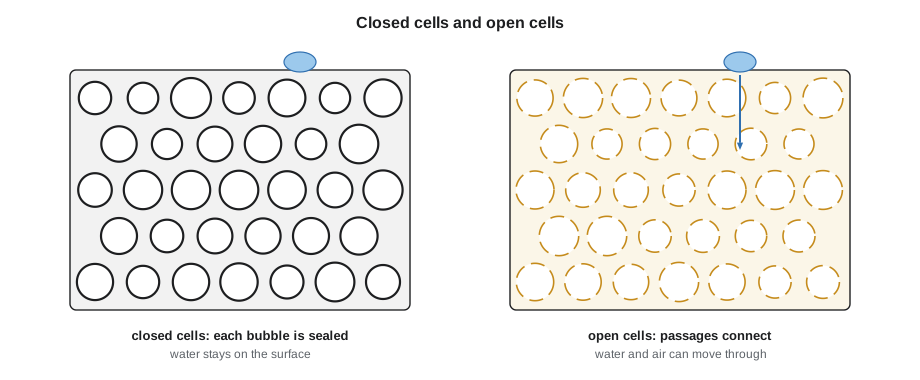
The ability of a material to let water vapor pass is its water vapor permeability, sometimes called perm-rating per thickness. It is measured to ASTM E96 and given in perm-in: the lower the number, the better the material resists vapor. Lesson 9 explains vapor retarders and their perm ratings. For now, the key point is that the best closed-cell materials, especially cellular glass, are close to vapor-tight on their own, while fibrous insulations let vapor through freely and depend entirely on their jacket.
Cellular glass
Cellular glass, often called foam glass, is made by mixing finely ground glass with a small amount of carbon and heating it in molds. The carbon releases gas as the glass softens, and the gas forms millions of sealed cells. The blocks are then cooled slowly, cut and fabricated into pipe half-shells, segments for fittings and boards. The material standard is ASTM C552.
| Property | Typical value for current cellular glass |
|---|---|
| Service temperature | −450 °F to about 800 °F under ASTM C552; some products are rated higher |
| Typical k at 75 °F mean | 0.29 Btu·in/(h·ft²·°F) |
| Density | about 7.3 lb/ft³ |
| Compressive strength | about 90 psi average for a common grade |
| Water vapor permeability | essentially zero |
| Water absorption | only in the cut cells at the surface |
| Combustibility | noncombustible |
Cellular glass has a rare combination of properties: it is vapor-tight, it does not absorb water, it does not burn, it is rigid enough to carry pipe loads, it does not shrink or sag, and it works from cryogenic temperatures up to well above steam temperatures. That is why it is chosen for ammonia refrigeration, chilled water in demanding places, liquefied gas lines, underground and buried piping, and hot lines in wet or washdown areas. Its compressive strength also makes it a common material for inserts at pipe supports.
It has drawbacks. It is brittle, so it cracks if dropped, flexed or struck, and it must be cut with fine-tooth saws, not knives. Its cut surfaces are abrasive, and on lines that vibrate or expand and contract a great deal, the inside of the shells can grind against the pipe or each other. Manufacturers then call for an anti-abrasive coating on the bore of the insulation, and on cold lines for joint sealants and a bore coating to keep the system tight. Its dust irritates the eyes and skin, so eye protection and a dust mask are needed when sawing it. Bernie's cellular glass rule: "Carry it like eggs, cut it like glass, seal it like it's holding water."
On cold systems, cellular glass is usually installed in two layers with staggered joints. The joints of each layer are sealed with a joint sealant compatible with the product, and the outer surface is finished with a vapor retarder mastic or jacket. The Kellerton ammonia line repair used exactly this system: two layers of cellular glass, a vapor retarder mastic and a stainless steel jacket.
Flexible elastomeric foam
Flexible elastomeric foam is the black, rubbery closed-cell tube and sheet that refrigeration and plumbing insulators know well. It is made from synthetic rubber, such as nitrile rubber blends or ethylene propylene diene monomer (EPDM), and is covered by ASTM C534. It comes as tubing, either unslit for sliding onto pipe before connection or slit with a self-adhesive closure, and as sheet and rolls for large pipes, tanks and ducts.
ASTM C534 divides elastomeric insulation into types by form and grades by temperature. All grades have a lower limit of −297 °F.
| ASTM C534 grade | Upper temperature limit | Typical use |
|---|---|---|
| Grade 1 | 220 °F | Most commercial refrigeration, chilled water, plumbing and HVAC work |
| Grade 2 | 350 °F | Higher-temperature industrial work |
| Grade 3 | 250 °F | Industrial work where halogen-free material is wanted |
C534 limits k to no more than about 0.28 Btu·in/(h·ft²·°F) at a 75 °F mean for Grades 1 and 3, and sets a maximum water vapor permeability of about 0.10 perm-in, very low for a flexible material. Elastomeric foam is flexible enough to follow bends and fittings, installs quickly with contact adhesive, needs no separate vapor retarder in most indoor uses and does not crack. That makes it the usual choice for refrigerant lines, small chilled water lines and cold plumbing.
Its weaknesses are mostly about installation. Every seam and butt joint must be glued with the manufacturer's adhesive, because the foam's vapor resistance is useless if vapor can travel through an open joint. The tube must not be stretched to fit, or the joints will pull apart as the foam relaxes. Outdoors, sunlight breaks the surface down, so elastomeric foam outdoors must be painted with the manufacturer's coating or covered with a jacket. It is combustible, though products are formulated to meet flame spread and smoke limits up to a certain thickness, so the thickness and listing must match the code requirement for the space. Elastomeric adhesive solvents are flammable and have strong vapors, so they are used with ventilation and away from ignition sources.
Worked problem
Elastomeric sheet for a buffer tank
A chilled water buffer tank at Mountview is a vertical cylinder 4 ft in diameter and 6.5 ft tall, with flat ends. It will be covered with elastomeric sheet sold in sheets 3 ft × 4 ft. Allow 10 in 100 for waste. How many sheets are needed?
Show solution
- Shell area: π × diameter × height = π × 4 × 6.5 ≈ 81.7 ft².
- Each end: π × radius² = π × 2² ≈ 12.6 ft²; two ends ≈ 25.1 ft².
- Total area: 81.7 + 25.1 = 106.8 ft².
- With waste: 106.8 × 1.10 ≈ 117.5 ft².
- Area of one sheet: 3 × 4 = 12 ft².
- Sheets: 117.5 ÷ 12 ≈ 9.8, so 10 sheets.
Answer: 10 sheets, plus adhesive for every seam.
Rigid plastic foams
Several rigid plastic foams are used for mechanical insulation. They are usually made in large blocks called bunstock and then cut by fabricators into pipe shells, fitting segments and boards to order.
| Material | ASTM standard | Typical temperature range | Typical k at room temperature | Notes |
|---|---|---|---|---|
| Polyisocyanurate (PIR) | C591 | −297 °F to 300 °F | 0.19 Btu·in/(h·ft²·°F) aged | Low k; needs a vapor retarder on cold work; k rises slowly with age |
| Phenolic foam | C1126 | −290 °F to 257 °F | 0.13 to 0.16 Btu·in/(h·ft²·°F) | Very low k; low smoke; brittle |
| Extruded polystyrene (XPS) | C578 | −65 °F to 165 °F for board | 0.20 Btu·in/(h·ft²·°F) | Low cost; low temperature limit; combustible |
| Expanded polystyrene (EPS) | C578 | −65 °F to 165 °F | 0.25 to 0.27 Btu·in/(h·ft²·°F) | Mostly for building and cold storage work |
| Polyimide foam | C1482 | wide range, from cryogenic to about 400 °F or higher | about 0.28 Btu·in/(h·ft²·°F) | Very light; used in marine and specialty work |
Polyisocyanurate, often called polyiso or PIR, is the most common rigid foam on chilled water, refrigeration and cold process piping in large commercial and industrial jobs. Its low k means a thinner layer gives the same resistance as other materials. Like all foams on cold work, it must be covered with a continuous vapor retarder jacket or mastic, and its joints sealed, because its cells are not completely vapor-tight. Polystyrene is used for cold storage buildings, some below-ground and low-temperature work and, in special forms, on cryogenic pipe.
Worked problem
Thickness for the same resistance
A designer wants a flat layer of R-8.5 on the side of a cold equipment cabinet. How thick must polyisocyanurate (k = 0.19), elastomeric foam (k = 0.25) and cellular glass (k = 0.29) be, in Btu·in/(h·ft²·°F)?
Show solution
- Thickness = R × k.
- Polyiso: 8.5 × 0.19 ≈ 1.6 in.
- Elastomeric: 8.5 × 0.25 ≈ 2.1 in.
- Cellular glass: 8.5 × 0.29 ≈ 2.5 in.
Answer: About 1.6 in, 2.1 in and 2.5 in. In practice the designer rounds up to the thicknesses each product is made in.
A lower k is not the whole story. Cellular glass needs more thickness than polyiso for the same resistance, but it does not age, does not burn and does not let vapor in through a scratch. Owners of ammonia plants often accept the extra thickness and weight for that reliability. Lesson 11 shows how these trade-offs are weighed.
Flexible plastic foams
Polyethylene and polyolefin foam tubes, covered by ASTM C1427, are light, inexpensive closed-cell products used mostly on residential and light commercial plumbing and refrigerant lines. They are typically rated from about −150 °F to 200 °F. They are less flexible than elastomeric foam and have a higher vapor permeability, and many are not rated for the flame spread and smoke limits of commercial plenums. Melamine foam (ASTM C1410) is a light, open-cell foam used for acoustic work and in some marine and transit applications where low smoke is important.
Fire and plastics
Cellular glass is noncombustible. Elastomeric and plastic foams are combustible: they will burn if exposed to enough heat, and many produce dense, toxic smoke. Building codes therefore limit their use. In most commercial buildings, exposed insulation and its jacket must meet flame spread and smoke developed limits, such as 25 and 50, when tested as installed. Foam plastic insulation in buildings usually must be protected by a thermal barrier or be part of a tested assembly, except in the specific cases the code allows. Specifications and product listings tell insulators which products are permitted where. Lesson 9 explains the surface burning tests; for now, the rule is never to substitute a plastic foam for a specified mineral product without written approval.
Working with cellular products
- Store foams out of sunlight and away from heat; store cellular glass flat and protected from impact.
- Cut cellular glass with a fine-tooth saw; cut elastomeric with a long, sharp knife; cut rigid foam with a fine saw, hot wire or knife as the manufacturer recommends.
- Use only the manufacturer's adhesives, sealants and coatings. Some solvents dissolve some foams.
- Keep adhesives and solvents away from flames and sparks, and ventilate the area.
- Never use plastic foams near open flames or welding, and keep a hot-work permit area clear of them.
- On cold work, glue or seal every seam and joint. A foam with a perfect vapor rating is only as good as its worst joint.
Common mistakes
MistakeStretching elastomeric tube to cover a longer run.
InsteadCut it to length without stretching, and glue the butt joints, so the joints do not open as the foam relaxes.
MistakeLeaving elastomeric foam unprotected outdoors.
InsteadPaint it with the manufacturer's coating or cover it with a jacket to protect it from sunlight.
MistakeCutting cellular glass with a knife or dropping cartons.
InsteadUse a fine-tooth saw, carry and store it carefully, and wear eye protection.
MistakeSkipping the joint sealant on cellular glass in cold service.
InsteadSeal every joint as the manufacturer specifies; vapor will find an open joint.
MistakeSubstituting a foam plastic for a specified mineral product.
InsteadFoam plastics are combustible and limited by code. Get written approval before any substitution.
MistakeUsing a foam above its temperature limit.
InsteadCheck the grade and type: many foams soften or degrade well below steam temperatures.
Summary and key terms
- Cellular insulations are solids filled with small gas cells; closed cells resist water and water vapor.
- Cellular glass (ASTM C552) is vapor-tight, noncombustible, rigid and usable from cryogenic temperatures to well above steam temperatures, but brittle.
- Flexible elastomeric foam (ASTM C534) is used from −297 °F to 220 °F for Grade 1, with higher grades for hotter work; every seam must be glued.
- Rigid foams such as polyisocyanurate (C591), phenolic (C1126) and polystyrene (C578) have low k but low temperature limits and need vapor retarders on cold work.
- Polyolefin and polyethylene tube (C1427) is light and inexpensive for small plumbing and refrigerant lines.
- Plastic and elastomeric foams are combustible, and codes limit where they can be used.
- Closed-cell
- A cellular material in which each gas cell is sealed from its neighbors.
- Open-cell
- A cellular material in which the cells connect, allowing air and water to pass.
- Cellular glass
- A rigid, closed-cell insulation made by foaming glass; also called foam glass.
- Flexible elastomeric foam
- A closed-cell rubber foam insulation in tube and sheet form.
- Polyisocyanurate
- A rigid closed-cell plastic foam with low k, often fabricated into pipe shells; PIR or polyiso.
- Bunstock
- A large block of foam from which pipe shells and boards are cut.
- Water vapor permeability
- The rate at which water vapor passes through a material of unit thickness under a unit vapor pressure difference.
- Anti-abrasive coating
- A coating applied to the bore of cellular glass to stop it grinding against a vibrating or moving pipe.
Practice problems
Work each problem on paper first, then reveal the answer to check.
What is the temperature range of ASTM C534 Grade 1 elastomeric foam?
Show answer
−297 °F to 220 °F.
Why does cellular glass not need a separate vapor retarder to stop vapor passing through the material itself?
Show answer
Its closed glass cells are essentially vapor-tight.
How thick must polyiso with k = 0.19 be for R-11?
Show answer
11 × 0.19 ≈ 2.1 in.
Name two reasons cellular glass is chosen for ammonia lines.
Show answer
Any two of: vapor-tight, does not absorb water, rigid, does not age, noncombustible, works at very low temperatures.
Why must elastomeric foam outdoors be painted or jacketed?
Show answer
Sunlight breaks down its surface.
Lesson quiz · 5 questions
Score 60% or more to complete this lesson.
Create a free account to save your progress, take quizzes and earn a certificate.