
INS-120 · Lesson 11 of 12 · 23 min
Choosing materials for the service temperature
▶ Video coming soon A video version of this lesson is on the way.
On the last Friday of October, Raj brought the apprentices a puzzle. He handed out a list of six Kellerton systems, each with its temperature, location and a short note from the plant, and a stack of product data sheets. "Pick a material for each one," he said. "Then tell me what you ruled out and why. The ruling out is the important part." It took the apprentices most of the afternoon, and they argued about two of the six.
Insulators usually install what the specification calls for. But the specification writer, the estimator, the foreperson checking a submittal and the insulator who finds that the specified product cannot be delivered all need to understand how materials are chosen. This lesson brings together everything in the course so far into a method for matching materials to the service. It is the same method designers use, at an apprentice level.
Start with the temperature range
The service temperature is the first filter, because a material used outside its range will fail no matter how well it is installed. The range has several parts:
- Normal operating temperature: what the system runs at day to day.
- Maximum temperature, including upsets: the highest temperature the surface can reach, for example during a process upset, a steam-out cleaning, a regeneration cycle or a failed control. Designers often use the design temperature from the piping specification rather than the normal one.
- Minimum temperature: the lowest the surface will reach, including shutdowns in winter for outdoor lines.
- Cycling: whether the system changes between hot and cold, for example a dual-temperature heating and cooling line, or starts and stops often. Cycling causes expansion and contraction and can draw moisture in.
A material must be rated above the maximum and below the minimum, with a margin. Many owners and designers want a margin of at least several tens of degrees below a product's maximum use temperature, partly because the data sheet limit is often the temperature at which the product just passes a test.
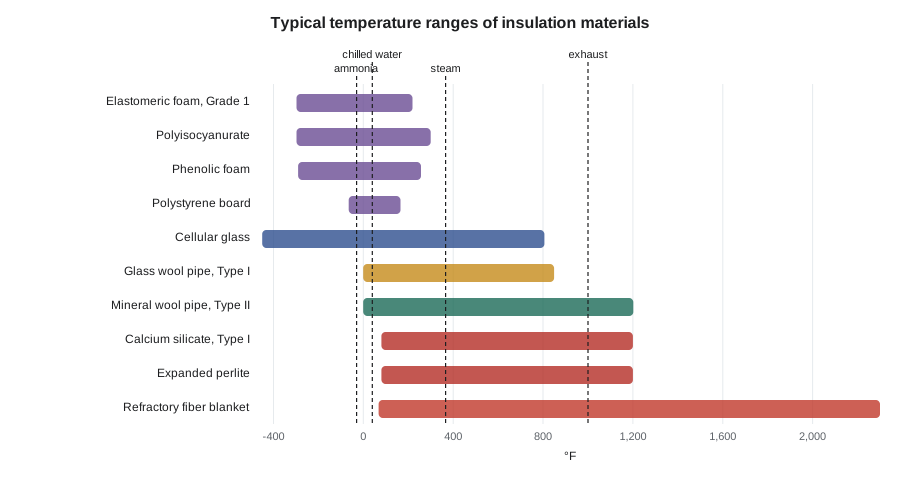
| Material | Typical lower limit | Typical upper limit |
|---|---|---|
| Flexible elastomeric foam (C534 Grade 1) | −297 °F | 220 °F |
| Polyisocyanurate (C591) | −297 °F | 300 °F |
| Phenolic foam (C1126) | −290 °F | 257 °F |
| Extruded polystyrene board (C578) | −65 °F | 165 °F |
| Cellular glass (C552) | −450 °F | 800 °F, higher for some products |
| Glass fiber pipe insulation (C547 Type I) | about 0 °F as rated; colder only in special designs | 850 °F |
| Mineral wool pipe insulation (C547 Type II) | about 0 °F as rated | 1,200 °F |
| Calcium silicate (C533 Type I) | 80 °F | 1,200 °F |
| Expanded perlite (C610) | 80 °F | 1,200 °F |
| Refractory ceramic fiber blanket, common grade | ambient | about 2,300 °F |
Then the environment and the purpose
Once the temperature has narrowed the choice, the environment and the main purpose narrow it further.
| Question | What it points to |
|---|---|
| Is the system below ambient, so condensation is possible? | Closed-cell materials or fibrous insulation under a continuous, sealed vapor retarder |
| Is it outdoors, buried or in a washdown area? | Materials that tolerate water (cellular glass, closed-cell foams) and weatherproof or washable jackets |
| Is it subject to foot traffic, impact or heavy loads? | Rigid, strong materials (calcium silicate, perlite, cellular glass) or a heavy jacket |
| Is it austenitic stainless steel? | Products that meet ASTM C795, and low-chloride accessories |
| Must it be noncombustible, or meet a 25/50 rating, or form part of a fire-rated system? | Mineral products, or listed products within their rated thickness |
| Is space limited? | Low-k products such as polyisocyanurate, phenolic, aerogel or microporous |
| Will it be removed often for maintenance? | Removable covers or easily reused products |
| Does it vibrate or move a lot? | Flexible products, anti-abrasive coatings on cellular glass, secure fastening |
| Is it in a food, hospital or clean area? | Smooth, washable, low-emitting finishes; no fibers exposed |
Finally, the owner's standards, cost, availability and the skills of the crew all play a part. An owner that runs a large ammonia plant may specify cellular glass on every refrigeration line even where a cheaper product would pass on paper, because one failure costs more than the difference in price. A hospital may forbid exposed fibrous insulation in patient areas. A remote site may need a product that can be delivered quickly.
Dual-temperature systems
Many commercial buildings use the same piping for heating in winter and cooling in summer. The water in a dual-temperature line might run at 43 °F in July and 180 °F in January. The insulation must survive the hot season and must also stop condensation in the cold season. That means a material rated above the hot temperature, installed with a continuous, sealed vapor retarder as if it were always cold. Insulators sometimes treat dual-temperature lines as hot work because they feel hot when they are installed in winter, and the vapor retarder is left unsealed. The first humid summer shows the mistake.
Worked problem
Checking a dual-temperature line
A dual-temperature line at Mountview runs from 43 °F to 180 °F. The designer is considering elastomeric foam (C534 Grade 1, up to 220 °F), polyisocyanurate (up to 300 °F) and glass fiber with an all-service jacket (up to 850 °F). What margin does each have at the top of the range, and what must every option include?
Show solution
- Elastomeric: 220 − 180 = 40 °F of margin.
- Polyisocyanurate: 300 − 180 = 120 °F of margin.
- Glass fiber: 850 − 180 = 670 °F of margin.
- All three are rated well below 43 °F, so the low end is not a problem.
- Because the line runs below the dew point in summer, every option needs a continuous vapor retarder with all seams and joints sealed: glued seams for elastomeric, a sealed jacket for polyiso, and a sealed ASJ for glass fiber.
Answer: All three pass on temperature, elastomeric with the smallest margin. The vapor retarder is the deciding detail, whichever product is chosen.
Raj's puzzle: six Kellerton systems
Here are the six systems from Raj's puzzle, with the answers the apprentices agreed on after the discussion. In the real plant, Kellerton's own standard and the engineer's specification decide; this exercise shows the reasoning.
| System | Temperature and location | Ruled out | Good choices |
|---|---|---|---|
| Ammonia suction line | −30 °F, engine room, washdown nearby | Calcium silicate and perlite (not for cold); fibrous (too risky in a wet cold area) | Cellular glass in two layers with sealed joints, or polyisocyanurate with a vapor retarder jacket; stainless steel jacket |
| Chilled glycol to a process cooler | 25 °F, indoors, ceiling space | Calcium silicate and perlite | Flexible elastomeric foam or polyisocyanurate with a sealed jacket |
| Domestic hot water | 140 °F, indoors | Calcium silicate and perlite are possible but heavy and unnecessary | Glass fiber with ASJ; elastomeric foam where flexibility helps |
| Steam header | 366 °F, boiler house | Elastomeric (Grade 2 limit 350 °F), polyiso, phenolic, polystyrene | Mineral wool (plant standard), with calcium silicate inserts; calcium silicate or perlite in high-abuse spots |
| Steam line on the outdoor rack | 366 °F, outdoors | All foams; glass fiber is possible but less tolerant of water | Mineral wool or perlite with aluminum jacket and moisture barrier; calcium silicate at supports |
| Turbine exhaust duct | 1,000 °F, enclosure | All foams, glass fiber as the inner layer, cellular glass above its limit | High-temperature mineral wool inner layer; glass fiber or mineral wool outer layer if the interface temperature allows |
The two systems the apprentices argued about were the chilled glycol line and the outdoor steam line. For the glycol line, Tessa argued for elastomeric because it is quick to install in a crowded ceiling; Devon argued for polyiso because the line is large and the plant wanted a hard jacket. Both were reasonable. For the outdoor steam line, Devon at first chose glass fiber because it was rated high enough. Raj pointed out that mineral wool and perlite tolerate the occasional wetting of an outdoor line better, and that Kellerton's standard called for mineral wool. "The data sheet tells you what's allowed," he said. "The site tells you what's wise."
Comparing products with numbers
When two products both pass every filter, designers compare them on performance and cost. Performance comparisons must be fair: the same pipe, the same temperature, the same thickness or the same heat loss, and k at the right mean temperature. Lesson 12 does this for a real line. A simpler comparison uses thickness for equal resistance, as in lesson 6, or the margin to each product's temperature limit.
Worked problem
Comparing two products on margin and heat loss
For the outdoor steam line at 366 °F, Raj compares mineral wool (limit 1,200 °F, k = 0.31 at the mean) with perlite (limit 1,200 °F, k = 0.42 at the mean), both 3 in thick on 6 in pipe. Using the cylinder equation from lesson 4 with an outer face at 50 °F, how do their heat losses compare?
Show solution
- Both have about 830 °F of margin to their limits, so temperature does not separate them.
- From lesson 4, mineral wool gives about 79.5 Btu/h·ft.
- Heat loss is in proportion to k when everything else is the same, so perlite gives about 79.5 × 0.42 ÷ 0.31 ≈ 108 Btu/h·ft.
- Difference: 108 − 79.5 ≈ 28 Btu/h·ft, or about a third more for perlite.
Answer: Mineral wool loses about a quarter less heat at the same thickness. Perlite would need more thickness to match it, but it resists water and abuse better. The plant chose mineral wool for the run and calcium silicate at the supports.
Substitutions
On real jobs, a specified product is sometimes not available, and a supplier offers a substitute. Insulators and forepersons are often the first to see the substitute arrive. The rule is simple: a substitution is the designer's decision, made in writing, never the crew's. A substitute must match or beat the specified product on every point that matters for that system: temperature range, k at the right mean temperature, water and vapor behavior, strength, fire rating, compatibility with stainless steel and jacket, and any code or listing requirement. A product that is cheaper, thinner or easier to install may fail on one of those points.
The NPS 3 cellular glass delivered in place of NPS 4 during the Kellerton outage was a size error, not a substitution, but it shows the same habit at work: check what arrives against what is specified, before it goes on the pipe.
| Step | Question |
|---|---|
| 1 | What are the normal, maximum and minimum temperatures, and does the system cycle? |
| 2 | Which materials are rated for that whole range, with a margin? |
| 3 | Is the system cold or dual-temperature, so that vapor control decides the system? |
| 4 | Is it outdoors, wet, buried, washdown or corrosive? |
| 5 | Does it need strength, abuse resistance or support inserts? |
| 6 | Is the surface stainless steel? |
| 7 | What fire and code requirements apply? |
| 8 | What do the owner standard and the specification require? |
| 9 | Among the remaining products, how do performance, cost and availability compare? |
| 10 | Which jacket, accessories and fasteners suit the chosen material and environment? |
When the specification is silent
Occasionally an insulator meets a system that the specification does not mention: a line added late by a change order, a drain or vent the designer missed, or an existing line that has to be reinsulated where no specification survives. The right response is not to guess. The foreperson asks the designer or the owner in writing, through a request for information, and offers the information that will help them decide: the pipe size and material, the operating temperature, the location and what the neighboring systems have. Many owners, Kellerton among them, have a written insulation standard that covers this situation, and the foreperson should ask for it at the start of any plant job.
Until the answer comes back, the work on that line waits, or, if the owner agrees, a temporary covering protects people from a hot surface. Bernie's rule is that a line nobody specified is a line somebody will argue about later, and the argument goes better when the question was asked in writing before the work was done.
Common mistakes
MistakeChoosing a product by its normal operating temperature only.
InsteadCheck the maximum, including upsets and cleaning cycles, and the minimum.
MistakeTreating a dual-temperature line as hot work.
InsteadInstall it with a continuous, sealed vapor retarder as if it were always cold.
MistakeUsing calcium silicate or perlite on cold service.
InsteadThey are rated only from about 80 °F up.
MistakeChoosing a product with no margin to its limit.
InsteadLeave a margin below the maximum use temperature.
MistakeAccepting a substitute product on site because it looks similar.
InsteadSubstitutions are the designer's decision, in writing, after checking every property.
MistakeComparing k-values at different mean temperatures.
InsteadCompare at the same mean temperature for the service.
Summary and key terms
- Start with the full temperature range: normal, maximum including upsets, minimum and cycling.
- A material must be rated beyond both ends of the range, with a margin.
- Below-ambient and dual-temperature systems are designed around vapor control.
- Environment, abuse, stainless steel, fire requirements, space and maintenance narrow the choice further.
- Owner standards and specifications often decide between products that both pass on paper.
- Compare products fairly: same pipe, same conditions and k at the right mean temperature.
- Substitutions are made by the designer in writing, after checking every property that matters.
- Service temperature
- The temperature range a system operates over, including normal, maximum and minimum temperatures.
- Design temperature
- The temperature a system is designed for, usually above its normal operating temperature.
- Upset
- An abnormal operating condition in which temperatures or pressures go beyond their normal range.
- Dual-temperature system
- A system that runs hot in some seasons and cold in others, such as a heating and cooling water line.
- Margin
- The difference between a system temperature and a material’s rated limit.
- Owner standard
- An owner’s own written requirements for materials and methods, often stricter than codes.
- Substitution
- Use of a product other than the one specified, which requires the designer’s written approval.
Practice problems
Work each problem on paper first, then reveal the answer to check.
Name three parts of the service temperature range to check.
Show answer
Normal operating, maximum including upsets, minimum (and whether it cycles).
A line runs at 250 °F. Which of these are rated high enough: elastomeric Grade 1, polyisocyanurate, phenolic?
Show answer
Polyisocyanurate (300 °F) and phenolic (257 °F, with only 7 °F margin); elastomeric Grade 1 (220 °F) is not.
Why are calcium silicate and perlite ruled out for chilled water?
Show answer
They are hot-service products rated from about 80 °F up and absorb moisture.
What must every insulation system on a dual-temperature line include?
Show answer
A continuous, sealed vapor retarder.
Who decides whether a substitute product can be used?
Show answer
The designer, in writing.
Lesson quiz · 5 questions
Score 60% or more to complete this lesson.
Create a free account to save your progress, take quizzes and earn a certificate.