
INS-120 · Lesson 9 of 12 · 26 min
Jacketing, coatings and mastics
▶ Video coming soon A video version of this lesson is on the way.
On a wet Friday in late October, Tomasz set three short lengths of insulated pipe on the shop floor and turned a garden hose on them. One had a white all-service jacket, one a smooth aluminum jacket with its seam facing down, and one bare mineral wool. After two minutes he cut them open. The bare wool was soaked through, the aluminum-jacketed piece was dry, and the all-service jacket was dry inside but sagging and stained on the outside. "Insulation does the insulating," he said. "The jacket keeps the insulation alive."
Almost every mechanical insulation system has a covering over the insulation: a factory-applied facing, a field-applied jacket, a fabric and coating, or a mastic. This lesson explains what these coverings do, the main materials and how their properties affect the system. INS-220 covers measuring, fabricating and installing metal and PVC jacketing; here the focus is on choosing and understanding the materials.
What a jacket or finish does
| Purpose | Why it matters |
|---|---|
| Weather protection | Keeps rain, snow, wash water and spray out of the insulation |
| Mechanical protection | Protects soft insulation from foot traffic, ladders, tools and impact |
| Vapor retarder | On cold systems, stops water vapor from reaching the cold surface (if the covering is a vapor retarder) |
| Fire and smoke performance | Must meet the flame spread and smoke limits of the space as part of the complete product |
| Surface emittance | Sets how hot or cold the surface runs and affects personnel protection and condensation |
| Cleanability and hygiene | Smooth, washable surfaces for food plants, hospitals and clean rooms |
| Appearance and identification | Neat finish; a surface for labels and color bands |
| Chemical and ultraviolet resistance | Protects the insulation from spills, fumes and sunlight |
Factory-applied facings
Many commercial insulation products arrive with a facing already bonded to them. The facing is designed with the product and is tested with it for fire performance.
- All-service jacket (ASJ): a laminate of white kraft paper, glass fiber reinforcing scrim and aluminum foil, used on glass fiber pipe insulation. It is a vapor retarder and an indoor finish, with a self-sealing lap along the split and matching butt strips for the joints. Facings for vapor retarders are covered by ASTM C1136, which sets limits on their permeance, strength and other properties.
- Polymer or paperless all-service jackets: laminates that replace the kraft paper with a plastic film. They resist tearing, mold and moisture staining better than paper and are popular in hospitals, food plants and humid spaces.
- Foil-scrim-kraft (FSK) and polypropylene-scrim-kraft (PSK): facings on duct wrap and some boards, sealed at the seams with matching tape.
- Plain or white kraft: a paper facing that is not a vapor retarder, used where only an indoor finish is needed.
Factory facings are for indoor use. Outdoors, or where the insulation can be wetted or damaged, they are covered by a field-applied jacket. A torn or punctured facing on a cold line must be repaired with the matching tape or a vapor retarder mastic, because the facing is the vapor retarder.
Vapor retarders and perm ratings
A vapor retarder is a material that greatly slows the passage of water vapor. The rate at which water vapor passes through a sheet or coating is its water vapor permeance, measured to ASTM E96. In the United States it is given in perms; in SI, in ng/(Pa·s·m²). One US perm is about 57.2 ng/(Pa·s·m²). The lower the number, the better the vapor retarder.
Worked problem
Converting a permeance
A European submittal for a jacket lists a permeance of 1.14 ng/(Pa·s·m²). What is that in perms?
Show solution
- 1.14 ÷ 57.2 ≈ 0.020 perm.
Answer: About 0.02 perm, a very low permeance suitable for cold service when every seam and joint is sealed.
A vapor retarder's rating applies only to the sheet itself. In an installed system, the real resistance to vapor depends on the laps, butt joints, punctures and terminations. On cold work, every seam is sealed with the matching tape or a vapor retarder mastic, and the system is closed off at regular intervals and at every fitting so that if vapor gets in at one spot, the damage cannot spread along the whole line. INS-320 covers these details.
On hot systems the opposite rule often applies. Hot insulation must be able to dry out if a little water gets in, so outdoor hot systems use weather barrier coatings, sometimes called breather mastics, that keep liquid water out but let water vapor escape. A vapor retarder mastic on an outdoor hot line can trap moisture and cause corrosion under insulation. Using the wrong mastic is one of the classic insulation mistakes.
Metal jackets
Metal jacketing is the standard protection for outdoor piping and equipment and for industrial work indoors. It is formed from sheet or coil into cylinders, fitting covers, heads and cones.
| Material | Standard | Typical thicknesses | Typical uses |
|---|---|---|---|
| Aluminum | ASTM C1729 | 0.016 to 0.024 in; thicker for large equipment | Most outdoor and industrial piping and equipment |
| Stainless steel | ASTM C1767 | 0.010 to 0.020 in | Food plants, chemical and coastal areas, fire-exposed areas, high abuse |
| Galvanized or aluminized steel | various ASTM sheet standards | by specification | Some equipment and heavy-abuse areas |
- Finish: smooth, stucco-embossed or corrugated. Embossed and corrugated finishes are stiffer and hide dents; smooth finishes are easier to clean.
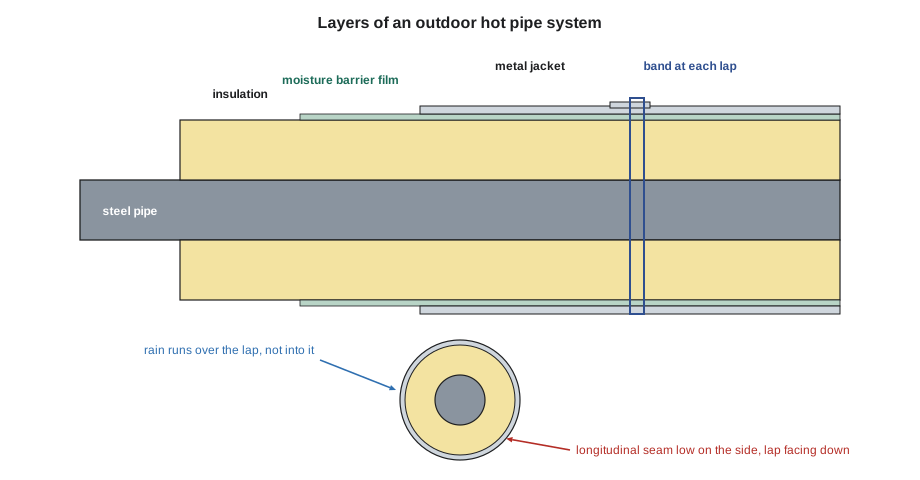
- Moisture barrier: aluminum jacketing for insulation usually has a factory-applied moisture barrier film or kraft paper bonded to its inner face. It keeps moisture and alkaline insulation materials from corroding the aluminum from the inside and separates it from dissimilar metals. It is not a vapor retarder for cold service.
- Seams and laps: longitudinal seams are placed to shed water, usually below the horizontal center line and facing down, with laps of at least the minimum the specification sets. Circumferential laps face downhill on sloping and vertical lines, so water runs over them, not into them.
Dissimilar metals can corrode each other when wet. Aluminum jacket touching copper pipe, stainless steel bands on aluminum jacket in a wet place or carbon steel screws through aluminum can all cause galvanic corrosion. Specifications match fasteners and bands to the jacket, for example stainless steel or aluminum bands on aluminum jacket and stainless steel on stainless.
Stainless steel jacket is chosen where aluminum would corrode, such as near caustic washdown in food plants, chemical fumes and salt air, and where fire exposure must be resisted, because aluminum melts at about 1,220 °F while stainless steel keeps its shape far higher. Kellerton uses stainless steel jacket on its ammonia lines for both reasons.
Plastic and composite jackets
- PVC jacketing and fitting covers: smooth, white, washable and easy to cut and glue. They are common indoors on commercial piping, especially in food plants, hospitals and kitchens. PVC softens at modest temperatures, so it is limited to surfaces below about 150 °F on the jacket, and indoor grades must be protected from sunlight. UV-resistant grades exist for outdoor use. PVC must meet the fire ratings required for the space.
- Other plastic jackets: grades of polyvinylidene fluoride and similar plastics for corrosive areas, and white polymer films for clean rooms.
- Self-adhesive membrane jackets: multi-ply laminates of rubberized bitumen or butyl with aluminum or polymer facings, wrapped and sealed with no fasteners. They are used outdoors on cold and dual-temperature lines because they are both weatherproof and vapor retarding.
- Fabric and coating systems: glass fiber cloth or canvas lagging, adhered with lagging adhesive and finished with a coating. They follow irregular shapes well and are common indoors on fittings and equipment in older work and in some specifications.
Coatings, mastics and adhesives used as finishes
Mastics are thick coatings applied by brush, trowel or spray, usually with a reinforcing fabric of glass or polyester mesh embedded between two coats. They form a seamless finish over fittings, equipment and irregular shapes.
| Type | What it does | Typical use |
|---|---|---|
| Vapor retarder mastic | Very low permeance at the specified dry film thickness | Cold piping, fittings and equipment; sealing joints in cellular glass |
| Weather barrier (breather) mastic | Keeps liquid water out but lets water vapor escape | Outdoor hot piping and equipment |
| Lagging adhesive and coating | Bonds and seals canvas or glass cloth | Indoor fittings and equipment |
| Fire-resistant and intumescent coatings | Protect insulation or substrate in a fire as part of a listed system | Fire-rated assemblies |
| Coatings for elastomeric foam | Protect foam from sunlight and weather | Outdoor elastomeric insulation |
A mastic's performance depends on its thickness. Manufacturers give a coverage rate and a wet and dry film thickness, and a vapor retarder mastic only reaches its rated permeance at the specified dry film thickness. Too thin a coat is the most common failure. Insulators check thickness with a wet film gauge as they apply, follow the minimum and maximum temperature for application and allow the drying time between coats. Most mastics cannot be applied below a minimum temperature, which matters on winter jobs.
Worked problem
Estimating mastic for a run
A 100 ft run of 4 in pipe (4.5 in OD) with 2 in of insulation is to be finished with two coats of mastic, each 20 mils (0.020 in) wet. How many gallons are needed, before waste? A gallon is 231 in³.
Show solution
- Outside diameter of the insulation: 4.5 + 2 × 2 = 8.5 in.
- Surface area: π × 8.5 ÷ 12 × 100 ≈ 222.5 ft².
- Coverage of 1 gal at 20 mils: 231 in³ ÷ 0.020 in = 11,550 in², or 11,550 ÷ 144 ≈ 80.2 ft².
- Two coats: 2 × 222.5 ÷ 80.2 ≈ 5.5 gal.
Answer: About 5.5 gal, plus an allowance for waste, fittings and the reinforcing mesh lap. Mastic is usually ordered in 5 gal pails, so two pails would be ordered.
Fire performance of jackets and facings
Building and mechanical codes limit how readily exposed insulation and its coverings spread flame and produce smoke. In the United States, surface burning characteristics are tested to ASTM E84 or the equivalent UL 723, which gives a flame spread index and a smoke developed index. Pipe and duct coverings in many spaces, including air plenums, must have a flame spread index of no more than 25 and a smoke developed index of no more than 50. The rating applies to the complete product as tested, including its facing and adhesive, so a jacket or coating that changes the surface must itself be rated or tested with the insulation.
Insulators see the result on the carton as a 25/50 rating, sometimes limited to a maximum thickness. A product rated 25/50 at 1 in may not be rated at greater thicknesses, which matters for elastomeric foam and some plastics. Specifications and submittals list the rating; if a substitution changes the facing or the thickness, the rating must be rechecked.
Emittance and the jacket choice
Lesson 3 showed that a shiny metal jacket radiates heat poorly and therefore runs hotter than a painted, PVC or canvas surface over the same insulation. The difference is large enough to matter for personnel protection and, on cold work, for condensation, because a low-emittance jacket on a cold line runs colder than a painted one and is more likely to drop below the dew point.
Worked problem
Surface temperature with two jackets
The 6 in steam line with 3 in of mineral wool (k = 0.31 Btu·in/(h·ft²·°F)) runs indoors in a 77 °F room. With an aluminum jacket, the combined surface coefficient is about 0.63 Btu/(h·ft²·°F); with PVC, about 1.50. Using the cylinder equation plus the surface film, Raj's calculation gives these results. What do they show?
Show solution
- Aluminum jacket: heat loss about 65 Btu/h·ft, surface about 108 °F.
- PVC jacket: heat loss about 69 Btu/h·ft, surface about 91 °F.
- The heat loss differs by only about 4 Btu/h·ft, or about 6 in 100.
- The surface temperature differs by about 17 °F.
Answer: The jacket barely changes the heat loss but changes the surface temperature noticeably. Both are below the 140 °F personnel protection limit here, but on a hotter line or a thinner insulation, the choice of jacket could decide whether the surface is safe to touch.
This is why a change of jacket material is never just a cosmetic change. If an owner asks to switch from painted canvas to aluminum on a hot line with tight personnel protection limits, or from PVC to aluminum on a chilled water line in a humid space, the designer must check the thickness again.
Common mistakes
MistakeUsing a vapor retarder mastic on an outdoor hot line.
InsteadUse a weather barrier (breather) mastic on hot outdoor work so moisture can escape.
MistakePlacing metal jacket seams on top of the pipe.
InsteadPlace longitudinal seams below the horizontal center line facing down, and circumferential laps facing downhill.
MistakeUsing carbon steel screws or bands on aluminum jacket.
InsteadMatch fasteners and bands to the jacket material to avoid galvanic corrosion.
MistakeApplying mastic thinner than specified to make it go further.
InsteadCheck the wet film thickness and apply the full specified coats.
MistakeLeaving a torn ASJ on a cold line.
InsteadRepair it with matching tape or vapor retarder mastic; the facing is the vapor retarder.
MistakeUsing PVC jacket on a surface hotter than its limit or outdoors without a UV-rated grade.
InsteadCheck the jacket's temperature limit and outdoor rating.
Summary and key terms
- Jackets and finishes protect insulation from weather and damage, act as vapor retarders on cold work, set fire performance and emittance, and give a cleanable surface.
- Factory facings such as ASJ and FSK are indoor finishes and vapor retarders; outdoors they need a field jacket.
- Vapor retarders are rated by permeance; 1 perm ≈ 57.2 ng/(Pa·s·m²), and the installed system is only as good as its sealed joints.
- Outdoor hot systems use breather coatings that let moisture escape; cold systems use vapor retarder mastics and jackets.
- Aluminum (C1729) and stainless steel (C1767) jackets are the main metal jackets; seams and laps must shed water and fasteners must match the metal.
- PVC jacket is washable but limited to cool surfaces; mastics must be applied at the specified film thickness.
- Jacket emittance changes the surface temperature much more than the heat loss.
- All-service jacket
- A factory-applied kraft, scrim and foil laminate used as an indoor finish and vapor retarder on pipe insulation; ASJ.
- Vapor retarder
- A material or system that greatly slows the passage of water vapor.
- Permeance
- The rate at which water vapor passes through a sheet or coating per unit area per unit vapor pressure difference.
- Perm
- The US unit of permeance, about 57.2 ng/(Pa·s·m²).
- Breather mastic
- A weather barrier coating that keeps liquid water out but lets water vapor escape.
- Moisture barrier
- A film or paper bonded to the inside of metal jacketing to protect it from moisture and corrosion.
- Galvanic corrosion
- Corrosion caused when two different metals touch in the presence of moisture.
- Dry film thickness
- The thickness of a coating after it has dried, which determines its performance.
Practice problems
Work each problem on paper first, then reveal the answer to check.
Convert 0.05 perm to SI units.
Show answer
0.05 × 57.2 ≈ 2.9 ng/(Pa·s·m²).
Why are outdoor hot lines finished with breather coatings?
Show answer
So moisture that gets in can escape and does not cause corrosion under insulation.
Where should the longitudinal seam of a jacket on a horizontal outdoor pipe be?
Show answer
Below the horizontal center line, facing down, so water runs off.
A 200 ft² surface needs two coats of mastic at 25 mils wet each. How many gallons?
Show answer
1 gal covers 231 ÷ 0.025 ÷ 144 ≈ 64.2 ft²; 2 × 200 ÷ 64.2 ≈ 6.2 gal.
Why is stainless steel jacket used on ammonia lines at Kellerton?
Show answer
It resists corrosion from washdown and keeps its shape in a fire, where aluminum would melt.
Lesson quiz · 5 questions
Score 60% or more to complete this lesson.
Create a free account to save your progress, take quizzes and earn a certificate.