
INS-120 · Lesson 5 of 12 · 24 min
Fibrous insulations: mineral wool and fiberglass
▶ Video coming soon A video version of this lesson is on the way.
Most of the insulation Devon had handled at Mountview came in cardboard cartons of yellow or white pipe covering with a paper-and-foil jacket already glued on. At Kellerton the header insulation was heavier, greenish-brown and much stiffer. "Same family, different cousins," Tomasz said at the fifth Friday session, setting a section of each on the bench. "One's made from glass, the other from rock. You'll install more of these two than everything else in this shop put together."
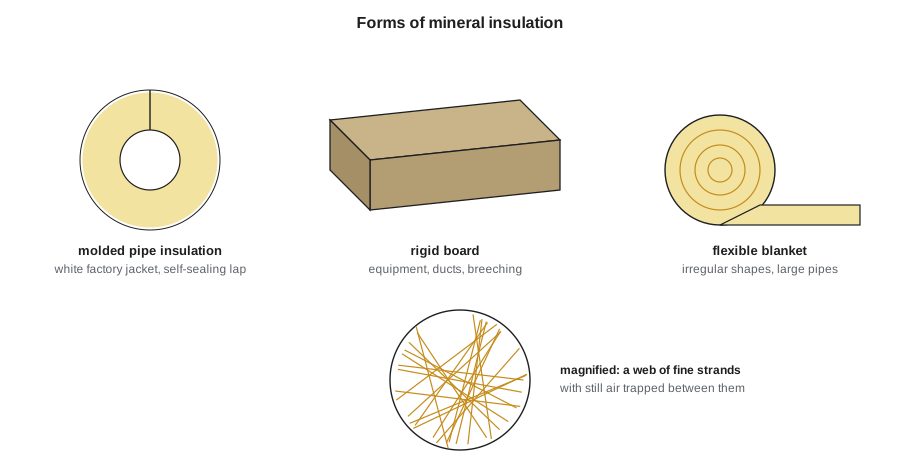
Fibrous insulations are made of fine fibers of glass, stone or slag, bonded together or loosely packed. The fibers trap air in a web of tiny spaces, and the web slows conduction, convection and radiation. Mineral fiber products are the workhorses of mechanical insulation: they are relatively inexpensive, easy to cut and fit, noncombustible in their fiber core and available for temperatures from below freezing to well above the limits of plastics. This lesson describes the two main types, their forms, their limits and how to handle them.
What the fibers are made of
The ASTM standards group these products together as mineral fiber insulation, and divide them by what the fibers are made from:
- Glass fiber, also called fiberglass or glass wool, is made by melting sand, limestone, soda ash and a large share of recycled glass and spinning the melt into fine fibers. It is light, springy and usually yellow, white, pink or brown depending on the binder and the maker.
- Mineral wool is made from molten rock, such as basalt, or from slag left over from making iron and steel. Rock-based products are often called stone wool or rock wool; slag-based products are called slag wool. Mineral wool is denser than glass fiber for the same job, is usually greenish-gray or brown and withstands higher temperatures.
In both cases, the fibers are sprayed with a binder, a resin that holds them together once it is cured in an oven. Many binders are phenolic resins; some makers now use plant-based binders without added formaldehyde. A small number of products, such as some high-temperature blankets and loose wool, have little or no binder.
Forms and their standards
Fibrous insulation comes in many forms, each covered by an ASTM material specification. Specifications usually name the standard and type, for example "mineral fiber pipe insulation, ASTM C547, Type II, Grade A."
| Form | ASTM standard | Typical uses |
|---|---|---|
| Molded pipe insulation, and precision V-groove pipe insulation | C547 | Piping from heating water to high-pressure steam |
| Blanket (rolls and batts) | C553 | Equipment, irregular surfaces, wrapping large pipes, ducts |
| Block and board | C612 | Flat and curved equipment, boilers, breeching, tanks, ducts |
| Metal-mesh covered blanket (industrial) | C592 | Large hot equipment, breeching and irregular industrial surfaces |
| Duct wrap (flexible blanket for ducts) | C1290 | Outside of sheet metal ductwork |
| Duct liner | C1071 | Inside of sheet metal ducts for sound and heat control |
| Pipe and tank wrap (lagging blanket with a jacket) | C1393 | Large pipes and tanks, wrapped around the surface |
Molded pipe insulation is the form insulators handle most. It is made in sections, usually 3 ft long, split lengthwise on one side and hinged on the other so it can be opened and snapped over the pipe. For commercial piping, glass fiber pipe insulation usually comes with a factory-applied all-service jacket (ASJ), a laminate of white kraft paper, glass fiber scrim and aluminum foil, with a self-sealing lap along the split. The ASJ is a vapor retarder and a finish in one, which lesson 9 covers. Industrial mineral wool pipe insulation more often comes plain, to be jacketed with metal in the field.
Pipe insulation is made to fit either iron pipe size (IPS), the outside diameter of steel pipe, or copper tube size (CTS), the outside diameter of copper tube. A section for NPS 1 steel pipe will not fit 1 inch copper tube properly, because the outside diameters differ. Insulators check the label for the pipe size, the pipe type and the wall thickness on every carton. INS-130 covers pipe and insulation sizes in detail.
Worked problem
Ordering pipe covering for a run
Coldstream is quoting a 210 ft run of 6 in steam pipe. Pipe covering comes in 3 ft sections. Raj allows 5 in 100 extra for waste and cutting. How many sections should be ordered?
Show solution
- Sections for the length: 210 ÷ 3 = 70 sections to cover the run.
- Add waste: 70 × 1.05 = 73.5.
- Round up to a whole section: 74 sections.
Answer: 74 sections, before allowing for fittings. Elbows, tees and valves are counted separately.
Temperature limits
Each fibrous product has a maximum use temperature, the highest pipe or surface temperature at which it can be used without losing its shape or properties. The ASTM standards divide products into types by these limits. For pipe insulation under ASTM C547, the types are as follows.
| ASTM C547 type | Form | Maximum use temperature | Typical fiber |
|---|---|---|---|
| Type I | Molded | 850 °F | Glass fiber |
| Type IV | Molded | 1,000 °F | Glass fiber (high-temperature) |
| Type II | Molded | 1,200 °F | Mineral wool |
| Type III | Precision V-groove | 1,200 °F | Mineral wool |
| Type V | Molded | 1,400 °F | Mineral wool (high-temperature) |
Blanket under ASTM C553 ranges from types rated about 450 °F up to 1,200 °F, and block and board under ASTM C612 from about 450 °F up to about 1,800 °F for the highest type. In general, glass fiber products are used up to about 850 °F and mineral wool above that. Glass fiber is also used on cold work, but only under a continuous vapor retarder, because the fibers cannot stop water vapor on their own; with a good retarder it is common on chilled water and cold domestic water.
C547 also sets grades. A Grade A product can be heated straight to its maximum use temperature. A Grade B product needs a heat-up schedule: the temperature is raised in stages at a rate the manufacturer sets, because heating a thick layer of a product with organic binder too fast can cause the binder to react and release heat inside the insulation. This exothermic reaction can scorch or even ignite the inside of a thick layer. The specification or the manufacturer tells the plant how fast to bring the system up to temperature.
Even within the limit, the binder near the hot face of fibrous insulation burns off the first time the system is heated, usually at a few hundred degrees. The insulation keeps its shape, but the burnout produces smoke and an odor for a short time. Insulators warn the plant before start-up so nobody mistakes it for a fire, and good ventilation is provided. On systems that run near the top of a product's range, the inner layer may lose strength once the binder is gone, which is one reason high-temperature work is often done in two layers, as lesson 8 explains.
Worked problem
Checking temperature limits
Kellerton's boiler house has three lines to insulate: the steam header at 366 °F, a hot water line at 180 °F and a turbine exhaust duct on a small cogeneration unit at 1,000 °F. Which of these can take glass fiber pipe or board rated to 850 °F, and which need mineral wool?
Show solution
- Steam header: 366 °F is well below 850 °F, so glass fiber is acceptable by temperature. The specification may still call for mineral wool for other reasons.
- Hot water: 180 °F is far below 850 °F, so glass fiber is acceptable.
- Exhaust: 1,000 °F is above 850 °F and at the 1,000 °F limit of C547 Type IV, with no margin, so it needs mineral wool rated to at least 1,200 °F, such as C547 Type II or a C612 board of a suitable type.
Answer: The steam and hot water lines can take glass fiber; the exhaust needs mineral wool rated well above 1,000 °F.
Kellerton's own standard specifies mineral wool on all steam and condensate lines. Walt explained why when Devon asked: mineral wool is denser and stiffer, so it resists damage from foot traffic and ladders in the boiler house; it handles the occasional upset when a line runs hotter than normal; and many grades are treated to repel liquid water. Owners often choose materials for reasons like these that go beyond the temperature limit.
Thermal and physical properties
| Property | Glass fiber pipe insulation | Mineral wool pipe insulation |
|---|---|---|
| Typical density | 3 to 5 lb/ft³ | 6 to 10 lb/ft³ |
| Typical k at about 75 °F mean | 0.23 Btu·in/(h·ft²·°F) | 0.24 to 0.25 Btu·in/(h·ft²·°F) |
| Typical k at about 200 °F mean | 0.28 Btu·in/(h·ft²·°F) | 0.29 to 0.31 Btu·in/(h·ft²·°F) |
| Maximum use temperature | 850 °F for most products | 1,200 °F for most pipe products |
| Compressive strength | Low; crushes under point loads | Higher than glass fiber, still low |
| Combustibility of the fiber core | Noncombustible | Noncombustible |
| Water | Does not absorb into fibers, but holds water between them if wetted | Often treated to repel water; still holds water if soaked |
Two properties need special attention on the job.
- Low compressive strength. Fibrous insulation cannot carry the weight of a pipe. At hangers and supports, where the pipe rests on a saddle or roller, the insulation would be crushed. Specifications call for high-density inserts of calcium silicate, cellular glass, high-density mineral wool or rigid foam at each support, with a metal shield outside to spread the load. Lesson 7 and INS-130 cover inserts and shields.
- Water. Fibers do not absorb water the way a sponge does, but water fills the spaces between them. Wet fibrous insulation loses much of its insulating value, sags, can grow mold on its facings and, on carbon steel, can cause corrosion under insulation. Water-repellent treatments help fibrous insulation shed occasional splashes and dry out, but they do not make it waterproof, and the jacket must still keep water out.
Fire properties
The glass or rock fibers themselves do not burn. Mineral fiber cores without facings are generally classed as noncombustible when tested to ASTM E136, the standard tests for noncombustibility. The small amount of organic binder can burn off, as described above, but does not support a fire. Facings and jackets, such as the kraft paper in an ASJ, are combustible, so the complete product is tested for surface burning characteristics. Lesson 9 explains flame spread and smoke developed ratings.
Because the core is noncombustible, mineral wool is used in many fire-resistance-rated systems, such as firestops and fire-rated duct wraps, and as the safing insulation that fills the gap between a floor slab and a curtain wall. Those uses require the exact listed product and must follow the tested system. INS-330 covers them.
Use over stainless steel
Austenitic stainless steel, the common 300-series stainless used for food, pharmaceutical and chemical piping, can suffer stress corrosion cracking when chlorides are present and the metal is warm and wet. Chlorides can leach out of some insulation materials when they get wet. ASTM C795 sets limits on the leachable chlorides in insulation used in contact with austenitic stainless steel, balanced against sodium silicate, which helps prevent cracking. Many fibrous, calcium silicate, perlite and cellular glass products are made to meet C795 and say so on the label or data sheet.
Kellerton has stainless steel product lines in its cooking rooms. Bernie's rule there is simple: only material labeled as meeting C795 goes on stainless, and it stays in its packaging until it is installed so it does not pick up chlorides from wash water or salty air. Marking pens, tapes and adhesives used on stainless must also be low in chlorides.
Handling fibrous insulation safely
Glass fiber and mineral wool fibers irritate the skin, eyes and throat. The irritation is mechanical: the fibers rub and itch. It usually fades soon after exposure ends. Health research over decades led the International Agency for Research on Cancer in 2001 to move glass wool, stone wool and slag wool insulation fibers into its group of agents not classifiable as to their carcinogenicity to humans, and modern insulation wools are designed to be biosoluble, which means the body can clear them from the lungs. Refractory ceramic fibers, covered in lesson 8, are treated more strictly.
INS-110 covered the protective measures, and they still apply: long sleeves and loose-fitting clothing, gloves, safety glasses, a dust mask or respirator when cutting or when dust is visible, and washing work clothes separately. Use sharp knives rather than power saws to cut fibrous insulation, keep the work area clean with a HEPA vacuum rather than a broom or compressed air, and store cartons dry and off the floor. Old fibrous insulation can look like newer products, but very old insulation on a plant system may contain asbestos or may have been installed over asbestos fittings; INS-230 covers how to recognize suspect materials.
Common mistakes
MistakeUsing glass fiber pipe insulation above its maximum use temperature.
InsteadCheck the operating and upset temperatures and choose a type rated above them, usually mineral wool for high temperatures.
MistakeInstalling IPS covering on copper tube, or CTS covering on steel pipe.
InsteadRead the label: the inside diameter must match the pipe or tube outside diameter.
MistakeLetting fibrous insulation carry the pipe at a hanger.
InsteadInstall the specified high-density insert and a metal shield at every support.
MistakeStarting up a thick Grade B installation at full temperature immediately.
InsteadFollow the manufacturer's heat-up schedule to avoid an exothermic reaction in the binder.
MistakeUsing ordinary insulation on austenitic stainless steel.
InsteadUse only products that meet ASTM C795, and keep them clean and dry until installed.
MistakeSweeping or blowing fiber dust.
InsteadClean up with a HEPA vacuum or wet methods.
Summary and key terms
- Fibrous insulations are made of glass, stone or slag fibers bonded with a binder; the fibers trap air in tiny spaces.
- Forms include molded pipe insulation (C547), blanket (C553), block and board (C612), duct wrap and duct liner.
- C547 types set maximum use temperatures from 850 °F (Type I) to 1,400 °F (Type V); glass fiber is used up to about 850 °F and mineral wool above.
- Grade B products need a heat-up schedule; the binder near the hot face burns off on first heat-up and produces smoke and odor.
- Fibrous insulation has low compressive strength and needs inserts and shields at supports.
- Wet fibrous insulation loses insulating value; water-repellent treatments help but the jacket must keep water out.
- Products used on austenitic stainless steel must meet ASTM C795.
- Mineral fiber
- A general name for insulation fibers made from glass, rock or slag.
- Glass fiber
- Insulation fiber made from molten glass; also called fiberglass or glass wool.
- Mineral wool
- Insulation fiber made from molten rock or slag; includes stone wool and slag wool.
- Binder
- A resin that holds insulation fibers together once cured.
- All-service jacket
- A factory-applied laminate of kraft paper, scrim and foil used as a finish and vapor retarder; ASJ.
- IPS and CTS
- Iron pipe size and copper tube size: the two outside diameter series that pipe insulation is made to fit.
- Heat-up schedule
- A manufacturer’s limit on how fast a system may be brought to temperature after insulating.
- Stress corrosion cracking
- Cracking of austenitic stainless steel caused by tensile stress and chlorides in warm, wet conditions.
Practice problems
Work each problem on paper first, then reveal the answer to check.
What is the maximum use temperature of ASTM C547 Type II pipe insulation?
Show answer
1,200 °F.
Why do supports on fibrous-insulated pipe need inserts?
Show answer
Fibrous insulation has low compressive strength and would be crushed.
A run of 150 ft needs pipe covering in 3 ft sections plus 5 in 100 waste. How many sections?
Show answer
150 ÷ 3 = 50 sections; 50 × 1.05 = 52.5, so 53 sections.
What does ASTM C795 control?
Show answer
Leachable chlorides (balanced against sodium silicate) in insulation used on austenitic stainless steel.
Why warn a plant before the first heat-up of new fibrous insulation?
Show answer
The binder burns off and produces smoke and an odor that could be mistaken for a fire.
Lesson quiz · 5 questions
Score 60% or more to complete this lesson.
Create a free account to save your progress, take quizzes and earn a certificate.