
HSE-351 · Lesson 6 of 12 · 22 min
Drains, separators and stormwater
Drains are where a station's small spills become someone else's problem. A storm drain on the forecourt may run straight to a ditch or creek, and a floor drain in the car wash or service bay may run to the sewage plant. Between the station and those places there may be an oil-water separator, a tank designed to catch oil and fuel before the water leaves the site, or there may be nothing at all. This lesson explains how a station's drains work, what a separator can and cannot do, and how to keep both working.
Lesson 1 asked every worker to know where the drains go. This lesson explains why that matters so much.
Two kinds of drains
Most towns and cities have two separate drain systems:
- Storm drains collect rain and snowmelt from roofs, roads and parking lots. In most places the water is not treated: it goes through pipes to the nearest ditch, creek, river or lake. Anything that enters a storm drain goes to the environment.
- Sanitary sewers collect wastewater from toilets, sinks and floor drains and carry it to a wastewater treatment plant. Treatment plants are built to treat sewage, not fuel. A large slug of gasoline can kill the bacteria that do the treatment, create explosive vapor in sewer pipes and pass through to the river.
Some older areas still have combined sewers that carry both, and overflow to a river in heavy rain. At a station, forecourt drains usually go to the storm system, often through a separator; car wash and service bay drains usually go to the sanitary sewer through a sand trap and separator. The site plan shows which is which, and it is worth checking, because older sites sometimes have surprises such as a forecourt drain connected to the sewer or a floor drain that goes nowhere at all and soaks into the ground.
City ordinances control what may go into each system. Billings, like most US cities, operates its storm sewer under a federal stormwater permit and has ordinances that prohibit illicit discharges, meaning anything other than stormwater, into storm drains, and pretreatment rules that limit oil and grease in the sanitary sewer. Businesses such as fuel stations and car washes may be required to install and maintain oil-water separators and keep cleaning records. These rules, and the federal and state reporting rules (Lesson 9), apply to any fuel that goes down a drain, whatever the reason.
How an oil-water separator works
An oil-water separator is an underground tank, usually concrete or steel or fiberglass, with several chambers. Water from the drains flows in at one end and slows down. Oil and fuel, which are lighter than water, float to the top and are held back by baffles. Grit and sludge sink to the bottom. Cleaner water leaves from the middle depth at the far end. Many separators also have coalescing plates or media that help small droplets join into bigger ones that float more easily.
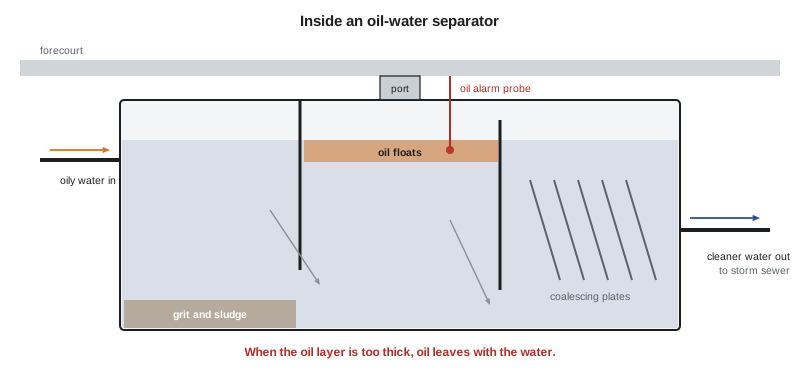
A separator is designed for the small, steady amounts of oil that rain washes off a forecourt: drips from cars, the sheen from topping-off stains. It holds a limited volume of oil. When the oil layer gets too thick, or the sludge too deep, oil starts to pass through to the outlet. A separator can be overwhelmed in three ways:
- A large spill fills the oil storage space at once, and the rest passes through.
- A separator that has not been pumped out for a long time is already full of oil and sludge, so even small amounts pass through.
- Detergents, degreasers or hot water break oil into tiny droplets that do not float, so they pass straight through. This is why car wash water should not go to a forecourt separator, and why detergent must never be used on a spill.
A separator is a last line of defense, not a reason to let fuel go down the drain. The first line is the drain cover in the spill kit.
How much can a separator hold?
Separators are sized for the area that drains to them and the rainfall they must handle, and they have a stated oil storage capacity. The program below uses a common simple method to estimate the peak flow of rainwater from a forecourt, the separator volume needed to hold that water long enough for oil to rise, and how a spill compares with the separator's oil storage. All the inputs are illustrative teaching values; real separators are designed by engineers to the manufacturer's standard and local rules.
# Rough separator check for a forecourt (illustrative inputs only).
area_ft2 = 13000        # forecourt draining to the separator
runoff_coeff = 0.9      # share of rain that runs off concrete
rain_in_per_h = 1.0     # design storm intensity
retention_min = 6       # time water should stay in the separator
oil_storage_gal = 400   # separator's rated oil storage

flow_gpm = runoff_coeff * rain_in_per_h / 12 * area_ft2 * 7.48 / 60   # cubic ft to gal
volume_needed_gal = flow_gpm * retention_min
print(f"Peak runoff: {flow_gpm:.0f} gal/min; working volume needed: {volume_needed_gal:,.0f} gal")

for spill_gal, oil_already_gal in [(5, 50), (100, 350), (500, 50)]:
    room = oil_storage_gal - oil_already_gal
    passes = max(0, spill_gal - room)
    status = "held" if passes == 0 else f"about {passes:,} gal could pass through"
print(f"Spill {spill_gal:>4,} gal with {oil_already_gal:>4,} gal oil already stored: {status}")Peak runoff: 122 gal/min; working volume needed: 729 gal Spill 5 gal with 50 gal oil already stored: held Spill 100 gal with 350 gal oil already stored: about 50 gal could pass through Spill 500 gal with 50 gal oil already stored: about 150 gal could pass through
The three cases show the point. A small spill into a well-kept separator is held. A moderate spill into a separator that has not been pumped out overflows it, even though the separator would have held the spill if it had been empty. And a large spill passes through any separator. Keeping the separator pumped out and the drains covered during a spill both matter.
Looking after the separator
Separators need regular inspection and pumping out by a licensed contractor with a vacuum truck. How often depends on the size and how much oil and grit it collects; many stations have them inspected a few times a year and pumped out at least once a year, and after any spill that reached the drain. The contractor measures the oil layer and sludge depth, pumps out the oil, water and sludge, and takes them away as waste. The station keeps the cleaning records, which inspectors and municipal staff may ask to see.
Some separators have an oil level alarm that sounds at the tank gauge console or a separate panel when the oil layer gets thick. That alarm is a call for pumping out, not something to silence. Workers can also help by keeping grates clear of litter and leaves, reporting a sheen or fuel smell at a drain, and never putting anything into a drain except rain.
Stormwater without a separator
Many stations, especially older ones, have forecourt drains that go straight to the storm system with nothing in between. At those sites, every drop of fuel that reaches a drain goes to the creek, and the drain covers in the spill kits are the only protection. A station like this should have a drain cover for every forecourt drain, kept next to it, and should treat any spill near a drain as urgent. Some stations also use drain inserts, filter baskets that sit inside the catch basin and catch some oil from runoff. They help with everyday drips but fill up quickly in a spill and must be inspected and replaced regularly.
Rain on the forecourt also carries everyday drips and stains toward the drains, which is why keeping the forecourt clean matters even between spills. Dry sweeping with absorbent, rather than washing down with a hose, keeps that oil out of the stormwater.
For supervisors: the drain map
Make a drain map: a simple site plan showing every drain and catch basin, which system it goes to (storm or sanitary), whether it passes through a separator, and where the drain covers are kept. Color-code it, post it next to the spill binder and include it in orientation. Add the separator's location, inspection port, last cleaning date and the contractor's number. The first question in any spill near a drain is "where does it go?", and the map answers it in seconds.
Worked problem
Rain, a spill and a full separator
During a heavy afternoon rain at Northfield, a customer's portable container tips over in a truck bed, and gasoline runs out of the truck and across the forecourt. The rain is carrying it toward the forecourt drain, which leads to a separator and then the storm sewer. Grace sees it from the window. The separator's last pumping was more than a year ago. What does this mean for the response?
Show solution
- The rain makes the drain urgent: fuel will reach it in seconds, not minutes. Grace grabs the drain cover from the kit beside the drain and lays it first, then sets up the container upright and moves people away.
- Oil-only absorbents are the right choice in the rain, because they soak up the gasoline and repel water.
- With the drain covered, rainwater pools behind the cover. Grace lays socks to steer the fuel-and-water mix into a corner where it can be absorbed, and calls Leah Morin.
- Because the separator is overdue for cleaning, any fuel that did get into the drain is more likely to pass through to the storm sewer. Leah has the contractor inspect the separator and pump it out, and checks the outlet for sheen.
- The spill and the separator's condition both go in the report; the overdue cleaning is a lesson for the maintenance schedule.
Answer: Cover the drain first, use oil-only absorbents in the rain, and have the overdue separator inspected and pumped out because it may not hold even a small spill.
Signs of trouble at a drain
Workers walking the lot can spot drain problems early. A rainbow sheen on the water in a catch basin, a fuel smell from a grate on a dry day, dark staining around a drain, foam or an oily film at the outlet in the ditch, or water standing over a drain long after the rain stops are all signs that oil is getting in or that the separator or drain is blocked. A sheen that swirls and flows back together when poked with a stick is usually oil; a sheen that breaks into flat pieces may be natural, from bacteria or decaying leaves, but it is still worth reporting to the manager. Each sign should go in the spill log with a photo, so that the manager can decide whether the separator needs pumping, the drain needs cleaning or there is a leak somewhere upstream that needs finding.
Common mistakes
MistakeAssuming every drain goes to a treatment plant.
InsteadStorm drains usually go untreated to a ditch, creek or river; check the drain map.
MistakeCounting on the separator to catch any spill.
InsteadSeparators are for small, steady amounts; cover the drain in a spill.
MistakeSilencing the separator oil alarm.
InsteadCall the contractor to pump it out.
MistakeWashing the forecourt down with a hose and detergent.
InsteadDry sweep with absorbent; detergent breaks oil into droplets that pass through separators.
MistakeLeaving the separator for years between cleanings.
InsteadInspect and pump out on a schedule and after any spill into the drain.
Summary and key terms
- Storm drains usually go untreated to the environment; sanitary sewers go to a treatment plant not designed for fuel.
- An oil-water separator lets oil float and grit sink so cleaner water leaves, but holds only a limited amount of oil.
- Large spills, full separators and detergents all let oil pass through.
- Separators need regular inspection and pumping out, and after any spill that reaches them.
- Where there is no separator, drain covers are the only protection.
- A drain map shows every drain, where it goes and where the covers are.
- Storm drain
- A drain that carries rain and snowmelt, usually untreated, to the environment.
- Sanitary sewer
- A drain that carries wastewater to a treatment plant.
- Oil-water separator
- An underground tank that lets oil float and be held back while water passes through.
- Coalescing plates
- Plates in a separator that help small oil droplets join and rise.
- Drain insert
- A filter basket in a catch basin that catches some oil from runoff.
- Drain map
- A site plan showing every drain, where it goes and where the covers are kept.
Practice problems
Work each problem on paper first, then reveal the answer to check.
Where does water from a storm drain usually go?
Show answer
Untreated to a ditch, creek, river or lake.
Why is fuel in a sanitary sewer a problem?
Show answer
Treatment plants are not built for fuel; it can kill treatment bacteria, create explosive vapor and pass through to the river.
How does an oil-water separator work?
Show answer
Water slows down, oil floats and is held back by baffles, grit sinks, and cleaner water leaves from the middle.
Name three ways a separator can be overwhelmed.
Show answer
A large spill, a separator already full of oil and sludge, and detergents or hot water that break oil into droplets.
What should happen after a spill reaches a separator?
Show answer
Have it inspected and pumped out by a contractor, and check the outlet for sheen.
What protects the drains at a station with no separator?
Show answer
Drain covers kept beside each drain and fast action in a spill.
What should a drain map show?
Show answer
Every drain and catch basin, which system it goes to, any separator, and where the drain covers are kept.
Lesson quiz · 5 questions
Score 60% or more to complete this lesson.
Create a free account to save your progress, take quizzes and earn a certificate.