
HSE-351 · Lesson 1 of 12 · 22 min
Why fuel spills matter
A fuel station handles more liquid fuel in a week than most people will use in a lifetime, and almost all of it moves exactly where it should: from the tanker into the underground tanks, from the tanks through buried pipes to the dispensers, and from the nozzle into a vehicle. A small amount does not. A customer squeezes the trigger once more after the nozzle clicks off and fuel runs down the side of the car. A hose cracks in the cold. A driver forgets to close a valve and a few liters pour from a delivery hose. A tank fitting corrodes slowly, out of sight, and leaks a cupful a day for years. Each of these is a spill or a release, and this course is about preventing them, catching them early and dealing with them correctly.
Spills matter for three reasons. First, spilled gasoline is a fire hazard: it evaporates quickly, and its vapor is heavier than air and flammable in very small concentrations, as HSE-350 explained. Second, fuel is harmful to people who breathe it or get it on their skin, especially the workers who clean it up. Third, fuel that reaches soil, drains or water causes environmental damage that can take years and a great deal of money to clean up, and the law makes the station owner responsible for reporting it and paying for it.
This is the second of four courses in the fuel stations track. HSE-350 covered fuel properties, ignition sources, static, emergency shut-off, fuel deliveries and the basics of tank gauges and overfill prevention. This course builds on that: what kinds of spills happen at stations, how to respond, clean up and dispose of the waste, how spill kits, drains and oil-water separators work, how underground storage tanks are built and monitored for leaks, how and when to report a spill, what spilled fuel does to health and the environment, and how to prevent spills in the first place. HSE-352 covers working alone and late-night safety, and HSE-353 covers propane cylinder exchange.
Some topics are covered fully elsewhere. HSE-103 covers hazard recognition and hazardous products (WHMIS in Canada, Hazard Communication in the United States). HSE-330 covers flammable atmospheres and gas detection in oil and gas work, and HSE-332 covers spills at pipelines and larger facilities. Personal protective equipment and respirators are covered in the safety core courses. This course applies those ideas to the forecourt.
Back at Northfield Fuel and Market
We continue at Northfield Fuel and Market, the invented station on the west side of Billings, Montana, from HSE-350. Leah Morin is the manager and Raj Patel the assistant manager and safety representative. Tyler, Grace and Ben are attendants, Sofia is the newest hire, Mike drives for the fuel hauler and Marco Delgado is the company's safety lead. The station has three underground tanks: regular gasoline, 13,200 gal (50,000 L); premium, 6,600 gal (25,000 L); and diesel, 10,600 gal (40,000 L). For this course we add two more people: Dana Whitcombe, the company's environmental coordinator, and an invented environmental contractor, Rimrock Environmental, which Northfield calls for spill cleanups too big for staff and for tank testing.
Two features of Northfield's site matter for spills. The forecourt slopes gently toward the street, and at the low corner of the lot is a storm drain that carries rainwater, untreated, into a ditch and then a creek about a kilometer away. And behind the store, the car wash drains through an oil-water separator into the sanitary sewer. Workers who know where these drains are, and where they lead, make better decisions in the first minute of a spill.
Spills and releases
People use several words for fuel getting where it should not be. In this course a spill is fuel that escapes above ground and can be seen: on the forecourt, at the fill ports, under a vehicle. A release is the broader legal term, covering any escape of fuel into the environment, including slow leaks from tanks and pipes underground that nobody can see. A leak usually means a release from equipment, such as a tank, pipe, hose or fitting. A discharge is the word some US laws use for oil reaching water.
The difference matters because the law treats them differently. A small spill on concrete that is cleaned up quickly may not need to be reported to anyone outside the company. A release from an underground tank, or any spill that reaches soil, a drain or water, usually must be reported to the government, often within hours. Lesson 9 covers reporting.
Where spilled fuel goes
Spilled fuel does not stay where it lands. Within seconds it starts to move in four directions at once.
- Into the air: gasoline evaporates fast, especially on hot days. The vapor is a fire hazard close to the spill and a health hazard for whoever is standing over it. Diesel evaporates much more slowly and stays on the ground longer.
- Across the surface: fuel flows downhill on concrete and asphalt, following the slope of the forecourt toward drains, curbs and the edge of the lot. It also spreads into a thin film over a large area.
- Into the ground: fuel soaks into cracks, joints, gravel, soil and asphalt, which is itself made from petroleum and softens in contact with gasoline.
- Into drains and water: a storm drain can carry fuel to a ditch, creek or river within minutes, and a sanitary sewer can carry it to a treatment plant that is not designed to handle it.
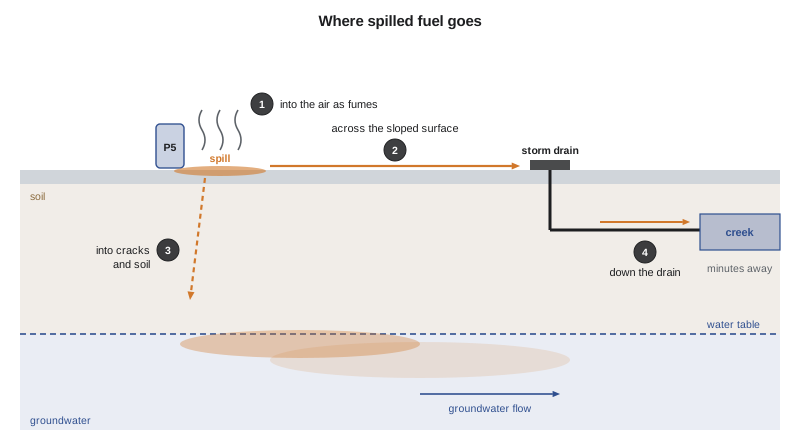
The first minutes of any spill response are about cutting off these pathways: stopping the source, keeping fuel away from drains and soil, and keeping people away from the vapor. Lesson 4 turns this into a simple sequence that every worker can follow.
How big is a spill?
Spill sizes are hard to judge by eye. A thin film of fuel on concrete looks alarming but may be a cupful; a dark stain that has soaked into asphalt may hide several gallons. Responders estimate volume from the area of the puddle and its depth. On smooth concrete, a fresh gasoline spill spreads to a film roughly 1/16 of an inch deep, so a puddle 6 ft by 3 ft is about a gallon. On rough asphalt or in a low spot it may be deeper.
The program below turns a puddle's size into an estimated volume. The depths are typical values for teaching, not measurements; on a real spill, estimate generously, because underestimating can mean failing to report a spill that should be reported.
# Estimate spill volume from puddle size (teaching values, not measurements).
puddles = [  # (description, length ft, width ft, average depth in)
    ("overfill drips beside a car", 2.6, 1.3, 0.04),
    ("topped-off spill under nozzle", 6.5, 3.3, 0.06),
    ("delivery hose disconnect", 10.0, 6.5, 0.12),
    ("fuel pooled in low corner", 13.0, 8.0, 0.30),
]
for desc, length, width, depth_in in puddles:
    area = length * width                      # square feet
    gallons = area * depth_in / 12 * 7.48       # 1 cubic foot = 7.48 gal
print(f"{desc:30} {area:5.1f} ft2 x {depth_in:4.2f} in = {gallons:6.1f} gal")overfill drips beside a car 3.4 ft2 x 0.04 in = 0.1 gal topped-off spill under nozzle 21.4 ft2 x 0.06 in = 0.8 gal delivery hose disconnect 65.0 ft2 x 0.12 in = 4.9 gal fuel pooled in low corner 104.0 ft2 x 0.30 in = 19.4 gal
The results show why size matters for the response. A few drops beside a car are a job for an absorbent pad. A delivery hose disconnect can release a volume large enough to run toward a drain within a minute. Fuel pooled in a low corner is a significant spill that may be reportable, needs a full response and may need the contractor. Lesson 3 looks at the kinds of spills that happen at stations, and Lesson 9 at the volumes and conditions that make a spill reportable.
The costs of a spill
The direct cost of a small forecourt spill is a few absorbent pads, some time and a bag of hazardous waste. The cost of a spill that gets away is very different. Fuel that reaches a creek can kill fish and other aquatic life, close water intakes and bring fines and cleanup orders. Fuel that leaks from a tank into the ground can contaminate soil and groundwater under the station and neighboring properties, and cleaning it up can take years and cost hundreds of thousands of dollars or more. Lesson 10 looks at these impacts in more detail.
There are also human costs: a worker who breathes vapor for half an hour while mopping up a spill can have a headache, nausea and dizziness, and someone who gets gasoline in their eyes or on their skin for a long time can be hurt. A spill that finds an ignition source becomes a fire. The cheapest spill, by far, is the one that never happens, which is why Lesson 11 is about prevention.
For supervisors: know your drains
Walk the lot with a site plan and mark every drain: storm drains, the car wash trench, floor drains in the store and the service area, and any catch basins. For each one, find out where it goes. Storm drains usually lead untreated to a ditch, creek or river; sanitary drains go to the sewage plant; some lead to an oil-water separator first. Mark them on the plan, paint storm drains or label them with a sign such as "drains to creek", and keep drain covers in the spill kit next to the drains they fit. Every new worker should be able to point to the drains on their first shift.
Worked problem
Reading the site in the first minute
On a warm afternoon, Grace sees a customer drive off from pump 5 with a slow leak dripping from under the car, leaving a trail across the forecourt toward the street. The forecourt slopes toward the storm drain in the low corner. What does she need to think about first?
Show solution
- Is anyone in danger? Fuel on a warm forecourt gives off vapor; no one should be smoking or starting cars beside it.
- Is the source still active? The car has gone, so the source has left; the fuel already on the ground is what is left to deal with.
- Where is the fuel heading? Downhill, toward the storm drain that leads to the creek.
- What can she do first? Put a drain cover or absorbent sock on the storm drain, then contain and soak up the trail.
- Who needs to know? The manager, and, if any fuel reached the drain, the manager decides on reporting (Lesson 9).
Answer: Protect people, then cut off the pathway to the drain before cleaning up; knowing the slope and the drain is what makes the right first action obvious.
Common mistakes
MistakeTreating a spill as only a cleaning job.
InsteadTreat it as a fire, health and environmental hazard until it is controlled.
MistakeJudging spill size by how alarming it looks.
InsteadEstimate from area and depth, and estimate generously.
MistakeNot knowing where the forecourt drains lead.
InsteadLearn every drain on the site plan and where it goes.
MistakeHosing a small spill into the nearest drain.
InsteadNever wash fuel into a drain; soak it up and dispose of it as hazardous waste.
MistakeAssuming an underground leak would be noticed.
InsteadUnderground leaks are invisible; they are found by monitoring and records (Lessons 7 and 8).
Summary and key terms
- Spills are fire, health and environmental hazards, and the law makes the owner responsible for reporting and cleanup.
- A spill is visible fuel above ground; a release is any escape into the environment, including hidden leaks.
- Spilled fuel moves into the air, across the surface, into the ground and into drains and water.
- Estimate spill volume from area times depth; on concrete a fresh gasoline film is roughly 1/16 of an inch deep.
- Know every drain on the site and where it leads before a spill happens.
- The cheapest spill is one that is prevented.
- Spill
- Fuel that escapes above ground where it can be seen.
- Release
- Any escape of fuel or another product into the environment, including hidden leaks.
- Leak
- A release from equipment such as a tank, pipe, hose or fitting.
- Storm drain
- A drain that carries rainwater, usually untreated, to a ditch, creek or river.
- Sanitary sewer
- A drain that carries wastewater to a sewage treatment plant.
- Pathway
- A route by which spilled fuel moves: air, surface, ground or water.
Practice problems
Work each problem on paper first, then reveal the answer to check.
Give three reasons spills matter at a fuel station.
Show answer
Fire hazard, harm to people who breathe or touch fuel, and environmental damage with legal responsibility for reporting and cleanup.
What is the difference between a spill and a release?
Show answer
A spill is visible fuel above ground; a release is any escape into the environment, including underground leaks.
Name the four directions spilled fuel moves.
Show answer
Into the air, across the surface, into the ground and into drains and water.
Estimate the volume of a gasoline puddle 10 ft by 3 ft with an average depth of 1/10 in.
Show answer
30 square feet times 1/120 ft = 0.25 cubic feet, about 1.9 gal.
Why estimate spill volume generously?
Show answer
Underestimating can mean not reporting a spill that should be reported, or not calling for enough help.
Where does a storm drain usually lead?
Show answer
Untreated to a ditch, creek or river.
What should every worker know about the site on their first shift?
Show answer
Where the drains are, where they lead, and where the spill kit and drain covers are.
Lesson quiz · 5 questions
Score 60% or more to complete this lesson.
Create a free account to save your progress, take quizzes and earn a certificate.