
HSE-351 · Lesson 4 of 12 · 22 min
The first minutes: stop, protect and contain
What happens in the first few minutes of a spill decides how big it becomes. A spill that is stopped at the source and kept away from drains is usually a small cleanup job. The same spill left for ten minutes while someone looks for the manager can reach a creek, soak into the ground or find an ignition source. This lesson sets out the steps every worker at Northfield follows, in order, for any fuel spill, and explains the spill kit that makes them possible.
The steps are simple on purpose. In a spill, people are rushed and worried, customers are asking questions and the phone may be ringing. A short sequence that is practiced in drills (Lesson 12) is much more reliable than a long procedure read for the first time on the day.
The five steps
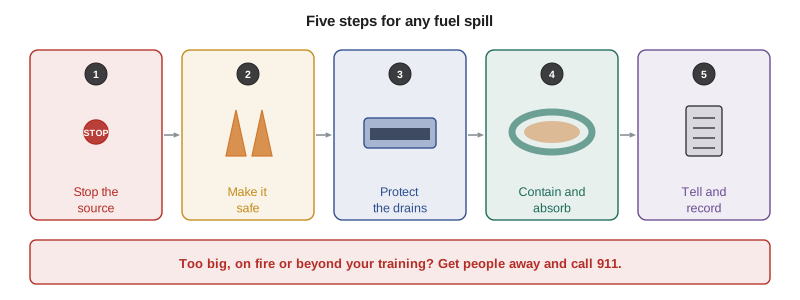
- Step 1, stop the source. If fuel is still flowing, stop it. At a dispenser, that means the emergency stop or the pump controls at the console. During a delivery, the driver closes the truck valves. For a leaking container, turn it upright or put it in a drip tray. For a leaking vehicle, the engine stays off and a drip pan goes under the leak.
- Step 2, make it safe. Keep people away from the spill and its vapor, upwind if possible. Stop fueling at the nearby pumps, ask customers to turn engines off and not to start them, and put out cones. No smoking, no phones held over the puddle, no running engines. If the spill is large or there is any fire, get everyone away and call 911.
- Step 3, protect the drains. Find the nearest drain downhill of the spill and cover it, or block the path to it with a sock or boom. Fuel that reaches a storm drain has left the station.
- Step 4, contain and absorb. Ring the spill with socks or granular absorbent to stop it spreading, then work inward with pads or granular absorbent. Put used material in the hazardous waste container.
- Step 5, tell and record. Tell the manager as soon as the source is stopped and the drains are protected. Record the time, place, product, estimated volume and what was done. The manager decides with the environmental coordinator whether the spill must be reported (Lesson 9).
The order matters. Stopping the source comes first because every second it flows makes the spill bigger. Making it safe comes before cleanup because no spill is worth a burn or a collision. And protecting the drains comes before absorbing, because a spill that reaches a drain cannot be absorbed any more.
When the steps are not for you
Some spills are beyond what a station worker should handle. The step then becomes simply: get people away, raise the alarm and call for help. That applies when:
- The spill is large, roughly more than the station's spill kit can absorb (at Northfield, more than about 25 gallons of gasoline), or still flowing and cannot be stopped.
- There is a fire, or a strong vapor smell spreading beyond the spill, or vapor inside the store or a building.
- Fuel is entering a storm drain, sewer or ditch faster than it can be blocked.
- A vehicle is leaking steadily, or has hit a dispenser.
- Someone is hurt, or has fuel in their eyes or on large areas of skin.
- The worker is unsure, untrained for the task, or does not have the right equipment.
The station's threshold is set in its own procedure; the number above is Northfield's, chosen for its kits and staffing, and is not a legal limit. A worker who calls the fire department for a spill that turns out to be manageable has done nothing wrong. Fire departments would much rather attend a spill than a fire.
Personal protection
Fuel is a skin irritant, its vapor can cause headaches and dizziness, and gasoline contains benzene, a known carcinogen (HSE-350, Lesson 4). The PPE for a small forecourt spill is modest but important:
- Chemical-resistant gloves, such as nitrile, which hold up to gasoline and diesel for short tasks. Latex and cloth gloves do not.
- Safety glasses, or splash goggles if there is any chance of splashing, such as when handling a leaking container.
- Closed, fuel-resistant footwear, and avoiding stepping in the fuel at all.
- A high-visibility vest when working on the forecourt among vehicles.
Respirators are not part of a station worker's small-spill kit. A spill that produces enough vapor to need a respirator is a spill for the fire department or a trained contractor. Workers should stay upwind, keep their face away from the puddle and take breaks away from the smell. Anyone who feels dizzy, sick or has a headache should stop and get fresh air. Fuel-soaked clothing should be removed and the skin washed with soap and water; the safety data sheet sets out first aid.
The spill kit
Northfield keeps three spill kits: a large wheeled kit by the forecourt island nearest the storm drain, a smaller kit at the tank fill area, and a small kit in the store for spills of oil and fluids. Each kit is a clearly labeled, weatherproof container with:
- Absorbent socks (long, sausage-shaped tubes) and pads made for oil and fuel.
- A bag of granular absorbent and a non-sparking shovel or scoop and a broom.
- A drain cover (a heavy, flexible mat that seals over a grate) for each nearby drain type.
- Nitrile gloves, safety glasses and goggles.
- Heavy-duty bags and ties, labeled for hazardous waste, and a pen for labels.
- A copy of the spill procedure and the contact list, and a spill report form.
- Cones and a "Spill, do not enter" sign.
Absorbents come in two broad types. Oil-only (or "petroleum") absorbents, usually white, soak up fuel and oil but repel water, so they can be used in the rain or on a wet forecourt and float on water. Universal absorbents, usually gray, soak up any liquid, including water and coolant. Granular absorbents such as treated clay or plant fiber are cheap and good for working into rough surfaces. Sawdust and paper towels should not be used for gasoline: they are combustible, absorb poorly and make a fire hazard.
How much absorbent?
Every absorbent has a rated capacity, printed on the package, for how much liquid it holds before it is saturated. Real capacity is usually less than the label, because pads are not used perfectly and some fuel stays on the ground. The program below estimates how much absorbent a spill needs, with an allowance for that. The capacities are typical illustrative values; the station should use the figures on its own products.
import math
# Illustrative rated capacities (gallons held per unit); check your product labels.
capacity = {"pad (15 x 19 in)": 0.2, "sock (4 ft)": 1.0, "granular (per 25 lb bag)": 2.5}
use_factor = 0.6      # real-world share of rated capacity actually used

def absorbent_needed(spill_gal):
    plan = {}
    edge = spill_gal * 0.3             # socks hold the edge, about 30% of fuel
    middle = spill_gal - edge          # pads and granular soak up the rest
    plan["sock (4 ft)"] = math.ceil(edge / (capacity["sock (4 ft)"] * use_factor))
    plan["pad (15 x 19 in)"] = math.ceil(middle * 0.5 / (capacity["pad (15 x 19 in)"] * use_factor))
    plan["granular (per 25 lb bag)"] = math.ceil(middle * 0.5 / (capacity["granular (per 25 lb bag)"] * use_factor))
    return plan

for spill in (1, 5, 15):
print(f"Spill of {spill} gal: " + ", ".join(f"{n} x {k}" for k, n in absorbent_needed(spill).items()))Spill of 1 gal: 1 x sock (4 ft), 3 x pad (15 x 19 in), 1 x granular (per 25 lb bag) Spill of 5 gal: 3 x sock (4 ft), 15 x pad (15 x 19 in), 2 x granular (per 25 lb bag) Spill of 15 gal: 8 x sock (4 ft), 44 x pad (15 x 19 in), 4 x granular (per 25 lb bag)
The results show why a spill kit has limits. A small spill needs a handful of pads. A medium spill uses most of a kit. A large spill would empty two or three kits and leave a lot of contaminated material to handle, which is one reason the station's procedure sets a size above which the contractor is called. The program also helps a supervisor decide how much to stock: enough for the largest spill the station expects its staff to handle, plus a margin.
Containing on different surfaces
How a spill behaves depends on what it lands on:
- Smooth concrete: fuel spreads quickly into a thin film. Ring it with socks first, then use pads. Granular absorbent works well when swept in and then swept up.
- Asphalt: gasoline softens asphalt and soaks into it. Work quickly; leftover stains may need a contractor.
- Gravel or soil: fuel soaks in almost at once. Stop the source, keep it from spreading, and mark the area; contaminated soil usually has to be dug up by a contractor (Lesson 5).
- Wet surfaces and rain: use oil-only absorbents, which repel water. Rain carries fuel toward drains faster, so drain protection is even more urgent.
- Snow and ice: fuel can travel under snow and along frozen ruts. Contaminated snow is a waste too and must not be pushed into a pile that will melt into a drain.
Things never to do
Some instinctive reactions make a spill worse. Never hose a spill down with water: it spreads the fuel and carries it into the drains. Never use detergent or dispersant on a forecourt spill: it breaks the fuel into tiny droplets that pass straight through drain traps and separators. Never sweep fuel into a drain or the car wash trench. Never use a vacuum or electrical tool on a gasoline spill unless it is rated for flammable atmospheres. And never leave a spill unattended without cones and a sign.
For supervisors: kit checks
A spill kit is only useful if it is full, unlocked and where people expect it. Check each kit weekly as part of the opening walk (HSE-350, Lesson 2): seal intact or contents complete, drain cover present, gloves in the right sizes, and the contact list current. Refill a kit as soon as it is used, not at the next order. Make sure every worker, including new hires like Sofia, can find the kits, open them and lay a sock and drain cover in a drill. Lesson 5 shows a simple log for kit use and restocking.
Worked problem
A nozzle that would not shut off
At 7:40 one morning, a customer at pump 3 shouts that the nozzle will not stop. Fuel is pouring from the car's filler onto the forecourt and running toward the storm drain 25 ft away. Raj Patel is at the counter; Sofia is on the forecourt. What happens?
Show solution
- Stop the source: Raj presses the emergency stop at the counter. All the dispensers stop within a second. He announces on the speaker that fueling is paused and asks customers not to start their engines.
- Make it safe: Sofia asks the customer to step away, puts cones around pump 3 and keeps people away from the puddle.
- Protect the drains: Sofia takes the drain cover from the wheeled kit and lays it over the storm drain grate before the fuel reaches it, then lays a sock across the flow path.
- Contain and absorb: she rings the puddle with socks and works pads in from the edge. The spill is about 4 gallons; the kit is enough.
- Tell and record: Raj calls Leah Morin, tags pump 3 out of service for the contractor, and starts the spill report. Once the spill is contained and the other pumps are safe, he restarts them.
Answer: Emergency stop, cones, drain cover, socks and pads, then the manager and the report: the five steps in order, done in a few minutes.
Common mistakes
MistakeStarting to mop up while fuel is still flowing.
InsteadStop the source first.
MistakeAbsorbing the puddle before covering the drain.
InsteadProtect the drain first; fuel in a drain cannot be absorbed.
MistakeHosing the spill away with water or detergent.
InsteadUse absorbents; water and detergent spread fuel into the drains.
MistakeUsing sawdust or paper towels on gasoline.
InsteadUse fuel-rated absorbents; sawdust and paper are combustible.
MistakeTackling a large or burning spill alone.
InsteadGet people away and call 911.
Summary and key terms
- The five steps are: stop the source, make it safe, protect the drains, contain and absorb, tell and record.
- Protect the drains before absorbing; fuel in a drain has left the station.
- If a spill is large, on fire, entering a drain faster than it can be blocked or beyond your training, get people away and call 911.
- Wear nitrile gloves and eye protection, stay upwind and stop if you feel unwell.
- Use oil-only or universal absorbents rated for fuel; never water, detergent or sawdust.
- Kits must be full, unlocked and checked weekly.
- Emergency stop
- The switch that shuts down every dispenser at once.
- Drain cover
- A heavy, flexible mat that seals over a drain grate.
- Absorbent sock
- A long tube filled with absorbent, used to ring a spill.
- Oil-only absorbent
- Absorbent that soaks up fuel and oil but repels water.
- Universal absorbent
- Absorbent that soaks up any liquid.
- Rated capacity
- How much liquid an absorbent holds, as printed on the package.
Practice problems
Work each problem on paper first, then reveal the answer to check.
What are the five steps for a fuel spill?
Show answer
Stop the source, make it safe, protect the drains, contain and absorb, tell and record.
Why does protecting the drains come before absorbing?
Show answer
Fuel that reaches a drain leaves the station and can no longer be absorbed.
Name three situations where a worker should get people away and call 911.
Show answer
For example, a large or flowing spill, a fire or spreading vapor, fuel entering a drain faster than it can be blocked, a vehicle leaking steadily, an injury, or being unsure.
Which gloves are suitable for a small fuel spill?
Show answer
Chemical-resistant gloves such as nitrile.
When should oil-only absorbents be used?
Show answer
On wet surfaces, in the rain or on water, because they repel water.
Why should detergent never be used on a forecourt spill?
Show answer
It breaks fuel into droplets that pass through drain traps and separators.
How often should spill kits be checked?
Show answer
Weekly, and refilled as soon as they are used.
Lesson quiz · 5 questions
Score 60% or more to complete this lesson.
Create a free account to save your progress, take quizzes and earn a certificate.