
HSE-351 · Lesson 5 of 12 · 23 min
Cleanup, waste and restocking
Once a spill has been stopped and contained, it still has to be cleaned up properly. That means getting the fuel off the ground, dealing with what is left behind, handling the contaminated absorbents and fuel as waste, and getting the station ready for the next spill. This part is less urgent than the first minutes, but it is where many stations go wrong: used pads end up in the regular garbage, a stain is left to wash into the drain with the next rain, or the spill kit is never refilled.
This lesson covers finishing the cleanup, deciding when a spill needs a contractor, handling the waste, and keeping a log of spill kit use so that kits are always ready.
Finishing the cleanup
After the socks and pads have soaked up the free fuel, the job is not done. Work through these steps:
- Pick up saturated pads and socks with gloved hands and put them straight into a hazardous waste bag or container. Do not wring them out.
- Spread granular absorbent over any remaining wet areas, work it in with a broom, leave it for the time on the package, then sweep it up with a non-sparking shovel and bag it.
- Check the edges of the spill, the cracks and joints in the concrete, the base of the dispenser island and the drain cover for fuel that was missed.
- Look at the drain: lift the cover only when the area around it is clean, and check for any sheen or smell in the catch basin. If fuel got in, the drain needs a contractor (Lesson 6).
- Leave the cones out until the surface is dry and no longer slippery, especially after a diesel spill.
- Clean tools such as the shovel and broom by wiping them with pads, and bag the pads. Wash hands and any exposed skin with soap and water.
A small stain left on concrete after a thorough cleanup is normal. A stain that is still wet, still smells strongly or is spreading is not done. On asphalt, gasoline can soften and stain the surface; if it is damaged, the manager should arrange a repair so the next rain does not wash fuel out of it.
When the spill needs a contractor
Station staff handle small spills on hard surfaces. A spill response contractor is needed when the job is bigger or harder than that. At Northfield, Leah Morin calls the contractor when:
- The spill is larger than the station's kits can handle (about 25 gallons of gasoline at Northfield).
- Fuel has reached soil, gravel, landscaping, a drain, a ditch or water.
- Fuel has soaked into asphalt or has run under a building, a sidewalk or a dispenser island.
- There is recovered liquid fuel or fuel and water to be pumped out.
- The regulator or fire department asks for professional cleanup.
Spill response contractors have vacuum trucks for pumping out drains and catch basins, equipment for digging out contaminated soil, sampling equipment, and the licenses to transport and dispose of the waste. They will usually take samples of the soil or water after the cleanup to show it meets the cleanup standard, and send a report that the station keeps with its spill records.
Recovered fuel
Sometimes fuel can be recovered as a liquid, for example from a spill bucket, a drip tray under a leaking vehicle, or a pool in a low spot that the contractor pumps out. Recovered fuel must never go back into the station's tanks or into a customer's vehicle. It is usually mixed with water, dirt and grit, and putting it in a tank can damage engines and the tank system. It is handled as waste, or recycled by a licensed contractor.
Fuel-contaminated waste
In the United States, waste contaminated with gasoline is often a hazardous waste under the federal Resource Conservation and Recovery Act (RCRA) and Montana's hazardous waste rules, because it can be ignitable or contain benzene. Absorbents contaminated only with used oil or diesel may be managed under the used-oil rules instead, if they are handled that way. A station's obligations depend on how much hazardous waste it generates each month; most stations are very small quantity generators, generating no more than about 220 lb (100 kg) of hazardous waste a month, with lighter requirements. All of it must be stored in closed, labeled containers and taken by a qualified hauler to a permitted facility, and none of it may go in the regular trash or down a drain. The waste contractor and Montana DEQ guidance confirm which rules apply to each waste.
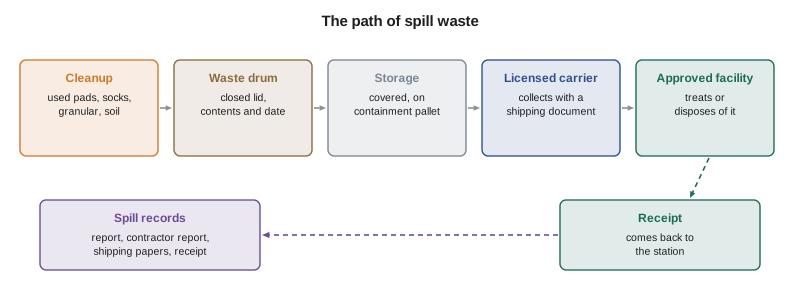
At Northfield, the waste goes into a 55 gal (205 L) steel drum with a lid, kept in a fenced, covered area behind the store, on a containment pallet away from drains. The drum is labeled with the contents ("Fuel-contaminated absorbents"), the date the first waste went in, and the hazard symbols. The waste contractor collects it when it is about three-quarters full or every few months, whichever comes first, and leaves a copy of the shipping document. The receipt from the disposal facility comes back later and is filed with the spill records.
Rules for storing the drum are simple: keep the lid closed except when adding waste, keep it out of the rain, do not mix in other wastes such as used oil filters, antifreeze or garbage unless the contractor says so, and do not let the drum overflow. A drum of fuel-soaked pads is itself a fire hazard, so it must be kept away from ignition sources and not in the store.
Keeping kits ready: the spill kit log
A spill kit that was used last week and never refilled is one of the most common findings in station inspections. The fix is a simple log: each time a kit is used or checked, someone writes down the date, which kit, what was used and whether it was restocked. The same log, kept for a few months, shows how often spills happen, where and how much material they take, which helps with ordering and with spotting problems.
The program below keeps a small spill kit log, works out what needs to be restocked in each kit and summarizes the month. The log entries are illustrative.
# Spill kit log: what was used, what needs restocking (illustrative entries).
full_kit = {"forecourt": {"pads": 50, "socks": 6, "granular_bags": 2, "drain_covers": 2},
            "fill area": {"pads": 30, "socks": 4, "granular_bags": 1, "drain_covers": 1},
            "store":     {"pads": 20, "socks": 2, "granular_bags": 1, "drain_covers": 0}}
log = [  # (date, kit, gallons spilled, items used)
    ("Mar 02", "forecourt", 0.5, {"pads": 6}),
    ("Mar 09", "forecourt", 4.0, {"pads": 18, "socks": 3, "drain_covers": 1}),
    ("Mar 14", "store",     0.3, {"pads": 4}),
    ("Mar 21", "fill area", 1.5, {"pads": 10, "socks": 2, "granular_bags": 1}),
]
stock = {k: dict(v) for k, v in full_kit.items()}
for date, kit, gal, used in log:
    for item, n in used.items():
        stock[kit][item] -= n
for kit, items in stock.items():
    short = {i: full_kit[kit][i] - n for i, n in items.items() if n < full_kit[kit][i]}
    text = ", ".join(f"{n} {i.replace('_', ' ')[:-1] if n == 1 else i.replace('_', ' ')}" for i, n in short.items())
    print(f"{kit:10} restock: {text or 'nothing, kit full'}")
print(f"March: {len(log)} spills, {sum(e[2] for e in log):.1f} gal in total, "
f"largest {max(e[2] for e in log)} gal ({max(log, key=lambda e: e[2])[0]})")forecourt restock: 24 pads, 3 socks, 1 drain cover fill area restock: 10 pads, 2 socks, 1 granular bag store restock: 4 pads March: 4 spills, 6.3 gal in total, largest 4.0 gal (Mar 09)
In this example, the forecourt kit is about half empty after two spills in March, and is missing a drain cover; if it is not restocked, the next spill will find a kit without the most important item in it. A paper log works just as well as a program: what matters is that it is filled in every time and that someone acts on it.
Cleaning up after a vehicle or delivery spill
The same steps apply to larger spills, with a few additions. After a delivery spill, the hauling company usually has its own responsibilities for cleanup and reporting, and the driver will call their dispatcher. The station and the hauler need to agree who is calling the contractor and the regulator, so it is not done twice or not at all; the station procedure should say which, and the station should always make sure the report has been made. After a vehicle spill, the customer's insurer may be involved, but the cleanup cannot wait for them: the station cleans up and sorts out the cost later.
Cleaning up in winter
Winter adds its own problems at a station in a cold climate. Fuel spilled on snow or ice spreads under the surface and along ruts, so the spill can be larger than it looks. Absorbents work poorly on ice, and granular absorbent can freeze into clumps. Scoop contaminated snow and slush into bags or a lined container and treat it as waste; never push it into the snowbank at the edge of the lot, because it will melt into the drain or the ditch in spring. Gasoline evaporates more slowly in the cold, so the vapor hazard lasts longer than on a warm day, but the fire hazard does not go away: gasoline gives off flammable vapor even far below freezing.
Snow clearing itself can cause a spill problem. A plow that hits a fill cap, a vent pipe or a dispenser island can damage the tank system, and snow piled over fill caps and monitoring wells hides them from the driver and from inspection. Mark them with tall poles before the first snowfall, and check them after every clearing.
For supervisors: the cleanup checklist
Before a spill is closed in the log, the manager or shift lead should walk the area and confirm: no free fuel or wet stains; drains checked and clean; all waste bagged, labeled and in the drum; tools cleaned; kits restocked or ordered; the spill report complete; and, if a contractor was used, their report and the waste paperwork requested. A two-minute walk with this list catches most of the problems inspectors find later.
Worked problem
Closing out a diesel spill
After a truck's saddle tank was punctured on a bollard, about 15 gallons of diesel spread across the diesel lane. Ben and Raj stopped it reaching the drain and soaked up most of it with two kits. Some diesel ran onto the gravel strip along the edge of the lot. What still needs to happen?
Show solution
- Finish the hard surface: granular absorbent on the remaining film, swept up and bagged; cones left out until it is no longer slippery.
- The gravel strip: diesel soaked into gravel cannot be cleaned by station staff. Leah Morin calls the contractor to dig out and remove the contaminated gravel and soil.
- Waste: all pads, socks and granular absorbent into the drum, lid closed; the contractor removes the gravel separately with its own paperwork.
- Kits: both kits used are restocked from the store room the same day, and an order is placed to replace the stock.
- Records: the spill report, the reporting decision (Lesson 9), the contractor's report and the waste receipts are filed together. The truck owner's details go in the report for cost recovery.
Answer: Finish the concrete, have the contractor remove the contaminated gravel, contain the waste, restock both kits and file the records together.
Common mistakes
MistakePutting used fuel pads in the regular garbage.
InsteadPut them in the closed, labeled hazardous waste container.
MistakePouring recovered fuel back into the tank.
InsteadHandle recovered fuel as waste or have it recycled by a licensed contractor.
MistakeCalling a spill finished while the surface is still wet.
InsteadCheck edges, cracks and drains, and leave cones until it is dry.
MistakeRaking fuel-soaked gravel or soil to "spread it out".
InsteadMark the area and call the contractor to remove it.
MistakeLeaving the spill kit half empty after use.
InsteadRestock the same day and log what was used.
Summary and key terms
- Finish the cleanup by bagging all absorbents, working in granular absorbent, checking edges and drains and leaving cones until the surface is dry.
- Call the contractor for large spills and for fuel in soil, gravel, drains, water or under structures.
- Recovered fuel never goes back into the tanks.
- Fuel-contaminated waste goes into closed, labeled containers and is shipped by a licensed carrier to an approved facility, with paperwork kept.
- A spill kit log shows what to restock and reveals patterns.
- Walk the area with a checklist before closing a spill.
- Spill response contractor
- A company licensed to clean up larger spills and handle the waste.
- Recovered fuel
- Liquid fuel collected from a spill, which must be handled as waste or recycled.
- Hazardous waste
- Waste that is ignitable, toxic or otherwise dangerous and must be handled under special rules.
- Shipping document (manifest)
- The paperwork that travels with hazardous waste from the station to the facility.
- Spill kit log
- A record of each use and check of a spill kit.
- Containment pallet
- A pallet with a built-in sump that catches leaks from drums.
Practice problems
Work each problem on paper first, then reveal the answer to check.
What should be done with saturated pads?
Show answer
Put them straight into the hazardous waste bag or container, without wringing them out.
Name three situations that need a spill contractor.
Show answer
For example, a large spill, fuel in soil or gravel, fuel in a drain or water, fuel soaked into asphalt or under structures, or liquid to pump out.
Why must recovered fuel never go back into the tank?
Show answer
It contains water, dirt and grit that can damage engines and the tank system, and it is waste.
How should the waste drum be kept?
Show answer
Lid closed, labeled, out of the rain, on containment, away from drains and ignition sources, and not mixed with other wastes.
What does a spill kit log record?
Show answer
The date, which kit, what was spilled and used, and whether it was restocked.
After a delivery spill, what must the station and hauler agree on?
Show answer
Who is calling the contractor and the regulator, so the report is made once and not missed.
What should be checked before a spill is closed in the log?
Show answer
No free fuel, drains clean, waste contained, tools clean, kits restocked, report complete and contractor paperwork requested.
Lesson quiz · 5 questions
Score 60% or more to complete this lesson.
Create a free account to save your progress, take quizzes and earn a certificate.