
HSE-351 · Lesson 2 of 12 · 22 min
Law and responsibilities for spills and tanks in the United States
Fuel spills and storage tanks sit where several areas of law meet. Workplace safety law protects the workers who respond to a spill. Fire codes govern how tanks and dispensers are built and run. Environmental law decides what must be reported, who pays for cleanup and how tanks must be monitored for leaks. Hazardous products rules cover labels, safety data sheets and training for fuel and the cleanup products used on it. And waste rules decide how contaminated absorbents must be stored, transported and disposed of. A station worker does not need to be a lawyer, but knowing which rules exist, who enforces them and what they expect of the people on shift makes it much easier to do the right thing quickly.
This lesson maps those rules at a high level. It does not quote clause numbers, because rules change and the details vary by province, state and municipality. When a detail matters, the station's written spill procedure, the company's environmental coordinator and the regulator's own guidance are the places to check.
Who makes the rules
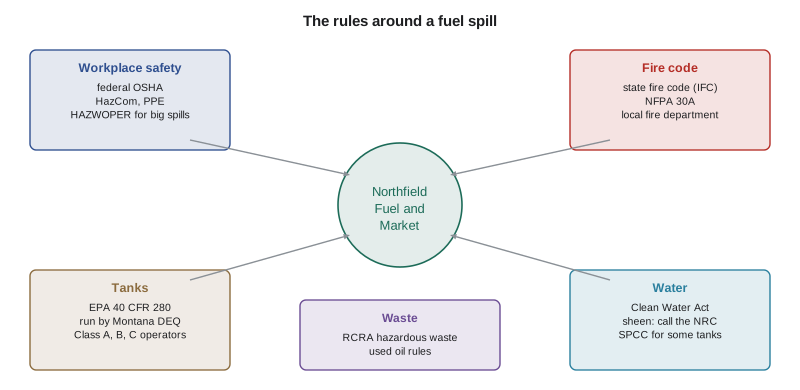
In the United States, rules come from federal, state and local governments. For Northfield in Montana, they are:
- Workplace safety: federal OSHA, because Montana does not run its own state plan for private employers. The General Duty Clause, Hazard Communication, PPE rules and, for larger incidents, the emergency response standard (HAZWOPER) apply.
- Fire safety and tanks: the state fire code, based on the International Fire Code, and NFPA 30A for motor fuel dispensing, enforced by the state fire marshal and local fire departments.
- Underground storage tanks: EPA's UST regulations (40 CFR Part 280), which Montana runs through its Department of Environmental Quality (DEQ). They set requirements for tank construction, release detection, spill and overfill prevention, walkthrough inspections, operator training, release reporting and financial responsibility.
- Spills to water: the Clean Water Act, which requires any oil discharge that causes a sheen on water to be reported to the National Response Center, and the Spill Prevention, Control and Countermeasure (SPCC) rule for some aboveground storage.
- Hazardous products: OSHA Hazard Communication, which requires labels, safety data sheets and training.
- Waste: federal and state hazardous waste rules (RCRA), which decide how contaminated absorbents and fuel-water mixtures are classified and disposed of.
Federal rules in the background
Federal law applies directly in several ways. EPA's UST rules set the national minimum that every state program must meet. The Clean Water Act sheen rule applies everywhere: an oil discharge that creates a film or sheen on a creek, river or lake, however small, must be reported to the National Response Center. The SPCC rule applies to facilities with more than 1,320 gallons of aboveground oil storage in containers of 55 gallons or more that could reasonably discharge to navigable waters; most stations whose fuel is all underground in regulated tanks are outside it, but a station with aboveground tanks may be inside it. Transport of fuel and of waste from the station falls under the Department of Transportation hazardous materials rules.
Who is responsible for what
The law places most responsibility on the owner and operator of the station and its tanks, but everyone on the site has a part to play.
| Who | Main responsibilities for spills and tanks |
|---|---|
| Owner or operator (the company) | Register and maintain USTs; run release detection; keep records; train Class A and B operators; write the spill procedure; supply kits and PPE; report releases; show financial responsibility for cleanup |
| Manager (often the Class B operator) | Make sure release detection and walkthrough inspections are done and recorded; train Class C operators; decide on reporting; call the contractor |
| Attendant or cashier (Class C operator) | Respond to alarms and spills; stop the source; protect people; contain and clean up small spills; notify the manager and emergency services |
| Fuel hauler and driver | Deliver safely; prevent overfills and hose spills; stop and contain delivery spills; report them |
| Contractors | Test and repair tanks and equipment; clean up larger spills; handle and transport waste |
| Regulators and fire department | Inspect; receive reports; order and oversee cleanup; respond to emergencies |
Under EPA's 2015 UST rule, every UST facility must have trained Class A, Class B and Class C operators. Class A operators (usually at the company level) are responsible for the overall operation and compliance of the tank system. Class B operators handle day-to-day operation and maintenance, such as release detection records and walkthrough inspections. Class C operators are the employees on site who respond to alarms and emergencies, which at a station like Northfield means every attendant. Class C operators must be trained before they work alone at the station, and the facility must keep records of the training. Montana DEQ runs the state program and sets its own details.
The duty to act
Environmental law does not just require reporting; it requires action. The person responsible for a release must take reasonable steps to stop it, contain it and clean it up, and must not make it worse. In practice, that means the first actions of the worker on shift, stopping the source and protecting drains, are part of meeting the company's legal duties. A spill that is reported promptly and handled well is treated very differently from one that is ignored, hidden or washed down a drain.
This is also why the station procedure and records matter. When a regulator asks what happened, the company needs to show when the spill was found, what was done, how much was released and recovered, where the waste went and who was told. Lesson 9 covers the report itself, and Lesson 5 covers the waste paperwork.
Workers' rights and protections
Workers have rights during a spill, too. They have the right to know about the hazards of fuel and cleanup products, through labels, safety data sheets and training. They have the right to the PPE the job needs, provided by the employer. And they have the right to refuse work they believe is dangerous, such as being asked to clean up a large spill without training, equipment or ventilation, or to work beside a spill that has not been made safe. A worker who refuses unsafe work must follow the procedure for doing so, but must not be punished for raising a genuine concern.
Under federal OSHA, workers are protected from retaliation for raising safety concerns, and in limited circumstances may refuse work that presents an imminent danger; HSE-102 covers the details.
For supervisors: the binder at the counter
Keep a spill binder at the counter, next to the tank gauge console. It should contain the station's spill procedure on one page, the phone numbers for emergency services, the manager, the environmental coordinator, the contractor and the regulator's spill line, a site plan with drains and spill kits marked, blank spill report forms, and the safety data sheets for the fuels and cleanup products. Check it every quarter: phone numbers and contractors change. A worker on the late shift should be able to handle the first hour of a spill with that binder and nothing else.
Worked problem
Which rules apply?
During a delivery at Northfield, about 10 gallons of diesel spills from a hose coupling. Some of it runs across the lot and into the storm drain, and a sheen appears in the ditch. Which areas of law are involved?
Show solution
- Workplace safety: Mike and Ben must be protected while they stop and contain the spill, with the right PPE and training (OSHA).
- Fire code: the spill must be controlled to prevent ignition, and the fire department may attend (state fire code).
- Water: the sheen in the ditch means the discharge must be reported to the National Response Center (Clean Water Act).
- State: the spill must also be reported to Montana's spill line (Lesson 9).
- Waste: the absorbents and any recovered fuel must be handled under hazardous waste rules.
Answer: Workplace safety, fire code, environmental reporting and waste rules all apply at once; the station procedure turns them into one set of steps.
Records the law expects
Most of what an inspector checks at a fuel station is paperwork. The records prove that the tanks are being watched, that alarms are answered and that spills are handled. If a record is missing, the inspector has to assume the job was not done. Keeping records is therefore part of the job, not an extra.
| Record | What it shows | Who usually keeps it |
|---|---|---|
| Release detection records | That the tanks and piping were monitored every month | Class B operator |
| Walkthrough inspection checklists | That spill buckets, sumps and the gauge were checked every 30 days | Class B operator |
| Delivery records | Volumes delivered and any spills or overfills | Manager and the fuel hauler |
| Spill reports and spill log | What spilled, how much, what was done and who was told | Manager |
| Waste manifests and receipts | Where contaminated absorbents and fuel went | Manager |
| Operator training records | That Class A, B and C operators were trained | Manager or head office |
| Test and repair records | Spill bucket, sump, overfill and leak detector tests and repairs | Head office; kept for the period the rule requires |
When the inspector visits
A Montana DEQ inspector, a fire inspector or, after a spill, an EPA or state responder may visit the station. Montana DEQ inspects UST facilities on a regular cycle. The worker on shift should be polite, ask for identification, and call the manager (or Class B operator) right away. The inspector may ask to see the tank gauge, spill buckets, sumps, spill kits and the records. Workers should answer honestly about what they know and did, and should not guess about things they do not know; saying "I don't know, but the manager can tell you" is a perfectly good answer.
Inspectors see the same problems again and again: spill buckets full of water and fuel, alarms silenced and not followed up, inventory records that were never reconciled, empty spill kits, and staff who cannot say where the storm drain goes. Each of these is cheap to fix before the visit and expensive to explain after a spill. Lesson 7 covers the tank equipment and Lesson 8 the inventory records in detail.
After the visit, the manager should read the inspection report carefully, fix every item it lists by the date it gives, and keep a copy with proof of the fix, such as a contractor's invoice or a photo of the new spill kit. An item that appears on two inspections in a row is a sign that the station's own checks are not working, and that is the point to change the routine rather than just fix the item again.
Common mistakes
MistakeThinking only the environment department cares about spills.
InsteadWorkplace safety, fire, environmental, hazardous products and waste rules can all apply to one spill.
MistakeLeaving reporting decisions to whoever happens to be on shift.
InsteadName in the procedure who decides on reporting, and how to reach them.
MistakeKeeping out-of-date phone numbers in the spill binder.
InsteadCheck the binder every quarter.
MistakeAsking an untrained worker to clean up a large spill.
InsteadTrain workers for the spills they are expected to handle, and call the contractor for the rest.
MistakeHiding or downplaying a spill to avoid a report.
InsteadReport promptly and accurately; prompt action is part of meeting the legal duty.
Summary and key terms
- Spills and tanks fall under workplace safety, fire code, environmental, hazardous products and waste rules.
- In Montana, federal OSHA, the state fire code, EPA UST rules run by DEQ, the Clean Water Act sheen rule and RCRA waste rules apply.
- The owner and operator carry most responsibility, but workers on shift stop the source, protect people and drains, and report.
- The law requires action as well as reporting: stop, contain and clean up, and do not make it worse.
- Workers have the right to know, to PPE and to refuse unsafe work.
- A spill binder at the counter supports the first hour of any spill.
- UST (underground storage tank)
- A tank system with 10% or more of its volume, including piping, underground, regulated by EPA and the state.
- Class C operator
- An employee trained to respond to alarms and emergencies at a UST facility.
- National Response Center
- The federal number for reporting oil discharges that cause a sheen on water.
- SPCC
- Spill Prevention, Control and Countermeasure plan rule for facilities with more than 1,320 gallons of aboveground oil storage.
- Spill procedure
- The station's written steps for responding to and reporting spills.
- Right to refuse
- A worker's protection when refusing work that presents an imminent danger, following the set process.
Practice problems
Work each problem on paper first, then reveal the answer to check.
Name five areas of law that can apply to a fuel spill.
Show answer
Workplace safety, fire code, environmental protection and reporting, hazardous products, and waste.
Which federal rule requires a sheen on water to be reported?
Show answer
The Clean Water Act, with reports to the National Response Center.
Who carries most of the legal responsibility for tanks and spills?
Show answer
The owner and operator of the station and its tanks.
What does the attendant on shift do in a spill?
Show answer
Stops the source, protects people and drains, contains and cleans up small spills, tells the manager and records what happened.
Why are the first actions of the worker on shift part of the company's legal duty?
Show answer
Because the law requires the responsible party to stop, contain and clean up releases and not make them worse.
What should a spill binder contain?
Show answer
The spill procedure, phone numbers, a site plan with drains and kits, spill report forms and safety data sheets.
What rights does a worker have during a spill?
Show answer
The right to know the hazards, to the right PPE and to refuse dangerous work.
Lesson quiz · 5 questions
Score 60% or more to complete this lesson.
Create a free account to save your progress, take quizzes and earn a certificate.