
HSE-351 · Lesson 3 of 12 · 23 min
Spill scenarios at stations
Most fuel spills at stations are small, and most of them happen in a handful of predictable ways. A worker who knows those ways can spot a spill starting, guess how big it might get and know what to do before it grows. This lesson walks through the common scenarios at Northfield Fuel and Market, from a few drops at the nozzle to a leak from an underground tank, and looks at what makes each one dangerous.
HSE-350 covered the fire and health hazards of fuel at the pumps. Here the focus is on the spill itself: where the fuel comes from, how fast it comes out, where it goes and how quickly it can be stopped.
The spill families
It helps to group spills by where they start, because the source decides who can stop it and how.
| Family | Typical sources | Usual size | Who stops the source |
|---|---|---|---|
| Dispensing spills | Topping off, nozzle failing to shut off, nozzle dropped, overfilled portable container | A few drops to a gallon | The customer or the attendant, at the dispenser or the emergency stop |
| Equipment failures | Leaking dispenser, cracked hose, broken breakaway, failed shear valve | A gallon to tens of gallons | The attendant, with the emergency stop |
| Vehicle spills | Leaking fuel tank or line, punctured tank, collision with a dispenser | A gallon to a whole vehicle tank | The attendant and emergency services |
| Delivery spills | Overfilled tank, hose disconnect, coupling leak, spill bucket overflow, truck leak | A gallon to hundreds of gallons | The driver, with the truck emergency valves |
| Underground leaks | Corroded or damaged tank, leaking piping joint, failed sump or fitting | Slow: drops per hour, but it can add up to hundreds of gallons | The manager and tank contractor |
| Other products | Used oil, antifreeze, washer fluid, DEF, propane cylinders (HSE-353) | Usually small | The attendant |
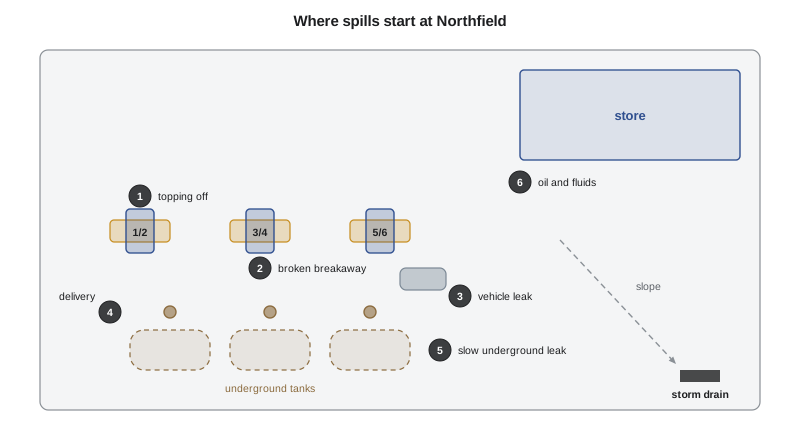
Dispensing spills
The most common spill at any station is the customer who keeps squeezing the nozzle after it clicks off, to round the price up. The extra fuel has nowhere to go: it spills from the filler neck, runs down the side of the car and drips onto the forecourt. Each topping-off spill is small, but at a busy station they happen many times a day, and the stain under each pump is the result. Topping off also pushes liquid fuel into the vehicle's vapor recovery system, which can damage it.
Other dispensing spills come from automatic shut-off failures, which are rare but can pump fuel onto the ground at full flow for several seconds before the customer reacts; nozzles dropped on the ground while still flowing; customers filling portable containers on the back of a truck or in the trunk of a car, where the container cannot be watched and static electricity is a fire risk (HSE-350, Lesson 6); and customers who drive off without hanging up the nozzle.
Equipment failures
A dispenser is a box of pipes, valves, filters and meters, and any of them can leak. The first sign is often a wet patch inside the cabinet, a stain on the island or a smell of fuel near one pump. Hoses crack with age and sunlight, especially where they bend near the nozzle. Breakaway couplings are designed to separate and seal both ends when a car drives off with the nozzle still in the tank; if one fails to seal, fuel flows from the hose until the pump is stopped. Shear valves under each dispenser are designed to close if the dispenser is knocked over, but only if they are installed and maintained correctly.
Equipment spills are dangerous because the source keeps flowing as long as the submersible pump runs. The emergency stop, the big red button at the counter and outside, shuts down every dispenser at once. It is the fastest way to stop a leak at a dispenser that is still flowing, and every worker should be able to reach it without thinking (HSE-350, Lesson 7).
Vehicle spills
Vehicles bring their own spills onto the forecourt: a leaking fuel line, a rusted tank, a cracked filter housing or a fuel cap left open. A car hitting a bollard or dispenser can puncture its tank and release its whole contents, which for a pickup can be well over 25 gallons, and the collision can also damage the dispenser. Trucks and motorhomes carry large tanks and may have saddle tanks that hang low and are easily damaged.
Vehicle spills are hard because the source is the customer's property. The attendant can ask the customer to turn off the engine, stay away from the vehicle and wait for help, but cannot repair the car. A slow drip can be caught in a drip pan or absorbent pad; a steady stream needs the fire department, because the vehicle cannot be moved safely while it is leaking.
Delivery spills
Fuel deliveries move large volumes quickly. A tanker trailer at Northfield may carry 9,000 to 11,000 gallons in several compartments, and each compartment drops into an underground tank through a hose at 100 or more gallons a minute. Delivery spills can happen when:
- The tank is overfilled because the driver did not check the available space (ullage) before starting, or the wrong compartment was dropped into the wrong tank.
- The hose is disconnected before it has drained, releasing the fuel still in it.
- A coupling or gasket leaks, or the hose is damaged.
- The spill bucket around the fill pipe overflows or is full of water and fuel from earlier deliveries.
- The truck itself leaks, or is struck by another vehicle while unloading.
The driver is in charge of the delivery and of stopping the source: closing the truck's internal valves and using its emergency shut-off. The station's job is to keep the area clear, make sure the right tank is ready, watch the tank gauge, and help contain any spill with the station's kits. HSE-350, Lesson 9 covered the delivery from the station's side; this course looks at what happens when it goes wrong. Lesson 11 covers overfill prevention.
Underground leaks
Underground leaks are the opposite of a forecourt spill: no one sees them, they are slow, and they can go on for months. A pinhole in an old steel tank, a loose joint in the piping, a cracked fitting in a sump or a failed seal can each release fuel into the soil a drop at a time. Over months, a leak of a small fraction of a tank's volume each day adds up to a large amount of fuel in the ground. Most of the big, expensive contamination cases at stations are underground leaks that went unnoticed, not dramatic forecourt spills.
The defenses against underground leaks are the leak detection systems and records covered in Lessons 7 and 8: tank gauges, line leak detectors, sump sensors and inventory reconciliation. The worker on shift is often the first to see the warning: an alarm on the tank gauge console, a smell of fuel in the store basement or a nearby sewer, a sheen in a ditch, or a neighbor complaining that their basement smells of gasoline.
How fast fuel evaporates
Gasoline and diesel behave very differently once they are on the ground. Gasoline is a mixture of light hydrocarbons, and a thin film of it on warm concrete can lose much of its volume to the air in an hour, which is why gasoline spills smell so strongly and why the vapor near them can reach flammable levels. Diesel is made of heavier hydrocarbons that evaporate slowly; a diesel spill stays on the surface, makes it slippery, soaks into asphalt and leaves a stain for weeks.
Evaporation does not make a gasoline spill go away safely. The vapor is a fire hazard and a health hazard, the heavier parts of the gasoline are left behind, and fuel that has soaked into the ground or reached a drain is not evaporating. The program below uses a simple teaching model to compare how much of a thin film of each fuel might remain over time at two temperatures. The rates are illustrative, chosen to show the pattern, not measured values for any real spill.
import math
# Teaching model: fraction of a thin fuel film left after t hours.
# Rate constants (per hour) at 59 F are illustrative, not measured;
# the model assumes the rate roughly doubles for every 18 F warmer.
base_rate = {"gasoline": 0.50, "diesel": 0.004}
spill_gal = 5.0
for temp_f in (59, 86):
    factor = 2 ** ((temp_f - 59) / 18)
    print(f"At {temp_f} F:")
    for fuel, k in base_rate.items():
        left = [spill_gal * math.exp(-k * factor * t) for t in (1, 4, 24)]
print(f" {fuel:9} left after 1 h {left[0]:4.1f} gal, 4 h {left[1]:4.1f} gal, 24 h {left[2]:4.1f} gal")At 59 F: gasoline left after 1 h 3.0 gal, 4 h 0.7 gal, 24 h 0.0 gal diesel left after 1 h 5.0 gal, 4 h 4.9 gal, 24 h 4.5 gal At 86 F: gasoline left after 1 h 1.2 gal, 4 h 0.0 gal, 24 h 0.0 gal diesel left after 1 h 4.9 gal, 4 h 4.8 gal, 24 h 3.8 gal
The pattern is the point: on a hot day, much of a thin gasoline film goes into the air within an hour or two, putting vapor where people are standing, while most of the diesel is still on the ground after a whole day. That is why gasoline spills call for keeping people and ignition sources away, and diesel spills call for absorbents and a slip warning. Real evaporation also depends on wind, sunlight, film thickness and the surface, and a deep pool of gasoline evaporates far more slowly than a thin film.
Spills inside the store and service bays
Not every spill is on the forecourt. The store sells motor oil, washer fluid, antifreeze and small containers of fuel additives, and a dropped case can leave a slippery, sometimes toxic puddle in an aisle. A station with a service bay may store used oil and used antifreeze in drums or tanks, and those can leak or be knocked over. DEF (diesel exhaust fluid) is not flammable, but it is slippery, crystallizes as it dries and corrodes some metals. These spills are usually small and handled with the same steps as a forecourt spill: stop the source, keep people away, contain, absorb and dispose of the waste properly. They must never go down a floor drain or into the sink.
For supervisors: track the near misses
Small spills are a good early warning. If the same pump has a topping-off stain every day, a sign or a talk with regular customers may help. If one dispenser keeps dripping, the hose or a seal is wearing out. If the spill bucket at the diesel fill pipe is always full after deliveries, the driver's routine or the bucket may be the problem. Record every spill in the spill log, however small, and look at the log once a month for patterns. The spill kit log in Lesson 5 makes this easy.
Worked problem
Sorting out a busy afternoon
On one Friday afternoon at Northfield, Tyler notices three things within half an hour: a damp stain spreading under dispenser 4 when no one is fueling; a customer at pump 9 who has spilled about a cupful while topping off; and a smell of diesel by the fill pipes, where a delivery finished an hour ago. Which spill family is each one, and what does each need?
Show solution
- The stain under dispenser 4 with no one fueling is an equipment failure: something inside is leaking whenever the pump is pressurized. Tyler should stop that dispenser (or use the emergency stop if fuel is flowing), put out cones, contain the stain and tell the manager to call the service contractor.
- The topping-off spill at pump 9 is a dispensing spill. Tyler should ask the customer to stop, then absorb the fuel with pads or granular absorbent and put the waste in the hazardous waste container.
- The diesel smell by the fill pipes after a delivery may be a full spill bucket or a small delivery spill. Tyler should look in the spill bucket (without stepping in any fuel), check for a stain around the fill caps, and tell the manager so the bucket can be emptied properly and the driver's company told.
- All three go in the spill log, with the time, location and what was done.
Answer: An equipment failure, a dispensing spill and a possible delivery spill: each needs its source found and stopped, the fuel contained and a log entry.
Common mistakes
MistakeThinking only big, dramatic spills matter.
InsteadMost contamination comes from small, repeated or slow leaks; log and fix them all.
MistakeAssuming gasoline that has evaporated is gone safely.
InsteadThe vapor is a fire and health hazard, and fuel in the ground or drain is not evaporating.
MistakeTrying to stop a leak inside a dispenser by hand.
InsteadStop the dispenser or use the emergency stop, and call the service contractor.
MistakeAsking a customer to drive a leaking car off the forecourt.
InsteadKeep the engine off and people away, contain the drip and call for help if it is more than a drip.
MistakeIgnoring a fuel smell after a delivery.
InsteadCheck the spill bucket and fill area and tell the manager.
Summary and key terms
- Station spills fall into a few families: dispensing, equipment, vehicle, delivery, underground and other products.
- The source decides who can stop the spill and how: the customer, the attendant with the emergency stop, the driver or the tank contractor.
- Topping off is the most common spill; equipment and delivery spills can be much larger.
- Underground leaks are slow and hidden, and cause most of the costly contamination.
- Gasoline evaporates fast and creates vapor; diesel stays on the surface and soaks in.
- Log every spill, however small, and look for patterns.
- Topping off
- Continuing to pump fuel after the nozzle clicks off.
- Breakaway coupling
- A fitting on the dispenser hose that separates and seals both ends if a vehicle drives off with the nozzle in.
- Shear valve
- A valve under a dispenser that closes if the dispenser is knocked over.
- Spill bucket
- A small container around a tank fill pipe that catches drips during deliveries.
- Ullage
- The empty space in a tank available to receive fuel.
- Underground leak
- A slow release from a buried tank, pipe or fitting.
Practice problems
Work each problem on paper first, then reveal the answer to check.
What is the most common spill at a station?
Show answer
Topping off by customers.
What is the fastest way to stop fuel flowing from a broken dispenser hose?
Show answer
The emergency stop, which shuts down all the dispensers.
Who stops the source during a delivery spill?
Show answer
The driver, using the truck's internal valves and emergency shut-off.
Why do underground leaks cause so much contamination?
Show answer
They are slow and hidden and can go on for months before being found.
How do gasoline and diesel spills differ on the ground?
Show answer
Gasoline evaporates quickly, making vapor; diesel stays on the surface, is slippery and soaks into asphalt.
Name two warning signs of an underground leak.
Show answer
For example, a tank gauge alarm, a fuel smell in a basement or sewer, a sheen in a ditch or a neighbor's complaint.
Why should small spills be logged?
Show answer
They show patterns, such as a wearing hose or a delivery problem, before a bigger spill.
Lesson quiz · 5 questions
Score 60% or more to complete this lesson.
Create a free account to save your progress, take quizzes and earn a certificate.