
HSE-351 · Lesson 10 of 12 · 22 min
When fuel reaches soil and water
Most of this course is about keeping fuel on the pavement, where it can be cleaned up in an afternoon. This lesson is about what happens when it is not: when a spill soaks into the ground, or a tank leaks for months, or fuel reaches a creek. Understanding how fuel moves underground and in water explains why the first minutes of a response, and the leak detection routines of Lessons 7 and 8, matter so much. It also explains why contaminated sites take so long and cost so much to clean up.
Workers do not investigate or clean up contaminated soil and groundwater; that is work for environmental consultants and contractors. But the station staff are often the people who first notice the signs, and they will see the drilling rigs and monitoring wells if a cleanup happens at their site.
How fuel moves underground
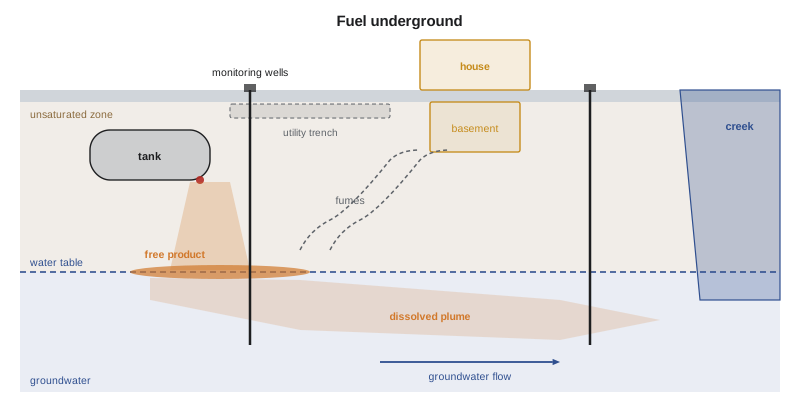
Fuel that soaks into the ground moves downward through the soil above the water table, called the unsaturated zone. Some of it clings to soil grains and stays there; some evaporates into the air spaces between them, and some keeps moving down. If enough fuel is released, it reaches the water table, the level below which the ground is saturated with water.
Gasoline and diesel are lighter than water and do not mix well with it, so fuel that reaches the water table spreads out on top of it as a layer, often called free product or LNAPL (light non-aqueous phase liquid). The water table rises and falls with the seasons, smearing the fuel through a band of soil. Some of the fuel's compounds dissolve into the groundwater, especially benzene, toluene, ethylbenzene and xylenes (BTEX), and the groundwater carries them away from the source in a dissolved plume. Vapor from the fuel can also travel through the soil, along buried utility trenches and into basements and sewers.
Why it matters
Fuel underground causes harm in several ways:
- Drinking water: many rural homes and some towns rely on wells. Benzene is a carcinogen, and drinking water limits for it are very low, so a small amount of fuel can make a well unusable.
- Vapor intrusion: fuel vapor can seep into basements, crawl spaces and sewers, causing a smell, health effects and, in the worst cases, a fire or explosion risk.
- Surface water: groundwater feeds creeks and rivers, so a plume can reach surface water and harm fish and other aquatic life.
- Property: contaminated land is hard to sell, lend money on or redevelop, and neighboring owners may sue.
- Cost and time: cleaning up soil and groundwater at a station can take years and cost from tens of thousands to millions of dollars.
How fast does groundwater move?
Groundwater moves through the spaces between soil grains, and how fast it moves depends on the soil. In coarse sand and gravel it can move meters a day; in clay it may move only centimeters a year. The basic relationship is Darcy's law: the speed depends on how easily water flows through the soil (its hydraulic conductivity), how steeply the water table slopes (the hydraulic gradient) and how much open space there is between grains (the porosity).
The program below uses typical illustrative values to estimate how long groundwater, and anything dissolved in it, would take to travel from a leaking tank to a creek downhill of the station, for three kinds of soil. Real sites need measured values; dissolved fuel compounds also travel somewhat more slowly than the water itself, and break down along the way.
# Groundwater travel time with Darcy's law (illustrative soil values).
# seepage velocity v = K * i / n_e
soils = {  # hydraulic conductivity K (ft/day), effective porosity n_e
    "gravelly sand": (164.0, 0.30),
    "silty sand":    (1.6, 0.25),
    "silty clay":    (0.003, 0.10),
}
gradient = 0.01          # water table drops 1 ft every 100 ft
distance_ft = 500        # from the tank to the creek
for soil, (K, n_e) in soils.items():
    v = K * gradient / n_e                 # feet per day
    days = distance_ft / v
    if days < 365:
        when = f"{days:,.0f} days"
    else:
        when = f"{days / 365:,.0f} years"
print(f"{soil:14} v = {v:8.5f} ft/day -> reaches creek in about {when}")gravelly sand v = 5.46667 ft/day -> reaches creek in about 91 days silty sand v = 0.06400 ft/day -> reaches creek in about 21 years silty clay v = 0.00030 ft/day -> reaches creek in about 4,566 years
The range is enormous. Under sand and gravel, dissolved fuel from a leak could reach the creek within months. Under silty sand it takes decades. Under clay it may barely move in a lifetime, but the contamination stays in place and is very hard to clean out. That is why consultants start every investigation by finding out what the ground is made of and which way the groundwater flows.
When fuel reaches surface water
Fuel that reaches a creek, river or pond spreads quickly as a thin film over the surface, producing the rainbow sheen that is the usual first sign. Even a small amount can cover a large area. The lighter parts of gasoline evaporate, some compounds dissolve into the water, and the heavier parts stick to plants, banks and sediment. Fish and insects can be killed by dissolved compounds, and birds and other animals can be coated by the film.
Responding on water is work for trained responders with booms, skimmers and boats. Station staff should never wade into a creek or ditch. What they can do, if it is safe from the bank, is report it immediately (Lesson 9), stop more fuel coming from the station, and note where the sheen is and how far it goes.
Investigating a contaminated site
When contamination is suspected at a station, the company hires an environmental consultant. The work usually follows a sequence: a review of the site's history and records (often called a Phase I environmental site assessment), then drilling and sampling of soil and groundwater (a Phase II), then more detailed work to map the plume and assess the risks. Under EPA's UST rule, a confirmed release from a UST leads to release response and corrective action: stopping the release, removing free product, investigating soil and groundwater and, if needed, a corrective action plan approved by the state. In Montana, DEQ's petroleum tank cleanup program oversees the cleanup, and eligible owners may be reimbursed for part of the cost by the state's Petroleum Tank Release Compensation Board.
Cleaning up
There is no single way to clean up a fuel-contaminated site; the consultant chooses methods to suit the soil, the depth of the water table, how much fuel there is, and who and what is nearby. Common methods include:
- Excavation: digging out contaminated soil and taking it to an approved facility, often done when tanks are removed or replaced.
- Free product recovery: pumping or skimming the fuel layer off the water table from wells.
- Soil vapor extraction: drawing air through the soil with a vacuum to pull out fuel vapor.
- Groundwater treatment: pumping contaminated water out and treating it, or injecting air or chemicals into the ground to break down the fuel.
- Bioremediation and natural attenuation: letting or helping soil bacteria break down the fuel, while monitoring the plume to show it is shrinking.
Cleanups at stations are often done while the station stays open, with monitoring wells set into the forecourt and treatment equipment in a fenced corner of the lot. They can take years. The workers' part is to keep well caps closed and undamaged, keep vehicles off the equipment and report any damage.
For supervisors: monitoring wells and old sites
Many stations have monitoring wells: capped pipes set flush with the pavement, usually with a bolted cover marked "monitoring well" or with a triangle. They let consultants sample groundwater or vapor. Keep the covers clear of snow and parked vehicles, never use them as drains or fill points, and report damage. Fuel delivered into a monitoring well by mistake goes straight into the groundwater. Also find out whether the site has a history: older stations sometimes have abandoned tanks or old contamination, and the company's environmental records will say what is known and what to watch for during any digging.
Worked problem
A basement that smells of gasoline
A neighbor calls Northfield to say that her basement, 200 ft downhill from the tanks, has smelled of gasoline for a week. Leah Morin takes the call. The inventory records for the regular tank have shown a small shortfall for about a month. What should happen?
Show solution
- Safety first: gasoline vapor in a basement is a fire and health hazard. Leah tells the neighbor to air out the basement, avoid using anything that could spark, leave if the smell is strong or anyone feels unwell, and call 911 if there is any danger. The fire department can check vapor levels.
- Treat it as a suspected release: the smell, the downhill location and the inventory shortfall together point to a leak. Leah reports it to Montana DEQ within 24 hours (Lesson 9).
- Stop any source: Leah has the regular tank taken out of service and calls the tank contractor to test the tank and lines.
- The company's environmental consultant investigates, starting with soil vapor and groundwater sampling between the tanks and the house.
- Leah records everything and keeps the neighbor informed through the company, as the regulator advises.
Answer: Make the neighbor safe, treat it as a possible release and report it, take the tank out of service for testing, and let the consultant investigate.
Signs workers might notice
Underground contamination is usually found by testing, but people on site often notice the first signs. Any of these should be reported to the manager and written in the spill log:
- A fuel smell from a storm drain, sewer manhole, utility vault or the store basement when there has been no spill.
- A sheen or fuel smell in a ditch, pond or creek near the station, especially after rain.
- Fuel or a strong smell in soil dug up for any reason, such as a sign post, a fence or a utility repair.
- Dead or yellowing grass and plants in a strip or patch near the tanks or piping.
- A neighbor's complaint about a smell or a strange taste in well water.
- Water appearing in a tank, or fuel appearing in a sump, with no obvious cause.
None of these proves there is a leak, but each is a reason to look. The cost of checking is small; the cost of a leak that runs on for another year is not.
When tanks come out
Tanks are eventually removed or replaced, often after 20 to 30 years. When they come out, the hole is the best chance anyone will have to see the soil around them. The contractor and consultant will look for stains and smells, take soil samples from the walls and floor of the excavation, and dig out contaminated soil while the hole is open. Station staff should keep the public well away from the excavation and the equipment, which is a fall, vapor and traffic hazard, and leave the work to the crews.
Common mistakes
MistakeThinking fuel that soaks into the ground has gone away.
InsteadIt moves down to the water table and spreads with the groundwater.
MistakeIgnoring a neighbor's complaint about a fuel smell.
InsteadTreat it as a possible release and act on it.
MistakeWading into a creek to stop a sheen.
InsteadStay on the bank, report it and let trained responders work on the water.
MistakeUsing a monitoring well as a drain or fill point.
InsteadKeep well covers closed, clear and undamaged.
MistakeAssuming a cleanup will be quick.
InsteadExpect months to years; prevention is far cheaper.
Summary and key terms
- Fuel in the ground moves down to the water table, floats as free product and dissolves into a plume that moves with the groundwater.
- Fuel vapor can travel through soil into basements, trenches and sewers.
- Groundwater speed varies from meters a day in gravel to centimeters a year in clay.
- Fuel on surface water spreads as a sheen; station staff report it and stay out of the water.
- In Montana, confirmed UST releases go through EPA corrective action steps overseen by DEQ, with possible help from the Petroleum Tank Release Compensation Board.
- Cleanups can take years; keep monitoring wells clear and undamaged.
- Water table
- The level below which the ground is saturated with water.
- Free product (LNAPL)
- Fuel floating as a separate layer on the water table.
- Dissolved plume
- Groundwater carrying dissolved fuel compounds away from the source.
- BTEX
- Benzene, toluene, ethylbenzene and xylenes, the fuel compounds that dissolve most readily.
- Vapor intrusion
- Fuel vapor moving from the ground into a building.
- Monitoring well
- A capped pipe used to sample groundwater or soil vapor.
Practice problems
Work each problem on paper first, then reveal the answer to check.
What happens to fuel that reaches the water table?
Show answer
It floats as free product, and some of it dissolves into a plume that moves with the groundwater.
Name three ways fuel underground can cause harm.
Show answer
For example, contaminating drinking water wells, vapor intrusion into buildings, reaching surface water, and affecting property.
What three things does groundwater speed depend on?
Show answer
Hydraulic conductivity, hydraulic gradient and porosity.
Why does clay make a site hard to clean up even though groundwater moves slowly?
Show answer
The contamination stays in place and is very hard to remove from fine soil.
What should station staff do about a sheen on a creek?
Show answer
Report it, stop more fuel coming from the station, stay out of the water and note the extent.
Name two cleanup methods.
Show answer
For example, excavation, free product recovery, soil vapor extraction, groundwater treatment or bioremediation.
How should monitoring wells be looked after?
Show answer
Keep covers closed, clear of snow and vehicles and undamaged, and never use them as drains or fill points.
Lesson quiz · 5 questions
Score 60% or more to complete this lesson.
Create a free account to save your progress, take quizzes and earn a certificate.