
HSE-251 · Lesson 12 of 12 · 27 min
Capstone: a spill prevention and response plan for a fleet maintenance yard
This capstone brings the course together by building a spill prevention and response plan for an invented workplace: Northwind Fleet Services, a company that maintains and fuels about 60 delivery trucks and a few loaders at a single yard. The company, the site and the numbers are invented for teaching, but the problems are real ones found at many yards. Work through each step, then compare your thinking with the worked answers.
The site
Northwind's yard covers about five acres on the edge of a small Ohio town. It has a maintenance shop with four service bays, a parts room and a small chemical storage room; a fuel island with a 6,500-gallon aboveground diesel tank and a 1,300-gallon gasoline tank in a shared concrete dike; a 500-gallon used oil tank beside the shop; a drum storage pad; a vehicle wash bay with an oil-water separator; and a paved parking area. Storm drains in the parking area lead to a ditch along the rear fence, which flows to Cedar Creek, a small trout stream about 500 feet away. The shop floor drains connect to the wash bay separator and then to the municipal sanitary sewer. There is a domestic well on a neighboring property about 400 feet from the fuel island, and the soil is sandy.
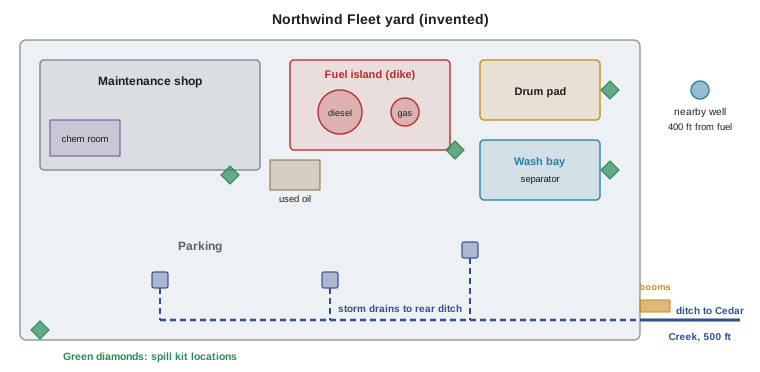
Step 1: inventory and risk assessment
The first step is to list every substance and every place it could escape, then rate the risks. The inventory includes diesel, gasoline, used oil, new engine and hydraulic oils in drums, antifreeze, windshield washer fluid, brake cleaner, parts washer solvent, battery acid in stored batteries, diesel exhaust fluid, and wash bay detergents. The table summarizes the main sources and pathways, and the code ranks them.
| Source | Largest credible spill | Pathway | Receptor |
|---|---|---|---|
| Fuel delivery overfill | Up to 100 gallons or more | Fuel pad to storm drain; sandy soil | Cedar Creek; neighbor's well |
| Diesel tank failure | 6,500 gallons (into dike) | Dike if intact; soil and ditch if not | Creek, well |
| Drum puncture on pad | 55 gallons | Pad edge to gravel and storm drain | Creek |
| Truck fuel tank leak in parking | 100 to 300 L | Pavement to catch basins | Creek |
| Shop spills | Small to moderate | Floor drains to separator and sewer | Sewer treatment plant |
| Wash bay separator bypass | Chronic oil discharge | Sanitary sewer | Treatment plant |
# Ranking Northwind's spill risks: likelihood (1-5) x consequence (1-5). Scores are a matter of opinion.
risks = [
    ("Fuel delivery overfill",          3, 5),
    ("Truck fuel tank leak in parking", 4, 4),
    ("Drum puncture on drum pad",       3, 4),
    ("Hydraulic hose burst in yard",    4, 3),
    ("Wash bay separator bypass",       3, 3),
    ("Diesel tank failure (in dike)",   1, 5),
    ("Shop chemical spill",             3, 2),
]
for name, l, c in sorted(risks, key=lambda r: r[1] * r[2], reverse=True):
    s = l * c
print(f"{name:<34} {s:>2} {'HIGH' if s >= 15 else 'medium' if s >= 8 else 'low'}")Truck fuel tank leak in parking 16 HIGH Fuel delivery overfill 15 HIGH Drum puncture on drum pad 12 medium Hydraulic hose burst in yard 12 medium Wash bay separator bypass 9 medium Shop chemical spill 6 low Diesel tank failure (in dike) 5 low
The ranking points to three priorities: fuel deliveries, leaks from trucks parked over storm drains, and the drum pad. A tank failure has a severe consequence but is unlikely, and the dike is the control, so its integrity and rainwater management matter. The wash bay separator is a chronic source that needs maintenance rather than emergency response.
Step 2: prevention
Prevention measures follow from the risks. For the fuel island: check the dike capacity, keep its drain valve locked and inspect rainwater before release; fit and test high-level alarms on both tanks; require an independent level check and an attended delivery with the supplier; label fill pipes; put a spill kit and a drain cover at the island; and fit an insert or valve on the nearest catch basin. For the parking area: inspect trucks for leaks during each service, use drip pans under leaking vehicles until repaired, and mark storm drains with a no-dumping message. For the drum pad: add spill pallets, a roof and bollards; keep only working stock outside; and move the pad away from the catch basin if possible. For the wash bay: pump out and inspect the separator on a schedule and keep records.
Worked problem
Checking the shared dike
The diesel tank holds 6,500 gallons and the gasoline tank 1,300 gallons. The dike is 30 feet by 20 feet with walls 2 feet high. Does it hold the largest tank plus a 10 % allowance for rain?
Show solution
- Requirement: 6,500 × 1.10 = 7,150 gallons, or about 956 cubic feet.
- Gross dike volume = 30 × 20 × 2 = 1,200 cubic feet, about 8,980 gallons.
- Subtract the volume taken up by the gasoline tank and footings below the wall height, roughly 100 cubic feet (about 750 gallons): about 8,230 gallons available.
- 8,230 gallons is above 7,150, so it passes, but rain reduces the margin. Rainwater must be removed promptly, and an engineer should confirm the design.
Answer: It passes, with limited margin. Locked drain valve, prompt removal of inspected rainwater and a roof or more frequent checks are needed.
# Northwind dike check (metric, Canadian rule). Tank displacement is an estimate.
diesel, gasoline = 25000, 5000
required = max(1.10 * diesel, diesel + 0.10 * gasoline)
gross = 9 * 6 * 0.6 * 1000
displacement = 3000                     # gasoline tank and footings below wall height (estimate)
available = gross - displacement
print(f"Required {required:,.0f} L; available about {available:,.0f} L; margin {available - required:,.0f} L")
rain_mm = 50
print(f"A {rain_mm} mm storm adds {9*6*rain_mm:,} L of water, leaving a margin of {available - required - 9*6*rain_mm:,.0f} L")Required 27,500 L; available about 29,400 L; margin 1,900 L A 50 mm storm adds 2,700 L of water, leaving a margin of -800 L
Step 3: equipment
Spill kits go where the risks are: a wheeled kit of at least 65 gallons capacity with drain covers at the fuel island; a 40-gallon kit in the shop; a kit on the drum pad; a kit at the wash bay; and small kits in every service truck. Because the yard drains to a trout stream, the plan adds a cache of oil-only booms and materials for an underflow dam at the rear ditch, near where the storm outfall enters it. Kits are inspected monthly with tamper seals and restocked after any use. Protective equipment in each kit matches the safety data sheets for fuels, oils and the shop chemicals.
Step 4: response levels and roles
The plan defines three levels. Level 1: small spills of known substances on pavement or the shop floor, with no pathway to drains or water, cleaned up by trained staff. Level 2: larger spills, any spill reaching a catch basin, the ditch or soil, or any uncertainty; the shift lead becomes spill coordinator, the site response team responds and regulatory reporting is assessed. Level 3: fire, strong vapor, injuries, a tank or dike failure, or oil reaching Cedar Creek; evacuate the area, call 911 and the spill contractor, and notify regulators. Each shift has a named spill coordinator and backup, a person to make calls and a person to meet responders at the gate.
Step 5: notification
The notification card at each kit lists: 911 for fire, injury or immediate danger; the shift spill coordinator; the operations manager; the National Response Center at 1-800-424-8802 for any oil sheen on the ditch or creek; the state spill line for spills at or above state thresholds or reaching soil or water; the sewer authority for spills to the sanitary sewer; the spill contractor; and CHEMTREC for chemical advice. Because the facility has more than 1,320 gallons of aboveground oil storage and could discharge to Cedar Creek, it needs an SPCC plan, and the plan notes the 60-day reporting rule for qualifying discharges. The neighbor with the well is on the list, to be contacted if a spill reaches soil near the fuel island, after discussion with the regulator.
Step 6: waste, training, drills and review
The plan names a licensed waste contractor, confirms Northwind's RCRA generator category for its used solvent and spill waste, and notes that a large spill could change the category for that month. It sets up a lined, covered storage area for spill waste with labels and accumulation dates. All shop and yard staff receive training on the plan when hired and every year, with hands-on practice placing drain covers and booms. The coordinator team runs two drills a year, one tabletop and one functional, and the plan is reviewed after each drill, each level 2 or 3 spill, at least yearly, and the SPCC plan at least every five years.
Testing the plan with a scenario
Worked problem
Scenario: a truck leaks fuel over a catch basin overnight
At 6:30 a.m., a technician finds diesel pooled around a catch basin under a parked truck. The truck's tank has a crack and is still dripping. A rainbow sheen is visible in the rear ditch. About 48 gallons is missing from the truck tank. Walk through the response.
Show solution
- Assess: diesel, no fire, no strong vapor in open air, no injuries. Remove ignition sources; do not start the truck.
- Stop the source: place a drain pan under the crack and transfer the remaining fuel, or plug the crack with leak-sealing putty.
- Contain: cover the catch basin, ring the pool with socks and soak up the pool with pillows.
- Downstream: the sheen means oil reached the ditch. Deploy booms and an underflow dam in the ditch before Cedar Creek.
- Notify: the coordinator calls the National Response Center because of the sheen, the state spill line, and the spill contractor to clean the storm line and ditch.
- Document: log times, take photos, estimate volume recovered, keep waste separate and labeled.
- Close out and investigate: why did the crack go unnoticed in the last service, and why was the truck parked over a drain?
Answer: A level 2 spill with reporting required because oil reached the ditch. Stop, contain at the drain and in the ditch, report, document, then fix the inspection and parking practices.
| Plan element | Northwind decision |
|---|---|
| Priority risks | Fuel deliveries, truck leaks over drains, drum pad |
| Key prevention | Alarms and attended deliveries, drip pans, drum pad roof and pallets, drain inserts |
| Containment check | Dike passes with limited margin; manage rainwater |
| Equipment | Kits at five locations and in trucks; booms and underflow dam materials at the ditch |
| Levels | Three levels, with a named coordinator and backup each shift |
| Notification | 911, NRC, state line, sewer authority, contractor, CHEMTREC |
| Waste | RCRA category known, licensed contractor, covered storage |
| Training and review | Yearly training, two drills a year, review after drills and spills |
Common mistakes
MistakeWriting a generic plan that does not mention the creek or the well.
InsteadBuild the plan around the site's actual pathways and receptors.
MistakeAssuming the dike is big enough without checking.
InsteadCalculate capacity, allow for tank displacement and rain, and manage rainwater.
MistakePutting all spill kits in the shop.
InsteadPlace kits at each risk point, plus booms where the yard drains to water.
MistakeListing only internal phone numbers.
InsteadInclude emergency services, regulators, the sewer authority, contractors and affected neighbors.
MistakeFinishing the plan and never drilling it.
InsteadDrill twice a year and review the plan after drills and spills.
Summary and key terms
- Start with an inventory and a risk assessment based on sources, pathways and receptors.
- Use the ranking to focus prevention on the highest risks.
- Check containment capacity, including tank displacement and rainwater.
- Place equipment at risk points, with extra capacity where the site drains to sensitive water.
- Define response levels and name roles and backups for every shift.
- Build a notification list that fits the jurisdiction and the site's receptors.
- Plan waste handling, training, drills and review so the plan stays current and works.
- Fleet maintenance yard
- A site where vehicles are serviced and fueled, with fuels, oils and chemicals on site.
- Inventory (spill planning)
- A list of every substance on site with quantities and locations.
- Largest credible spill
- The biggest release that could realistically happen from a source.
- Tank displacement
- The volume inside a dike taken up by tanks and footings, which reduces containment capacity.
- Catch basin insert
- A device fitted in a storm drain that can trap oil or be closed during a spill.
- Drip pan
- A tray placed under a leaking vehicle or machine to catch drips.
- Notification card
- A posted card listing the first calls to make after a spill.
- Scenario test
- Walking through a realistic spill to check that the plan works.
- Plan review
- A scheduled or triggered check that the plan still matches the site.
- Close-out investigation
- Finding and fixing the cause of a spill after the response.
Practice problems
Work each problem on paper first, then reveal the answer to check.
What were Northwind's three highest spill risks?
Show answer
Fuel delivery overfills, truck leaks over storm drains and drum punctures on the drum pad.
Why is the sandy soil important?
Show answer
Spills can soak in fast and travel toward the neighbor's well.
What volume must the shared dike hold with a 10 % rain allowance?
Show answer
About 7,150 gallons (110 % of 6,500 gallons).
Why must tank displacement be subtracted?
Show answer
Tanks and footings inside the dike take up space that cannot hold spilled liquid.
Why does Northwind keep booms near the rear ditch?
Show answer
The yard drains to a trout stream, so oil must be intercepted before it reaches the creek.
What makes a spill level 2 at Northwind?
Show answer
Larger spills, any spill reaching a catch basin, ditch or soil, or any uncertainty.
Why must Northwind call the NRC in the scenario?
Show answer
Oil caused a sheen in the ditch leading to the creek, which is federally reportable.
What should be done first when the truck is found leaking?
Show answer
Assess safely, then stop the source by catching or transferring fuel or plugging the crack.
How often should Northwind drill its plan?
Show answer
Twice a year: one tabletop and one functional drill.
What two practices did the scenario investigation question?
Show answer
Why the crack was missed at the last service and why the truck was parked over a drain.
Lesson quiz · 5 questions
Score 60% or more to complete this lesson.
Create a free account to save your progress, take quizzes and earn a certificate.