
HSE-251 · Lesson 5 of 12 · 27 min
Spill response planning
When a spill happens, there is no time to work out who should do what, where the spill kit is, which drain leads to the creek or which number to call. Those decisions have to be made in advance and written down in a spill response plan. A good plan is short enough to use under pressure, specific to the site, and known to everyone who works there. This lesson explains what a plan contains, which laws require formal plans, and how to keep a plan alive through training and drills.
Why a written plan
Spill response depends on speed and on doing things in the right order. In the first few minutes, people need to protect themselves, stop the source if they safely can, stop the spill from reaching drains and water, and call the right people. A written plan sets out that sequence, assigns roles, lists the equipment and where it is, and gives the phone numbers. It also shows regulators and courts that the employer took reasonable care. A plan that sits in a binder in an office that nobody visits does none of this. The plan must be used in training, practiced in drills and posted where spills are likely.
What the plan contains
Plans vary in length and format, but most contain the same core elements. The table below lists them. Small sites may combine them into a few pages; large sites with many hazardous substances need more detail and often separate procedures for each major hazard.
| Element | What it covers |
|---|---|
| Site description and map | Buildings, storage areas, tanks, drains and where they lead, nearby water and wells, access routes |
| Substance inventory | Each substance stored, maximum quantities, locations and safety data sheets |
| Risk assessment | Likely spill scenarios, largest credible spill and pathways to receptors |
| Roles and responsibilities | Who discovers and reports, who leads the response, who calls agencies, backups for each role |
| Response procedures | Step-by-step actions for small and large spills of each main substance type |
| Equipment | Spill kits, PPE and other equipment, their locations and how they are checked |
| Notification list | Internal contacts, emergency services, regulators, sewer authority, neighbors, contractors |
| Reporting | Thresholds, timelines and forms for regulatory and internal reports |
| Cleanup and waste | Approved contractors, waste handling and disposal arrangements |
| Training, drills and review | Who is trained, how often drills are held, when the plan is reviewed |
Defining spill sizes and response levels
Most plans classify spills into levels so that people know what they can handle and when to escalate. A typical scheme has three levels. A minor or incidental spill is small, of a known substance, contained on a surface without a pathway to drains or water, and safe to clean up with a local spill kit by trained workers wearing standard protective equipment. A moderate spill is larger or reaches soil or a drain, needs the site response team and more equipment, and usually must be reported. A major spill threatens people or the environment beyond the site, involves a hazardous substance that workers are not equipped to handle, or is too large to control, and needs evacuation and outside emergency responders.
| Level | Typical description | Who responds | Notification |
|---|---|---|---|
| 1 Minor | Small, known, contained, no pathway to drains or water | Trained workers with local spill kit | Supervisor; internal record |
| 2 Moderate | Larger, or reaches soil or drain, or uncertain hazard | Site response team | Management; regulators as thresholds require |
| 3 Major | Fire, toxic vapor, large volume, off-site impact or beyond site capability | Evacuate; emergency services and specialist contractors | Emergency services, regulators, neighbors |
The levels should match OSHA's distinction between incidental releases and emergency response. A level 1 spill is usually incidental and can be handled by trained workers in the area. Anything that requires an emergency response under HAZWOPER must be handled by responders trained to the appropriate level, and the employer's emergency response plan must say who they are.
Roles
Every plan needs clear roles, with named people and backups for every shift. The person who discovers a spill must know what to do first and whom to tell. A spill coordinator or incident commander takes charge, decides on the response level and directs the response. Someone calls emergency services and regulators. Someone meets responders at the gate and briefs them. Someone keeps a log of times, actions and decisions. On small sites one person may fill several roles; on large sites the roles follow the incident command system used by emergency services.
Formal plans required by law
Some sites must prepare formal plans under specific regulations. Facilities subject to the Spill Prevention, Control, and Countermeasure rule must prepare an SPCC plan. The rule applies to non-transportation facilities that could reasonably be expected to discharge oil to navigable waters or adjoining shorelines and have more than 1,320 US gallons of aboveground oil storage capacity (counting only containers of 55 gallons or more) or more than 42,000 gallons of completely buried capacity. A professional engineer must certify the plan, except that smaller qualified facilities may self-certify, and the plan must be reviewed at least every five years. Facilities that could cause substantial harm, such as large oil terminals, must also prepare a facility response plan under the Oil Pollution Act. Facilities with large quantities of certain chemicals may need a Clean Air Act risk management plan, and EPCRA requires reporting of hazardous chemical inventories. OSHA requires emergency action plans and, where employees respond to releases, an emergency response plan under HAZWOPER.
Worked problem
Does a farm need an SPCC plan?
A farm stores 1,000 gallons of diesel in one aboveground tank, 300 gallons of gasoline in another, and four 55-gallon drums of hydraulic oil. Does the SPCC rule apply?
Show solution
- Count containers of 55 gallons or more: 1,000 + 300 + 4 × 55 = 1,520 gallons.
- That is above the 1,320-gallon threshold for aboveground capacity.
- If a discharge could reasonably reach navigable water, for example through a ditch to a creek, the farm needs an SPCC plan.
- Under 10,000 gallons with no reportable discharges, the farm is likely a qualified facility and can self-certify, possibly using the Tier I template if no container exceeds 5,000 gallons.
Answer: Yes, if a discharge could reach navigable water. As a likely qualified facility, it can self-certify its plan.
# SPCC applicability check (US): count aboveground containers of 55 gallons or more.
containers_gal = {"diesel tank": 1000, "gasoline tank": 300, "hydraulic drum 1": 55,
                  "hydraulic drum 2": 55, "hydraulic drum 3": 55, "hydraulic drum 4": 55,
                  "5-gal oil cans x 6": 30}
counted = {k: v for k, v in containers_gal.items() if v >= 55}
total = sum(counted.values())
print("Counted containers:", ", ".join(counted))
print(f"Aboveground capacity counted: {total:,} gal (threshold 1,320 gal)")
print("Above threshold" if total > 1320 else "Below threshold")
print(f"That is about {total * 3.785:,.0f} L")Counted containers: diesel tank, gasoline tank, hydraulic drum 1, hydraulic drum 2, hydraulic drum 3, hydraulic drum 4 Aboveground capacity counted: 1,520 gal (threshold 1,320 gal) Above threshold That is about 5,753 L
Notification lists
The notification list is the part of the plan used most under pressure, so it must be accurate and easy to read. It should start with emergency services, then the internal spill coordinator and managers, then regulators with their numbers and what triggers a call, then the sewer authority or municipality, then spill contractors, and finally neighbors or downstream water users who must be warned. Numbers must be checked regularly, because people change jobs and agencies change numbers. Many sites post a laminated card at each spill kit with the first few calls to make.
For US sites the list typically includes 911 for fire, injury or immediate danger, the National Response Center at 1-800-424-8802, the state spill line, the state emergency response commission and local emergency planning committee where EPCRA applies, the sewer authority for spills to sewers, and CHEMTREC for chemical advice. Lesson 11 covers reporting in detail.
Training and drills
People do not remember a plan they have only read once. Everyone who works where spills could happen should be trained on the plan when they start, when it changes and at regular intervals, often yearly. Training should cover recognizing a spill, the first actions, the site's spill levels, where the kits are and how to use them, whom to call, and personal safety. Supervisors and spill team members need more detail.
Drills test whether the plan works. A tabletop exercise walks through a scenario around a table, testing decisions and communication. A functional drill has people actually deploy spill kits, cover drains and make practice calls. A full-scale exercise may involve outside responders. Each drill should end with a short review of what worked, what did not and what will change, and the changes should be made. Drills often reveal practical problems: an empty spill kit, a locked gate, a phone number that no longer works, drain covers that do not fit the drains.
Worked problem
Learning from a drill
During a drill, workers take 12 minutes to find and place a drain cover over the storm drain near the fuel pad, because the cover is kept in a locked shed. A real diesel spill there could reach the drain in two minutes. What should change?
Show solution
- The plan's assumption that the drain could be covered in time is wrong.
- Move a drain cover into an unlocked, clearly marked box beside the fuel pad, or install a permanent shut-off valve or insert on the drain.
- Add the change to the plan and retrain the people who refuel there.
- Repeat the drill to confirm the time is now short enough.
Answer: Put the drain cover where it is needed and retest. The drill did its job by exposing the gap before a real spill did.
Keeping the plan current
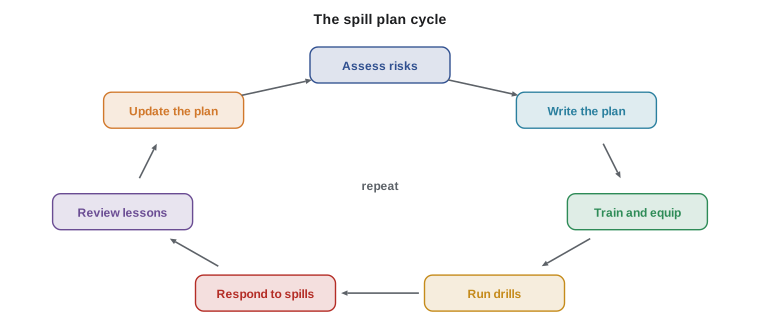
Plans go out of date when the site changes. New tanks, different chemicals, new buildings, changes to drains, new staff and new phone numbers all need updating. Most plans should be reviewed at least yearly and after every significant spill or drill, and formal plans have their own review requirements. Each version should show its date and what changed. Old copies should be removed from circulation so that nobody follows outdated instructions.
Common mistakes
MistakeKeeping the only copy of the plan in a locked office.
InsteadPost key parts at spill kits and work areas, and train everyone on them.
MistakeListing roles by job title without backups.
InsteadName people and backups for every shift.
MistakeWriting the plan once and never testing it.
InsteadRun drills, review them and update the plan.
MistakeExpecting all workers to handle any spill.
InsteadDefine spill levels and limit workers to what their training covers.
MistakeLeaving old phone numbers in the notification list.
InsteadCheck numbers regularly and after staff changes.
Summary and key terms
- A written spill plan sets the order of actions, roles, equipment and contacts in advance.
- Core elements include a site map with drains, an inventory, risks, roles, procedures, equipment, contacts, reporting, cleanup and training.
- Classify spills into levels so workers know what they can handle and when to escalate.
- SPCC plans are required above 1,320 gallons of aboveground oil capacity where discharges could reach water.
- Notification lists must be accurate, simple and posted where spills happen.
- Training and drills make the plan work; reviews after drills and spills keep it current.
- Update the plan whenever the site, substances or people change.
- Spill response plan
- A written plan setting out how a site will respond to spills.
- Spill coordinator
- The person who takes charge of a spill response and directs others.
- Incident command system
- A standard structure for managing emergencies with clear roles and a single commander.
- Response level
- A category of spill that decides who responds and who must be notified.
- Largest credible spill
- The biggest release that could realistically happen at a site, used for planning.
- Notification list
- The contacts to call after a spill, in order, with phone numbers.
- Tabletop exercise
- A discussion-based drill that walks through a scenario.
- Functional drill
- A drill in which people carry out real response actions such as deploying spill kits.
- Qualified facility
- Under SPCC, a smaller facility that may self-certify its plan.
- E2 plan
- An environmental emergency plan required under Canada's Environmental Emergency Regulations, 2019.
Practice problems
Work each problem on paper first, then reveal the answer to check.
Why should a spill plan be written in advance?
Show answer
So that roles, actions, equipment and contacts are decided before the pressure of a real spill.
Name five core elements of a spill plan.
Show answer
Any five of site map, inventory, risk assessment, roles, procedures, equipment, notification list, reporting, cleanup and waste, training and review.
What makes a spill level 1?
Show answer
Small, known substance, contained, no pathway to drains or water, safe for trained workers with a local kit.
What should workers do at a level 3 spill?
Show answer
Evacuate as the plan directs and call emergency services and specialists.
What aboveground capacity triggers the SPCC rule?
Show answer
More than 1,320 US gallons in containers of 55 gallons or more, where a discharge could reach navigable water.
What is the difference between a tabletop exercise and a functional drill?
Show answer
A tabletop discusses a scenario; a functional drill carries out real actions.
Why should roles name backups?
Show answer
Because the named person may be absent or off shift when a spill happens.
When should a plan be reviewed?
Show answer
At least yearly, after significant spills or drills, and when the site changes.
What did the drill in this lesson reveal?
Show answer
That the drain cover was locked away and could not be placed in time.
Where should the first calls be posted?
Show answer
On a card at each spill kit and in work areas.
Lesson quiz · 5 questions
Score 60% or more to complete this lesson.
Create a free account to save your progress, take quizzes and earn a certificate.