
HSE-251 · Lesson 2 of 12 · 29 min
Spill risks at work
Before you can prevent spills, you need to know where they are likely to happen. Most workplaces have a handful of activities that cause nearly all their spills: transferring liquids, storing containers, maintaining equipment, washing vehicles and floors, and receiving deliveries. A spill risk assessment walks through the site, lists each place where liquids are stored or moved, and asks three questions about each one. What could escape? How much, and how fast? Where would it go?
Where spills come from
Transfer is the riskiest activity at most sites. Every time a liquid moves from one container to another, it can overflow, splash, leak from a hose or fitting, or go into the wrong place. Fueling vehicles and equipment, filling day tanks, decanting chemicals into smaller containers, pumping out sumps and loading tanker trucks all involve transfer. Overfills during fuel deliveries are a classic cause of large spills: the driver pumps more than the tank can hold, often because a gauge is wrong or the overfill alarm has been disabled.
Storage is the next big source. Drums and totes get punctured by forklifts, corrode from the outside, or split when frozen. Tanks leak from corroded bottoms, failed welds or loose fittings. Containers stored outdoors fill with rainwater and overflow. Incompatible chemicals stored together can react if one leaks. Lesson 4 covers safe storage in detail, and HSE-312 covers chemical storage and compatibility more fully.
Equipment is a constant source of small spills. Hydraulic hoses burst on excavators, loaders and lifts. Engines and transmissions drip oil and coolant. Gearboxes leak. Compressors drain oily condensate. Mobile equipment working near water, such as on bridges, docks and shorelines, is a particular concern because even a small hose failure can put oil straight into a waterway.
Washing and cleaning move contaminants with water. Vehicle wash bays send oil, detergent and road grime to drains. Floor washing in shops can flush spilled oil and metal fines into sewers. Equipment cleaning with solvents creates waste that must be collected. Concrete truck washout is highly alkaline and harmful to fish if it reaches a stream.
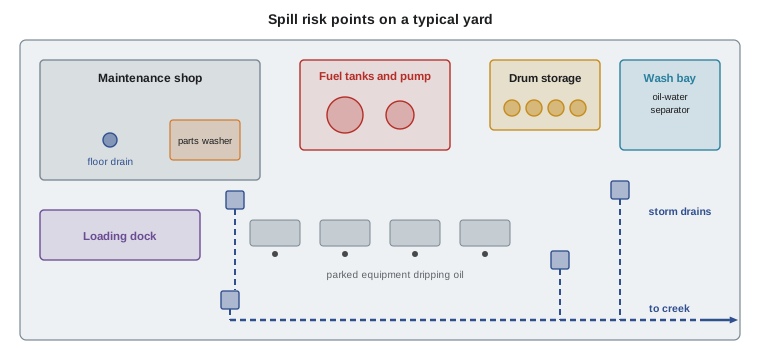
Thinking in terms of source, pathway and receptor
Environmental professionals use a simple model: source, pathway, receptor. The source is where the substance could escape. The pathway is how it would travel: across pavement, into a floor drain, into a storm drain, into soil, through groundwater or through the air as vapor. The receptor is what could be harmed: a worker, a neighbor, a creek, a wetland, a drinking water well, a sewage treatment plant. If any one of the three is missing, there is no risk to that receptor. Prevention works by controlling the source, cutting the pathway or protecting the receptor.
A drum of oil stored on a spill pallet inside a building with no floor drains has a source but almost no pathway. The same drum on gravel beside a ditch has a short pathway to a creek. A fuel tank uphill from a drinking water well has a pathway through soil and groundwater to a receptor that people depend on. Mapping these chains is the heart of a good spill risk assessment.
| Source | Possible pathways | Possible receptors |
|---|---|---|
| Fuel tank and pump | Pavement runoff, storm drain, soil, vapor | Workers (fire), creek, groundwater |
| Drum storage | Floor drain, door sill, rainwater overflow | Sanitary sewer, storm sewer, soil |
| Hydraulic equipment near water | Direct discharge | River, fish, birds |
| Wash bay | Floor drain, oil-water separator bypass | Sewer treatment plant, creek |
| Battery storage | Floor, drains, air (fumes) | Workers, sewer |
| Pesticide mixing area | Soil, runoff, well casing | Drinking water, creek, crops |
Knowing your drains
Drains are the most important pathways at most sites, and many workers do not know where they go. Buildings and yards usually have two separate systems. Sanitary sewers carry wastewater from toilets, sinks and some process drains to a sewage treatment plant. Storm sewers carry rainwater from roofs, parking lots and roads, usually without any treatment, straight to the nearest creek, river, lake or ditch. Some older cities have combined sewers that carry both and overflow into rivers in heavy rain.
Pouring oil into a storm drain is essentially pouring it into a creek. Pouring it into a sanitary sewer is not much better: sewage plants are not designed to treat fuels, solvents and many chemicals, and municipal sewer-use bylaws prohibit discharging them. Floor drains in older shops are sometimes connected to storm sewers by mistake, or to dry wells that drain straight into the ground. Every site should have a drain map that shows where each drain goes, and drains near spill risks should be clearly labeled, for example with a painted marking that says the drain leads to a creek.
Worked problem
Tracing a floor drain
A maintenance shop has a floor drain near the parts washer. Nobody knows where it goes. How can the site find out, and why does it matter?
Show solution
- Check building drawings and the site drain map, if there is one.
- Ask the municipality or a plumber whether the building connects to sanitary or storm sewer at that point.
- A dye test, in which a plumber puts a harmless dye into the drain and watches where it appears, can confirm the connection.
- If the drain leads to storm sewer, a dry well or the ground, it must be sealed, connected to a proper treatment system, or protected with a drain cover and a no-liquids rule.
Answer: Trace it with drawings, the municipality or a dye test. If it leads anywhere other than an approved system, any spill near the parts washer could go straight to the environment.
Rating spill risks
Once the sources are listed, it helps to rate them so that effort goes where it matters most. A simple method multiplies a likelihood score by a consequence score. Likelihood reflects how often the activity happens, how reliable the equipment is and whether there have been past spills. Consequence reflects the volume that could escape, how hazardous the substance is and how short the pathway to a sensitive receptor is. The highest scores get attention first.
# A simple spill risk ranking: likelihood (1-5) x consequence (1-5). Illustrative site.
sources = [
    ("Fuel delivery to main tank",     3, 5),
    ("Drum storage on gravel by ditch", 4, 4),
    ("Excavator working at riverbank",  3, 5),
    ("Parts washer near floor drain",   3, 3),
    ("Battery shelf in shop",           2, 3),
    ("Antifreeze top-ups in yard",      4, 2),
]
ranked = sorted(sources, key=lambda s: s[1] * s[2], reverse=True)
for name, like, cons in ranked:
    score = like * cons
    level = "high" if score >= 15 else "medium" if score >= 8 else "low"
print(f"{name:<34} L{like} x C{cons} = {score:>2} {level}")Drum storage on gravel by ditch L4 x C4 = 16 high Fuel delivery to main tank L3 x C5 = 15 high Excavator working at riverbank L3 x C5 = 15 high Parts washer near floor drain L3 x C3 = 9 medium Antifreeze top-ups in yard L4 x C2 = 8 medium Battery shelf in shop L2 x C3 = 6 low
The numbers in such a ranking are judgments, not measurements, and two people may score the same source differently. The value lies in the discussion: walking the site together, agreeing on what could go wrong, and producing a short list of the places that need better containment, procedures or spill kits.
Human factors
Equipment fails, but people cause or worsen most spills. Common human factors include rushing, leaving a transfer unattended, skipping a pre-use inspection, using the wrong container, overfilling because a gauge was not checked, disabling an alarm that kept going off, and not reporting a small leak because it seemed unimportant. Fatigue, poor lighting, unclear labels and confusing valve arrangements make errors more likely.
Good design and procedures make the safe action the easy action. Fill pipes are labeled with the product they take, so diesel cannot easily go into the gasoline tank. Automatic shut-off nozzles stop flow when a container is full. Transfers are never left unattended. Valves are locked when not in use. Workers are encouraged, not blamed, when they report small leaks and near misses, because those reports reveal problems before they cause a large spill.
Worked problem
An overfill during a fuel delivery
A supplier delivers diesel to a 1,300-gallon aboveground tank. The gauge reads half full, so the driver pumps 650 gallons. Fuel starts pouring from the vent. What went wrong, and how could it have been prevented?
Show solution
- The gauge was wrong: the tank was fuller than it showed. A stuck float gauge is a common cause.
- No one dipped the tank or checked the level independently before the delivery.
- There was either no overfill alarm or high-level shut-off, or it did not work.
- Prevention: check the level independently, order a volume that leaves room, test gauges and alarms regularly, and have someone watch the vent and stop the pump at the first sign of trouble.
Answer: A faulty gauge combined with no independent check and no working overfill protection. Simple checks and maintained alarms would have prevented it.
Seasonal and site-specific risks
Weather changes spill risks. Spring thaw and heavy rain overload containment areas and wash spills off pavement. Freezing splits containers and hoses and can crack tanks if water collects inside. Hot weather increases vapor from fuels and solvents and can make sealed containers bulge. Floods can lift tanks off their foundations and carry drums away. A spill risk assessment should consider what happens in each season, not just on a dry summer day.
Some sites have special risks. Farms handle large volumes of fuel, fertilizer, pesticides and manure, often near wells and streams. Construction sites move fuel to temporary tanks and equipment that work near watercourses. Laboratories store many small containers of different chemicals. Marinas fuel boats over water. Fuel stations, covered in HSE-351, handle large volumes of gasoline and diesel with frequent transfers by the public. Each needs a risk assessment that fits its activities.
Worked problem
Rating a construction site risk
A contractor will park a 2,000 L fuel trailer on a site 20 m from a creek for six months. Excavators will be refueled there daily. How should this be rated, and what controls make sense?
Show solution
- Likelihood is moderate to high: daily transfers over six months.
- Consequence is high: diesel, a short pathway to a creek, and fish habitat.
- Controls: move the trailer as far from the creek as practical, use a double-walled trailer or place it in secondary containment, refuel on a lined pad with a spill kit beside it, never leave the nozzle unattended, and keep drain or culvert covers ready.
- Check what setback distances the permit, municipality or environmental regulator requires for fuel storage near water.
Answer: A high-priority risk. Distance, containment, a refueling pad, attended transfers and a nearby spill kit reduce it to an acceptable level.
Common mistakes
MistakeAssuming storm drains go to a treatment plant.
InsteadMost storm drains discharge untreated to the nearest water body.
MistakeLeaving a fuel transfer running while doing another job.
InsteadAttend every transfer from start to finish.
MistakeDisabling an overfill alarm because it is annoying.
InsteadFix the cause of false alarms and keep the alarm working.
MistakeDoing the risk assessment once, on a dry day.
InsteadConsider rain, thaw, frost, heat and floods, and review the assessment when things change.
MistakeIgnoring small drips because they are not real spills.
InsteadReport and fix small leaks; they add up and signal bigger failures.
Summary and key terms
- Most workplace spills come from transfer, storage, equipment, washing and deliveries.
- Use the source, pathway and receptor model to understand each risk.
- Know where every drain goes; storm drains usually lead straight to water.
- Rank risks by likelihood and consequence and act on the highest first.
- Human factors such as rushing and unattended transfers cause many spills.
- Design and procedures should make the safe action the easy one.
- Seasons and site type change the risks, so review the assessment regularly.
- Source
- The place where a substance could escape, such as a tank, drum or hose.
- Receptor (spills)
- Something that could be harmed, such as a worker, creek or well.
- Storm sewer
- A drain system that carries rainwater, usually untreated, to a water body.
- Sanitary sewer
- A drain system that carries wastewater to a sewage treatment plant.
- Combined sewer
- An older system that carries both stormwater and sewage and can overflow in heavy rain.
- Drain map
- A site plan showing every drain and where it discharges.
- Dye test
- A test in which harmless dye is put into a drain to find where it comes out.
- Overfill
- Filling a container beyond its capacity so that liquid escapes.
- Spill risk assessment
- A structured review of where spills could happen, how big they could be and where they would go.
- Near miss
- An event that could have caused a spill or injury but did not.
Practice problems
Work each problem on paper first, then reveal the answer to check.
Name the activity that causes the most spills at many sites.
Show answer
Transferring liquids from one container to another, including fueling and deliveries.
What are the three parts of the source, pathway, receptor model?
Show answer
Where the substance escapes, how it travels, and what it could harm.
Where does a typical storm drain discharge?
Show answer
Untreated, to the nearest creek, river, lake or ditch.
Why should oil not go into a sanitary sewer?
Show answer
Treatment plants are not designed for it, and sewer-use bylaws prohibit it.
How can you find where an unknown floor drain goes?
Show answer
Check drawings, ask the municipality or a plumber, or do a dye test.
A source scores likelihood 4 and consequence 4. What is its risk score?
Show answer
16, which would usually be rated high.
Give two human factors that cause spills.
Show answer
Any two of rushing, leaving transfers unattended, skipping inspections, wrong containers, disabled alarms, not reporting leaks.
Why is a faulty tank gauge dangerous during a delivery?
Show answer
The driver may pump more than the tank can hold and overfill it.
How does freezing weather cause spills?
Show answer
Water freezing inside containers, hoses or tanks can split or crack them.
Why is concrete washout a concern near streams?
Show answer
It is strongly alkaline and harmful to fish.
Lesson quiz · 5 questions
Score 60% or more to complete this lesson.
Create a free account to save your progress, take quizzes and earn a certificate.