
HSE-251 · Lesson 8 of 12 · 27 min
Land spills, soil and groundwater
A spill on concrete or asphalt stays mostly on the surface, where it can be absorbed and collected. A spill on gravel, soil, grass or snow behaves very differently. The liquid soaks in, and once it is below the surface it is out of sight, hard to recover and able to travel. Fuels and solvents that reach groundwater can contaminate wells and streams for decades. This lesson explains how liquids move in soil, what first responders can do on unpaved ground, and why the later stages of soil and groundwater cleanup need environmental professionals.
How liquids move in soil
Soil is a mixture of mineral grains, organic matter and pore spaces filled with air and water. When a liquid spills on soil, gravity pulls it downward through the pores, while capillary forces spread it sideways. In coarse soils such as sand and gravel, liquid drains down quickly. In fine soils such as clay, it moves slowly and spreads more sideways, but cracks, root holes and old burrows can still carry it deep. Some of the liquid stays behind, clinging to soil grains as it passes, which is why even a small spill leaves a contaminated column of soil.
Below a certain depth, the pores are completely filled with water. The top of this saturated zone is the water table, and the water below it is groundwater. Groundwater is not an underground lake; it is water held in the pores of soil and rock, moving slowly from higher ground toward springs, streams, lakes and wells. Depending on the site, the water table may be a meter below the surface or many meters down, and it rises and falls with the seasons.
Floaters and sinkers
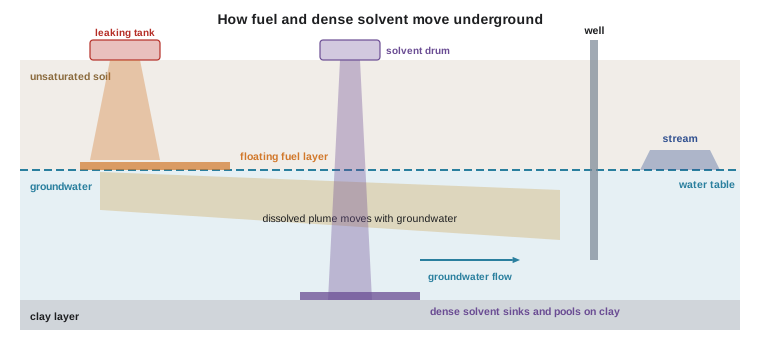
What happens at the water table depends on the liquid. Fuels and most oils are lighter than water and do not mix with it. When they reach the water table, they spread out as a floating layer, sometimes called free product or light non-aqueous phase liquid, or LNAPL. Some components, especially benzene, toluene, ethylbenzene and xylenes, known as BTEX, dissolve slowly into the groundwater and travel with it as a dissolved plume, which can reach far beyond the original spill.
Chlorinated solvents such as trichloroethylene and tetrachloroethylene, once common in degreasing and dry cleaning, are denser than water. They sink below the water table and can collect in pools on clay layers or bedrock, slowly dissolving for decades. These dense non-aqueous phase liquids, or DNAPLs, are among the hardest contaminants to clean up. Water-soluble chemicals such as glycols, some pesticides and road salt mix directly with groundwater and travel with it.
| Type | Examples | Behavior in groundwater |
|---|---|---|
| Light, insoluble (LNAPL) | Gasoline, diesel, heating oil, lubricating oil | Floats on the water table; BTEX dissolves into a plume |
| Dense, insoluble (DNAPL) | Chlorinated solvents, creosote, some heavy oils | Sinks, pools on low-permeability layers, dissolves slowly |
| Soluble | Glycols, road salt, nitrate, some pesticides | Mixes with groundwater and travels with it |
How fast groundwater moves
Groundwater moves much more slowly than surface water, usually centimeters to meters a day. Its speed depends on how easily water passes through the soil, called hydraulic conductivity, how steeply the water table slopes, called the hydraulic gradient, and how much of the soil is open pore space, called porosity. A simple form of Darcy's law estimates the average speed of the water through the pores:
Here \( v \) is the average groundwater velocity, \( K \) is the hydraulic conductivity, \( i \) is the hydraulic gradient and \( n \) is the effective porosity. Dissolved contaminants usually move a little slower than the water because they stick to soil, but the estimate shows the order of magnitude.
# Average groundwater velocity v = K * i / n for different soils (illustrative values).
soils = {"gravel": 1e-2, "clean sand": 1e-4, "silty sand": 1e-6, "clay": 1e-9}   # K in m/s
i, n = 0.01, 0.30                                     # gradient (1 m per 100 m), porosity
for soil, K in soils.items():
    v = K * i / n                                     # m/s
    per_day, per_year = v * 86400, v * 86400 * 365
    print(f"{soil:<11} K={K:.0e} m/s -> {per_day:9.4f} m/day, {per_year:10.2f} m/year")
d = 200
v_sand = 1e-4 * i / n * 86400
print(f"Time for water to travel {d} m through clean sand: about {d / v_sand:.0f} days")gravel K=1e-02 m/s -> 28.8000 m/day, 10512.00 m/year clean sand K=1e-04 m/s -> 0.2880 m/day, 105.12 m/year silty sand K=1e-06 m/s -> 0.0029 m/day, 1.05 m/year clay K=1e-09 m/s -> 0.0000 m/day, 0.00 m/year Time for water to travel 200 m through clean sand: about 694 days
In clean sand, groundwater can travel a hundred meters in a year, so a fuel plume can reach a well across the road within a few years. In clay, the same distance could take thousands of years. This is why site geology matters so much: the same spill can be a minor local problem on clay and a regional water supply problem on sand and gravel.
Why small spills matter to groundwater
Very small amounts of some contaminants make large volumes of water unfit to drink. Benzene, a component of gasoline, is a known human carcinogen. Health Canada's drinking water guideline and the US Environmental Protection Agency's maximum contaminant level for benzene are both 0.005 milligrams per liter, or 5 micrograms per liter. The example below shows how much water the benzene in a single liter of gasoline could contaminate to that level if it all dissolved.
# How much water could the benzene in 1 L of gasoline contaminate? (illustrative)
gasoline_density_kg_per_L = 0.74
benzene_fraction = 0.01          # roughly 1 % by mass in modern North American gasoline
limit_ug_per_L = 5               # drinking water limit for benzene (Canada and US)
benzene_ug = 1 * gasoline_density_kg_per_L * benzene_fraction * 1e9   # micrograms
water_L = benzene_ug / limit_ug_per_L
print(f"Benzene in 1 L of gasoline: about {benzene_ug/1e6:.1f} g")
print(f"Water it could take to the drinking water limit: about {water_L:,.0f} L")
print(f"That is roughly {water_L/2500:,.0f} household water tanks of 2,500 L,")
print(f"or about {water_L/3.785:,.0f} US gallons")Benzene in 1 L of gasoline: about 7.4 g Water it could take to the drinking water limit: about 1,480,000 L That is roughly 592 household water tanks of 2,500 L, or about 391,017 US gallons
Not all the benzene would dissolve, and much would evaporate or break down, so the real figure is smaller. But the point stands: a few liters of fuel soaking into the ground near a well is a serious matter, and spills to bare ground must be dealt with quickly.
First response on unpaved ground
The goals on soil are the same as on pavement: stop the source, stop the spread and recover as much liquid as possible before it soaks in. Speed matters even more, because every minute more liquid moves below the surface. Stop the source if safe. Contain the spill with socks or by scraping up a small earth berm downhill of it. If liquid is pooling, soak it up with pillows and pads or pump it into a container. Cover the area with plastic sheeting if rain is coming, because rain drives contamination deeper and spreads it. Do not flush the area with water.
Mark the area so that nobody drives over it or digs in it, which can spread contamination. For small spills on soil, the site plan may allow trained workers to dig out the visibly stained soil into lined containers, with care not to spread it. For anything larger, or where the spill may have gone deep or reached groundwater, the plan should call in an environmental consultant or spill contractor. Excavation can disturb buried utilities, so call for a locate before digging, as covered in HSE-217.
Worked problem
A diesel spill on gravel
A fuel truck's tank is punctured while parked on a gravel lot, and about 40 gallons of diesel runs onto the gravel before the leak is stopped. What should happen?
Show solution
- Stop the source: the driver plugs the hole or transfers the remaining fuel. Remove ignition sources.
- Contain any surface flow with socks, and cover any nearby catch basin or ditch.
- Soak up pooled fuel; it will soak into gravel quickly, so recover what you can fast.
- Check state reporting thresholds; many states require reports of petroleum spills to soil at or above a set volume, often 25 gallons or less.
- Call the spill contractor or consultant to excavate contaminated gravel and soil and test what remains.
Answer: Stop, contain and recover quickly, report, and arrange professional excavation and testing.
Snow, ice and frozen ground
Winter changes how spills behave. Snow absorbs liquid like a sponge, which can help: contaminated snow can be scooped into lined containers before it melts. But snow also hides spills, and when it melts in spring the contamination is released to soil and drains. Frozen ground slows downward movement, so liquid spreads across the surface instead, often farther than expected. Ice on a lake or river can hold a spill on top for collection, but cracks and open water can let it through. Cold temperatures make oils thicker and slower to evaporate. Mark winter spill areas so that they can be checked after melt.
After the first response
Spills that reach soil and groundwater usually need investigation by qualified environmental professionals. They take soil and water samples, compare results with state cleanup standards, and design a cleanup. States set soil and groundwater cleanup levels, often drawing on EPA risk-based screening levels, and many run voluntary cleanup programs. Cleanup may involve excavation and disposal, pumping out free product, treating groundwater, or allowing natural breakdown with monitoring. Leaks from regulated underground storage tanks follow specific federal and state tank rules.
The first responder's job in this phase is to give the professionals good information: what spilled, how much, when, where it went, what was done and where any recovered liquid and contaminated material went. Photos and a sketch of the spill area made at the time are very valuable.
Worked problem
Thinking about a well
A farm spills about 20 L of pesticide concentrate while mixing it beside a domestic well. The soil is sandy. Why is this urgent, and what should be done?
Show solution
- Sandy soil drains fast and the well is a direct receptor; spills near the wellhead can also run down the outside of the casing.
- Stop and contain the spill, soak up all free liquid and keep it away from the wellhead.
- Report it as the provincial or state rules require, and follow the pesticide label's spill instructions.
- Arrange professional advice; the well water may need testing, and people should not drink it until it is shown to be safe.
Answer: The short path through sand to a drinking water well makes this urgent. Contain and recover, report, and have the well tested before use. Mixing should be moved well away from wells in future.
Common mistakes
MistakeLeaving a spill on gravel because it seems to have disappeared.
InsteadIt has soaked in; recover what you can and arrange excavation and testing.
MistakeFlushing a soil spill with water.
InsteadNever flush; water drives contamination deeper and spreads it.
MistakeDigging out stained soil without a utility locate.
InsteadCall for a locate before excavating and follow the plan.
MistakeLeaving contaminated snow to melt.
InsteadCollect it in lined containers and check the area after melt.
MistakeMixing chemicals or fueling right beside a well.
InsteadKeep transfers well away from wells and protect wellheads.
Summary and key terms
- Liquids soak into unpaved ground quickly, out of sight and hard to recover.
- Fuels float on the water table; dense solvents sink; soluble chemicals travel with groundwater.
- Groundwater speed depends on soil, gradient and porosity: fast in sand and gravel, very slow in clay.
- Tiny amounts of benzene can make large volumes of water unfit to drink.
- On soil, stop, contain and recover quickly, cover from rain and never flush with water.
- Snow and frozen ground change spill behavior; collect contaminated snow.
- Soil and groundwater cleanup needs qualified professionals and good records from responders.
- Water table
- The top of the saturated zone, below which all soil pores are filled with water.
- Groundwater
- Water held in the pores of soil and rock below the water table.
- Hydraulic conductivity
- How easily water passes through soil or rock.
- Hydraulic gradient
- The slope of the water table, which drives groundwater flow.
- Porosity
- The fraction of soil volume that is open pore space.
- LNAPL
- Light non-aqueous phase liquid, such as fuel, that floats on the water table.
- DNAPL
- Dense non-aqueous phase liquid, such as a chlorinated solvent, that sinks below the water table.
- BTEX
- Benzene, toluene, ethylbenzene and xylenes, the more soluble components of fuels.
- Dissolved plume
- A zone of groundwater containing dissolved contaminants spreading from a source.
- Free product
- Spilled liquid present as a separate layer, not dissolved in water.
Practice problems
Work each problem on paper first, then reveal the answer to check.
Why are spills on soil harder to deal with than spills on pavement?
Show answer
They soak in out of sight, are hard to recover and can travel to groundwater.
What happens to gasoline when it reaches the water table?
Show answer
It floats as a layer, and components such as benzene dissolve into a plume.
Why are chlorinated solvents so hard to clean up?
Show answer
They are denser than water and sink to pool on low-permeability layers, dissolving slowly.
Write Darcy's law for average groundwater velocity.
Show answer
v = K i / n.
Roughly how far can groundwater move in a year in clean sand, in the lesson example?
Show answer
About 100 meters.
What is the drinking water limit for benzene in Canada and the US?
Show answer
0.005 mg/L, or 5 micrograms per liter.
Why cover a soil spill with plastic before rain?
Show answer
Rain drives contamination deeper and spreads it.
What must happen before excavating contaminated soil?
Show answer
A utility locate, and excavation following the plan.
How should contaminated snow be handled?
Show answer
Scooped into lined containers before it melts, and the area checked after melt.
What information should responders give environmental professionals?
Show answer
What spilled, how much, when, where it went, what was done, where recovered material went, plus photos and a sketch.
Lesson quiz · 5 questions
Score 60% or more to complete this lesson.
Create a free account to save your progress, take quizzes and earn a certificate.