
HSE-251 · Lesson 10 of 12 · 28 min
Cleanup, decontamination and waste management
Once a spill is stopped and contained, the work is not over. The liquid has to be recovered, surfaces cleaned, tools and people decontaminated, and every pad, sock, glove and shovelful of soil handled as waste. Done well, cleanup leaves the area safe and the waste properly documented. Done badly, it spreads contamination, exposes workers and creates a second violation when contaminated waste ends up in the regular garbage. This lesson covers each stage and the waste rules that apply.
Recovering the spilled material
Recover as much liquid as possible before using absorbents, because absorbents turn a liter of liquid into several kilograms of solid waste. Pump or scoop pooled liquid into a compatible container. Then soak up what remains with absorbents, working from the outside of the spill toward the center so that the spill does not spread. Leave absorbents in place long enough to soak up the liquid, then collect them with a non-sparking shovel or by hand with gloves, and place them in heavy-duty bags or a drum. Do not overfill bags; a bag of saturated absorbent is heavy and can split.
For powders and granular solids, avoid creating dust. Scoop or vacuum with a vacuum rated for the material, rather than dry sweeping. For broken containers, place the leaking container in an overpack drum or salvage drum. For mercury from broken thermometers or switches, use a mercury spill kit; never vacuum mercury with an ordinary vacuum, which spreads vapor.
Cleaning the surface
After the bulk of the spill is recovered, a film usually remains on the surface. Use granular absorbent worked into the surface and swept up, or a cleaner recommended for the substance, applied sparingly and recovered with absorbent. Do not wash the area down with a hose, because that sends the remaining contamination to drains and soil. On porous surfaces such as concrete, some staining may remain; that is normal, but it should not be left slippery or giving off odor. On soil, as lesson 8 explained, contaminated soil may need to be excavated by a contractor.
Decontamination
Decontamination removes the spilled substance from people, tools and equipment so that it does not spread or harm anyone later. For small oil and fuel spills, this usually means removing gloves and disposable coveralls carefully, turning them inside out as they come off, placing them with the spill waste and washing hands and any exposed skin. Reusable tools such as shovels and squeegees are wiped clean with absorbent and a suitable cleaner, and the wipes go into the waste. For hazardous chemicals, decontamination follows the safety data sheet and the site plan and may involve a set sequence of washing stations.
Never take contaminated clothing home to wash with family laundry. Clothing soaked with fuel or solvent is a fire hazard and can expose others; it should be removed promptly, bagged and either cleaned by a service that handles contaminated workwear or disposed of as spill waste. Workers who were splashed should follow the first aid measures in section 4 of the safety data sheet.
| Item | How to decontaminate or dispose |
|---|---|
| Disposable gloves and coveralls | Remove inside out; bag with spill waste |
| Reusable gloves, boots, aprons | Wash with suitable cleaner; inspect; dispose of if damaged or soaked |
| Shovels, squeegees, pumps | Wipe and clean; collect wipes and rinse with the waste |
| Skin | Wash with soap and water; follow SDS first aid |
| Contaminated work clothing | Bag; send to an approved cleaner or dispose of as waste; never wash at home |
Spill waste is waste
Everything that touched the spill is waste: used absorbents, pads, booms, rags, contaminated soil and gravel, recovered liquid, disposable protective equipment and broken containers. Whether that waste is hazardous depends on what was spilled and the rules where you are. Absorbents soaked with gasoline or solvent, acids or pesticides are usually hazardous waste. Absorbents with used motor oil may be managed under used oil or waste oil rules. Absorbents from a spill of water-based paint may not be hazardous at all. The safety data sheet, the site's waste procedures and, where needed, laboratory testing decide.
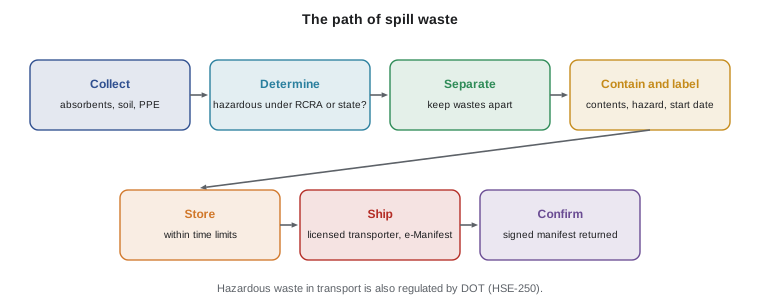
The basic rules are the same everywhere. Keep spill waste separate from regular garbage and from other wastes it could react with. Put it in containers that are compatible with it, closed and in good condition. Label every container with what is inside, the hazard and the date. Store it in a secure area with secondary containment, out of the rain, until it is picked up by a licensed waste carrier and taken to an authorized facility. Never put spill waste in the regular garbage, burn it, bury it on site or pour recovered liquid down a drain.
Hazardous waste rules in the United States
In the United States, hazardous waste is regulated under the Resource Conservation and Recovery Act, usually through state programs that may be stricter than the federal rules. A generator's category depends on how much hazardous waste it produces in a calendar month. A very small quantity generator produces 100 kilograms or less of non-acute hazardous waste a month; a small quantity generator more than 100 but less than 1,000 kilograms; and a large quantity generator 1,000 kilograms or more, or more than 1 kilogram of acute hazardous waste. Small and large quantity generators must use the uniform hazardous waste manifest, which is now tracked electronically through EPA's e-Manifest system, and must meet accumulation time limits and training requirements. Used oil, including absorbents with used oil that are not hazardous waste, may be managed under the separate used oil management standards. While on the road, hazardous waste is also a hazardous material under DOT rules, covered in HSE-250.
| Generator category | Monthly hazardous waste generated |
|---|---|
| Very small quantity generator (VSQG) | 100 kg or less of non-acute waste and 1 kg or less of acute waste |
| Small quantity generator (SQG) | More than 100 kg and less than 1,000 kg |
| Large quantity generator (LQG) | 1,000 kg or more, or more than 1 kg of acute hazardous waste |
| Manifest | SQGs and LQGs ship with the uniform manifest through e-Manifest |
| States | May set stricter categories, fees and reporting |
How much waste a spill creates
Spill waste is heavier than people expect. Absorbents hold several times their own weight of liquid, and the saturated material weighs about the same as the liquid plus the absorbent. Contaminated soil weighs around 1.5 to 2 metric tons per cubic meter. A modest spill can therefore create enough waste to change a site's waste category or fill a bin, as the example shows.
# Waste created by a 60 L diesel spill cleaned up with absorbents (illustrative).
spill_L = 60
recovered_by_pump_L = 20                 # liquid pumped straight into a drum
diesel_kg_per_L = 0.84
to_absorb_L = spill_L - recovered_by_pump_L
absorbent_capacity = 3.0                 # L absorbed per kg of absorbent (product dependent)
absorbent_kg = to_absorb_L / absorbent_capacity * 1.5    # 1.5x: absorbents are never fully used
waste_solid_kg = absorbent_kg + to_absorb_L * diesel_kg_per_L + 3   # + gloves, bags, PPE
print(f"Pumped liquid: {recovered_by_pump_L} L ({recovered_by_pump_L*diesel_kg_per_L:.0f} kg)")
print(f"Absorbent used: about {absorbent_kg:.0f} kg")
print(f"Solid spill waste: about {waste_solid_kg:.0f} kg ({waste_solid_kg*2.2:.0f} lb)")
soil_m3 = 0.5
print(f"If 0.5 m3 of soil must also be dug out: about {soil_m3*1.8:.1f} t more")Pumped liquid: 20 L (17 kg) Absorbent used: about 20 kg Solid spill waste: about 57 kg (125 lb) If 0.5 m3 of soil must also be dug out: about 0.9 t more
In the United States, hazardous spill waste counts toward the month's generation. A site that is normally a very small quantity generator could become a small quantity generator for that month because of one cleanup, which brings additional requirements. EPA rules provide some flexibility for episodic events such as spills, but sites must follow specific notification and management conditions; check the current rules and your state's requirements.
Worked problem
Is the waste hazardous?
A shop cleans up three spills in a month: 10 L of used motor oil, 5 L of brake cleaner (a chlorinated solvent) and 20 L of water-based floor finish. How should the waste be handled?
Show solution
- Keep each spill's waste separate; do not mix them in one drum.
- Used motor oil absorbents: usually managed under used oil or waste oil rules, often collected by a used oil recycler; check the local rules.
- Brake cleaner absorbents: chlorinated solvent waste is usually hazardous waste and must go through a licensed hazardous waste carrier with the proper documents.
- Water-based floor finish: check the safety data sheet; it may be non-hazardous and acceptable as regular industrial waste, but confirm before disposing of it.
Answer: Separate, identify each waste from its SDS and the rules, and send each to the right route. Mixing them could make all of it hazardous waste.
Closing out the spill
Before the response is declared finished, the area should be checked: no free liquid, no slippery film, no strong odor, drains clear and drain covers removed only after the area is clean. Spill kits are restocked. Equipment is cleaned and returned. Waste is labeled and stored for pickup. The spill report is completed, including the estimated volume, how much was recovered, where the waste went and photos. Finally, the cause should be investigated and fixed, so that the same spill does not happen again; HSE-403 covers incident investigation and root cause analysis in depth.
Worked problem
Closing out a drum spill
A forklift punctured a drum of hydraulic oil in a warehouse. About 32 gallons was recovered by pumping and absorbing. What should the close-out include?
Show solution
- Inspect the floor: no free oil or slippery film; any floor drain checked and still protected until clean.
- Place the damaged drum in an overpack drum; label all waste containers and move them to the waste storage area.
- Restock the spill kit and clean the pump and tools.
- Complete the spill report with volumes, actions, waste details and photos; confirm whether any report to regulators was needed.
- Investigate why the forklift punctured the drum, for example aisle width, drum position or training, and fix it.
Answer: Area checked, waste contained and labeled, equipment restored, report completed and the cause investigated.
Recovered product and reuse
Sometimes recovered liquid can be reused or recycled instead of disposed of. Clean diesel pumped from a containment area into a clean, compatible container may be usable again if it has not been contaminated with water, dirt or absorbent. Used oil recovered from a spill can often go to a used oil recycler. Reuse should be decided by the supervisor following the site's procedures, because contaminated fuel can damage engines and mixed liquids may be hazardous waste. When in doubt, treat recovered liquid as waste.
Storing spill waste safely matters until it leaves the site. Bags of oily absorbent can leak and attract animals; drums can corrode; rags soaked with some oils and finishes can heat up and catch fire on their own as they oxidize. Keep spill waste in closed metal or approved containers, out of the sun and rain, away from ignition sources, and arrange pickup promptly rather than letting it build up.
Common mistakes
MistakePutting used absorbent pads in the regular garbage.
InsteadTreat spill waste as waste: identify it, contain it and send it through the right route.
MistakeHosing the remaining film into a drain.
InsteadClean with absorbent and a suitable cleaner; recover everything.
MistakeMixing wastes from different spills in one drum.
InsteadKeep wastes separate so they can be identified and managed correctly.
MistakeTaking fuel-soaked clothing home to wash.
InsteadBag it for an approved cleaner or dispose of it as waste.
MistakeDeclaring the spill finished without finding the cause.
InsteadInvestigate and fix the cause as part of close-out.
Summary and key terms
- Recover liquid first, then absorb from the outside in, and collect waste in compatible containers.
- Clean surfaces without washing contamination to drains.
- Decontaminate people, tools and clothing; never take contaminated clothing home.
- All spill waste is waste; whether it is hazardous depends on the substance and the rules.
- Separate, contain, label and store waste securely until a licensed carrier takes it.
- RCRA generator categories, manifests and DOT rules apply to hazardous spill waste.
- Close out by checking the area, restocking, reporting and fixing the cause.
- Recovery
- Collecting spilled liquid, by pumping or scooping, before it is absorbed.
- Decontamination
- Removing a spilled substance from people, tools and equipment.
- Spill waste
- Everything contaminated by a spill, including absorbents, soil, PPE and recovered liquid.
- Hazardous waste
- Waste that is regulated because it is flammable, corrosive, toxic, reactive or listed.
- Manifest
- A document that tracks a hazardous waste shipment from generator to receiving facility.
- Generator
- The person or site that produces a waste and is responsible for managing it properly.
- Licensed carrier
- A transporter approved to carry a particular type of waste.
- Overpack drum
- A larger drum into which a leaking drum or spill waste is placed.
- Used oil
- Oil that has been used and is contaminated, often managed under separate recycling rules.
- Close-out
- The final steps of a spill response: checks, restocking, reporting and fixing the cause.
Practice problems
Work each problem on paper first, then reveal the answer to check.
Why recover liquid before using absorbents?
Show answer
Absorbents turn liquid into much more solid waste.
Which direction should you absorb a spill?
Show answer
From the outside toward the center, so it does not spread.
Why should you not vacuum mercury with an ordinary vacuum?
Show answer
It spreads mercury vapor.
How should disposable gloves be removed after a spill?
Show answer
Inside out, and placed with the spill waste.
Name four things that become spill waste.
Show answer
Any four of absorbents, booms, rags, soil, recovered liquid, disposable PPE and broken containers.
What decides whether spill waste is hazardous?
Show answer
The substance spilled and the rules where you are, using the SDS and testing if needed.
Why keep wastes from different spills separate?
Show answer
So each can be identified and managed correctly, and to avoid reactions or making all of it hazardous.
What is a small quantity generator under RCRA?
Show answer
One that generates more than 100 kg and less than 1,000 kg of hazardous waste in a month.
Roughly how much does a cubic meter of contaminated soil weigh?
Show answer
About 1.5 to 2 metric tons.
What should close-out include?
Show answer
Checking the area, restocking, cleaning equipment, labeling waste, completing the report and fixing the cause.
Lesson quiz · 5 questions
Score 60% or more to complete this lesson.
Create a free account to save your progress, take quizzes and earn a certificate.