
HSE-251 · Lesson 9 of 12 · 27 min
Spills to water: drains, sewers, creeks and wetlands
Water spreads a spill faster and farther than anything else. Oil on a creek can travel kilometers in an hour. A chemical in a storm sewer can reach a river before anyone knows it has spilled. Spills to water are also the ones most likely to be reportable, most likely to harm fish and wildlife and most likely to lead to prosecution. This lesson explains how spills behave in drains, ditches, creeks, ponds and wetlands, what first responders can safely do, and when to leave the work to specialists.
From drain to creek
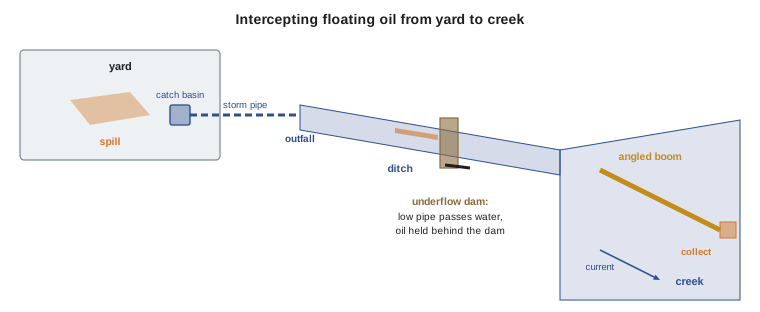
Most spills reach water through drains. As lesson 2 explained, storm drains usually lead straight to a creek, ditch, river or lake with no treatment. A spill that enters a catch basin travels through buried pipes and comes out at an outfall, sometimes hundreds of meters away, where nobody at the site can see it. Knowing where your site's outfalls are lets you check them after a spill and, where possible, intercept the spill before it reaches open water.
If a spill has entered a storm drain, act at both ends. At the drain, stop more liquid going in by covering or plugging it. Downstream, go to the outfall or the next accessible manhole or ditch and see whether the spill has arrived. Floating oil can sometimes be caught at the outfall with absorbent booms or an underflow dam, described below. Tell your supervisor immediately, because a spill to a storm sewer is almost always reportable and the municipality may be able to help by closing valves or alerting downstream users.
Spills to sanitary sewers go to the treatment plant, which may be harmed. Fuels and solvents can create explosive vapor in sewers, and toxic chemicals can kill the bacteria that treat sewage, so that untreated sewage is released. Sewer-use bylaws and ordinances require spills to sanitary sewers to be reported to the sewer authority immediately so that the plant can prepare.
How oil behaves on water
Most oils and fuels float. On calm water they spread quickly into a thin film. Within minutes a few liters can cover an area the size of a large room, and the film keeps thinning and spreading as long as nothing stops it. The lightest components evaporate, which is why gasoline spills on water shrink quickly but give off flammable vapor, while heavier oils persist. Wind, current and waves move the oil and break it up. Over time some oil mixes into the water as droplets, some forms emulsions with water, some sticks to sediment and sinks, and some is broken down by bacteria.
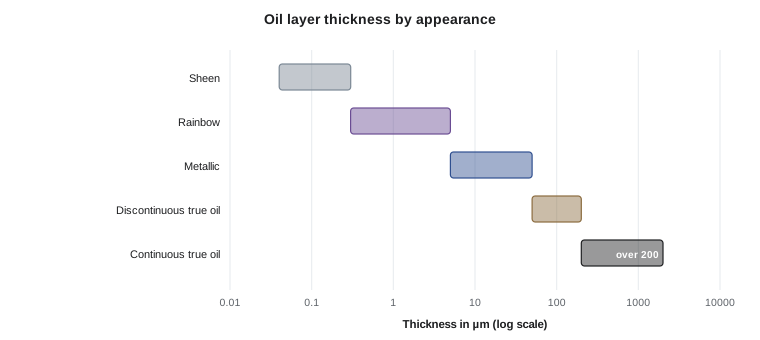
The thickness of an oil layer can be estimated from its appearance. Responders use a standard appearance code, the Bonn Agreement Oil Appearance Code, which links color to approximate thickness. A silvery sheen is less than about 0.3 µm thick; a rainbow sheen up to about 5 µm; a metallic, gray sheen up to about 50 µm; and dark, true oil color much thicker. Because the volume is the area times the thickness, a large area of silvery sheen may represent only a small volume of oil, while a smaller area of dark oil represents much more.
| Appearance | Approximate thickness (µm) | Approximate volume per km² (m³) |
|---|---|---|
| Sheen (silvery or gray) | 0.04 to 0.30 | 0.04 to 0.3 |
| Rainbow | 0.30 to 5.0 | 0.3 to 5 |
| Metallic | 5.0 to 50 | 5 to 50 |
| Discontinuous true oil color | 50 to 200 | 50 to 200 |
| Continuous true oil color | More than 200 | More than 200 |
# Estimating the volume of oil on water from area and appearance (approximate).
codes = {"sheen": 0.3, "rainbow": 5.0, "metallic": 50.0}     # upper thickness in µm
area_m2 = 2000                                                # e.g. a pond 40 m by 50 m
for name, thick_um in codes.items():
    vol_L = area_m2 * thick_um * 1e-6 * 1000
print(f"{area_m2:,} m2 of {name:<8} (up to {thick_um:>4} um): up to about {vol_L:7.1f} L ({vol_L/3.785:6.1f} US gal)")2,000 m2 of sheen (up to 0.3 um): up to about 0.6 L ( 0.2 US gal) 2,000 m2 of rainbow (up to 5.0 um): up to about 10.0 L ( 2.6 US gal) 2,000 m2 of metallic (up to 50.0 um): up to about 100.0 L ( 26.4 US gal)
A silvery sheen over a whole pond may hold less than a liter of oil, but it is still a reportable discharge in many jurisdictions and still harmful to birds and insects that land on the surface. Do not dismiss a sheen as too small to matter.
Oils that sink and chemicals that mix
Not everything floats. Heavy oils, some diluted bitumens after their light components evaporate, and oil mixed with sediment can sink, as the Kalamazoo spill in lesson 1 showed. Sinking oil cannot be caught with booms and needs specialist recovery from the bottom. Many chemicals dissolve in water and travel with it, invisible. Acids and caustics change the water's pH; glycols, milk and sugars remove oxygen; pesticides and ammonia are directly toxic. These cannot be boomed or absorbed from moving water. For dissolved substances, the priorities are stopping the source, stopping more from entering, warning downstream users and calling the regulator.
How much harm a dissolved spill does depends on how much it is diluted. A simple mass balance estimates the concentration in a stream if a spill enters it steadily over a period of time. The comparison with a toxicity threshold below is illustrative only; real effects depend on the species, duration, temperature and other factors.
# Dissolved spill entering a creek: average concentration while it flows in (mass balance).
stream_flow_m3_s = 0.15          # a small creek
spill_kg = 20                    # e.g. 20 kg of a soluble chemical
minutes = 10                     # time over which it enters the creek
water_L = stream_flow_m3_s * 1000 * minutes * 60
conc_mg_L = spill_kg * 1e6 / water_L
print(f"Water passing in {minutes} min: {water_L:,.0f} L")
print(f"Average concentration while the spill enters: {conc_mg_L:.1f} mg/L")
lc50 = 10.0                      # illustrative 96-hour LC50 for a sensitive fish, mg/L
print(f"That is {conc_mg_L/lc50:.1f} times an illustrative LC50 of {lc50} mg/L")
print("Short, concentrated pulses can kill fish even if the river is large further downstream.")Water passing in 10 min: 90,000 L Average concentration while the spill enters: 222.2 mg/L That is 22.2 times an illustrative LC50 of 10.0 mg/L Short, concentrated pulses can kill fish even if the river is large further downstream.
Containing floating oil
Booms are floating barriers that contain oil on the water surface. Containment booms have a float and a skirt that hangs below the surface to stop oil passing under. Absorbent booms are long sausages of oil-only absorbent that both contain and soak up oil; they are what most workplace spill kits carry. On still water, a boom can be pulled around a slick to enclose it. On moving water, a boom placed straight across the current will usually fail, because the current pushes oil under it once the water moves faster than about 0.35 meters a second, a little under one knot. Instead, booms are angled across the current to deflect oil toward a calm area at the bank where it can be collected. The faster the current, the smaller the angle must be.
In small ditches and culverts, an underflow dam is a simple and effective tool. A small dam of earth, sandbags or boards is built across the ditch with a pipe set low in it, angled so its inlet is near the bottom on the upstream side. Water flows out through the pipe from below, while floating oil is held back behind the dam where it can be absorbed or pumped. A filter fence or absorbent boom in front of the dam helps. Underflow dams only work for floating oil, and they must be built so they do not overflow or wash out.
Working near water is dangerous. Banks may be steep, slippery or unstable, water may be deeper or faster than it looks, and cold water can incapacitate a person within minutes. Never enter water to deploy a boom unless you are trained, wearing a personal flotation device and following the plan, with another person watching. For anything beyond placing a boom or absorbent from the bank, call the spill contractor.
Worked problem
Diesel in a roadside ditch
A delivery truck's fuel tank leaks diesel into a grassy roadside ditch with a slow trickle of water. The ditch flows through a culvert to a creek 200 m away. What can a trained worker do while help is coming?
Show solution
- Stop the source and protect people and traffic; call the supervisor and report as the plan requires.
- Walk downstream to see how far the oil has gone and whether it has reached the culvert or creek.
- Below the leading edge of the oil, and before the culvert, place an absorbent boom across the ditch and, if trained and equipped, build an underflow dam.
- Soak up oil collected behind the boom with pads and replace saturated booms.
- Brief the spill contractor and regulator on arrival; they will check the creek and remove contaminated soil and vegetation.
Answer: Stop the source, report, get ahead of the oil and hold it in the ditch with booms or an underflow dam before it reaches the creek.
Wetlands, shorelines and wildlife
Wetlands, marshes and shorelines are sensitive and easily damaged, both by oil and by cleanup. Trampling, vehicles and aggressive cleaning can do more harm than the oil itself, driving it into the sediment and destroying plants. Cleanup in these areas should be planned by specialists. The first responder's role is to stop more oil arriving, contain it at the edge if possible, and keep people and vehicles out until the specialists decide what to do.
Oiled birds and animals should not be handled by untrained people. Oil and stress can kill them, handling can injure both the animal and the person, and wildlife is protected by law, including the Migratory Bird Treaty Act. Note where the animals are and report them; the spill contractor and wildlife authorities, such as the state wildlife agency or the US Fish and Wildlife Service, will arrange trained rehabilitation.
Worked problem
A sheen on the stormwater pond
A site's stormwater pond shows a rainbow sheen covering about 300 m² after a rainstorm. Nobody reported a spill. What should happen?
Show solution
- Estimate the volume: 300 m² × up to 5 µm = up to about 1.5 L. Small, but the sheen shows oil is reaching the pond.
- Contain it with an absorbent boom at the pond outlet so it cannot leave, and soak it up with oil-only pads.
- Report as the plan and the rules require; a sheen leaving the site to a creek is usually reportable.
- Find the source: walk the drainage system back from the pond, checking catch basins, oil-water separators and parked equipment.
Answer: Contain and recover the oil, report as required, and trace the source upstream so it can be stopped.
Common mistakes
MistakePlacing a boom straight across a fast stream.
InsteadAngle booms to deflect oil to a calm collection point at the bank.
MistakeAssuming a thin sheen is too small to report.
InsteadSheens can be reportable and still harm wildlife; follow the plan.
MistakeWading into a creek without a flotation device.
InsteadWork from the bank unless trained, equipped and supervised.
MistakeTrying to boom a dissolved chemical.
InsteadBooms only catch floating oil; stop the source and warn downstream users.
MistakeCatching and cleaning oiled birds yourself.
InsteadReport them; trained wildlife responders must handle them.
Summary and key terms
- Storm drains carry spills to water quickly and out of sight; act at both the drain and the outfall.
- Spills to sanitary sewers must be reported to the sewer authority immediately.
- Oil spreads into thin films; the Bonn appearance code links color to thickness and volume.
- Heavy oils can sink and dissolved chemicals cannot be boomed; stop the source and warn downstream.
- Angle booms across currents and use underflow dams in ditches for floating oil.
- Never enter water without training, a flotation device and a watcher.
- Leave wetlands, shorelines and oiled wildlife to specialists; keep people out.
- Outfall
- The point where a storm drain pipe discharges to a ditch, creek, river or lake.
- Sheen
- A very thin, silvery or rainbow film of oil on water.
- Bonn Agreement Oil Appearance Code
- A standard scale linking the appearance of oil on water to its approximate thickness.
- Containment boom
- A floating barrier with a skirt that holds oil on the water surface.
- Absorbent boom
- A floating sausage of oil-only absorbent that contains and soaks up oil.
- Deflection booming
- Placing booms at an angle across a current to guide oil to a collection point.
- Underflow dam
- A small dam with a low pipe that lets water pass beneath while holding back floating oil.
- Emulsion
- A mixture of oil and water droplets, often thick and hard to recover.
- LC50
- The concentration of a substance that kills half of a test population in a set time.
- Mass balance
- An accounting of how much of a substance enters, mixes and leaves a system.
Practice problems
Work each problem on paper first, then reveal the answer to check.
A spill has entered a storm drain. Where should you act?
Show answer
At the drain to stop more entering, and downstream at the outfall to intercept it.
Why must spills to sanitary sewers be reported quickly?
Show answer
They can create explosive vapor or kill the treatment plant bacteria, so the plant must prepare.
About how thick is a rainbow sheen?
Show answer
About 0.3 to 5 µm.
Roughly how much oil is in 1,000 m² of silvery sheen at 0.3 µm?
Show answer
About 0.3 L.
Why can a boom fail across a current?
Show answer
Above about 0.35 m/s, the current pushes oil under the boom.
How does an underflow dam work?
Show answer
A low pipe lets water out from below while floating oil is held behind the dam.
What should you do about a dissolved chemical spill in a creek?
Show answer
Stop the source, stop more entering, warn downstream users and call the regulator.
What protective equipment is needed to work near water?
Show answer
A personal flotation device, plus training and another person watching.
Why should cleanup crews avoid trampling wetlands?
Show answer
It drives oil into sediment and destroys plants, sometimes doing more harm than the oil.
What should you do if you see an oiled bird?
Show answer
Note its location and report it; do not handle it.
Lesson quiz · 5 questions
Score 60% or more to complete this lesson.
Create a free account to save your progress, take quizzes and earn a certificate.