
HSE-251 · Lesson 6 of 12 · 28 min
Spill kits and response equipment
A spill kit is only useful if it is the right kind, big enough, close enough and fully stocked when the spill happens. Many sites have spill kits that fail one of those tests: an oil-only kit beside a battery charging station, a kit that holds 20 liters beside a 5,000-liter tank, a kit locked in a storeroom, or a kit whose absorbent pads were used up last month and never replaced. This lesson covers how to choose, place, maintain and use spill response equipment, including the protective equipment that keeps responders safe.
Types of absorbent
Absorbents soak up liquid so it can be collected and disposed of. They come in three main types, usually color-coded by manufacturers. Universal absorbents, often gray or green, soak up oils, water-based liquids, coolants and most mild chemicals. Oil-only absorbents, usually white, are made of materials such as polypropylene that repel water and soak up only oils and fuels. Because they float and do not take up water, they are the right choice for oil on a pond, a flooded ditch or a wet parking lot. Chemical or hazmat absorbents, often yellow or pink, are made to handle aggressive chemicals such as acids, caustics and oxidizers without reacting or breaking down.
Using the wrong absorbent can make things worse. Universal pads on an oil sheen in water soak up water and sink. Cellulose-based absorbents, made from paper or plant fibers, can react with strong oxidizers and acids and even catch fire. Clay-based granular absorbent on a large area makes a heavy, dusty mess. Each spill kit should be labeled with what it is for, and the safety data sheet for each chemical stored on site should be checked to confirm the absorbent is suitable.
| Absorbent type | Usual color | Use for | Do not use for |
|---|---|---|---|
| Universal | Gray or green | Oils, coolants, water-based liquids, mild chemicals | Strong acids, caustics or oxidizers unless rated for them |
| Oil-only | White | Fuels and oils, including on water (floats, repels water) | Water-based chemicals, antifreeze |
| Chemical (hazmat) | Yellow or pink | Acids, caustics, oxidizers, unknown chemicals | Not needed for routine oil drips |
| Granular (clay, cellulose, mineral) | Varies | Floors and pavement, small spills, slip control | Water spills; cellulose with oxidizers |
| Neutralizers | Often color-change | Acids or bases, before absorption | Unknown substances, large spills, solvents |
Forms of absorbent
Absorbents come in several forms, each with a job. Pads and rolls are flat sheets for wiping up and covering small spills and drips. Socks, also called snakes, are long tubes filled with absorbent that are laid around a spill to contain it and stop it spreading, or across a doorway. Pillows are thick bags that soak up larger volumes, good for leaks under a drum or in a sump. Booms are long floating tubes used on water to contain and absorb oil; lesson 9 covers them. Loose granular absorbent is spread on floors to soak up liquid and to make surfaces less slippery.
What a kit contains
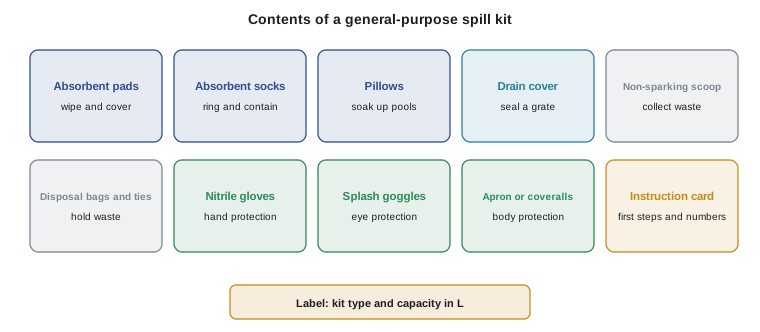
A typical general-purpose spill kit contains absorbent pads, socks and pillows; a drain cover or plug; heavy-duty disposal bags with ties and labels; a non-sparking shovel or scoop if flammable liquids may be involved; nitrile gloves, splash goggles and an apron or coveralls; and a laminated instruction card with the first steps and phone numbers. Larger kits come in wheeled bins or overpack drums, which can also serve as the container for the waste. Specialized kits add neutralizers for acids and bases, mercury absorbent for broken thermometers or switches, or extra protective equipment for chemical hazards.
Kits are rated by capacity: the volume of liquid the absorbents in the kit can soak up when fully used. A small kit for a vehicle might absorb 20 to 40 liters, a wheeled bin 100 to 250 liters, and a large overpack drum kit more. The capacity should be matched to the largest likely spill at that location, not the average one. Where the largest possible spill is much bigger, for example a full tank, the plan relies on secondary containment to hold most of it and on additional absorbent, pumps, vacuum trucks or contractors to recover it.
Worked problem
Matching a kit to a risk
A shop has a 55-gallon drum of hydraulic oil on a spill pallet and a parts washer holding 21 gallons of solvent. The current spill kit is rated at 10 gallons. Is it adequate?
Show solution
- The largest likely spill is a punctured drum. The spill pallet should hold most of it, but a forklift puncture often sprays oil beyond the pallet.
- The parts washer could release 21 gallons if knocked over.
- A 10-gallon kit could not handle either worst case alone.
- Upgrade to a wheeled kit rated for at least 25 to 40 gallons, and keep extra socks to contain flow toward the floor drain.
Answer: No. The kit should be sized for the largest likely spill, with extra socks for containment.
# How many absorbent items do you need? Capacities are illustrative; use the product label.
spill_l = 60
capacity = {"pad": 0.8, "sock (1.2 m)": 4.0, "pillow": 8.0}   # L absorbed per item
safety_factor = 1.5          # absorbents rarely reach full rated capacity in real use
need = spill_l * safety_factor
print(f"Spill {spill_l} L; plan for {need:.0f} L of absorbent capacity")
# Typical mix: socks to ring the spill, pillows for the pool, pads to finish
plan = {"sock (1.2 m)": 6, "pillow": 6}
used = sum(capacity[k] * n for k, n in plan.items())
pads = max(0, -(-(need - used) // capacity["pad"]))   # ceiling division
print(f"6 socks + 6 pillows = {used:.0f} L; add {int(pads)} pads to reach {need:.0f} L")
print(f"In US gallons: spill {spill_l/3.785:.1f} gal, plan for {need/3.785:.1f} gal")Spill 60 L; plan for 90 L of absorbent capacity 6 socks + 6 pillows = 72 L; add 23 pads to reach 90 L In US gallons: spill 15.9 gal, plan for 23.8 gal
Where to put spill kits
Spill kits must be close to where spills are likely, easy to see and never locked away. Good locations include beside fuel tanks and dispensers, at loading docks, in maintenance shops near hydraulic and oil storage, beside chemical storage rooms, at wash bays, on service trucks and in vehicles that carry fuel or chemicals. A kit should be reachable within a minute or two of the risk point, because that is about how long it takes a spill to reach a nearby drain. Kits should be marked with signs that can be seen from a distance, and access to them must be kept clear.
Some sites use a simple rule of thumb: a kit for every significant risk area, a kit within about 25 meters of any fuel transfer point, and a kit in every vehicle that carries more than small amounts of fuel or chemicals. Larger sites add a central response trailer or cache with extra absorbent, booms, pumps, drums and protective equipment for bigger spills.
Drain protection
Stopping a spill from entering a drain is often the single most important action, because once liquid reaches a storm drain it can be in a creek within minutes. Drain protection comes in several forms. Drain covers are heavy, flexible mats, often made of polyurethane, that are laid over a grate to seal it. Drain plugs and inflatable stoppers block pipe openings. Absorbent socks laid around a grate help but do not seal it. Some sites install permanent valves or inserts in catch basins that can be closed during a spill, or oil-water separators that trap floating oil before it leaves the site.
Drain covers must match the drains on site: a cover too small for the grate is useless. They should be stored right beside high-risk drains, and workers should practice placing them, because a cover laid on a dirty or uneven grate may leak. Before placing a cover, check that the liquid is not a flammable substance pooling under it in a way that creates a vapor hazard, and always follow the site plan.
Protective equipment
Responders must protect themselves before they touch a spill. The minimum for most small oil and fuel spills is chemical-resistant gloves such as nitrile, safety glasses or splash goggles, and footwear that will not soak up liquid. For corrosive chemicals, add a face shield, chemical apron or suit and suitable gloves as the safety data sheet directs. Section 8 of the safety data sheet lists the protective equipment needed. Never use cotton work gloves on solvents or fuels; they soak up the liquid and hold it against the skin.
Respiratory protection is a different matter. If a spill gives off vapor strong enough to need a respirator, it is usually beyond awareness-level response. Respirators must be selected, fitted and used under a respiratory protection program, as covered in HSE-240. Workers who have not been fit-tested and trained must not use them. The plan should say clearly that if vapor, odor or symptoms such as dizziness or eye irritation are present, workers withdraw and call for help.
| Spill | Typical minimum protection (check the SDS) |
|---|---|
| Motor oil, hydraulic oil | Nitrile gloves, safety glasses, impervious boots |
| Diesel or gasoline, small | Nitrile gloves, splash goggles, no ignition sources, ventilation |
| Antifreeze | Nitrile gloves, safety glasses |
| Battery acid (sulfuric) | Acid-resistant gloves, splash goggles and face shield, apron, neutralizer |
| Caustic cleaner | Chemical-resistant gloves, goggles and face shield, apron |
| Unknown liquid | Do not handle; isolate the area and get help |
Inspecting and restocking kits
Spill kits should be inspected on a schedule, often monthly, and after every use. The inspection checks that the kit is in its place, the seal is intact, all items on the contents list are present and in good condition, protective equipment fits and is not expired, the instruction card is legible and the phone numbers are current. A tamper seal makes it easy to see whether a kit has been opened. Anything used must be replaced immediately; many sites keep a stock of refill packs and make restocking part of closing out every spill.
Worked problem
A kit inspection finding
A monthly check finds the spill kit at the fuel pad open, with no pads left, two socks, no gloves and an instruction card listing a supervisor who left the company. What should happen?
Show solution
- Treat the kit as unusable and replace it or restock it immediately, before the next fuel delivery.
- Update the instruction card with current contacts.
- Find out why it was not restocked: was there a spill nobody reported? Was there no refill stock?
- Add a tamper seal and make restocking part of the spill close-out procedure.
Answer: Restock and update it at once, investigate the unreported use, and fix the restocking process.
Other response equipment
Larger sites and those with bigger risks may need more: hand pumps or air-operated pumps to transfer liquid from a leaking container, overpack and salvage drums to hold leaking drums, leak-sealing putty and plugs, non-sparking tools, portable berms that unfold to contain a leak, wet-dry vacuums rated for the liquids involved, and portable gas detectors to check for flammable vapor. Each piece of equipment needs trained users and regular checks. Lesson 7 explains how these items are used in a response.
Common mistakes
MistakePutting universal absorbent pads on an oil sheen in a pond.
InsteadUse oil-only absorbents and booms on water; they repel water and float.
MistakeUsing cellulose absorbent on a strong oxidizer.
InsteadUse absorbents rated for the chemical, as the SDS and label direct.
MistakeKeeping spill kits in a locked storeroom.
InsteadPlace kits, unlocked and signed, near each risk point.
MistakeLeaving a kit half empty after a small spill.
InsteadRestock immediately as part of closing out every spill.
MistakeWearing cotton gloves to wipe up fuel.
InsteadWear chemical-resistant gloves such as nitrile, as the SDS directs.
Summary and key terms
- Universal, oil-only and chemical absorbents each have a job; using the wrong one can make things worse.
- Pads, socks, pillows, booms and granular absorbent serve different purposes.
- Size kits for the largest likely spill at each location, not the average.
- Place kits unlocked and signed within a minute or two of each risk point.
- Drain covers and plugs are often the most important equipment; they must fit the drains.
- Wear protective equipment from the SDS; vapor that needs a respirator means withdraw and call for help.
- Inspect kits monthly and after use, and restock immediately.
- Universal absorbent
- Absorbent that soaks up oils, water-based liquids and most mild chemicals.
- Oil-only absorbent
- Absorbent that repels water and soaks up only oils and fuels.
- Chemical absorbent
- Absorbent designed to handle aggressive chemicals without reacting.
- Absorbent sock
- A long, flexible tube of absorbent used to contain and stop the spread of a spill.
- Absorbent pillow
- A thick bag of absorbent for soaking up larger volumes.
- Neutralizer
- A material that reacts with an acid or base to make it less hazardous before cleanup.
- Drain cover
- A heavy mat placed over a drain grate to seal it during a spill.
- Overpack drum
- A large drum into which a leaking drum or spill waste is placed.
- Kit capacity
- The total volume of liquid the absorbents in a spill kit can soak up.
- Tamper seal
- A seal that shows whether a spill kit has been opened.
Practice problems
Work each problem on paper first, then reveal the answer to check.
Which absorbent should you use on oil floating on water?
Show answer
Oil-only absorbent, which repels water and floats.
Why can cellulose absorbent be dangerous with oxidizers?
Show answer
It can react and may catch fire.
What is the difference between a sock and a pillow?
Show answer
A sock is laid around a spill to contain it; a pillow soaks up larger volumes.
What should a spill kit capacity be matched to?
Show answer
The largest likely spill at that location.
How close should a kit be to a risk point?
Show answer
Reachable within a minute or two, unlocked and clearly signed.
Why are drain covers so important?
Show answer
Liquid that reaches a storm drain can be in a creek within minutes.
Where do you find the protective equipment needed for a chemical?
Show answer
Section 8 of its safety data sheet.
What should you do if a spill gives off strong vapor?
Show answer
Withdraw and call for help; do not use a respirator unless trained and fit-tested.
How often should spill kits be inspected?
Show answer
On a schedule, often monthly, and after every use.
Why use a tamper seal on a kit?
Show answer
To show at a glance whether it has been opened and may need restocking.
Lesson quiz · 5 questions
Score 60% or more to complete this lesson.
Create a free account to save your progress, take quizzes and earn a certificate.