
HSE-244 · Lesson 9 of 12 · 27 min
Safe work practices and controls
Detectors and breathing apparatus are essential, but they are the last lines of defense. The best hydrogen sulfide programs reduce the chance that anyone breathes the gas at all, by removing it at the source, keeping it inside closed systems, ventilating spaces and organizing work so that exposures and surprises are rare. This lesson applies the hierarchy of controls to hydrogen sulfide and describes the work practices found at well-run sour sites, wastewater plants and farms.
The hierarchy of controls
The hierarchy of controls ranks controls from most to least effective: elimination, substitution, engineering controls, administrative controls and personal protective equipment. For hydrogen sulfide, elimination and engineering controls often mean treating the source and designing equipment so that workers do not need to open it. Administrative controls include permits, procedures, training and supervision. Personal protective equipment includes personal monitors and breathing apparatus.
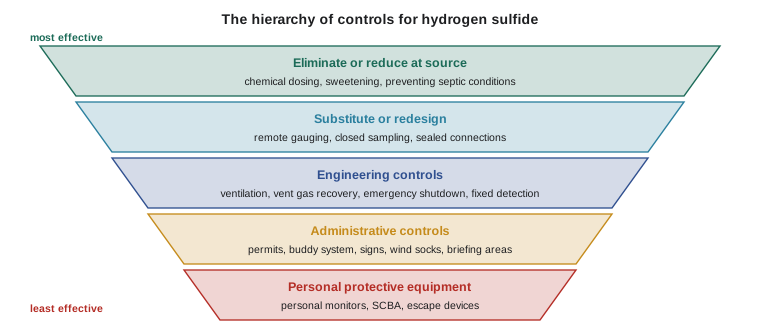
Controlling hydrogen sulfide at the source
In sewers, hydrogen sulfide forms when sewage goes septic. Utilities control it by adding oxygen, nitrate, iron salts or other chemicals to force mains and wet wells, by reducing the time sewage spends in force mains, by cleaning sludge regularly and by designing gravity sewers to avoid turbulence at drops. These measures also reduce odor complaints and concrete corrosion.
In oil and gas, sour gas is processed to remove hydrogen sulfide, a step called sweetening, before it is sold. In the field, operators may inject chemicals called scavengers into produced fluids to react with hydrogen sulfide and reduce the concentration in tanks and trucks. Biocides control sulfate-reducing bacteria in water handling systems, which can otherwise turn a sweet field sour over time.
On farms, manure management systems can reduce gas production, and barns with under-floor storage need ventilation designed to handle agitation. In industry, keeping sulfide-bearing wastes away from acids, as lesson 3 explained, prevents one of the fastest ways to generate the gas.
Keeping it inside: closed systems
Many exposures happen because a worker opens a system that contains hydrogen sulfide. Redesigning tasks so that this is not needed removes the exposure. Examples include remote and automated tank gauging instead of opening thief hatches; closed-loop sampling systems that capture purge gas instead of venting it; vapor recovery units and closed truck loading that route displaced vapor back to the system instead of the air; enclosed and ventilated sludge handling; and pigging and filter changes designed with purging and isolation built in.
Where systems must be opened, they should be isolated, depressurized, drained and purged first, with gas testing confirming the result, as part of a lockout and permit process. Work on sour equipment often includes flushing with water or inert gas and treating iron sulfide to prevent fires, as lesson 2 described.
Ventilation
Ventilation dilutes hydrogen sulfide and carries it away. In buildings such as pump houses, compressor buildings and headworks, ventilation is usually designed to give a set number of air changes per hour, with exhaust drawn from low levels where the gas collects and fresh air supplied from a clean location. In confined spaces, portable blowers supply fresh air during entry, as HSE-211 describes. Ventilation must be designed for the expected gas release and checked to make sure fans run, doors and louvers are open, and the airflow reaches the work area.
Dilution ventilation can be estimated from the rate at which gas is released and the target concentration. The airflow needed is the release rate divided by the target concentration. Real designs add a safety factor for poor mixing, often three to ten times.
Here Q is the airflow, G the gas release rate, C the target concentration expressed as a fraction, and K a mixing safety factor.
# Dilution airflow needed to keep a pump room below a target (illustrative).
release_l_per_min = 0.2          # L of H2S gas released per minute
for target_ppm, K in [(10, 3), (5, 5), (1, 5)]:
    frac = target_ppm / 1_000_000
    q_l_min = release_l_per_min / frac * K
    q_m3_h = q_l_min * 60 / 1000
    print(f"target {target_ppm:2d} ppm, safety factor {K}: about {q_m3_h:8,.0f} m3/h "
f"({q_m3_h*0.5886:7,.0f} cfm)")target 10 ppm, safety factor 3: about 3,600 m3/h ( 2,119 cfm) target 5 ppm, safety factor 5: about 12,000 m3/h ( 7,063 cfm) target 1 ppm, safety factor 5: about 60,000 m3/h ( 35,316 cfm)
The numbers show how quickly ventilation requirements grow as target concentrations fall. Lowering the target from 10 ppm to 1 ppm needs more than ten times the airflow. That is one reason controlling the source and closing systems are usually more practical than ventilating away a large release.
Emergency shutdown and engineered safety
Sour facilities use emergency shutdown (ESD) systems that close valves and stop equipment automatically when fixed detectors sense hydrogen sulfide, when pressure drops suddenly or when someone pushes a shutdown button. Flare systems burn off gas safely during upsets. Well control equipment, including blowout preventers, keeps reservoir fluids in the well during drilling and servicing. These systems need regular testing and must never be bypassed without a formal management-of-change process.
Signs, access control and site layout
Sour sites and buildings where hydrogen sulfide may be present should be marked with warning signs at access roads and entrances. Texas Rule 36 specifies black and yellow signs with the words Caution and Poison Gas where its thresholds apply, and offshore rules require Danger signs and red flags or lights when alarms sound. Access control, such as locked gates, sign-in systems and check-in with a control room, keeps untrained people out and lets the site know who is present. The Odessa investigation found that an unlocked gate allowed a family member to enter a site with a release under way.
Wind direction indicators, such as wind socks or streamers, should be visible from all work areas so that workers know which way gas will drift. Sites should have at least two safe briefing areas or muster points, located so that at least one is upwind or crosswind of likely release points whatever the wind direction. Vehicles should be parked facing the exit, upwind where possible, so that people can leave quickly.
# Choose a briefing area upwind of the release given the wind direction.
# Bearings in degrees: wind direction is where the wind comes FROM.
import math
release = (0, 0)
areas = {"North gate": (0, 150), "East pad": (150, 0), "South road": (0, -150), "West pad": (-150, 0)}
def bearing(frm, to):
    dx, dy = to[0]-frm[0], to[1]-frm[1]
    return (math.degrees(math.atan2(dx, dy)) + 360) % 360
for wind_from in (270, 0, 135):
    best = min(areas, key=lambda a: abs(((bearing(release, areas[a]) - wind_from) + 180) % 360 - 180))
print(f"wind from {wind_from:3d} deg: go to {best} (upwind of the release)")wind from 270 deg: go to West pad (upwind of the release) wind from 0 deg: go to North gate (upwind of the release) wind from 135 deg: go to East pad (upwind of the release)
Planning and permits
Work in hydrogen sulfide areas should be planned. A hazard assessment identifies sources, likely concentrations, release triggers and controls. A work permit, often combined with a confined space or hot work permit, records gas test results, isolations, ventilation, required PPE and breathing apparatus, communication and rescue arrangements. A pre-job briefing, sometimes called a tailgate meeting, makes sure everyone knows the hazards, alarm set points, wind direction, briefing areas, escape routes and the plan if something goes wrong.
The buddy system and working alone
Many hydrogen sulfide deaths involve workers alone at remote sites, discovered hours later. Rules on working alone in every jurisdiction require employers to assess the hazards and set up a way to check on lone workers. For hydrogen sulfide areas, good practice includes a buddy system for tasks with exposure potential, so that one person can raise the alarm if the other collapses; regular check-ins by radio, phone or satellite device at set intervals; lone-worker devices that detect a fall or lack of movement and send an alarm with location; and some tasks, such as opening hatches on sour tanks or entering pump houses at certain sites, permitted only with a second person present.
A buddy must know not to enter a toxic atmosphere to help without breathing apparatus. The buddy's job is to watch, raise the alarm, and assist only with proper protection.
Good habits
Experienced hydrogen sulfide workers build habits that reduce risk every day: checking the wind before approaching a hatch or vessel and standing upwind; approaching slowly and watching the detector; never putting their head over an open hatch; keeping SCBA or an escape device within reach where required; not lingering in low areas; reporting every alarm, odor and symptom; and stopping work when something seems wrong. These habits are taught in training and reinforced by supervision and by co-workers who speak up.
Worked problem
Redesigning tank gauging
Pumpers at a sour oil battery open tank thief hatches by hand twice a day to gauge levels. Datalogs show peaks up to 60 ppm at the hatches. What controls could reduce exposure?
Show solution
- Elimination or substitution: install remote level gauges so hatches do not need to be opened for gauging.
- Engineering: install vapor recovery to lower tank vapor pressure, and scavenger injection to reduce dissolved hydrogen sulfide.
- Administrative: until changes are made, require a second person, upwind approach and check-in procedures.
- PPE: require SCBA for hatch work if peaks remain above the IDLH or cannot be predicted.
Answer: Remote gauging and vapor recovery remove most of the exposure. Procedures and SCBA cover the gap until they are installed.
Worked problem
Placing safe briefing areas
A new sour well pad has one access road from the south. The prevailing wind is from the west, but winds from the east are common. Where should briefing areas be placed?
Show solution
- At least two briefing areas are needed so that one is upwind or crosswind whatever the wind.
- Place one on the west side and one on the east side of the pad, away from wellheads and tanks.
- Make sure both can be reached without crossing the likely release points, and that the road gives an exit.
- Stock breathing apparatus and communication equipment at each.
Answer: Two briefing areas on opposite sides, with wind socks visible from both, so workers can move upwind or crosswind whatever the wind.
Contractors and visitors
Contractors and visitors are often the least familiar with a site's hydrogen sulfide hazards. A site orientation should cover where hydrogen sulfide may be present, the alarm sounds and lights and what they mean, wind socks and briefing areas, check-in and access rules, required monitors and breathing apparatus, and who to call. Contractors' own hydrogen sulfide training should be verified before they start, and their work should be covered by the site's permit system. Visitors who have not been trained should be escorted and kept out of hydrogen sulfide areas.
Common mistakes
MistakeRelying on detectors and SCBA as the main controls.
InsteadTreat the source, close systems and ventilate first; PPE is the last line of defense.
MistakePutting your head over an open hatch to look inside.
InsteadStand upwind, use remote gauging and keep your face away from openings.
MistakeHaving only one muster point.
InsteadProvide at least two so one is upwind or crosswind whatever the wind.
MistakeLeaving gates open while working at a sour site.
InsteadControl access so untrained people cannot walk into a release.
MistakeLetting workers do hatch or pump-house work alone without check-ins.
InsteadUse buddies, lone-worker devices and regular check-ins.
Summary and key terms
- Apply the hierarchy of controls: treat the source, redesign tasks, engineer controls, then administrative controls and PPE.
- Source controls include chemical dosing in sewers, sweetening, scavengers and biocides.
- Closed systems, remote gauging and vapor recovery remove many routine exposures.
- Ventilation needs grow sharply as target concentrations fall; design for low-level exhaust and check it works.
- Emergency shutdown systems, signs, access control, wind socks and two briefing areas are standard at sour sites.
- Permits, pre-job briefings, buddy systems and check-ins organize safe work.
- Daily habits such as checking the wind and never looking into open hatches save lives.
- Hierarchy of controls
- A ranking of controls from elimination to personal protective equipment.
- Sweetening
- Removing hydrogen sulfide from sour gas.
- Scavenger
- A chemical injected into fluids to react with and remove hydrogen sulfide.
- Vapor recovery
- A system that captures tank vapors instead of venting them.
- Remote gauging
- Measuring tank levels without opening hatches.
- Dilution ventilation
- Reducing concentrations by mixing in fresh air.
- Emergency shutdown (ESD)
- A system that automatically closes valves and stops equipment in an emergency.
- Safe briefing area
- A designated muster point upwind or crosswind of release sources.
- Wind sock
- A fabric tube showing wind direction.
- Lone-worker device
- A device that alerts others if a lone worker falls, stops moving or presses an alarm.
Practice problems
Work each problem on paper first, then reveal the answer to check.
List the five levels of the hierarchy of controls.
Show answer
Elimination, substitution, engineering controls, administrative controls and personal protective equipment.
Give two ways utilities control hydrogen sulfide in sewers.
Show answer
Any two of adding oxygen, nitrate or iron salts, reducing force main retention time, cleaning sludge and reducing turbulence.
What is a hydrogen sulfide scavenger?
Show answer
A chemical injected into fluids to react with and remove hydrogen sulfide.
Give two task redesigns that remove exposure at tanks.
Show answer
Remote gauging and vapor recovery or closed loading.
Why must ventilation exhaust be drawn from low levels?
Show answer
Hydrogen sulfide tends to collect low.
How does required airflow change when the target falls from 10 ppm to 1 ppm?
Show answer
It increases about tenfold or more.
Why should a site have at least two briefing areas?
Show answer
So one is upwind or crosswind whatever the wind direction.
What should a buddy do if their partner collapses in gas?
Show answer
Raise the alarm and assist only with proper breathing apparatus.
Why is access control important at sour sites?
Show answer
It keeps untrained people out and lets the site know who is present.
Give three daily habits that reduce hydrogen sulfide risk.
Show answer
Any three of checking wind, approaching upwind slowly, watching the detector, never looking into hatches, keeping SCBA within reach and reporting alarms.
Lesson quiz · 5 questions
Score 60% or more to complete this lesson.
Create a free account to save your progress, take quizzes and earn a certificate.