
HSE-244 · Lesson 5 of 12 · 26 min
Exposure limits and the law
Hydrogen sulfide is regulated in two overlapping ways. Occupational health and safety law sets exposure limits and requires employers to assess hazards, control exposures, train workers and plan for emergencies. Energy and environmental regulators add rules for sour wells, pipelines and facilities, including emergency planning around them. This lesson describes the main limits and laws.
Kinds of exposure limits
Exposure limits for gases come in several forms. A time-weighted average (TWA) limit applies to the average concentration over a work shift, usually eight hours. A short-term exposure limit (STEL) applies to a 15-minute average that must not be exceeded at any time during the shift. A ceiling limit must not be exceeded at any instant. For hydrogen sulfide, short-term and ceiling limits matter most, because harm depends mainly on peak concentrations.
The ACGIH, a non-governmental scientific body in the United States, publishes threshold limit values (TLVs). Its TLVs for hydrogen sulfide, adopted in 2010, are 1 ppm as an eight-hour TWA and 5 ppm as a STEL. Many jurisdictions adopt ACGIH values into their law, sometimes years later and sometimes with changes. Others keep older limits.
Limits in the United States
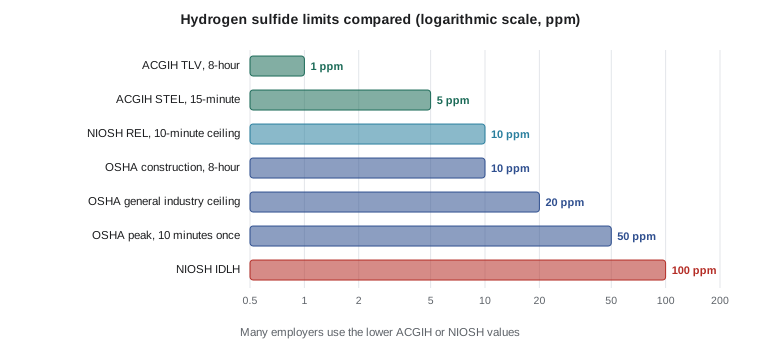
OSHA's permissible exposure limits (PELs) for hydrogen sulfide date from the early 1970s. In general industry, Table Z-2 of 29 CFR 1910.1000 sets a ceiling of 20 ppm, with a peak of up to 50 ppm allowed for no more than 10 minutes once per eight-hour shift, and only if there is no other measurable exposure during the shift. In construction, 29 CFR 1926.55 sets an eight-hour TWA of 10 ppm, and the shipyard limit in 1915.1000 is also 10 ppm. NIOSH recommends a 10 ppm ceiling for 10 minutes. The ACGIH TLVs of 1 ppm TWA and 5 ppm STEL are much lower. OSHA itself encourages employers to consider the more protective NIOSH and ACGIH values, and many oil and gas, wastewater and industrial employers do. Some state plans, such as California's, have their own limits.
| Source | Eight-hour average | Short-term or ceiling |
|---|---|---|
| ACGIH TLV (2010) | 1 ppm | 5 ppm STEL |
| OSHA general industry (Table Z-2) | none | 20 ppm ceiling; 50 ppm peak for 10 minutes once per shift |
| OSHA construction (1926.55) | 10 ppm | none listed |
| OSHA shipyards (1915.1000) | 10 ppm | none listed |
| NIOSH REL | none | 10 ppm ceiling (10 minutes) |
| NIOSH IDLH | not applicable | 100 ppm |
Calculating exposure
To compare an exposure with a TWA limit, average the concentrations over the shift, weighted by time. Time with no exposure counts as zero. For short-term limits, look at the highest 15-minute average. For ceilings, look at the highest instantaneous reading.
# A wastewater operator's shift (minutes, ppm) from a datalogging personal monitor.
periods = [(120, 0.2), (45, 4.0), (15, 9.0), (60, 0.5), (90, 2.5), (150, 0.3)]
total_min = sum(m for m, _ in periods)
twa_8h = sum(m * c for m, c in periods) / 480        # unexposed time beyond the log counts as 0
peak_15 = max(c for m, c in periods if m >= 15)
print(f"logged minutes: {total_min}")
print(f"8-hour TWA: {twa_8h:.2f} ppm")
print(f"highest 15-minute average: {peak_15:.1f} ppm")
for name, twa, stel in [("ACGIH TLV", 1, 5), ("Alberta OEL", 10, 15)]:
    print(f"{name:12s}: TWA {'over' if twa_8h > twa else 'under'} {twa} ppm; "
f"short-term {'over' if peak_15 > stel else 'under'} {stel} ppm")logged minutes: 480 8-hour TWA: 1.33 ppm highest 15-minute average: 9.0 ppm ACGIH TLV : TWA over 1 ppm; short-term over 5 ppm Alberta OEL : TWA under 10 ppm; short-term under 15 ppm
The same exposure can be acceptable under one limit and well over another. Under the ACGIH values, this operator exceeded both the eight-hour TLV and the short-term limit; under the older 10 ppm and 15 ppm values, the exposure would comply. The employer should apply the limit that legally applies and should consider the more protective one, especially since the ACGIH values reflect more recent evidence.
General duties
Exposure limits are only part of the law. Section 5(a)(1) of the Occupational Safety and Health Act, the General Duty Clause, requires employers to protect workers from recognized serious hazards, and OSHA has used it for hydrogen sulfide hazards not covered by a specific standard. Other OSHA standards that apply include respiratory protection (1910.134), permit-required confined spaces (1910.146 and construction Subpart AA), hazard communication (1910.1200), process safety management (1910.119) for facilities above threshold quantities of listed chemicals, ventilation and air contaminants. Confined space rules, covered in HSE-211, apply whenever hydrogen sulfide is in or may enter a permit space.
Energy and environmental regulators in the United States
Energy regulators add rules for sour oil and gas. Offshore on the Outer Continental Shelf, BSEE's 30 CFR 250.490 requires each area to be classified as H₂S absent, present or unknown, an approved H₂S contingency plan, training before work and annual refreshers, drills for each person at least weekly, detectors sensitive to at least 10 ppm with audible and visual alarms at 20 ppm, breathing apparatus for everyone on board, warning signs and red flags or lights when alarms sound. Onshore on federal leases, the Bureau of Land Management has its own hydrogen sulfide rules. In Texas, Railroad Commission Rule 36 (16 TAC 3.36) applies to operations with hydrogen sulfide above 100 ppm; operators calculate 100 ppm and 500 ppm radii of exposure, and if these reach public areas, roads or exceed set distances, a written contingency plan, warning signs and public notification are required. Other producing states, such as New Mexico, have similar rules. Refineries and chemical plants holding more than threshold quantities of hydrogen sulfide must also prepare risk management programs under EPA's chemical accident prevention rules.
Emergency planning distances
Regulators use dispersion models to estimate how far a release could travel at dangerous concentrations. The models consider the release rate, the hydrogen sulfide content, the weather and the terrain. The Texas formula is a simple example of such a calculation, using the hydrogen sulfide mole fraction and the maximum escape volume per day. It is shown here to illustrate how distances grow with release size, not as a planning tool for any jurisdiction.
# Texas Rule 36 radius-of-exposure formulas (feet), for illustration only.
# x100 = (1.589 * mole_fraction * Q) ** 0.6258 ; x500 = (0.4546 * mole_fraction * Q) ** 0.6258
# Q = maximum escape volume, cubic feet per day at standard conditions.
def roe(mole_fraction, q_cfd):
    x100 = (1.589 * mole_fraction * q_cfd) ** 0.6258
    x500 = (0.4546 * mole_fraction * q_cfd) ** 0.6258
    return x100, x500

for frac, q in [(0.001, 1_000_000), (0.01, 1_000_000), (0.05, 5_000_000)]:
    a, b = roe(frac, q)
    print(f"H2S {frac*100:4.1f} %, Q {q:>9,} cf/d: 100 ppm ROE {a:7,.0f} ft ({a*0.3048:6,.0f} m); "
f"500 ppm ROE {b:6,.0f} ft ({b*0.3048:5,.0f} m)")H2S 0.1 %, Q 1,000,000 cf/d: 100 ppm ROE 101 ft ( 31 m); 500 ppm ROE 46 ft ( 14 m) H2S 1.0 %, Q 1,000,000 cf/d: 100 ppm ROE 426 ft ( 130 m); 500 ppm ROE 195 ft ( 59 m) H2S 5.0 %, Q 5,000,000 cf/d: 100 ppm ROE 3,191 ft ( 973 m); 500 ppm ROE 1,458 ft ( 444 m)
Even a modest well with 1 percent hydrogen sulfide and a million cubic feet per day of potential escape gives a 100 ppm radius of hundreds of meters. That is why sour sites have signs, controlled access, wind socks and emergency plans that reach beyond the lease boundary.
Consensus standards and training rules
Beyond legislation, industry standards shape practice. ANSI/ASSP Z390.1-2024 sets accepted practices for hydrogen sulfide training programs, including course content, drills, instructor qualifications and records; it does not cover respiratory protection, which falls under OSHA 1910.134 and ANSI/ASSP Z88.2. American Petroleum Institute recommended practices address drilling, well servicing and production operations involving hydrogen sulfide. The GHS-based classification of hydrogen sulfide under OSHA's Hazard Communication Standard (flammable gas, gas under pressure, acute toxicity by inhalation) appears on cylinder labels and safety data sheets.
Worked problem
Choosing the limit to apply
A contractor works on construction projects, at a general industry wastewater plant and offshore. Which hydrogen sulfide limits apply, and what should the contractor's program use?
Show solution
- On construction work, the 10 ppm TWA in 1926.55 applies.
- At the wastewater plant, the general industry 20 ppm ceiling and 50 ppm peak apply.
- Offshore, BSEE's rules set detection and alarm requirements of 10 ppm sensitivity and 20 ppm alarms.
- The NIOSH REL of 10 ppm and ACGIH TLVs of 1 ppm TWA and 5 ppm STEL are more protective and widely used by employers.
Answer: Comply with each legal limit, but a single program built on the most protective values is simpler and safer for workers who move between sites.
Worked problem
Spotting a short-term exceedance
A personal monitor's datalog shows a worker's eight-hour TWA was 0.8 ppm, but one 15-minute period averaged 7 ppm during a pump change. Was the exposure acceptable under ACGIH values?
Show solution
- The TWA of 0.8 ppm is under the 1 ppm TLV.
- The 15-minute average of 7 ppm exceeds the 5 ppm STEL.
- Both limits must be met.
Answer: No. The short-term limit was exceeded, so controls for pump changes are needed even though the shift average complied.
Keeping up with changing rules
Exposure limits and energy regulations change. OSHA has not updated most of its 1970s PELs, but state plans, BSEE, BLM and state oil and gas regulators revise their rules, and the ACGIH and NIOSH update their recommendations. A hydrogen sulfide program should name a person responsible for tracking changes, check the regulations at least once a year, and update alarm set points, procedures and training when rules change. Contractors working across states, offshore and onshore, should keep a simple table of the requirements at each type of site and record which values their program uses.
It also helps to understand why limits differ. Legal limits reflect the evidence available when they were adopted, the regulator's process and sometimes feasibility. Recommendations such as the ACGIH TLVs are based on health evidence alone. When a legal limit is higher than a current recommendation, the legal limit is the minimum the law requires, not proof that exposures up to it are harmless. Employers who choose the lower value protect workers better and are rarely caught out when the law later catches up.
Finally, remember that limits apply to the air workers breathe. A fixed detector reading in a building is useful, but compliance with a TWA or STEL is judged from the worker's breathing zone, ideally from personal monitoring or datalogs, as the next lessons explain.
Common mistakes
MistakeChecking only the eight-hour average for hydrogen sulfide.
InsteadShort-term and ceiling limits matter most because harm depends on peaks.
MistakeAssuming the same limit applies in every province or state.
InsteadLimits differ widely; check the regulation that applies at each site.
MistakeTreating compliance with an old legal limit as proof of safety.
InsteadNewer evidence supports lower values; many employers adopt them.
MistakeUsing a regulatory dispersion formula outside its jurisdiction.
InsteadUse the model and method the applicable regulator requires.
MistakeThinking exposure limits are the only hydrogen sulfide law.
InsteadGeneral duties, confined space, respiratory protection, training and emergency planning rules also apply.
Summary and key terms
- Exposure limits come as time-weighted averages, short-term limits and ceilings; peaks matter most for hydrogen sulfide.
- The ACGIH TLVs, adopted in 2010, are 1 ppm TWA and 5 ppm STEL.
- OSHA PELs are older and higher: a 20 ppm ceiling in general industry and a 10 ppm TWA in construction and shipyards.
- The NIOSH IDLH is 100 ppm.
- General duties and rules on hazard assessment, confined spaces, respiratory protection and training also apply.
- BSEE, BLM and state regulators such as the Texas Railroad Commission add detection, contingency planning and training rules.
- A single program built on the most protective limit is simplest for workers who move between sites.
- Time-weighted average (TWA)
- The average concentration over a work shift, weighted by time.
- Short-term exposure limit (STEL)
- A 15-minute average concentration that must not be exceeded.
- Ceiling limit
- A concentration that must not be exceeded at any time.
- Threshold limit value (TLV)
- An exposure guideline published by the ACGIH.
- Permissible exposure limit (PEL)
- A legally enforceable OSHA exposure limit.
- Recommended exposure limit (REL)
- A NIOSH exposure recommendation.
- Emergency planning zone (EPZ)
- An area around a sour well, pipeline or facility requiring emergency planning.
- Radius of exposure (ROE)
- A calculated distance at which a release could produce a specified concentration.
- Contingency plan
- A written plan for responding to a hydrogen sulfide release.
- General duty
- A broad legal obligation on employers to protect workers from hazards.
Practice problems
Work each problem on paper first, then reveal the answer to check.
What are the current ACGIH TLVs for hydrogen sulfide?
Show answer
1 ppm as an eight-hour TWA and 5 ppm as a STEL.
Why are short-term limits especially important for hydrogen sulfide?
Show answer
Harm depends mainly on peak concentrations, not long-term averages.
Calculate the eight-hour TWA for 2 hours at 3 ppm and 6 hours at 0 ppm.
Show answer
0.75 ppm.
Give OSHA's general industry hydrogen sulfide limit.
Show answer
A 20 ppm ceiling, with a 50 ppm peak for up to 10 minutes once per shift if there is no other measurable exposure.
What is the difference between a STEL and a ceiling?
Show answer
A STEL is a 15-minute average; a ceiling must not be exceeded at any instant.
What does BSEE require for alarms on offshore facilities with hydrogen sulfide?
Show answer
Detectors sensitive to at least 10 ppm, with audible and visual alarms at 20 ppm.
Why might a company adopt the most protective limit across all its sites?
Show answer
Workers move between sites, and one consistent limit is simpler and safer.
Name three laws or rules besides exposure limits that apply to hydrogen sulfide work.
Show answer
Any three of general duty, hazard assessment, confined space, respiratory protection, hazard communication, training and emergency planning rules.
Why do radius-of-exposure distances grow with release size?
Show answer
More gas released needs more distance to dilute below a given concentration.
What consensus standard sets accepted practices for hydrogen sulfide training in the US?
Show answer
ANSI/ASSP Z390.1, currently the 2024 edition.
Lesson quiz · 5 questions
Score 60% or more to complete this lesson.
Create a free account to save your progress, take quizzes and earn a certificate.