
HSE-244 · Lesson 11 of 12 · 27 min
Special situations: confined spaces, sewers, farms and sour facilities
The general principles of hydrogen sulfide safety apply everywhere, but each setting has its own patterns: where the gas comes from, what triggers releases, and what tends to go wrong. This lesson looks at five settings where hydrogen sulfide deaths are most common: confined spaces, sewers and wastewater plants, farms, oil and gas sites and trucking, and vessels and other enclosed holds. It points to other courses for detail: HSE-211 for confined spaces, HSE-331 for drilling and well sites and HSE-332 for facilities and pipelines.
Confined spaces
Most hydrogen sulfide deaths in the United States between 2011 and 2017 happened in confined spaces, and the same pattern is seen in Canada. Tanks, vessels, pits, sumps, wet wells, manholes, vaults, digesters and holds trap the gas, limit ventilation and make escape and rescue difficult. HSE-211 covers confined space programs in full. For hydrogen sulfide, a few points need emphasis.
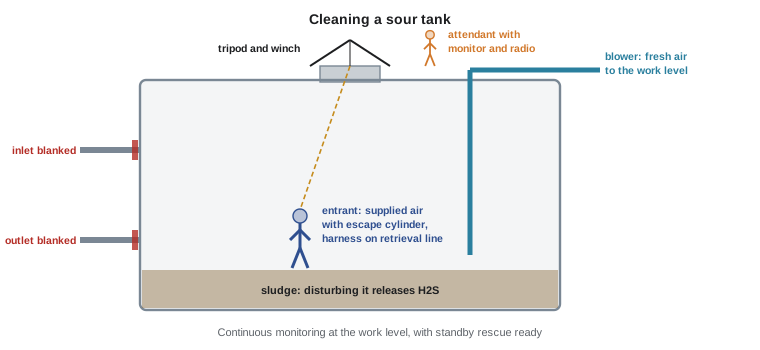
Test before and during entry, at several levels, with special attention to the bottom of the space and to sludge and liquids. Hydrogen sulfide readings can change during work, especially when sludge is disturbed, water is moved, or heat is applied. Continuous monitoring with an alarm audible to the entrant and attendant is the standard. Ventilate continuously with a blower supplying fresh air to the work level, and consider whether exhaust ventilation from the bottom is also needed. Isolate all lines that could bring sour fluids or gas into the space, using blanks or double block and bleed, not a single closed valve. Plan for the gas that comes out of sludge: cleaning a tank or digester often requires supplied-air breathing apparatus for the whole job even when the initial test is clear. Rescue must be ready. Entrants wear harnesses attached to retrieval systems where possible, and a rescue team with SCBA must be able to reach them within minutes, as lesson 10 explained.
Sewers and wastewater plants
Wastewater workers face hydrogen sulfide daily. Lesson 3 described where it forms and is released. Common exposure situations include opening manholes and wet well hatches, entering lift stations, cleaning screens and grit chambers, working on digesters and sludge tanks, maintaining odor control units, and jetting or vacuum cleaning sewers, which agitates sediment.
Specific practices for wastewater include: checking fixed detector readings and beacons before entering stations, but still carrying personal monitors; opening manhole covers with tools from upwind and letting the space vent before approaching; never entering wet wells or manholes without following confined space rules; recognizing that corrosion from hydrogen sulfide can damage ladders, steps, fans, detectors and electrical equipment, so equipment must be inspected; and coordinating with odor control and chemical dosing staff, because a dosing failure can cause hydrogen sulfide to rise quickly.
Wastewater plants also handle sludge, which can release large amounts of gas when centrifuged, pressed, loaded or stored. Dewatering buildings need good ventilation and fixed detection. Sludge storage tanks and silos are confined spaces with hydrogen sulfide, methane and low oxygen hazards.
Farms and manure
Manure gas incidents are a recurring tragedy on farms. They often involve family members, including young people, and multiple deaths in a single incident. The danger points are manure pits under barns, outdoor storage tanks, reception pits, pump-out structures and agitation. During agitation, hydrogen sulfide in a barn can jump to hundreds of ppm within minutes, killing livestock and anyone inside.
Key practices include: ventilating barns at maximum rate and keeping people and animals out during agitation and pump-out; keeping agitation below the surface where possible and avoiding agitation near slatted floors with people above; never entering manure pits, tanks or pump-out structures without testing, ventilation, supplied-air breathing apparatus and a rescue plan; fencing and covering outdoor storage to prevent falls; and posting signs warning of manure gas. Farm workers and families should be taught that a person who collapses in a manure structure must not be followed in.
Farm safety organizations and land-grant university extension services publish manure gas guidance. OSHA covers farms with employees, although small farms are exempt from some enforcement under appropriations rules, so guidance and training are especially important.
Oil and gas sites and trucking
On oil and gas sites, common exposures occur at tank hatches, sample points, separators, compressors, wellheads and during maintenance. Drilling, completions and well servicing in sour areas have specific procedures for hydrogen sulfide contingency planning, detection on the rig floor and at the shakers, breathing apparatus stations and drills, which are covered in HSE-331. Facility and pipeline safety, including pigging, sour gas plants and emergency shutdown systems, is covered in HSE-332.
Trucking deserves special attention. Drivers who haul crude oil, condensate and produced water climb onto tanks and trucks to open hatches for gauging and sampling, often alone and in remote locations. Several deaths across North America have involved drivers found on tank catwalks, overcome by hydrogen sulfide and hydrocarbon vapors released when the hatch was opened. NIOSH and OSHA issued a hazard alert on these exposures in 2016. Controls include remote gauging and sampling, closed loading, vapor recovery, standing upwind, wearing a personal monitor at the collar, and breathing apparatus where concentrations may be high. Drivers should never put their head over an open hatch.
Vessels, holds and other enclosed spaces
On fishing vessels, rotting fish and bilge water in holds and refrigerated seawater tanks can generate deadly hydrogen sulfide. Crew members entering holds to clear blockages or unload have been killed, often with others who tried to help. Ships carrying sour crude, asphalt or molten sulfur, and barges with decaying cargoes, have similar hazards in cargo tanks and enclosed spaces. Marine regulators require enclosed space entry procedures with gas testing, ventilation and rescue planning.
Estimating how far a release travels
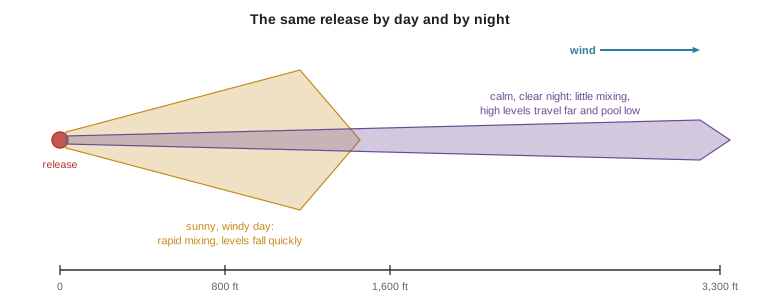
Outdoor releases spread with the wind and dilute as they travel. Air dispersion models used by regulators, such as the AERH2S and Rule 36 approaches mentioned in lesson 5, are complex. A simplified plume calculation shows how concentration falls with distance and why weather matters. It is shown only to illustrate the idea, not for planning.
# Simplified ground-level centreline concentration for a continuous ground release
# C = Q / (pi * u * sy * sz), with sigma values growing with distance (illustrative).
import math
Q_g_s = 5.0          # H2S release rate, grams per second
def sigmas(x, stable):
    # crude power-law fits: stable night air spreads less than unstable day air
    if stable:
        return 0.04 * x ** 0.9, 0.016 * x ** 0.8
    return 0.22 * x ** 0.9, 0.20 * x ** 0.85
for label, u, stable in [("sunny day, 5 m/s", 5.0, False), ("calm clear night, 1.5 m/s", 1.5, True)]:
    print(label)
    for x in (50, 200, 500, 1000):
        sy, sz = sigmas(x, stable)
        c_mg_m3 = Q_g_s / (math.pi * u * sy * sz) * 1000
        ppm = c_mg_m3 * 24.45 / 34.08
print(f" {x:5d} m: about {ppm:8.1f} ppm")sunny day, 5 m/s
50 m: about 5.5 ppm
200 m: about 0.5 ppm
500 m: about 0.1 ppm
1000 m: about 0.0 ppm
calm clear night, 1.5 m/s
50 m: about 1538.4 ppm
200 m: about 145.7 ppm
500 m: about 30.7 ppm
1000 m: about 9.4 ppmThe output shows the same release producing concentrations many times higher on a calm, clear night than on a windy, sunny day, because stable night air does not mix. Many large sour gas incidents have happened at night or in the early morning, when gas pools in valleys and drifts toward homes. That is why emergency planning uses conservative weather assumptions and why night work near sour facilities needs extra care.
Common threads
Across these settings, the same factors appear in incident reports again and again: work alone or out of sight of others; a task that opens or disturbs a source; reliance on smell or a single initial test; detectors not worn, not working or ignored; no ventilation or failed ventilation; and an unprotected rescue attempt. Programs that deal with these six factors prevent most deaths.
| Setting | Typical release trigger | Key controls |
|---|---|---|
| Confined spaces and tanks | Disturbing sludge, opening lines, cleaning | Isolation, ventilation, continuous monitoring, supplied air, retrieval, standby rescue |
| Sewers and lift stations | Opening hatches, pump starts, cleaning | Fixed detection, personal monitors, chemical dosing, confined space rules |
| Manure storage | Agitation and pump-out | Maximum ventilation, keep people out, never enter without SCBA and rescue plan |
| Tank batteries and trucking | Opening thief hatches, loading | Remote gauging, vapor recovery, upwind approach, personal monitors |
| Vessel holds | Entering holds with decaying catch | Enclosed space procedures, testing, ventilation, rescue planning |
Worked problem
A digester cleaning job
A contractor will clean out sludge from a drained anaerobic digester at a wastewater plant. Initial tests show 3 ppm hydrogen sulfide, 18 percent oxygen and 5 % LEL. What should the entry plan include?
Show solution
- The digester is a confined space with hydrogen sulfide, low oxygen and methane hazards.
- Sludge removal will release more gas, so readings will rise during work.
- Isolate all inlet and gas lines with blanks; ventilate continuously; monitor continuously at the work level for all gases.
- Because oxygen is already below 19.5 percent and hydrogen sulfide will rise, use supplied-air breathing apparatus with escape cylinders.
- Use intrinsically safe equipment because of methane, and plan rescue with retrieval systems and a standby team.
Answer: A full confined space plan with supplied air, continuous monitoring, isolation, ventilation and standby rescue, as HSE-211 describes.
Worked problem
A hauler at a remote battery
A produced-water hauler arrives at a remote tank battery at 5 a.m. The air is still. She plans to climb the tank, open the thief hatch and gauge by hand. What hazards and controls apply?
Show solution
- Calm early-morning air allows gas from the hatch to pool rather than disperse.
- She is alone, so no one will see if she collapses.
- Controls: use remote gauging if available; wear a personal monitor at the collar; check in with dispatch before and after climbing; stand upwind (there may be no wind, so stand to the side, never over the hatch); use SCBA if site rules require it.
Answer: Treat hatch work as a high-risk task: remote gauging first, otherwise monitor, check-in, position and breathing apparatus as required.
New and changing operations
Hydrogen sulfide hazards can appear where they did not exist before. A sweet oil field can turn sour as waterflooding introduces sulfate-reducing bacteria. A sewer system can develop new problem areas when flows drop or a new force main is built. A farm can change its manure handling system. Any change to processes, flows, chemicals or equipment should trigger a review of hydrogen sulfide hazards under the site's management of change process, with new monitoring to confirm conditions before people rely on old assumptions.
Common mistakes
MistakeTreating an initial clear test as valid for a whole tank-cleaning job.
InsteadGas rises as sludge is disturbed; monitor continuously and use supplied air where needed.
MistakeAgitating manure with people in the barn.
InsteadVentilate at maximum and keep people and animals out during agitation.
MistakeIsolating a tank with a single closed valve.
InsteadUse blanks or double block and bleed to prevent sour fluids entering.
MistakeAssuming night releases behave like day releases.
InsteadStill night air lets gas travel farther at higher concentrations and pool in low areas.
MistakeLeaning over a tank hatch to read the gauge.
InsteadUse remote gauging or stand to the side, upwind, with a monitor at the collar.
Summary and key terms
- Confined spaces account for most hydrogen sulfide deaths; test, ventilate, isolate, monitor continuously and plan rescue.
- Wastewater exposures occur at hatches, wet wells, screens, digesters and sludge handling; corrosion can disable equipment.
- Manure gas is most dangerous during agitation; keep people out and never enter without SCBA and a rescue plan.
- Tank hatches and truck loading are major exposure points in oil and gas; remote gauging and vapor recovery help.
- Vessel holds with decaying catch or sour cargo can hold lethal concentrations.
- Calm, stable night air lets releases travel farther at higher concentrations.
- Working alone, disturbing sources, relying on smell, detector failures, poor ventilation and unprotected rescues recur in incidents.
- Digester
- A tank where sludge is broken down by bacteria without oxygen, producing gas.
- Double block and bleed
- An isolation method with two closed valves and an open vent between them.
- Blanking
- Inserting a solid plate in a line to prevent flow.
- Retrieval system
- A harness, line and winch or tripod used to remove an entrant from a space.
- Dewatering
- Removing water from sludge by pressing or centrifuging.
- Reception pit
- A pit where manure collects before transfer to storage.
- Atmospheric stability
- How much the air mixes vertically; stable air mixes little.
- Plume
- A cloud of gas drifting downwind from a release.
- Gauging
- Measuring the liquid level in a tank.
- Enclosed space
- A marine term for a confined space on a vessel.
Practice problems
Work each problem on paper first, then reveal the answer to check.
Why must monitoring continue throughout a tank-cleaning job?
Show answer
Disturbing sludge releases more gas during the work.
What isolation method should be used for lines entering a confined space with sour fluids?
Show answer
Blanking or double block and bleed, not a single closed valve.
Name three wastewater tasks with hydrogen sulfide exposure.
Show answer
Any three of opening hatches, entering lift stations, cleaning screens, digester work, sludge handling and sewer jetting.
When is manure gas most dangerous?
Show answer
During agitation and pump-out.
What should happen to people and animals during agitation?
Show answer
They should be kept out of the barn, with ventilation at maximum.
Why are truck drivers at risk at tank batteries?
Show answer
They open hatches for gauging and sampling, often alone, releasing concentrated vapor.
Why are night releases more dangerous?
Show answer
Stable air mixes little, so gas travels farther at high concentrations and pools in low areas.
Which course covers drilling and well-site procedures in sour areas?
Show answer
HSE-331.
List four recurring factors in hydrogen sulfide incidents.
Show answer
Any four of working alone, disturbing a source, relying on smell or one test, detector failures, poor ventilation and unprotected rescue.
What hazard do fishing vessel holds present?
Show answer
Rotting fish and bilge water can generate lethal hydrogen sulfide in enclosed holds.
Lesson quiz · 5 questions
Score 60% or more to complete this lesson.
Create a free account to save your progress, take quizzes and earn a certificate.