
HSE-244 · Lesson 8 of 12 · 27 min
Respiratory protection for hydrogen sulfide
When hydrogen sulfide cannot be eliminated or controlled to safe levels by engineering and work practices, workers need respiratory protection. Because hydrogen sulfide can reach lethal concentrations within seconds and gives no reliable warning, respiratory protection for it is dominated by supplied-air equipment: self-contained breathing apparatus, supplied-air breathing apparatus with escape cylinders, and emergency escape devices. This lesson explains how these are used for hydrogen sulfide. Respirator programs, selection, assigned protection factors, medical evaluation, fit testing, breathing air quality, maintenance and SCBA inspection are covered in detail in HSE-240, which you should treat as the foundation for this lesson.
Why air-purifying respirators are rarely used
Air-purifying respirators remove contaminants from the air the wearer breathes, using cartridges or canisters. NIOSH lists certain air-purifying options, such as gas masks with canisters approved for hydrogen sulfide, for concentrations below the IDLH of 100 ppm and for escape. In practice, many employers, and most of the energy industry, do not allow air-purifying respirators for hydrogen sulfide work, for several reasons.
First, hydrogen sulfide concentrations can rise suddenly from low to lethal, for example when a hatch opens or a line fails, and an air-purifying respirator offers no protection above its rated concentration. Second, hydrogen sulfide has poor warning properties: the wearer cannot rely on smell to know the cartridge or canister is used up, because smell fatigues and is paralyzed. Third, air-purifying respirators do not supply oxygen, and many hydrogen sulfide environments, such as sewers, tanks and pits, may also be low in oxygen. Fourth, chemical cartridges have limited capacity, and change schedules depend on concentration and humidity, which are hard to predict. As HSE-240 explains, any atmosphere that is or may be IDLH or oxygen deficient requires supplied air.
Where air-purifying respirators are used for low-level hydrogen sulfide, such as in some odor-control or laboratory work, the employer must show that concentrations cannot exceed the respirator's limits, use cartridges or canisters approved for hydrogen sulfide, set a written change schedule and still provide personal monitors and escape equipment.
Self-contained breathing apparatus
Self-contained breathing apparatus (SCBA) gives the wearer a supply of breathing air from a cylinder carried on the back. For hydrogen sulfide, SCBA must be the positive-pressure (pressure-demand) type, which keeps the pressure inside the facepiece slightly above outside pressure so that any leak flows outward. Positive-pressure SCBA has the highest assigned protection factor of any respirator and is the standard equipment for entry into IDLH atmospheres, emergency response and rescue.
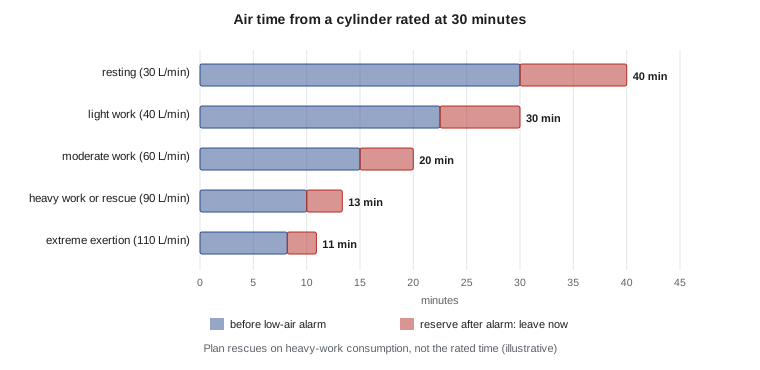
SCBA cylinders are rated by service time, commonly 30, 45 or 60 minutes, but the rating is based on a standard breathing rate used in certification testing. Actual duration depends on how hard the wearer works, their fitness, their stress level and the temperature. Under heavy work or the stress of a rescue, a 30-minute cylinder may last 15 minutes or less. Every SCBA has an end-of-service-time alarm, such as a bell, whistle or vibrating alert, that warns the wearer when the cylinder is down to a set fraction of its capacity. When that alarm sounds, the wearer must leave the hazardous area immediately.
# Estimate SCBA duration at different work rates (illustrative).
# A cylinder rated "30 minutes" in certification holds about 1,200 L of air
# (rated at 40 L/min). Real consumption varies widely.
rated_air_l = 1200
alarm_fraction = 0.25           # low-air alarm when about a quarter remains
for task, lpm in [("resting / standing", 30), ("light work", 40), ("moderate work", 60),
                  ("heavy work or rescue", 90), ("extreme exertion", 110)]:
    total = rated_air_l / lpm
    to_alarm = total * (1 - alarm_fraction)
print(f"{task:22s} {lpm:3d} L/min: total {total:4.1f} min, low-air alarm after {to_alarm:4.1f} min")resting / standing 30 L/min: total 40.0 min, low-air alarm after 30.0 min light work 40 L/min: total 30.0 min, low-air alarm after 22.5 min moderate work 60 L/min: total 20.0 min, low-air alarm after 15.0 min heavy work or rescue 90 L/min: total 13.3 min, low-air alarm after 10.0 min extreme exertion 110 L/min: total 10.9 min, low-air alarm after 8.2 min
The calculation shows why rescue plans must not assume the full rated time. A rescuer working hard may have 10 minutes or less before the low-air alarm, and that time must include getting in, doing the work and getting out. Work at a distance from fresh air, climbing and carrying a casualty all shorten the useful time.
Supplied-air breathing apparatus
For longer jobs in hydrogen sulfide atmospheres, such as tank cleaning, vessel work during turnarounds or extended well-site operations, workers often use supplied-air breathing apparatus (SABA), also called airline respirators. Air comes through a hose from a large cylinder bank or a compressor with breathing air purification. Because the hose can be cut, kinked or disconnected, a supplied-air respirator used in an IDLH atmosphere must have an auxiliary escape cylinder, typically rated for 5 to 15 minutes, that the wearer switches to if the airline fails.
Supplied-air systems need careful management: the air supply must meet breathing air quality standards, as HSE-240 explains; hose lengths must stay within the manufacturer's limits; hoses must be protected from vehicles, sharp edges and chemicals; and someone must watch the air supply and pressures. Workers must know how to switch to the escape cylinder, how long it lasts and the escape route.
Breathing air for SCBA and supplied-air systems in the United States must meet at least Grade D quality under the Compressed Gas Association specification referenced in OSHA 1910.134. Compressors must be located where they cannot draw in hydrogen sulfide or exhaust, a real risk on sour sites if the intake faces a vent or a running engine.
Escape respirators
Workers in areas where hydrogen sulfide could be released suddenly, but who do not normally need breathing apparatus, may carry or have nearby an emergency escape breathing device. These include small escape SCBAs with a hood or mask and a 5- to 15-minute cylinder, and in some settings escape hoods with filters approved for specific gases. Escape devices are only for getting out. They are never used to enter a hazardous area or to attempt a rescue.
Choosing the right equipment
| Situation | Typical respiratory protection |
|---|---|
| Routine work with continuous monitoring, no expected exposure | None worn; personal monitor; escape device available where required |
| Known or possible concentrations above limits but below the IDLH, short duration | Positive-pressure SCBA or SABA; air-purifying only if allowed by the employer's program and conditions are fully known |
| Atmosphere above 100 ppm (IDLH), unknown concentration or oxygen deficient | Positive-pressure SCBA, or SABA with escape cylinder |
| Long-duration work in hydrogen sulfide atmosphere | SABA with escape cylinder and an air supply attendant |
| Emergency response and rescue | Positive-pressure SCBA with a backup team |
| Escape from a sudden release | Emergency escape breathing device or SCBA |
Donning, checks and drills
In a hydrogen sulfide emergency, seconds matter. Workers who may need to put on SCBA must practice until they can do it quickly and correctly, often within a minute, including checking the cylinder pressure, opening the valve fully, putting on the facepiece and doing a seal check, and confirming positive pressure. Industry training such as H2S Alive includes hands-on SCBA donning. Offshore US rules require hydrogen sulfide drills for each person at least once every seven days.
Before each use, an SCBA should be checked: cylinder full and in test date, harness and straps intact, facepiece clean and undamaged, regulator working, low-air alarm working. After use, the cylinder is refilled and the unit cleaned and inspected. Units kept for emergencies must be inspected at least monthly, as HSE-240 describes, and stored where they can be reached without passing through the hazard, usually upwind or at the safe briefing area.
Facial hair, glasses and cold
A tight-fitting facepiece only protects if it seals against the skin. Beards, stubble and long sideburns where the seal sits allow leaks, and even positive pressure may not keep hydrogen sulfide out under heavy breathing. Workers who may need to wear SCBA must be clean-shaven where the facepiece seals, consistent with the fit testing rules in HSE-240. Prescription glasses must be the kind designed to mount inside the facepiece; ordinary glasses break the seal. Cold weather brings its own problems: facepieces can fog, regulators can freeze if moisture is present, and cylinders lose pressure as they cool. Equipment for cold climates should be rated and stored to prevent these problems.
Training and fitness
Wearing SCBA is physically demanding. The equipment can weigh 10 kg or more, breathing resistance increases effort, and wearers can overheat. Workers need medical clearance to wear respirators, fit testing for the specific facepiece, training in use and limits, and regular practice. Supervisors should assign SCBA work to workers who are trained, fit-tested and comfortable with the equipment, and should build in rest and rotation for long or heavy tasks.
Worked problem
Planning air for a tank entry
Two workers will enter a sour water tank wearing positive-pressure SCBA with cylinders rated at 30 minutes to remove a blockage near the far side. Getting in through the manway and crossing the tank takes about 4 minutes; getting out takes about 5 minutes with tools. The work is heavy. How much working time do they have?
Show solution
- At heavy work, consumption may be about 90 L/min, giving about 13 minutes total from 1,200 L.
- The low-air alarm sounds when about a quarter remains, after about 10 minutes.
- Entry takes 4 minutes and exit 5 minutes, leaving about 1 minute of working time before the alarm, with reserve air for the exit.
- That is not enough time; the task should be redesigned.
Answer: Use supplied-air breathing apparatus with escape cylinders for this job, or reduce travel distance, so that workers are not working against their air supply.
Worked problem
Choosing escape equipment
Operators at a gas plant work mostly in control rooms but walk through compressor buildings several times a shift. Fixed detectors are installed. A release could rapidly produce concentrations above 100 ppm. What respiratory protection should be planned?
Show solution
- Operators do not need to wear breathing apparatus for routine walk-throughs if monitoring shows safe conditions.
- A sudden release could create an IDLH atmosphere between them and the exit.
- Each operator should carry a personal monitor and an emergency escape breathing device, or have SCBA staged at building exits.
- Response teams need positive-pressure SCBA for entry and rescue.
Answer: Personal monitors, escape devices for walk-throughs, and SCBA for planned entry and emergency response.
Supervising breathing apparatus work
Supervisors of breathing apparatus work should confirm before the job that every wearer is trained, fit-tested for the facepiece in use and medically cleared; that cylinders are full and spare cylinders are available; that an attendant watches entrants and their air supply; that communication is set; and that rescue equipment and people are in place. During the job, they should track air time, rotate workers on heavy tasks, and stop work if equipment problems, fatigue or weather make it unsafe. After the job, they make sure equipment is cleaned, inspected, refilled and returned, and that any problem is reported.
Common mistakes
MistakeWearing a cartridge respirator into a possible high-concentration hydrogen sulfide area.
InsteadUse positive-pressure supplied air where concentrations may reach the IDLH or are unknown.
MistakePlanning a rescue on the cylinder's rated time.
InsteadHard work can halve the air time; plan on actual consumption.
MistakeUsing an escape device to go in after a casualty.
InsteadEscape devices are for getting out only.
MistakePlacing a breathing air compressor near a vent or engine exhaust.
InsteadLocate intakes in clean air, away from hydrogen sulfide sources and exhaust.
MistakeAllowing beards or stubble under SCBA facepieces.
InsteadWorkers must be clean-shaven where the facepiece seals.
Summary and key terms
- Respiratory protection for hydrogen sulfide is dominated by positive-pressure supplied-air equipment.
- Air-purifying respirators are rarely used because concentrations can rise suddenly, warning properties are poor and oxygen may be low.
- Positive-pressure SCBA is the standard for IDLH atmospheres, emergency response and rescue.
- Actual SCBA duration depends on work rate; heavy work can halve the rated time.
- Supplied-air breathing apparatus used in IDLH atmospheres needs an escape cylinder.
- Escape devices are for escape only, never for entry or rescue.
- Donning drills, inspections, clean-shaven seals, medical clearance and fit testing are essential, as detailed in HSE-240.
- SCBA
- Self-contained breathing apparatus, supplying air from a cylinder worn by the user.
- Positive-pressure (pressure-demand)
- Keeps facepiece pressure above outside pressure so leaks flow outward.
- SABA
- Supplied-air breathing apparatus, delivering air through a hose from a remote supply.
- Escape cylinder
- A small cylinder on a supplied-air respirator for escape if the airline fails.
- Emergency escape breathing device
- A short-duration device used only to escape from a hazardous atmosphere.
- Low-air alarm
- An alarm warning an SCBA wearer that the remaining air is low.
- Rated service time
- The certified duration of an SCBA cylinder at a standard breathing rate.
- Poor warning properties
- Characteristics of a gas, such as olfactory fatigue, that prevent a wearer from noticing breakthrough.
- Breathing air quality
- Standards for contaminants in compressed breathing air.
- Donning
- Putting on breathing apparatus.
Practice problems
Work each problem on paper first, then reveal the answer to check.
Give three reasons air-purifying respirators are rarely used for hydrogen sulfide.
Show answer
Concentrations can rise suddenly above their limits, poor warning properties hide breakthrough, they do not supply oxygen, and cartridge life is hard to predict (any three).
What type of SCBA is required for IDLH atmospheres?
Show answer
Positive-pressure (pressure-demand) SCBA.
Why does a 30-minute cylinder often last much less?
Show answer
The rating uses a standard breathing rate; heavy work, stress and fitness increase consumption.
What must a supplied-air respirator have for IDLH use?
Show answer
An auxiliary escape cylinder.
What should a wearer do when the low-air alarm sounds?
Show answer
Leave the hazardous area immediately.
Can an escape device be used for rescue?
Show answer
No; escape devices are for getting out only.
Why must compressor intakes be placed carefully on sour sites?
Show answer
They could draw in hydrogen sulfide or exhaust and contaminate breathing air.
Where should emergency SCBA be stored?
Show answer
Where it can be reached without passing through the hazard, usually upwind or at the safe briefing area.
Why must SCBA wearers be clean-shaven where the facepiece seals?
Show answer
Facial hair breaks the seal and allows leaks.
Which course covers respirator programs, fit testing and breathing air in detail?
Show answer
HSE-240.
Lesson quiz · 5 questions
Score 60% or more to complete this lesson.
Create a free account to save your progress, take quizzes and earn a certificate.