
HSE-244 · Lesson 12 of 12 · 27 min
Capstone: a hydrogen sulfide safety plan
This capstone brings the course together by building a hydrogen sulfide safety plan for an invented workplace. The site, numbers and people are fictional, chosen to show how the pieces fit. A real plan must be based on the actual site, its monitoring data and the law that applies, and written with the people who do the work.
The site
Tamarack Creek Utilities (invented) operates the wastewater system for a town of about 18,000 people in a western US state. Its assets include 11 sewage lift stations, a septage receiving station where vacuum trucks unload, and a treatment plant with a headworks building, grit chamber, aeration basins, an anaerobic digester and a sludge dewatering building. The utility has 24 field and plant staff, uses contractors for digester cleaning and major repairs, and dispatches crews from a central yard. Some staff also work part-time on the town's water system. Several lift stations are remote, and operators visit them alone on weekly rounds.
Over the past year, the utility has had three hydrogen sulfide alarms at lift stations, one operator treated for eye irritation after cleaning screens, a near miss when a vacuum truck driver unloaded acidic grease trap waste into the septage station, and repeated complaints of rotten-egg odor from residents near a force main discharge. The safety committee has asked for a written hydrogen sulfide safety plan.
Step 1: inventory and hazard assessment
The plan starts with an inventory of every location and task where hydrogen sulfide could be present, using monitoring data, datalogs, incident reports and operator knowledge.
| Location or task | Source and triggers | Observed or expected levels | Risk rating |
|---|---|---|---|
| Lift station wet wells (11) | Septic sewage; pump starts, hatch opening, float cleaning | Typically 1 to 20 ppm at hatch; peaks over 100 ppm at two stations | High at stations 4 and 9; medium elsewhere |
| Force main discharge manhole (station 4) | Turbulent discharge from 4 km force main | Fixed reading up to 60 ppm; odor complaints | High |
| Septage receiving | Truck unloading; incompatible wastes | Peaks to 40 ppm at the grate; near miss with acid waste | High |
| Headworks screens and grit | Turbulence, screenings handling | 3 to 8 ppm during cleaning | Medium |
| Digester and sludge tanks | Anaerobic digestion, sludge disturbance | Gas phase may exceed 1,000 ppm; confined space | Very high (entry) |
| Dewatering building | Centrifuging, conveying and loading sludge | 2 to 15 ppm during runs | Medium |
| Sewer manholes in collection system | Septic sections, jetting | Variable; unknown until tested | Medium to high (entry) |
The assessment identifies the main release triggers as opening wet wells and manholes, pump starts, cleaning, sludge handling, truck unloading and confined space entry. It also notes corrosion damage at older lift stations, where two fans and a fixed detector failed in the past year.
# Review one month of datalogs from four operators (invented data, 1-minute samples).
import random
random.seed(244)
def shift(peaks):
    data = [max(0.0, random.gauss(0.2, 0.15)) for _ in range(480)]
    for start, length, level in peaks:
        for i in range(start, start + length):
            data[i] = level * random.uniform(0.8, 1.2)
    return data
crew = {
    "Operator A": shift([(60, 12, 18), (300, 8, 6)]),
    "Operator B": shift([(120, 20, 4)]),
    "Operator C": shift([(200, 15, 35)]),
    "Operator D": shift([]),
}
for name, d in crew.items():
    twa = sum(d) / 480
    stel = max(sum(d[i:i+15]) / 15 for i in range(480 - 14))
    peak = max(d)
    flags = []
    if twa > 1: flags.append("TWA > 1 ppm")
    if stel > 5: flags.append("STEL > 5 ppm")
    if peak > 10: flags.append("peak > 10 ppm")
print(f"{name}: TWA {twa:4.2f} ppm, max 15-min {stel:5.1f} ppm, peak {peak:5.1f} ppm {', '.join(flags) or 'ok'}")Operator A: TWA 0.73 ppm, max 15-min 13.9 ppm, peak 21.6 ppm STEL > 5 ppm, peak > 10 ppm Operator B: TWA 0.36 ppm, max 15-min 4.1 ppm, peak 4.7 ppm ok Operator C: TWA 1.32 ppm, max 15-min 35.9 ppm, peak 41.3 ppm TWA > 1 ppm, STEL > 5 ppm, peak > 10 ppm Operator D: TWA 0.21 ppm, max 15-min 0.3 ppm, peak 0.6 ppm ok
The datalog review shows that short tasks drive the exposures. Two operators exceeded the ACGIH short-term limit during wet well work even though their shift averages were near or below 1 ppm, and one had a peak above 30 ppm. These peaks were never reported, because the alarms sounded only briefly.
Step 2: controls
Using the hierarchy of controls from lesson 9, the plan sets out controls for each high-risk location.
Source controls: add nitrate dosing at the station 4 force main to prevent septic conditions; schedule regular wet well cleaning to reduce sludge; and work with the town to reduce force main retention time at low flows.
Engineering controls: install continuous exhaust ventilation drawing from low level in the two worst wet wells; replace corroded fans and detectors with corrosion-resistant models; add fixed detection with beacons at each lift station door and remote alarms to the operations phone; install a sealed receiving connection at the septage station so trucks unload through a hose rather than an open grate; and enclose and ventilate the screenings conveyor.
Administrative controls: a written procedure for each high-risk task; a waste acceptance policy at the septage station requiring drivers to declare waste types and banning acidic wastes from being mixed with septage; confined space permits for all wet well, manhole, digester and tank entries; a lone-worker check-in system for lift station rounds, with check-ins before entering and after leaving each station; and pre-job briefings for contractor work.
Personal protective equipment: personal hydrogen sulfide monitors for every field and plant worker; positive-pressure SCBA at the plant and in each crew truck; supplied-air breathing apparatus with escape cylinders for digester and sludge tank cleaning; and fit testing, medical evaluation and training as HSE-240 requires.
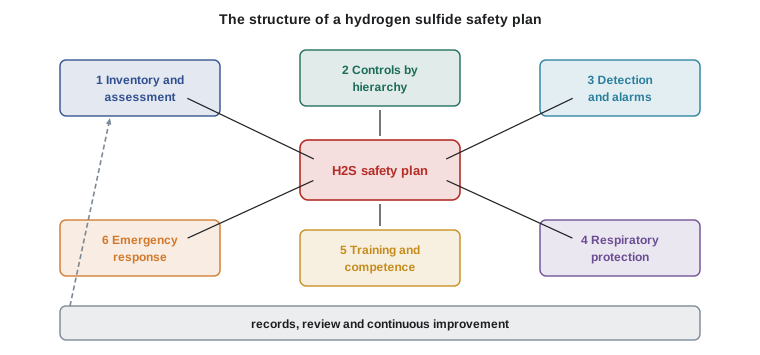
Step 3: detection and alarms
The plan sets alarm set points based on the most protective values rather than OSHA's older limits, which apply to this general industry work as a 20 ppm ceiling. The utility adopts the ACGIH values as its internal limits: personal monitors have a low alarm at 5 ppm, a high alarm at 10 ppm, a TWA alarm at 1 ppm and a STEL alarm at 5 ppm. Fixed detectors alarm at 5 ppm and 10 ppm and start ventilation at 5 ppm. Every alarm has a defined response: low alarm, stop work and move to fresh air; high alarm, evacuate to the briefing point and report. Monitors are bump tested daily using docking stations at the yard and plant, which also download datalogs weekly for review.
Step 4: training and competence
All field and plant staff complete hydrogen sulfide training meeting ANSI/ASSP Z390.1-2024, including hands-on SCBA and detector practice and drills, with refreshers at the interval set in the program, plus confined space training (HSE-211), respiratory protection training with fit testing (HSE-240) and site-specific training on each station's hazards, detectors and procedures. Vacuum truck drivers delivering to the septage station must show proof of hydrogen sulfide training and attend a site orientation. Supervisors complete additional training on the plan, datalog review and incident investigation.
Step 5: emergency response
The emergency plan follows the sequence in lesson 10. Each lift station has a laminated card at the door with its address, the nearest briefing point, the location of SCBA in the crew truck, and emergency numbers. For confined space entries, a standby rescue team with SCBA and a retrieval system is on site whenever an IDLH atmosphere is possible. The utility has an agreement with the town's fire department for confined space rescue, but because the fire hall is 15 minutes away, the plan does not rely on it for entries where knockdown is possible. Rescue drills are held twice a year at a lift station and at the digester.
# Annual plan check: training renewals and drills due (invented roster).
from datetime import date
today = date(2026, 10, 24)
roster = {
    "Operator A": date(2024, 3, 10), "Operator B": date(2023, 11, 2),
    "Operator C": date(2025, 6, 18), "Operator D": date(2023, 9, 30),
}
renewal_years = 3
for name, trained in roster.items():
    due = date(trained.year + renewal_years, trained.month, trained.day)
    days = (due - today).days
    status = "OVERDUE" if days < 0 else ("due within 90 days" if days <= 90 else "current")
print(f"{name}: trained {trained}, renewal due {due} -> {status}")Operator A: trained 2024-03-10, renewal due 2027-03-10 -> current Operator B: trained 2023-11-02, renewal due 2026-11-02 -> due within 90 days Operator C: trained 2025-06-18, renewal due 2028-06-18 -> current Operator D: trained 2023-09-30, renewal due 2026-09-30 -> OVERDUE
Step 6: records and review
The plan requires records of the inventory and assessments, detector bump tests and calibrations, datalog reviews, ventilation and fixed detector maintenance, training and fit testing, permits, drills, alarms, incidents and corrective actions. The safety committee reviews the plan every year and after any significant incident, alarm pattern or change in operations. Indicators include the number of alarms by location, datalog peaks above limits, overdue bump tests, training currency, drill results and corrective actions completed.
Reviewing the plan
A good test of a plan is to walk through a realistic scenario. Suppose an operator on a lone round at station 9 opens the wet well hatch and her monitor alarms high at 85 ppm. Under the plan, she steps back upwind, closes the hatch if it can be done from a safe position, leaves the station, reports by phone, and does not re-enter. The supervisor checks the fixed detector trend remotely, confirms the exhaust fan is running, and sends a two-person crew with SCBA to investigate. The alarm is logged, the datalog reviewed and the cause, perhaps a failed nitrate pump upstream, investigated and fixed. If any step in that story is unclear or impossible in practice, the plan needs work.
Worked problem
Evaluating the septage station controls
The near miss at the septage station involved a driver unloading acidic grease trap waste into a pit containing septage. Which controls in the plan address this, and are they enough?
Show solution
- Engineering: a sealed receiving connection removes the open grate where gas was released.
- Administrative: a waste acceptance policy requires drivers to declare waste and bans mixing acidic wastes with septage.
- Detection: fixed detection at the receiving point alarms locally and remotely.
- Gap: the policy relies on drivers knowing their waste; add pH testing of suspect loads and signage, and train drivers at orientation.
Answer: The controls address the main risk; adding pH checks and driver training closes the remaining gap.
Worked problem
Testing the rescue plan
During a drill at the digester, the standby team takes 7 minutes from the alarm to bring a mannequin out of the access hatch, mainly because the SCBA was stored in a building 150 m away. What should change?
Show solution
- The target is to restore breathing within about four to six minutes of collapse.
- Seven minutes, before any first aid, is too slow.
- Stage SCBA at the hatch with rescuers donned or ready during entry, and set up the retrieval system before entry begins.
- Repeat the drill to confirm the improvement.
Answer: Move equipment and people to the work location during entries, and repeat drills until the time meets the target.
Common mistakes
MistakeWriting the plan from generic templates without site data.
InsteadBase it on the actual inventory, monitoring data, datalogs and incidents, with input from workers.
MistakeSetting alarm points without defining the response.
InsteadEvery alarm level needs a clear, trained action.
MistakeRelying on distant fire departments for rescue during high-risk entries.
InsteadHave standby rescuers with SCBA on site when knockdown is possible.
MistakeFiling datalogs without reviewing them.
InsteadReview datalogs regularly to find unreported peaks and fix the tasks causing them.
MistakeReviewing the plan only when the regulator asks.
InsteadReview it yearly and after incidents, alarm patterns or changes.
Summary and key terms
- A hydrogen sulfide safety plan starts with an inventory of locations, sources, triggers and levels.
- Controls follow the hierarchy: source treatment, engineering, administrative controls, then PPE.
- Alarm set points and responses are defined and tied to the most protective applicable limits.
- Training covers awareness, hands-on SCBA and detector use, confined spaces, respirators and site specifics.
- Emergency plans ensure rescuers with SCBA can reach casualties within minutes, and are tested by drills.
- Records, datalog reviews and annual reviews drive continuous improvement.
- Walking through realistic scenarios reveals gaps in any plan.
- Hazard inventory
- A list of locations and tasks where a hazard may be present, with sources and controls.
- Risk rating
- A judgment of the likelihood and severity of harm for a hazard.
- Waste acceptance policy
- Rules on what wastes can be received and how they must be declared.
- Nitrate dosing
- Adding nitrate to sewage to prevent hydrogen sulfide formation.
- Internal limit
- An exposure limit an employer adopts that may be stricter than the law.
- Standby rescue
- Rescuers and equipment ready at a work location during hazardous work.
- Rescue drill
- A practice exercise to test and improve rescue capability.
- Leading indicator
- A measure of safety activity, such as training currency or drills completed.
- Lagging indicator
- A measure of outcomes, such as incidents and injuries.
- Continuous improvement
- Regularly reviewing performance and updating the plan.
Practice problems
Work each problem on paper first, then reveal the answer to check.
What should a hydrogen sulfide inventory record?
Show answer
Locations and tasks, sources and triggers, observed or expected levels, controls and risk rating.
Give one source control for a force main with hydrogen sulfide problems.
Show answer
Nitrate or other chemical dosing, or reducing retention time.
Why did the Tamarack Creek datalog review matter?
Show answer
It revealed unreported short-term exceedances during wet well work.
What engineering control addresses the septage station grate?
Show answer
A sealed receiving connection so trucks unload through a hose.
Why does the plan not rely on the fire department for digester entry rescue?
Show answer
The fire hall is 15 minutes away, too slow for a knockdown.
What does a lone-worker check-in system do on lift station rounds?
Show answer
Confirms the operator is safe before entering and after leaving each station.
Give three records the plan requires.
Show answer
Any three of bump tests, calibrations, datalog reviews, maintenance, training, fit tests, permits, drills, alarms and incidents.
When should the plan be reviewed?
Show answer
Every year and after significant incidents, alarm patterns or operational changes.
What should an operator do if her monitor alarms high on opening a hatch alone?
Show answer
Step back upwind, leave, report and not re-enter; a crew with SCBA investigates.
How can a rescue drill improve a plan?
Show answer
It shows how long rescue takes and where equipment or procedures need to change.
Lesson quiz · 5 questions
Score 60% or more to complete this lesson.
Create a free account to save your progress, take quizzes and earn a certificate.