
HSE-244 · Lesson 2 of 12 · 27 min
Properties of hydrogen sulfide
Every control in a hydrogen sulfide program follows from a handful of physical and chemical properties. The gas is heavier than air, so it settles. It dissolves in water and oil, so it travels with liquids and comes out when they are agitated, heated or depressurized. It is flammable, so a release can become a fire or explosion. It burns to sulfur dioxide, another toxic gas. It reacts with iron to form deposits that can catch fire on their own. And it attacks steel, making equipment brittle. This lesson explains each property and what it means on the job.
The basic numbers
| Property | Value | What it means at work |
|---|---|---|
| Chemical formula | H₂S | Two hydrogen atoms and one sulfur atom |
| Molar mass | 34.08 g/mol | Used to convert between ppm and mg/m³ |
| Relative vapor density (air = 1) | About 1.19 | Slightly heavier than air; tends to collect in low places |
| Color | None | Cannot be seen |
| Odor | Rotten eggs at low concentrations | Not a reliable warning; smell fades and is paralyzed |
| Flammable range in air | About 4 % to 45 % by volume | Burns or explodes within this range |
| Autoignition temperature | About 260 °C | Hot surfaces such as exhaust manifolds can ignite it |
| Solubility | Dissolves in water, oil and many liquids | Released when liquids are agitated, heated or depressurized |
| Combustion product | Sulfur dioxide (SO₂) | Burning H₂S creates another toxic gas |
Heavier than air: where it goes
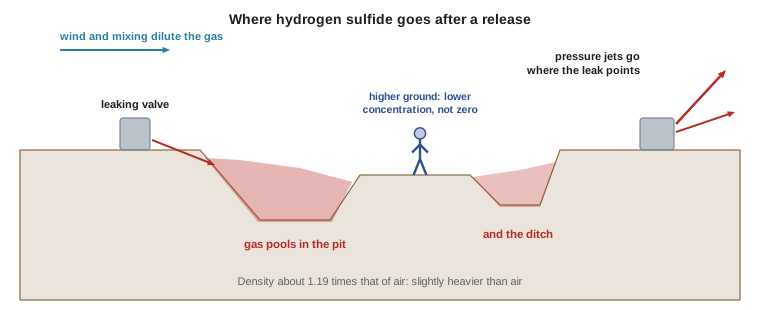
With a relative vapor density of about 1.19, hydrogen sulfide is only about a fifth heavier than air. That is enough for a pure or concentrated release to sink and flow downhill like an invisible liquid, collecting in pits, trenches, sumps, valve boxes, basements, ditches, low ground and the bottoms of tanks and vessels. On a calm night, gas from a leak can drift along a creek valley and pool in a low spot far from the source.
The heavier-than-air rule has limits. Once hydrogen sulfide is diluted in air at a few hundred ppm, the mixture is almost exactly as dense as air, and wind, warm air rising and ventilation move it around freely. A hot gas leaving a process can rise before it cools. Gas released under pressure jets in whatever direction the leak points. So the practical rule is: expect hydrogen sulfide to concentrate in low and enclosed places, but never assume high places are safe. Detectors should be placed and carried at the level where people breathe and where gas is likely to collect.
Converting between ppm and mg/m³
Gas concentrations in air are usually measured in parts per million by volume (ppm). Some limits and laboratory results are given in milligrams per cubic meter. The conversion depends on the molar mass of the gas and the volume one mole of gas occupies, which is about 24.45 liters at 25 °C and normal atmospheric pressure.
For hydrogen sulfide, with a molar mass of 34.08 g/mol, 1 ppm is about 1.39 mg/m³. So 10 ppm is about 14 mg/m³, and 100 ppm is about 139 mg/m³.
M = 34.08      # g/mol for hydrogen sulfide
MOLAR_VOL = 24.45  # L per mole at 25 C and 101.3 kPa

def ppm_to_mg(ppm):
    return ppm * M / MOLAR_VOL

def mg_to_ppm(mg):
    return mg * MOLAR_VOL / M

for ppm in (1, 5, 10, 20, 100):
    print(f"{ppm:4d} ppm = {ppm_to_mg(ppm):6.1f} mg/m3")
print(f"14 mg/m3 = {mg_to_ppm(14):.1f} ppm")1 ppm = 1.4 mg/m3 5 ppm = 7.0 mg/m3 10 ppm = 13.9 mg/m3 20 ppm = 27.9 mg/m3 100 ppm = 139.4 mg/m3 14 mg/m3 = 10.0 ppm
Percentages, ppm and mole fraction
In oil and gas, the hydrogen sulfide content of a gas stream is usually given as a mole percent or mole fraction, because the gas is mostly hydrocarbon. One percent by volume equals 10,000 ppm. A gas stream that is 2 percent hydrogen sulfide therefore contains 20,000 ppm, two hundred times the concentration that is immediately dangerous to life. Even small leaks of such gas need large dilution before the air is safe.
# How much dilution is needed before sour gas reaches a given level in air.
def dilution_needed(mole_percent, target_ppm):
    source_ppm = mole_percent * 10_000
    return source_ppm / target_ppm

for pct in (0.1, 1, 5, 20):
    print(f"{pct:5.1f} % H2S = {pct*10_000:9,.0f} ppm; "
          f"needs {dilution_needed(pct, 100):7,.0f}x dilution to reach 100 ppm, "
f"{dilution_needed(pct, 10):8,.0f}x to reach 10 ppm")0.1 % H2S = 1,000 ppm; needs 10x dilution to reach 100 ppm, 100x to reach 10 ppm 1.0 % H2S = 10,000 ppm; needs 100x dilution to reach 100 ppm, 1,000x to reach 10 ppm 5.0 % H2S = 50,000 ppm; needs 500x dilution to reach 100 ppm, 5,000x to reach 10 ppm 20.0 % H2S = 200,000 ppm; needs 2,000x dilution to reach 100 ppm, 20,000x to reach 10 ppm
The numbers make the point. A leak of gas containing 20 percent hydrogen sulfide must be diluted twenty thousand times before it falls to 10 ppm. That is why sour facilities are designed with emergency shutdown valves, flare systems and emergency planning zones, rather than relying on dilution alone.
Dissolved hydrogen sulfide
Hydrogen sulfide dissolves readily in water, crude oil and many other liquids. The amount dissolved depends on pressure, temperature and how much gas is above the liquid. When pressure drops, temperature rises or the liquid is agitated, dissolved gas comes out. That is why so many hydrogen sulfide exposures happen when workers open a hatch on a tank, gauge a tank by hand, dump a sample, transfer liquids between trucks and tanks, clean out sludge or open a line that has been under pressure.
Produced water and crude oil from sour wells can hold enough dissolved gas to create a lethal atmosphere at an open tank hatch, even when the gas phase of the well looks low in hydrogen sulfide. In sewers, hydrogen sulfide dissolved in sewage comes out where flow becomes turbulent: at drops, pump discharges, siphons and where force mains empty into gravity sewers. Lesson 3 describes these release points in more detail.
Flammability and fire
Hydrogen sulfide is flammable between about 4 and 45 percent in air. Those concentrations are tens of thousands of ppm, far above the levels that kill, so in most toxic exposures the gas is not in its flammable range. In a large release, however, the cloud near the source can be flammable, and an ignition source such as a running engine, a heater or a spark from tools can cause a flash fire or explosion. Its autoignition temperature of about 260 °C means a hot exhaust manifold or a steam line can ignite a rich mixture without a flame.
Gas detectors measure flammability separately as a percentage of the lower explosive limit (% LEL), usually calibrated to methane. Lessons 6 and 7 explain why a four-gas detector reads hydrogen sulfide in ppm on one sensor and flammability in % LEL on another, and why both readings matter.
Burning makes sulfur dioxide
When hydrogen sulfide burns, in a flare, an incinerator or an accidental fire, it forms sulfur dioxide and water:
Sulfur dioxide is a colorless gas with a sharp, choking smell. It is strongly irritating to the eyes and airways and can trigger severe asthma attacks; the ACGIH has set a short-term limit of 0.25 ppm, and OSHA's older limit is 5 ppm. Igniting a large sour gas release is sometimes the right decision, because sulfur dioxide is much less acutely toxic than hydrogen sulfide and rises with the hot plume, but ignition is a decision for trained responders following an emergency response plan, not for workers on site.
Iron sulfide: a fire waiting to happen
Hydrogen sulfide reacts with iron and steel to form iron sulfide, a black scale that coats the inside of pipes, tanks, vessels and filters in sour service. When this scale is exposed to air, for example when a vessel is opened for cleaning or a filter is removed, it can oxidize rapidly and heat up enough to glow and ignite nearby hydrocarbons. This is called pyrophoric iron sulfide. Fires and explosions in tanks and vessels during maintenance have been traced to it.
The usual controls are to keep iron sulfide deposits wet until they can be removed and disposed of properly, to use chemical treatments that neutralize the deposits before opening equipment, and to keep removed scale in water-filled containers. Workers cleaning sour equipment should treat black scale as a fire hazard and a possible source of trapped hydrogen sulfide.
Corrosion and cracking
Hydrogen sulfide also damages steel. In wet sour service, hydrogen atoms released by corrosion enter the metal and can cause a brittle failure called sulfide stress cracking, along with related forms of hydrogen damage. A pipe, fitting, valve or bolt that would be fine in clean service can crack suddenly under load in sour service. Equipment for sour service is therefore made from materials that meet recognized standards for resisting this damage, most widely the international standard published as NACE MR0175 and ISO 15156.
For workers, the practical messages are to use only equipment rated for sour service on sour systems, never to substitute an ordinary fitting or hose because it fits, and to report leaks, weeping joints and corrosion promptly. The details are a matter for engineers and are touched on again in HSE-332.
Worked problem
Converting a laboratory result
An air sample from a wastewater plant headworks building is reported as 4.2 mg/m³ of hydrogen sulfide. What is that in ppm, and how does it compare with an ACGIH TLV of 1 ppm as an eight-hour average?
Show solution
- Use the conversion ppm = mg/m³ × 24.45 ÷ 34.08.
- 4.2 × 24.45 = 102.7; 102.7 ÷ 34.08 = 3.0 ppm.
- If this is the average over the shift, it is three times the ACGIH eight-hour TLV.
Answer: About 3 ppm. If representative of the shift, the exposure is well above the ACGIH TLV and controls are needed. Lesson 5 explains which limit applies in each jurisdiction.
Worked problem
Opening a tank hatch
A truck driver arrives to load produced water from a tank at a well site. The site's gas analysis shows only 0.5 percent hydrogen sulfide in the separator gas. Is opening the tank thief hatch to gauge the level a low-risk task?
Show solution
- Produced water and oil can carry dissolved hydrogen sulfide that comes out in the tank's vapor space.
- The vapor space of a closed tank can build up concentrations far higher than the separator gas suggests.
- When the hatch opens, a puff of concentrated vapor rises past the driver's face.
- Even 0.5 percent is 5,000 ppm, fifty times the IDLH concentration of 100 ppm.
Answer: No. Hatch gauging is a well-known cause of deaths. Use remote gauging if available, wear a personal detector, stand upwind, and use breathing apparatus where the site requires it.
Common mistakes
MistakeBelieving hydrogen sulfide is always found only at ground level.
InsteadIt tends to collect low, but pressure jets, heat and wind can carry it anywhere.
MistakeUsing an ordinary fitting on a sour line because it fits.
InsteadUse only equipment rated for sour service; ordinary steel can crack suddenly.
MistakeLetting black scale from sour equipment dry out in the open.
InsteadKeep iron sulfide wet and dispose of it properly; it can self-ignite in air.
MistakeAssuming a low percentage of H₂S in gas means low risk.
InsteadOne percent is 10,000 ppm, a hundred times the IDLH.
MistakeThinking burning hydrogen sulfide makes it harmless.
InsteadIt forms sulfur dioxide, which is also toxic and irritating.
Summary and key terms
- Hydrogen sulfide has a molar mass of 34.08 g/mol, so 1 ppm is about 1.39 mg/m³ at 25 °C.
- It is slightly heavier than air and tends to collect in low and enclosed places, but pressure, heat and wind can move it.
- One percent by volume equals 10,000 ppm; sour gas streams can contain many times the lethal concentration.
- It dissolves in water and oil and comes out when liquids are agitated, heated or depressurized.
- It is flammable from about 4 to 45 percent and autoignites at about 260 °C.
- Burning it produces sulfur dioxide, and its reaction with steel forms pyrophoric iron sulfide and causes sulfide stress cracking.
- Equipment in sour service must be made to recognized sour-service material standards.
- Relative vapor density
- The density of a gas compared with air; values above 1 mean heavier than air.
- Molar mass
- The mass of one mole of a substance; 34.08 g/mol for hydrogen sulfide.
- Mole percent
- The proportion of a gas mixture made up of one component, by number of molecules; 1 % equals 10,000 ppm.
- Lower explosive limit (LEL)
- The lowest concentration of a gas in air that can burn or explode.
- Autoignition temperature
- The temperature at which a gas ignites without a flame or spark.
- Sulfur dioxide (SO₂)
- The toxic, irritating gas formed when hydrogen sulfide burns.
- Pyrophoric iron sulfide
- Iron sulfide scale that can heat and ignite spontaneously when exposed to air.
- Sulfide stress cracking
- Brittle cracking of steel under stress in wet sour service.
- Sour service
- Equipment or systems exposed to fluids containing hydrogen sulfide.
- NACE MR0175 / ISO 15156
- The international standard for materials resistant to cracking in sour oil and gas service.
Practice problems
Work each problem on paper first, then reveal the answer to check.
Convert 25 ppm of hydrogen sulfide to mg/m³.
Show answer
About 34.8 mg/m³ (25 × 34.08 ÷ 24.45).
Convert 70 mg/m³ of hydrogen sulfide to ppm.
Show answer
About 50 ppm (70 × 24.45 ÷ 34.08).
How many ppm is 3 percent hydrogen sulfide by volume?
Show answer
30,000 ppm.
Why does hydrogen sulfide collect in pits and trenches?
Show answer
It is slightly heavier than air and flows to low places, especially in calm conditions.
Give three ways dissolved hydrogen sulfide is released from liquids.
Show answer
Agitation, heating and pressure drop (for example opening a hatch, pumping or transfer).
What does hydrogen sulfide produce when it burns?
Show answer
Sulfur dioxide and water.
Why must iron sulfide scale be kept wet?
Show answer
It can oxidize, heat up and ignite on its own when exposed to air.
What is sulfide stress cracking?
Show answer
Brittle cracking of steel under stress in wet sour service, caused by hydrogen entering the metal.
Why are high places not automatically safe from hydrogen sulfide?
Show answer
Pressure jets, hot gas and wind can carry it upward, and diluted gas mixes freely.
Is a 50 ppm toxic exposure likely to be in the flammable range?
Show answer
No; the flammable range starts at about 40,000 ppm, but large releases near the source can be flammable.
Lesson quiz · 5 questions
Score 60% or more to complete this lesson.
Create a free account to save your progress, take quizzes and earn a certificate.