
HSE-244 · Lesson 7 of 12 · 27 min
Gas detection II: bump tests, calibration and fixed monitoring
A gas detector is only as good as its last test. Electrochemical sensors can lose sensitivity gradually, become blocked by dirt, water or ice, or fail outright, and the display may still show a reassuring zero. The only way to know a detector will respond to hydrogen sulfide is to expose it to a known concentration of the gas and watch it react. This lesson covers bump tests, calibration, records, fixed detection systems and the practical limits of detection. Instrument maintenance for confined space work in general is covered in HSE-211.
Bump tests
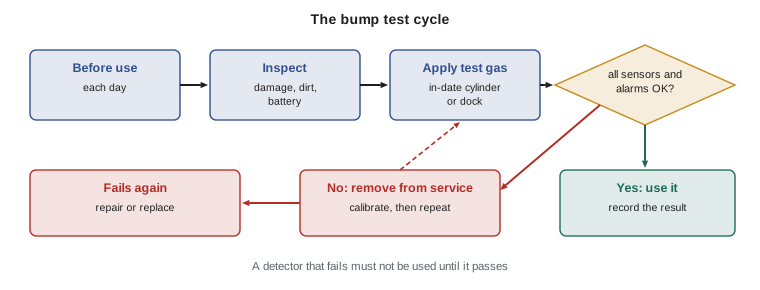
A bump test, also called a functional test, exposes the detector briefly to a test gas with a known concentration that is high enough to trigger the alarms. The test confirms that gas reaches the sensor, the sensor responds within an acceptable range and the audible, visual and vibrating alarms work. It does not adjust the detector's readings.
Manufacturers and most safety organizations recommend bump testing portable detectors before each day's use. Many employers in hydrogen sulfide work require it, and some regulations do too; BSEE, for example, requires functional tests of detectors at set intervals on offshore facilities. A bump test takes less than a minute with a docking station or a cylinder and regulator.
If a detector fails a bump test, it must not be used until it is calibrated and passes, or is repaired or replaced. A failed bump test is not an inconvenience to be worked around: it may be the only sign that a sensor has died.
Calibration
Calibration adjusts the detector so that its readings match known concentrations. The detector is first zeroed in clean air (or zero gas), then exposed to a calibration gas of known concentration, and its response is adjusted to read correctly. Calibration compensates for normal sensor drift. Manufacturers specify how often it should be done, commonly every 30 to 180 days depending on the model and use, and whenever a bump test fails or the detector has been exposed to very high concentrations, dropped or submerged.
Disposable single-gas monitors are not calibrated by the user. They are designed to run for a fixed period, usually two or three years, and are bump tested regularly; when a bump test fails or the life ends, they are discarded and replaced.
Test gas and accuracy
Bump and calibration gas comes in cylinders with a certified concentration and an expiry date. Hydrogen sulfide is a reactive gas, and its concentration in a cylinder falls over time, so out-of-date gas can give a false result. Typical hydrogen sulfide test concentrations are around 10 to 40 ppm, often mixed with carbon monoxide, methane and oxygen for multi-gas detectors. The regulator flow rate must match the manufacturer's requirements, and tubing should be short and made of materials that do not absorb hydrogen sulfide.
A bump test passes if the reading falls within a tolerance of the test gas concentration, often plus or minus 10 to 20 percent depending on the manufacturer, and the alarms activate. Offshore US rules, for example, require recalibration when a functional test reading differs from the applied concentration by more than 2 ppm or 10 percent, whichever is greater.
# Check a bump test result against a tolerance rule (illustrative).
def bump_ok(applied_ppm, reading_ppm, pct=10, abs_ppm=2):
    allowed = max(abs_ppm, applied_ppm * pct / 100)
    return abs(reading_ppm - applied_ppm) <= allowed, allowed

for applied, reading in [(25, 24), (25, 21), (10, 11.5), (10, 7)]:
    ok, allowed = bump_ok(applied, reading)
    print(f"applied {applied} ppm, read {reading} ppm, allowed +/-{allowed:.1f} ppm: "
f"{'PASS' if ok else 'FAIL - calibrate'}")applied 25 ppm, read 24 ppm, allowed +/-2.5 ppm: PASS applied 25 ppm, read 21 ppm, allowed +/-2.5 ppm: FAIL - calibrate applied 10 ppm, read 11.5 ppm, allowed +/-2.0 ppm: PASS applied 10 ppm, read 7 ppm, allowed +/-2.0 ppm: FAIL - calibrate
Records
Records show that detectors were tested and calibrated and help investigators if something goes wrong. Docking stations log bump tests and calibrations automatically and can store the detector's datalog, which records readings and alarms during use. Datalogs are also valuable for exposure assessment: they show when and where peaks occurred, which tasks caused them and whether the TWA and STEL were exceeded. A review of datalogs across a crew often reveals routine exposures that nobody reported because no one smelled anything or the alarm only chirped briefly.
Fixed detection systems
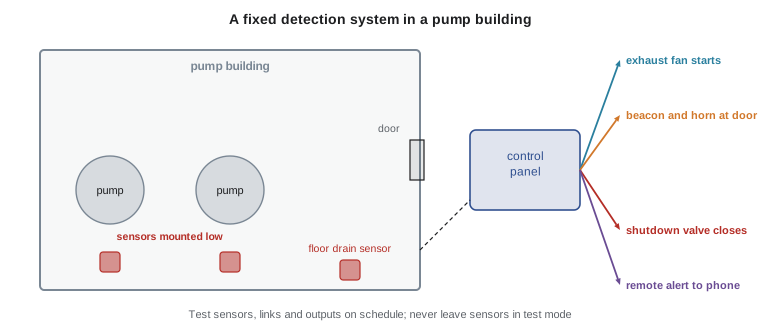
Fixed systems protect places where hydrogen sulfide could be released at any time, such as compressor buildings, pump houses, wellheads, separators, tank farms, sewage lift stations and headworks buildings. A well-designed system places sensors where gas is likely to be released and where it would collect or reach people, typically near potential leak sources and in low areas, at a height suited to the gas and the room. It considers airflow patterns, doors, ventilation and the location of workers, and it uses enough sensors to cover the area.
Fixed systems can do much more than sound an alarm. They can start exhaust fans, close emergency shutdown valves, shut down pumps, light beacons at building entrances so that workers do not walk in, send alerts to control rooms and phones and record readings for review. For these functions to work when needed, the system must be tested and maintained like any other safety system: sensors bump tested and calibrated on schedule, communication links checked, alarm devices tested, and faults fixed promptly.
The Odessa investigation described in lesson 1 found a fixed system that existed but did not work: detectors were not communicating with the control panel and some were left in test mode, so the beacon and phone alerts did not activate. A fixed system that is not maintained can be worse than none, because people trust it.
Beacons and entry
Many sites with fixed detection put a beacon or display at each entrance showing whether the building is clear. Workers should check it before entering but should still carry their own personal monitor; a beacon cannot show a release that started after the last reading, a local pocket of gas, or a system fault. Some sites require a call to a control room before entering certain buildings so that someone knows the worker is there.
Limits of detection
Even well-maintained detectors have limits that workers need to understand.
Point detectors only measure where they are. A personal monitor on a worker's chest may read lower than the air at a hatch opening a few centimeters from the worker's nose. A fixed sensor in a corner may not see a leak on the other side of a building until gas spreads.
Response is not instant. Electrochemical sensors typically take tens of seconds to reach 90 percent of their final reading. In a sudden release, the first breath may come before the alarm.
Environmental conditions matter. Extreme cold can slow sensors and drain batteries; heat and dry air can dry out electrolytes; condensation, mud, ice or paint can block sensor openings; and strong electromagnetic fields from radios can affect some instruments.
Sensors can be overwhelmed. Concentrations far above the sensor's range, often a few hundred ppm for personal monitors, may show as over-range and can damage the sensor.
People can defeat detectors: turning them off because of nuisance alarms, covering sensors, leaving them in vehicles, ignoring fault signals, or silencing a fixed alarm without investigating. Training, supervision and a culture that treats every alarm seriously are part of detection.
# Illustrative: reading shown by a sensor with first-order response (t90 = 30 s)
# when a worker steps into 200 ppm.
import math
t90 = 30.0
tau = t90 / math.log(10)        # time constant for first-order response
true_ppm = 200
for t in (2, 5, 10, 20, 30, 60):
    shown = true_ppm * (1 - math.exp(-t / tau))
print(f"t = {t:2d} s: display about {shown:5.0f} ppm (true {true_ppm} ppm)")t = 2 s: display about 28 ppm (true 200 ppm) t = 5 s: display about 64 ppm (true 200 ppm) t = 10 s: display about 107 ppm (true 200 ppm) t = 20 s: display about 157 ppm (true 200 ppm) t = 30 s: display about 180 ppm (true 200 ppm) t = 60 s: display about 198 ppm (true 200 ppm)
The model shows why detectors are a warning system, not a guarantee. By the time a typical sensor shows the true value, a worker has taken several breaths. Detectors work best when combined with other controls: knowing where gas may be released, approaching from upwind, opening hatches remotely, ventilating, and wearing breathing apparatus where high concentrations are possible.
A detection program
Pulling these points together, a hydrogen sulfide detection program should cover: selecting detectors suited to the hazards and environment; issuing personal monitors to everyone in hydrogen sulfide areas; setting and documenting alarm set points and responses; daily bump tests and scheduled calibration; maintaining and testing fixed systems; managing test gas; keeping records and reviewing datalogs; training workers on use, limits and responses; and investigating alarms and near misses.
Worked problem
A failed bump test
At the start of a shift, a wastewater operator's personal monitor reads 14 ppm when exposed to 25 ppm test gas. The operator is in a hurry and the monitor alarmed, so he wants to use it. What should happen?
Show solution
- The reading is 11 ppm below the applied concentration, a 44 percent error.
- Typical tolerances are 10 to 20 percent, so the detector fails.
- An alarm that triggers only at 25 ppm of test gas may not trigger at the set point in real use because the sensor is under-reading.
Answer: Do not use it. Calibrate it and repeat the bump test, or replace it if disposable. Use a spare detector that passes.
Worked problem
Reviewing datalogs
A supervisor downloads the datalogs from five pumpers' monitors for a month. Most days show zero, but each pumper has short peaks of 15 to 40 ppm at the same tank battery when gauging tanks. No one reported an exposure. What should the supervisor do?
Show solution
- The peaks show a repeated exposure at a specific task and location.
- Even brief peaks above the STEL or ceiling limits are exceedances.
- The task needs controls: remote gauging, vapor recovery, procedures to stand upwind, or breathing apparatus.
- Workers should be reminded to report alarms and peaks, and the site's hazard assessment updated.
Answer: Treat the pattern as a hazard to control, not a curiosity. Datalogs reveal exposures that people do not notice or report.
Common mistakes
MistakeSkipping the bump test because the detector looks fine.
InsteadBump test before each day's use; sensors can fail without visible signs.
MistakeUsing expired test gas.
InsteadHydrogen sulfide test gas degrades; use in-date cylinders at the right flow rate.
MistakeTrusting a building beacon instead of carrying a personal monitor.
InsteadCarry your own monitor; beacons can miss local pockets, new releases and faults.
MistakeLeaving fixed detectors in test mode after maintenance.
InsteadReturn systems to service and test alarms and outputs.
MistakeAssuming a detector reacts instantly.
InsteadSensors take tens of seconds to show true values; combine detection with other controls.
Summary and key terms
- A bump test confirms that a detector responds and its alarms work; do it before each day's use.
- Calibration adjusts readings to known concentrations; follow the manufacturer's schedule and recalibrate after failures or high exposures.
- Use in-date test gas at the correct flow rate; hydrogen sulfide test gas degrades over time.
- Records and datalogs prove testing and reveal exposures that workers do not notice or report.
- Fixed systems can alarm, ventilate, shut down and alert, but must be tested and maintained.
- Detectors have limits: point measurement, response delay, environmental effects and over-range.
- Detection works best combined with other controls and a culture that treats every alarm seriously.
- Bump test
- A brief exposure to test gas to confirm the detector responds and alarms work.
- Calibration
- Adjusting a detector so its readings match known gas concentrations.
- Zeroing
- Setting the detector's baseline reading in clean air or zero gas.
- Test gas
- A gas mixture of certified concentration used for bump tests and calibration.
- Docking station
- A device that automatically bump tests, calibrates and records detector results.
- Datalog
- A detector's stored record of readings and alarms over time.
- Over-range
- A concentration above the sensor's measuring range.
- Drift
- Gradual change in a sensor's response over time.
- Emergency shutdown valve
- A valve that closes automatically to stop a release.
- Functional test
- Another name for a bump test.
Practice problems
Work each problem on paper first, then reveal the answer to check.
What is the difference between a bump test and a calibration?
Show answer
A bump test checks response and alarms; calibration adjusts the readings to match known concentrations.
How often should a portable detector be bump tested?
Show answer
Before each day's use, as recommended by manufacturers and most safety organizations.
What should happen if a detector fails a bump test?
Show answer
Remove it from service; calibrate and retest, or repair or replace it.
Why does test gas have an expiry date?
Show answer
Hydrogen sulfide is reactive and its concentration in the cylinder falls over time.
Applied gas is 20 ppm; the detector reads 17 ppm. Does it pass a rule of 2 ppm or 10 percent, whichever is greater?
Show answer
No; the allowed error is 2 ppm and the error is 3 ppm.
Give three actions a fixed detection system can trigger.
Show answer
Any three of alarms and beacons, exhaust fans, shutdown valves, pump shutdown and remote alerts.
Why should workers carry personal monitors even where fixed detection exists?
Show answer
Fixed sensors may miss local pockets, new releases or faults.
Name three environmental conditions that can affect detectors.
Show answer
Any three of cold, heat, dry air, condensation, ice, mud and electromagnetic interference.
Why are datalogs useful?
Show answer
They show when and where peaks occurred and reveal unreported exposures.
What does the Odessa incident show about fixed systems?
Show answer
A system that is not maintained may not alarm, and people may trust it falsely.
Lesson quiz · 5 questions
Score 60% or more to complete this lesson.
Create a free account to save your progress, take quizzes and earn a certificate.