
HSE-244 · Lesson 4 of 12 · 27 min
Health effects and the dose–response
Hydrogen sulfide affects the body in two main ways. At low concentrations it is an irritant, especially to the eyes and airways. At higher concentrations it is a systemic poison that blocks cell respiration and acts on the nervous system, stopping breathing. Between these two, and depending on how long a person is exposed, it can cause fluid in the lungs, loss of consciousness and lasting damage to the brain. This lesson describes those effects, how they depend on concentration and time, and what this means for setting limits and alarms.
How the gas enters and acts
Inhalation is the main route of exposure. Hydrogen sulfide passes quickly from the lungs into the blood. The body can break down small amounts, mainly by oxidizing it in the liver and blood, which is why low exposures cause irritation rather than poisoning. When the concentration is high, the body's ability to detoxify it is overwhelmed, and the gas binds to cytochrome c oxidase in the mitochondria, the energy factories of each cell. Cells cannot use oxygen, and the tissues that need the most energy, the brain and the heart, fail first.
Hydrogen sulfide also acts directly on nerves. It deadens the olfactory nerve, which carries the sense of smell, and at high concentrations it paralyzes the respiratory center in the brainstem, so breathing stops. This combination explains the classic sudden collapse, often described by survivors as being hit without warning.
Because the body breaks down hydrogen sulfide and does not store it, the gas does not build up over days the way lead or some solvents do. That is why limits focus on peak and short-term concentrations, and why a person removed from exposure who is still breathing often recovers quickly. It also means that blood tests after an incident are of limited use; the gas is gone, though its damage may remain.
Effects by concentration
The effects of hydrogen sulfide depend mostly on concentration, and secondarily on how long a person breathes it. The table summarizes the range of effects reported at different concentrations. Individual responses vary, and the figures should be read as approximate.
| Concentration (ppm) | Typical effects |
|---|---|
| 0.01 to 1.5 | Odor threshold: most people can smell rotten eggs |
| 2 to 5 | Nausea, watery eyes, headache and poor sleep with prolonged exposure; airway narrowing in some people with asthma |
| About 20 | Fatigue, loss of appetite, headache, irritability, poor memory and dizziness with prolonged exposure |
| 50 to 100 | Eye and airway irritation and stomach upset after about an hour |
| About 100 | Coughing and eye irritation; loss of smell within minutes; drowsiness within 15 to 30 minutes; death possible after prolonged exposure |
| 200 to 300 | Marked eye and airway irritation within an hour; fluid in the lungs possible with longer exposure |
| 500 to 700 | Staggering and collapse within minutes; serious eye damage; death within 30 to 60 minutes |
| 700 to 1,000 | Rapid unconsciousness, breathing stops, death within minutes |
| 1,000 to 2,000 | Nearly instant collapse and death |
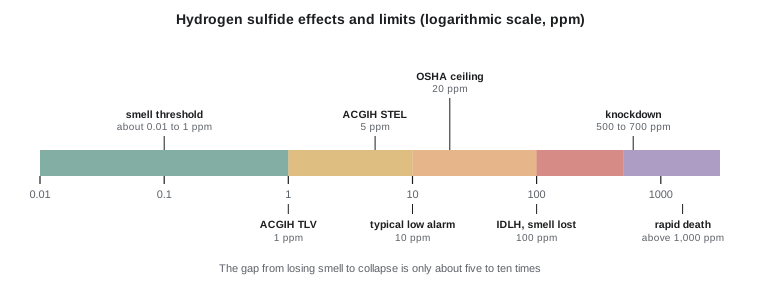
Two features of this range are striking. First, it spans five orders of magnitude, from barely smelled at 0.01 ppm to rapidly fatal at 1,000 ppm, which is why a logarithmic scale is used to show it. Second, the steps near the top are small: the concentration that causes loss of smell (around 100 to 150 ppm) is only five to ten times lower than the concentration that causes collapse. In a strong release, a person can move from irritating to deadly in a few steps.
Acute effects
Eye effects are among the most common complaints at low and moderate concentrations. Workers in sewers and pulp mills describe sore, gritty, watering eyes, sometimes called gas eye or sore eyes. Prolonged or higher exposure can inflame the cornea and cause temporary blurred vision and sensitivity to light, with halos around lights.
Respiratory effects range from a sore throat and cough to chest tightness and wheezing. At higher concentrations, hydrogen sulfide can injure the lining of the lungs, letting fluid leak in. This pulmonary edema may develop hours after exposure, so anyone who has had a significant exposure should be assessed by a doctor even if they feel better.
Nervous system effects at moderate concentrations include headache, dizziness, nausea, agitation, confusion and drowsiness. At high concentrations, a person can lose consciousness suddenly. Survivors of severe knockdowns often have no memory of the event.
Heart effects include irregular heart rhythms, and the heart's own energy supply is affected by the same block on cell respiration.
Knockdown and its aftermath
A knockdown is a sudden loss of consciousness from a high concentration. If the person is removed quickly into fresh air and breathing is supported, they may recover within minutes. If breathing has stopped and is not restored, brain damage begins within a few minutes and death follows. Some knockdown survivors recover fully. Others have lasting effects, including memory problems, poor concentration, movement disorders, headaches and personality changes, consistent with brain injury from lack of oxygen and direct toxicity.
Falls are a major secondary hazard. A worker who collapses on a ladder, a tank top, a catwalk or at the edge of a pit may be seriously injured or drown in the liquid below. That is one reason fall protection and retrieval systems are part of hydrogen sulfide planning in confined spaces and on tanks.
Long-term and repeated exposure
Repeated low-level exposure to hydrogen sulfide is associated with eye irritation, headaches, fatigue, poor sleep and irritability. Some studies of workers and communities exposed over long periods have reported effects on the nervous system and breathing, but the evidence is less clear than for acute effects, partly because exposure is often mixed with other gases. Hydrogen sulfide is not classified as a carcinogen. It is not known to build up in the body.
The ACGIH lowered its threshold limit value for hydrogen sulfide in 2010 from 10 ppm to 1 ppm as an eight-hour average, with a 5 ppm short-term limit, based on evidence of eye and respiratory effects at low concentrations and effects on the nose in animal studies. As lesson 5 explains, not every jurisdiction has adopted these lower values.
Who is more vulnerable
People with asthma and other lung disease may react to concentrations that do not bother others. People with heart disease may be more sensitive to the heart effects. Alcohol and some medications may worsen the nervous system effects. Physical work increases breathing rate and therefore dose. In confined spaces, low oxygen and other gases such as carbon dioxide, methane and ammonia often accompany hydrogen sulfide, and the combined effect is worse than any one alone.
Concentration and time
For many toxic gases, the harm depends roughly on concentration multiplied by time: double the concentration and you reach the same harm in half the time. For hydrogen sulfide, concentration matters more than time. Doubling the concentration more than halves the time to serious harm, because high concentrations overwhelm the body's detoxification and act directly on breathing. Emergency planning values reflect this. The table below gives illustrative times to collapse based on the effects table; they are not limits and should never be used to decide how long someone can stay in an atmosphere.
# Illustrative: rough time to serious incapacitation at different concentrations
# (midpoints read from published effect ranges; for teaching only, not limits).
effects = [
    (100, "drowsiness in 15-30 min; prolonged exposure can kill"),
    (300, "lung irritation within an hour; edema possible"),
    (600, "collapse within about 5 minutes"),
    (900, "unconscious within minutes, breathing stops"),
    (1500, "near-instant collapse"),
]
for ppm, note in effects:
    ratio_to_idlh = ppm / 100
print(f"{ppm:5d} ppm ({ratio_to_idlh:4.1f} x IDLH): {note}")100 ppm ( 1.0 x IDLH): drowsiness in 15-30 min; prolonged exposure can kill 300 ppm ( 3.0 x IDLH): lung irritation within an hour; edema possible 600 ppm ( 6.0 x IDLH): collapse within about 5 minutes 900 ppm ( 9.0 x IDLH): unconscious within minutes, breathing stops 1500 ppm (15.0 x IDLH): near-instant collapse
The output has no exact arithmetic, but the pattern is clear. Anything above the immediately dangerous level of 100 ppm, and especially above 500 ppm, is a situation where the only protection is breathing apparatus or not being there.
Immediately dangerous to life or health
NIOSH sets immediately dangerous to life or health (IDLH) values for many chemicals. The IDLH for hydrogen sulfide is 100 ppm. An IDLH atmosphere is one where a worker without respiratory protection could be killed or suffer irreversible health effects, or be prevented from escaping. Under respiratory protection rules, only pressure-demand self-contained breathing apparatus or a combination supplied-air respirator with an escape bottle may be used in an IDLH atmosphere, as lesson 8 explains, building on HSE-240.
Medical surveillance and records
There is no routine blood or urine test that tracks hydrogen sulfide exposure in the way blood lead is tracked. Medical programs for workers in hydrogen sulfide areas focus instead on fitness to wear respirators, eye and respiratory symptoms, and the response to any exposure incident. Every significant exposure, including any knockdown and any time a worker smelled gas strongly or felt symptoms, should be reported, recorded and investigated. Incidents that seem minor, such as a short episode of dizziness during tank gauging, are warnings that controls are not working.
Worked problem
Interpreting a symptom report
A wastewater operator reports sore, watering eyes and a headache after spending an afternoon cleaning screens in the headworks building. The fixed detector shows readings between 3 and 8 ppm during that period. What does this suggest?
Show solution
- Concentrations of 2 to 10 ppm are associated with eye irritation and headaches with prolonged exposure.
- If the readings are representative of the operator's breathing zone, the eight-hour average may exceed the ACGIH TLV of 1 ppm and the short-term limit of 5 ppm may have been exceeded.
- Fixed detectors may not reflect the higher concentrations right at the screens where gas is released.
- The symptoms are consistent with hydrogen sulfide exposure and should be reported and investigated.
Answer: The operator's symptoms are a warning sign. The employer should assess personal exposure, improve ventilation at the screens, review respiratory protection and record the incident.
Worked problem
After a brief knockdown
A worker gauging a tank becomes dizzy and collapses on the tank top but is pulled to fresh air by a rescuer wearing SCBA. Within ten minutes the worker is awake, says they feel fine and wants to finish the shift. What should happen?
Show solution
- Loss of consciousness from hydrogen sulfide means exposure was very high, likely several hundred ppm or more.
- Fluid in the lungs can develop hours later, and the person may have injuries from the fall.
- Some brain effects may not be obvious immediately.
Answer: The worker must be assessed by emergency medical services or a physician, not returned to work. The incident must be reported, recorded and investigated.
Common mistakes
MistakeAssuming a worker who recovers quickly after a knockdown is fine.
InsteadPulmonary edema and brain effects can appear later; medical assessment is essential.
MistakeTreating sore eyes in sewer work as normal.
InsteadEye irritation is a sign of exposure above protective limits and should be investigated.
MistakeUsing time-to-collapse figures to decide how long someone can stay in gas.
InsteadAbove the IDLH, only SCBA or leaving the area is acceptable.
MistakeBelieving hydrogen sulfide builds up in the body over weeks.
InsteadIt is broken down and not stored; peak concentrations drive acute harm.
MistakeIgnoring other gases in confined spaces.
InsteadLow oxygen, methane, carbon dioxide and ammonia often accompany hydrogen sulfide and add to the danger.
Summary and key terms
- Hydrogen sulfide irritates the eyes and airways at low concentrations and blocks cell respiration and breathing at high concentrations.
- Effects range from smell at about 0.01 ppm to near-instant death above 1,000 ppm.
- Loss of smell at about 100 to 150 ppm is only a few-fold below the concentrations that cause collapse.
- Knockdown survivors can develop fluid in the lungs hours later and may have lasting brain effects.
- The NIOSH IDLH is 100 ppm; above it, only SCBA or leaving the area protects.
- Concentration matters more than time; the body detoxifies low doses but is overwhelmed by high ones.
- Every symptom report and exposure incident should be recorded and investigated.
- Irritant
- A substance that inflames the eyes, skin or airways on contact.
- Pulmonary edema
- Fluid leaking into the lungs, which can develop hours after a significant exposure.
- Respiratory center
- The part of the brainstem that controls breathing; hydrogen sulfide can paralyze it.
- Gas eye
- A worker term for eye irritation and corneal inflammation from hydrogen sulfide.
- IDLH
- Immediately dangerous to life or health; 100 ppm for hydrogen sulfide.
- Dose–response
- The relationship between the amount of exposure and the severity of effects.
- Detoxification
- The body's chemical breakdown of a toxic substance into less harmful forms.
- Mitochondria
- Structures in cells that produce energy using oxygen.
- Logarithmic scale
- A scale where each step represents a multiplication, such as tenfold, used for wide ranges.
- Medical surveillance
- Health monitoring of workers exposed to a hazard.
Practice problems
Work each problem on paper first, then reveal the answer to check.
What are the two main ways hydrogen sulfide harms the body?
Show answer
As an irritant at low concentrations and as a systemic poison blocking cell respiration and breathing at high concentrations.
At about what concentration does loss of smell occur?
Show answer
Around 100 to 150 ppm, within minutes.
What concentration range is associated with collapse within minutes?
Show answer
About 500 to 700 ppm.
What is the NIOSH IDLH for hydrogen sulfide?
Show answer
100 ppm.
Why must a worker who recovered from a knockdown see a doctor?
Show answer
Fluid in the lungs and other effects can develop hours later, and there may be fall injuries.
Why do limits focus on short-term concentrations?
Show answer
The body breaks down low doses and does not store the gas; high peaks cause acute harm.
Name two groups who may be more sensitive.
Show answer
People with asthma or lung disease and people with heart disease.
Why are falls a hazard in hydrogen sulfide incidents?
Show answer
Workers collapse suddenly, often on ladders, tank tops or near pits.
When did the ACGIH lower its TLV for hydrogen sulfide, and to what?
Show answer
In 2010, to 1 ppm TWA with a 5 ppm STEL.
Why is there no routine biological monitoring for hydrogen sulfide?
Show answer
It does not build up in the body, so blood or urine tests are of limited use.
Lesson quiz · 5 questions
Score 60% or more to complete this lesson.
Create a free account to save your progress, take quizzes and earn a certificate.