
HSE-222 · Lesson 6 of 12 · 26 min
Leading an evacuation: the first minutes
Most of a warden's training, inspections and planning exist for a few minutes that may never come. When the alarm sounds, the warden's job is to turn a building full of people who are busy, distracted and slow to believe that anything is wrong into a group that is moving calmly and quickly along the right route. Research on real evacuations shows that the biggest delays usually happen before anyone takes a step: people finish their emails, look for colleagues, gather belongings and wait to see what others do. This lesson walks through the first minutes of an evacuation from the warden's point of view, from hearing the alarm to handing over at the stair or the exit.
Why people are slow to move
People rarely panic in fires. Far more often they underreact. An alarm on its own is an ambiguous cue, especially in buildings with frequent false alarms, so people look for confirmation: they glance at others, ask what is going on, look out of the corridor, or check their phones. Social roles also shape behavior. People continue the role they were in, such as the presenter finishing a slide, the shop assistant serving a customer or the nurse finishing a task, unless someone with authority tells them to stop. Groups tend to move together, and families or teams will wait for their members. These tendencies are normal, and the warden's job is to break them quickly with clear, confident instructions.
The warden's visible presence is itself a cue. A person in a high-visibility vest or cap, walking through the area and saying firmly, "This is a fire alarm. Leave now by the east stair. Leave your things," cuts the delay far more than the alarm alone. Specific instructions work better than general ones: "use the east stair" beats "please evacuate", and "leave your laptop" beats "don't take anything".
| Delay behavior | Why people do it | What the warden says or does |
|---|---|---|
| Finishing a task or call | Role commitment, belief it is a false alarm | "Stop now, this is a real alarm until we are told otherwise." |
| Gathering belongings | Habit, fear of losing valuables | "Leave your things, take only your coat and keys if they are at hand." |
| Waiting for others to move | Looking for social confirmation | Move first, point the way, call people by name |
| Searching for colleagues | Concern for others | "Your warden will check the floor. Go to the assembly area." |
| Going to the usual entrance | Familiarity with one route | "Use the nearest exit, the west stair, not the main entrance." |
| Investigating the fire | Curiosity, wish to help | "Leave it. I will report it to the chief warden." |
The first sixty seconds
When the alarm sounds, or a warden is told of a fire, the warden puts on their vest or cap, picks up the floor kit if it is close, and starts giving instructions. The first actions should be automatic, practiced in drills until they need no thought.
- Confirm the signal: is it an evacuation signal, an alert or a voice message? Follow the plan for that signal.
- Announce clearly and repeatedly what people must do and which route to use.
- Direct people toward the nearest safe exit or stair, away from any known fire location.
- Make sure people who need assistance are moving with their buddies or to the agreed refuge.
- Start the sweep of the area assigned to you, working toward your exit.
If the warden discovers the fire themselves, the order is the one taught in HSE-105: raise the alarm with the nearest pull station, get people out of immediate danger, and call the emergency number or make sure someone does. Only then, and only if trained, safe and the fire is small, may a warden attempt to use an extinguisher. Wardens are not firefighters; their main contribution is getting everyone out.
Sweeping the floor
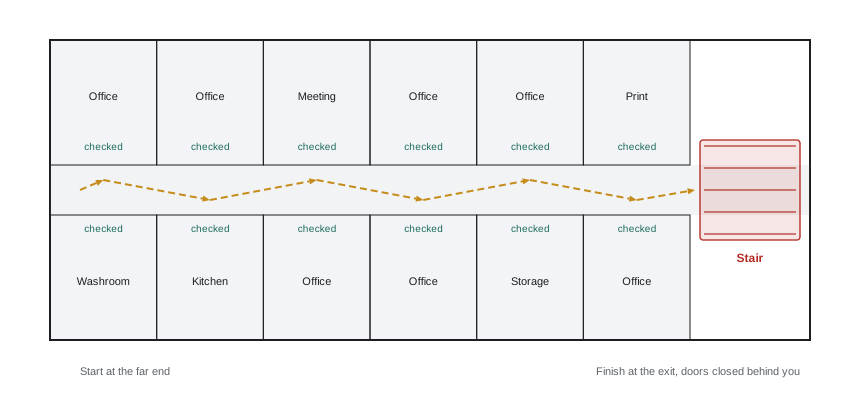
A sweep is a fast, systematic check of an area to make sure that everyone has heard the alarm and is leaving. It is not a search. Wardens should not open locked rooms, crawl under desks or go back into smoke. The sweep follows a planned route so that nothing is missed and the warden finishes at or near the exit. Wardens check washrooms, meeting rooms, quiet rooms, storage rooms, kitchens and any other place where people might not hear or see the alarm, knock and call out, and glance into rooms with vision panels.
Many buildings use a simple marker to show that a room has been checked, such as closing the door, hanging a tag on the handle or placing a sticker on the frame. Closed doors also slow the spread of smoke and fire. Wardens should close doors behind them but should not lock them, because firefighters may need to get in and someone may have been missed.
Worked problem
How long will the sweep take?
A floor warden's sweep route on an office floor is about 120 m long and passes 18 doors that must be checked: 10 offices, 3 meeting rooms, 2 washrooms, a kitchen, a print room and a storage room. A brisk walk in a clear corridor is about 1.2 m/s, and checking each door, by knocking, calling out and glancing in, takes about 5 seconds. The plan expects the floor to be clear within 4 minutes of the alarm. Estimate the sweep time and decide whether one warden is enough.
Show solution
- Walking time: 120 m ÷ 1.2 m/s = 100 seconds.
- Checking time: 18 doors × 5 s = 90 seconds.
- Add about 30 seconds for putting on the vest, giving instructions and dealing with people who need prompting: 100 + 90 + 30 = 220 seconds, about 3.7 minutes.
- That is just inside the 4-minute target, with little margin. Any delay, such as one reluctant occupant, will push the sweep over the limit.
- Splitting the floor between two wardens, each sweeping half and finishing at a different stair, cuts the time to roughly 2 minutes and also covers the floor if one warden is absent.
Answer: About 3.7 minutes for one warden, too close to the 4-minute target; two wardens sweeping half each is the more reliable plan.
Choosing and controlling the route
The plan sets normal routes and alternatives. In the first minutes, the warden has to decide whether the normal route is usable. A route is unusable if it is blocked, if there is smoke in it, or if the chief warden or a voice message says not to use it. Wardens should feel a closed door with the back of the hand before opening it, look for smoke at the top of the door and under it, and open it slowly while bracing against it. If there is heat or smoke, close the door and use the alternative route. Wardens should then make sure that no one else tries the blocked route, by standing at the junction or posting a reliable person there, and tell the chief warden as soon as possible.
At the stair, the floor warden or a stair monitor keeps people moving, keeps them to one side if firefighters are expected to come up, and stops people from going up instead of down unless the plan says so. In buildings where wardens use the stair doors to count people, the monitor can record roughly how many have entered. When the floor is clear, the warden is the last to leave by their planned exit, unless the plan assigns someone else to that role.
In buildings with selective evacuation, the floor warden on a floor hearing only the alert tone prepares the floor but does not start the evacuation unless a voice message says to evacuate, the evacuation signal sounds on that floor, or there is visible smoke or fire on that floor. Any immediate danger overrides the waiting.
Communicating with the chief warden
The chief warden, or incident controller in some plans, needs information from every floor as quickly as possible. Communication may be by radio, warden phone, mobile phone or runner. Reports should be short and in a standard form so that the chief warden can record them quickly. The most useful report says which floor or zone, whether it is clear, how many people are believed to remain and where, whether anyone needs assistance, and any hazard seen, such as smoke, a blocked exit or a locked door.
| Part of report | Example |
|---|---|
| Who and where | "Floor 6 warden, east stair." |
| Status | "Floor 6 is clear except one person." |
| People remaining | "One person using a wheelchair at the east stair refuge with a buddy." |
| Hazards | "Smoke seen in the west corridor; west stair door closed." |
| Next action | "I am leaving by the east stair now." |
Radio discipline matters. Wardens should listen before speaking, keep messages short, use names or call signs, and repeat back important instructions. Wardens should not use radios or mobile phones near a suspected gas leak or other flammable atmosphere unless they are intrinsically safe, because a spark could ignite it.
When people will not leave
Wardens have no power to force anyone to leave, and they should never physically drag an unwilling person or argue at length. They should explain clearly that the person must leave, ask them to come now, and, if they still refuse, note their name and exact location and report it immediately to the chief warden, who will tell the fire service. Then the warden leaves. A warden who stays behind arguing puts themselves at risk and delays their report about everyone else on the floor.
Sometimes people refuse because they are frightened, confused or unable to move but too embarrassed to say so. A calm question, such as "Is there something making it hard for you to leave?" may reveal that someone needs help on the stairs or is waiting for a child or colleague. The response then becomes an assistance question rather than a refusal.
Visitors, contractors and the public
Visitors and contractors do not know the building and may not know the alarm. Hosts are usually responsible for their visitors, but wardens should watch for people who look lost. In shops, venues and public buildings, wardens may need to manage crowds who do not know the routes, including stopping people from going back to their cars or to the main entrance, and using clear public address messages. In buildings with large numbers of the public, staff positioned at key points, such as escalators, entrances and stair doors, are often more effective than wardens sweeping.
Leaving and reporting
When the floor is clear, the warden leaves by the planned exit, goes to the assembly area or the warden reporting point, and reports to the chief warden. Wardens should not go back into the building for any reason until the fire service or the person in charge declares it safe. If they remember something they missed, such as an unchecked room, they report it rather than going back.
Emergency action plans under OSHA 1910.38 must describe procedures to account for employees after evacuation and the duties of employees who perform evacuation tasks. In high-rise buildings, local fire codes often require fire safety directors or wardens to meet the fire department on arrival and hand over information about the alarm, the fire floor and people needing assistance.
Common mistakes
MistakeGiving vague instructions such as "please evacuate" and assuming people will move.
InsteadGive specific instructions: which route, what to leave, where to go.
MistakeTurning the sweep into a full search, opening locked rooms and going into smoke.
InsteadSweep quickly along a planned route, close doors and report anything you cannot check.
MistakeOpening a hot door to see what is behind it.
InsteadFeel the door, look for smoke, and use the alternative route if it is hot or smoky.
MistakeStaying behind to argue with someone who refuses to leave.
InsteadTell them clearly, note their name and location, report it and leave.
MistakeGoing back in to check a room missed during the sweep.
InsteadReport the missed room to the chief warden and stay out.
Summary and key terms
- People usually underreact to alarms; clear, specific instructions from a visible warden cut delays.
- The first sixty seconds should be practiced until automatic: confirm the signal, announce, direct, assist, sweep.
- A sweep is a fast check along a planned route, not a search, and finishes at the exit.
- Wardens close doors behind them but do not lock them.
- Feel doors and look for smoke; use the alternative route if the normal one is unsafe.
- Reports to the chief warden should say where, status, people remaining, hazards and next action.
- Wardens cannot force people to leave; they report refusals and leave themselves.
- Pre-movement delay
- The time between an alarm and people starting to move toward an exit.
- Role commitment
- The tendency to continue a current task or role instead of reacting to an alarm.
- Sweep
- A fast, systematic check of an area to make sure everyone is leaving.
- Sweep route
- The planned path a warden follows so that no part of the area is missed.
- Door marker
- A tag or sticker showing a room has been checked.
- Alternative route
- A planned second way out used when the normal route is unsafe.
- Stair monitor
- A person at a stair door who keeps people moving and the stair orderly.
- Floor report
- A short standard report from a warden to the chief warden.
- Call sign
- A short name used to identify a speaker on the radio.
- Intrinsically safe
- Designed so that it cannot ignite a flammable atmosphere.
Practice problems
Work each problem on paper first, then reveal the answer to check.
Why are people often slow to leave when an alarm sounds?
Show answer
They seek confirmation, continue their roles, gather belongings and wait for others.
Give an example of a specific instruction.
Show answer
"This is a fire alarm. Leave now by the east stair. Leave your things."
What is the difference between a sweep and a search?
Show answer
A sweep is a fast check along a planned route; a search is a thorough look that is the fire service job.
Why close doors during the sweep?
Show answer
To show the room was checked and to slow the spread of smoke and fire.
Why not lock doors behind you?
Show answer
Firefighters may need to enter and someone may have been missed.
A sweep route is 90 m long with 12 doors at 5 s each. Walking at 1.2 m/s, how long will it take before allowances?
Show answer
75 s walking + 60 s checking = 135 s, about 2.3 minutes.
What should a warden do before opening a closed door on the route?
Show answer
Feel it with the back of the hand and look for smoke; if hot or smoky, use the alternative.
List the five parts of a floor report.
Show answer
Who and where, status, people remaining, hazards, next action.
What should a warden do if someone refuses to leave?
Show answer
Tell them clearly, note name and location, report to the chief warden and leave.
When may a warden go back into the building?
Show answer
Only when the fire service or the person in charge declares it safe.
Lesson quiz · 5 questions
Score 60% or more to complete this lesson.
Create a free account to save your progress, take quizzes and earn a certificate.