
HSE-222 · Lesson 12 of 12 · 25 min
Drills, debriefs and keeping the program alive
A warden program that is set up once and then left alone decays quickly. Wardens move jobs, floors are reorganized, doors are added, new people arrive, and the plan on paper drifts away from the building as it really is. Drills and debriefs are the main ways to keep the program alive. They test whether the plan works, train people by doing, show where the weaknesses are, and produce the records that fire officials and regulators expect. This final lesson covers how to plan a drill program, how to run a drill well, how to observe and measure it, how to hold a useful debrief, and how to turn findings into lasting improvements.
Why drills matter
In a real fire, people do what they have practiced. A warden who has swept their floor a dozen times in drills will do it smoothly under stress; one who has only read the plan will hesitate. Occupants who have used the east stair in drills will think of it when the west stair is blocked. Drills also find problems that no inspection would reveal: an alarm that cannot be heard in a meeting room, a stair door that sticks, an assembly area that floods, a radio channel that does not reach the basement, or a headcount method that takes twenty minutes.
US fire codes and NFPA 101 set drill frequencies by occupancy, as lesson 2 explained: for example monthly in schools while in session, with some exceptions, quarterly on each shift in health care, and at set intervals in high-rise and larger business occupancies under the IFC and local codes. OSHA 1910.38 does not set a drill frequency for most workplaces, but employers must review the plan with employees and train those with evacuation duties.
Types of drills and exercises
Not every drill has to be a full building evacuation. A balanced program uses several types of exercise, each with a different purpose and cost.
| Type | What happens | Best for |
|---|---|---|
| Tabletop exercise | Wardens talk through a scenario around a table or online | Testing decisions, roles and communication without disruption |
| Warden-only drill | Wardens practice sweeps, radios and reporting without evacuating occupants | Building warden skills, testing equipment |
| Partial drill | One floor, zone or tenant evacuates | Testing a specific area or new procedure |
| Full evacuation drill | Everyone leaves and is accounted for | Testing the whole plan and timing |
| Assisted evacuation practice | Evacuation chair teams practice with willing volunteers or manikins | Building chair operator skill safely |
| Scenario drill | A full or partial drill with a twist, such as a blocked stair or missing warden | Testing adaptability and alternative routes |
Planning a drill
A good drill has a clear purpose. Before each drill, decide what you want to test, such as pre-movement time on a newly occupied floor, use of the alternative stair, the PEEP for a new employee, the night-shift procedure, or the headcount method. Set measurable objectives, such as "floor clear within 4 minutes" or "all accounted for within 12 minutes". Choose the type of drill and the scenario. Brief the people who must know, such as building management, security, the alarm monitoring company, and, where required, the fire department. Arrange observers with clear tasks and stopwatches.
Safety in drills matters. People have been injured in drills, usually by falls on stairs, crushing at doors or heat stress at assembly areas. Plans should avoid creating real hazards, such as using real smoke in occupied areas without proper controls, and should not ask people who need assistance to take part in ways that could harm them. Evacuation chair practice should use willing volunteers who are briefed or training manikins, not unexpected live transfers.
Announced or unannounced? Announced drills are useful for training new wardens, practicing new procedures and including people who need assistance safely. Unannounced drills test the real response, including pre-movement. A mature program uses both. Even unannounced drills need some people to know in advance, such as the monitoring company, so the fire department is not dispatched unnecessarily, and security, so that they do not treat the drill as an incident.
Worked problem
Building a drill calendar for a mixed site
A seven-story office building with a fire alarm system has two shifts: day (about 300 people) and evening (about 40 people). The local fire code, based on the IFC, requires an annual evacuation drill for this business occupancy, and the employer wants a sensible program beyond the minimum. Build a simple annual calendar that meets the drill requirement, gives the evening shift its own practice, includes one full evacuation, and practices assisted evacuation.
Show solution
- Minimum: at least one evacuation drill each year. A sensible program goes well beyond this.
- Quarter 1: tabletop exercise for all wardens, using a blocked-stair scenario. Evacuation chair practice with manikins for chair teams.
- Quarter 2: announced full evacuation drill on the day shift, with timing and headcount measured. Evening shift warden-only drill the same week.
- Quarter 3: unannounced partial drill for two floors, testing pre-movement and sweeps. New warden orientation for summer staff and new hires.
- Quarter 4: unannounced evening shift evacuation drill, testing the reduced team and night procedures. Annual plan review with findings from all drills.
- Record every exercise, findings and actions, and keep the records available for the fire department.
Answer: Four quarterly exercises, including one full day-shift evacuation, an unannounced evening drill, a tabletop and chair practice, exceed the minimum and cover both shifts.
Running and observing the drill
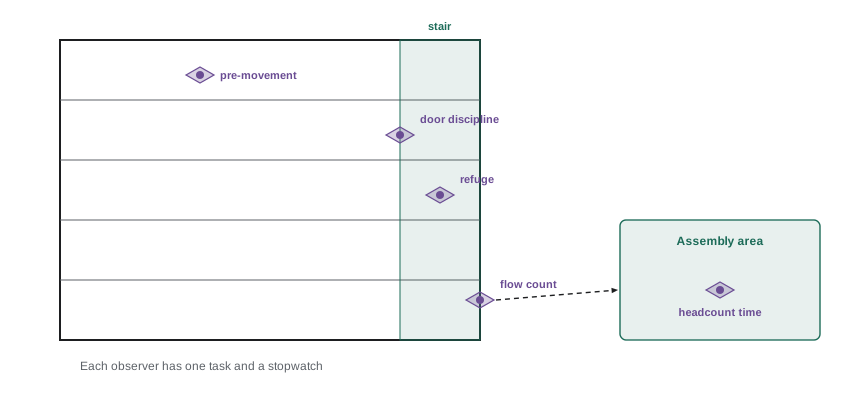
During the drill, wardens do exactly what they would do in a real alarm. Observers, positioned at key points such as stair doors, exits, refuges, and the assembly area, record times, behaviors and problems. Observers should not intervene unless there is a safety problem; their job is to see what really happens. Useful observations include when people started to move, whether anyone used elevators, whether doors were closed, how long the sweep took, whether stair doors were propped, how people who needed assistance were handled, whether radios worked, and how long accounting took.
Measuring results
Measurements turn impressions into facts. The measurements described in lesson 8, such as alarm to first movement, alarm to floor clear, flow at exits and time to account for everyone, can be compared across drills. A simple record sheet with the same headings each time makes trends visible. Wardens should not treat a drill as a race; a fast drill that skipped the sweep or lost someone at a refuge is worse than a slower one that did everything right.
| Measure | Drill 1 | Drill 2 | Drill 3 |
|---|---|---|---|
| Alarm to first movement (median floor) | 1 min 40 s | 1 min 10 s | 0 min 50 s |
| Alarm to last floor clear | 7 min 30 s | 6 min 10 s | 5 min 20 s |
| East stair share of people | 78 % | 64 % | 55 % |
| Stair doors found propped | 3 | 1 | 0 |
| Alarm to all accounted for | 19 min | 14 min | 11 min |
| PEEPs carried out as planned | 2 of 4 | 3 of 4 | 4 of 4 |
Holding a debrief
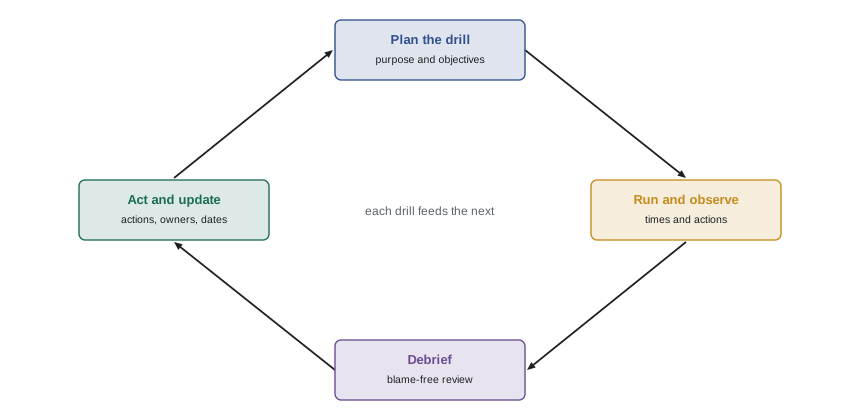
A debrief straight after the drill, while memories are fresh, captures what happened. A short hot debrief at the assembly area or in a meeting room, followed by a more considered review within a week, works well. The tone should be open and blame-free: the aim is to improve the plan, not to embarrass wardens or occupants. People admit problems more readily when they know they will not be punished for them.
A simple structure works for most debriefs. What was supposed to happen? What actually happened? Why was there a difference? What will we do about it, who will do it, and by when? Observers report first, then wardens, then anyone else involved. The facilitator records actions with owners and dates. Findings that need building changes, such as an inaudible alarm or a sticking door, go to the building owner or facilities, and findings about procedures go to the plan owner.
Turning findings into improvements
Debriefs are only useful if actions are completed. An action log, reviewed at each warden meeting, keeps track of open items. Typical actions include retraining wardens, adding signs to promote the less used stair, moving an assembly area, updating PEEPs, repairing doors, replacing radio batteries, changing voice messages, and adjusting the warden roster. The next drill should check whether the actions worked. Over time, the drill records show whether the program is improving and give evidence to fire officials, auditors and managers.
Keeping wardens engaged
Warden programs depend on volunteers who have other jobs. Keeping them engaged means respecting their time, training them well, recognizing their work, and giving them a voice in improving the plan. Regular short meetings, refresher training, new scenarios and visible thanks after drills help. When wardens see their suggestions acted on, they stay. When the role is treated as an afterthought, they drift away, and the program weakens just when nobody is watching.
Reviewing the plan
Emergency action plans must be reviewed with employees when the plan is developed, when an employee's responsibilities change, and when the plan changes, under OSHA 1910.38(f). Fire safety and evacuation plans under the IFC must be reviewed or updated annually or as necessary. Wardens contribute by reporting changes on their floors and drill findings.
Beyond this course
This course is awareness-level training for fire wardens and evacuation leaders. It does not qualify you as a fire code official, a fire prevention officer, a fire protection engineer or a fire safety director under city rules that require a certificate. Your building's plan, your local fire department and your employer's procedures always take priority over general guidance. Many wardens go on to further training, such as first aid, emergency management or fire safety director certification where it applies, and the experience of running a good warden program is valuable in any safety career.
Learning from real events
Real alarms, false alarms and near misses are drills you did not plan. Each one is a chance to learn. After any real evacuation, even a short one caused by burnt toast, the warden team should hold the same kind of debrief as for a drill: what happened, how long it took, what went well and what did not. Real events often show problems that drills hide, such as people refusing to leave because they assumed it was another drill, wardens who were away from their floors, or assembly areas crowded with people from neighboring buildings. Recording these lessons alongside drill findings gives a fuller picture of how the plan really performs.
Wardens can also learn from events elsewhere. Published investigation reports on major fires describe how people behaved, which systems worked and which failed, and what changes followed. Reading a short summary of one such report at a warden meeting, and asking whether the same thing could happen in your building, is an easy way to keep the program fresh and to remind everyone why the work matters.
Common mistakes
MistakeRunning the same announced drill every year and calling it done.
InsteadMix drill types, scenarios and timing, including unannounced drills.
MistakeTreating a drill as a race and praising the fastest time.
InsteadJudge drills on whether everything was done right, then on time.
MistakeHolding a debrief that blames individuals.
InsteadKeep debriefs blame-free and focused on improving the plan.
MistakeWriting debrief findings but never completing actions.
InsteadTrack actions with owners and dates, and check them in the next drill.
MistakeForgetting to tell the monitoring company before a drill.
InsteadNotify those who must know so the fire department is not dispatched unnecessarily.
Summary and key terms
- Drills train people by doing and reveal problems inspections miss.
- Fire codes set minimum drill frequencies by occupancy; good programs go beyond the minimum.
- Mix tabletop exercises, warden-only drills, partial, full, assisted and scenario drills.
- Plan each drill with a purpose, objectives, scenario, briefings and observers.
- Measure results consistently and judge quality before speed.
- Hold blame-free debriefs and track actions with owners and dates.
- Tabletop exercise
- A discussion of a scenario without physically evacuating.
- Warden-only drill
- A drill in which wardens practice without evacuating occupants.
- Partial drill
- A drill involving one floor, zone or tenant.
- Scenario drill
- A drill with a planned complication, such as a blocked stair.
- Unannounced drill
- A drill held without telling occupants in advance.
- Observer
- A person who watches and records a drill without intervening.
- Hot debrief
- A short review held immediately after a drill.
- After-action review
- A structured review of what was planned, what happened and why.
- Action log
- A list of improvements with owners and dates.
- Plan review
- A periodic check that the plan matches the building and people.
Practice problems
Work each problem on paper first, then reveal the answer to check.
Give three problems a drill might reveal that an inspection would not.
Show answer
Any three: inaudible alarm, sticking door, flooding assembly area, radio dead spots, slow headcount.
Name four types of drill or exercise.
Show answer
Any four: tabletop, warden-only, partial, full, assisted practice, scenario.
What should be decided first when planning a drill?
Show answer
Its purpose and measurable objectives.
Why tell the monitoring company before a drill?
Show answer
So the fire department is not dispatched unnecessarily.
What are the advantages of unannounced drills?
Show answer
They test the real response, including pre-movement.
Why should observers not intervene?
Show answer
Their job is to see what really happens, unless there is a safety problem.
A drill had 120 people through a door in 2.5 minutes. What was the flow?
Show answer
48 persons per minute.
What are the four questions in a simple debrief?
Show answer
What should have happened, what happened, why the difference, what will we do about it.
How do you make sure debrief actions are completed?
Show answer
Track them in an action log with owners and dates and check them in the next drill.
Does this course qualify you as a fire prevention officer?
Show answer
No; it is awareness-level training only.
Lesson quiz · 5 questions
Score 60% or more to complete this lesson.
Create a free account to save your progress, take quizzes and earn a certificate.