
HSE-222 · Lesson 7 of 12 · 25 min
Smoke, fire spread and route decisions
Most people who die in building fires are killed by smoke rather than by flames. Smoke spreads faster and further than fire, carries toxic gases, and cuts visibility so badly that people lose their way in corridors they walk every day. HSE-105 explained the fire triangle and the classes of fire. This lesson looks at fire and smoke from the point of view of a warden who must decide, in seconds, whether a route is safe, whether to redirect people, and when to stop and protect people in place. Wardens do not need to be fire scientists, but they do need a working picture of how quickly conditions change.
How a room fire develops
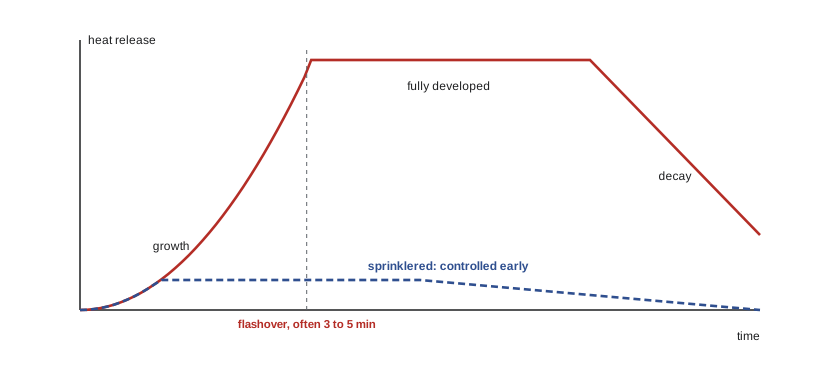
A fire in a room usually passes through recognizable stages. In the growth stage, a small fire heats the fuel nearby and spreads. Hot smoke rises and forms a layer under the ceiling, which grows deeper and hotter. If enough fuel and air are available, the hot layer radiates heat downward until all the exposed fuel in the room ignites almost at once. This is flashover, and after it nobody in the room can survive. In ordinary furnished rooms with modern plastics and foams, flashover can happen within a few minutes of ignition, much faster than in rooms furnished decades ago.
After flashover, the fire is fully developed and burns at the rate allowed by the air coming in through doors and windows. Flames and smoke push out of the room into the corridor. If doors are closed, fire separations hold the fire back for a period, and if sprinklers operate early, the fire is usually controlled long before flashover. That is why closing doors and sprinkler protection are the two most important features for a warden to understand.
How smoke moves
Hot smoke is buoyant. It rises to the ceiling, spreads along it, and moves into corridors, stairs, shafts and any opening it finds. In tall buildings, the stack effect, caused by the difference between indoor and outdoor temperatures, can drive smoke up shafts and stairs in cold weather and, more weakly, down in hot weather. Wind, ventilation systems and open doors also move smoke. A single door left wedged open can let smoke fill a stair that would otherwise protect hundreds of people.
As smoke cools, it loses buoyancy and drops lower. A corridor that had a clear layer of air below the smoke a minute ago can fill to the floor. Visibility is the first thing to go: when people can no longer see an exit sign 10 m away, they slow down, hesitate, and turn back. The gases then begin to affect them. Carbon monoxide reduces the blood's ability to carry oxygen, and hydrogen cyanide, from burning plastics, foams and wool, acts even faster. Both cause confusion and collapse before the person realizes they are in danger.
| Sign | What it suggests | Warden decision |
|---|---|---|
| Thin haze at ceiling level, clear below | Early smoke spread, fire possibly some distance away | Move people out quickly by the route away from the smoke |
| Smoke banking down to head height | Smoke layer deepening, conditions worsening fast | Do not send people through it; use the alternative route |
| Dark, thick smoke moving fast or pulsing at a door | Fire close by, possibly near flashover | Close doors, leave the area, report immediately |
| Hot door or handle | Fire or hot smoke on the other side | Keep it closed, redirect, report |
| Smoke in a stair | Stair compromised, doors may have been left open | Use another stair, report to the chief warden |
| Smoke odor but nothing visible | Fire somewhere in the building, location unknown | Follow the plan, report, watch for changes |
Fire separations and protected routes
Buildings are divided by fire separations, walls and floors built to resist fire for a set period, with fire doors that close and latch. Exit stairs are enclosed by fire separations so that once people are inside, they are protected from fire on the floors. Corridors in many buildings are also separated. These protections work only if doors are closed, latched and undamaged, and if holes made for cables and pipes have been properly sealed. A fire door wedged open, or a ceiling tile removed above a fire wall, can defeat the whole design.
In the US, fire barriers, smoke barriers, fire doors and exits are set by the International Building Code, NFPA 101 and local codes, and the fire code requires them to be maintained, with fire doors inspected under NFPA 80. Wardens should report damaged doors, missing closers and open penetrations during their inspections, as described in lesson 4.
Deciding whether a route is safe
The warden's decision is usually simple: go away from the fire and smoke, by the nearest protected route. The plan should give primary and alternative routes for every area. When the primary route is affected, the warden switches to the alternative and makes sure others do too. A warden should never send people through smoke when another route exists, and should never send people toward a fire to reach a familiar exit.
Where no route is safe, such as when both stairs are affected or when people on an upper floor are cut off, the right action is to protect people in place until rescued. Wardens should move people into a room as far from the fire as possible, close the door, seal gaps with cloth or tape if available, call the emergency number to give the exact location, and signal from a window. Breaking windows is usually a mistake because it can draw smoke in and cannot be undone. People should stay low if smoke enters, where the air is cooler and cleaner.
Worked problem
How long is the corridor still passable?
A warden on the third floor sees thin smoke at the ceiling of a 40 m corridor leading to the east stair. A fire is believed to be in an office near the west end. Occupants walk at about 1.2 m/s in clear conditions, but in light smoke with reduced visibility walking speed drops to about 0.5 m/s. The west stair is beside the fire office. Twenty people at the east end are close to the east stair. Eight people in offices at the west end, near the fire, need to reach the east stair along the corridor. Decide what the warden should do and estimate how long the west-end group needs.
Show solution
- The west stair is beside the fire office, so it is not a safe choice for the west-end group. The east stair is away from the fire.
- Time to walk 40 m in clear conditions: 40 ÷ 1.2 ≈ 33 seconds. In light smoke: 40 ÷ 0.5 = 80 seconds.
- The smoke layer is still at the ceiling, so the corridor is passable now, but conditions may worsen within a minute or two as the smoke deepens.
- The warden sends the west-end group immediately, low and along the wall, keeping hold of each other if visibility drops, while the east-end group goes straight into the east stair. The warden closes the fire office door if it can be done safely and closes corridor doors behind the group.
- If the corridor fills before the group can cross, the fallback is to protect in place in a room at the west end away from the fire office, close the door and call the emergency number with the room number.
Answer: Move the west-end group now along the corridor to the east stair, about 30 to 80 seconds; if the corridor fills first, protect in place and call.
Protect in place, defend in place and shelter in place
The phrase "protect in place" can mean different things. In this lesson it means moving people to a room away from the fire and protecting them until rescue, because they cannot leave safely. In health care and care homes, "defend in place" means keeping patients or residents in their rooms or moving them horizontally to a safe compartment behind a fire separation on the same floor, because moving them down stairs could harm them. In high-rise residential buildings, occupants are often told to stay in their units unless the fire is in their unit or threatens it. "Shelter in place" is also used for outdoor hazards such as chemical releases, where people stay inside with doors and windows closed and ventilation off. Wardens must know which strategy their building's plan uses for which situation.
Horizontal evacuation
Many hospitals, care homes and large buildings are divided into compartments separated by fire and smoke separations. Moving people horizontally through the separation into the next compartment protects them quickly without using stairs. A horizontal exit, a door through a fire wall to an area of equal safety, can count as an exit in building codes. Wardens in such buildings must know where the compartment boundaries are, how many people the next compartment can hold, and when to move further.
Using extinguishers as a warden
HSE-105 covered extinguisher selection and the PASS technique. For wardens, the important decision is whether to try at all. A warden should consider using an extinguisher only if the alarm has been raised, the fire is small and not spreading, the warden is trained, the extinguisher is the right type, the warden has a clear exit behind them, and the room is not filling with smoke. If any of these is not true, the warden closes the door and leaves. A warden whose job is to lead an evacuation should usually leave firefighting to others, because the time spent fighting the fire is time not spent getting people out.
Special hazards
Some fires behave differently. Lithium-ion battery fires, from e-bikes, scooters, laptops and power tools, can flare violently, give off toxic gas and reignite after they seem to be out. Fires involving gas cylinders, flammable liquids or chemicals may spread very quickly or explode. Electrical room fires and kitchen fires with cooking oil need special extinguishers. In all these cases, wardens should clear the area, close doors and tell the fire service exactly what is involved. Lesson 4 described how wardens can reduce these risks through housekeeping and reporting.
Common mistakes
MistakeBelieving there is plenty of time because the fire is small now.
InsteadRemember that furnished rooms can reach flashover within minutes; move people at once.
MistakeLeading people through smoke to reach the usual exit.
InsteadUse the alternative route away from the smoke.
MistakePropping stair doors open to help people move faster.
InsteadKeep stair doors closed so smoke cannot enter the stair.
MistakeBreaking a window as soon as smoke appears while waiting for rescue.
InsteadSeal the door, call with the exact location and signal from the window without breaking it.
MistakeSpending minutes fighting a fire while the floor is still occupied.
InsteadUse an extinguisher only on a small fire with a clear exit; leading the evacuation comes first.
Summary and key terms
- Smoke kills more people than flames, through lost visibility and toxic gases.
- Furnished rooms can reach flashover within minutes; sprinklers usually stop growth early.
- Smoke rises, spreads along ceilings, enters stairs and shafts, and drops as it cools.
- Fire separations and closed fire doors protect exit routes only if they are maintained and closed.
- Wardens choose routes away from fire and smoke, using the planned alternative when needed.
- Where no route is safe, protect people in place, seal the door and call with the exact location.
- Know whether the building uses evacuation, defend in place, horizontal evacuation or stay-in-unit strategies.
- Flashover
- The near-simultaneous ignition of all exposed fuel in a room, after which survival is impossible.
- Smoke layer
- The hot layer of smoke that forms under a ceiling and deepens over time.
- Stack effect
- Air movement in tall buildings caused by indoor and outdoor temperature differences.
- Carbon monoxide
- A toxic gas in smoke that reduces the blood's ability to carry oxygen.
- Hydrogen cyanide
- A fast-acting toxic gas produced by burning plastics, foams and wool.
- Fire separation
- A wall or floor built to resist fire spread for a set time.
- Protect in place
- Keeping people in a room away from the fire until rescue when no route is safe.
- Defend in place
- A health care strategy of keeping patients in rooms or protected compartments.
- Horizontal exit
- A protected door through a fire wall to an area of equal safety on the same level.
- Compartment
- An area of a building enclosed by fire or smoke separations.
Practice problems
Work each problem on paper first, then reveal the answer to check.
What kills most people in building fires?
Show answer
Smoke, through lost visibility and toxic gases.
What is flashover and why does it matter to wardens?
Show answer
All exposed fuel in a room ignites at once; nobody in the room survives, and it can happen within minutes.
How can one wedged door affect a stair?
Show answer
It can let smoke fill a stair that would otherwise protect many people.
Why can smoke in a corridor suddenly reach the floor?
Show answer
As smoke cools, it loses buoyancy and drops.
A group must cover 30 m at 0.5 m/s in light smoke. How long will it take?
Show answer
60 seconds.
What should a warden do if both stairs are blocked?
Show answer
Protect people in place in a room away from the fire, seal the door, call with the location and signal.
Why avoid breaking windows while waiting for rescue?
Show answer
It can draw smoke in and cannot be undone.
What is horizontal evacuation?
Show answer
Moving people through a fire separation to a safe compartment on the same floor.
Give four conditions for a warden to try using an extinguisher.
Show answer
Alarm raised, fire small, trained, right type, clear exit behind, no heavy smoke (any four).
Why are lithium-ion battery fires special?
Show answer
They flare violently, give off toxic gas and can reignite.
Lesson quiz · 5 questions
Score 60% or more to complete this lesson.
Create a free account to save your progress, take quizzes and earn a certificate.