
HSE-222 · Lesson 4 of 12 · 25 min
Before an emergency: inspections, housekeeping and readiness
The decisions that save lives in a fire are mostly made weeks before it. Whether a stair door closes and latches, whether an exit is blocked by a pallet, whether a new employee knows where to go, whether the warden knows that the person in the corner office cannot use stairs: all of these are settled long before the alarm sounds. This lesson covers the warden's routine duties in normal times, the floor walk, door and exit checks, housekeeping, keeping occupant information up to date, orienting newcomers, and reporting defects so they are fixed.
OSHA's fire prevention plan standard, 29 CFR 1910.39, requires employers to control fire hazards and accumulations of combustible waste, and OSHA's exit route standards in 1910.36 and 1910.37 require exit routes to be kept free and unobstructed. Owners carry the duty to inspect and maintain fire protection systems under the fire code and NFPA standards, usually through qualified contractors, but wardens are the eyes on the floor between formal inspections.
The floor walk
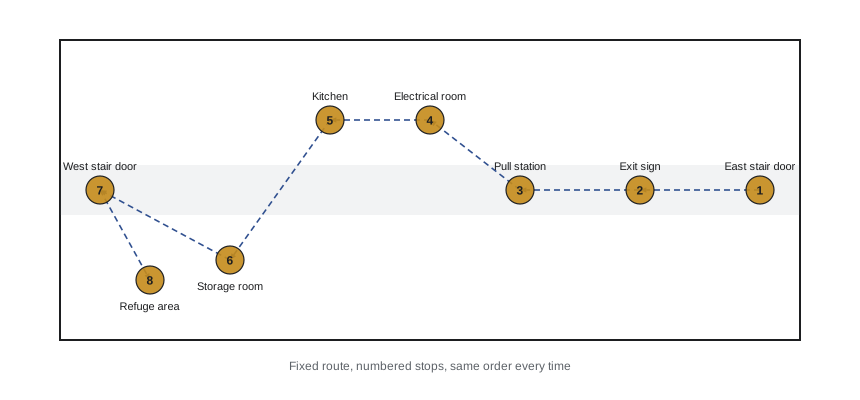
A regular floor walk is the warden's most useful routine. Many programs ask wardens to walk their area at least monthly, and more often in busy or changing spaces such as warehouses, labs and floors under renovation. The walk takes ten to twenty minutes with a checklist and covers exits, doors, fire protection equipment, housekeeping and anything new.
Exits and exit routes
Every exit and the route to it must be usable at all times while the building is occupied. On each walk the warden checks:
- Exit doors open easily from the inside without keys, special knowledge or effort, and are not chained, padlocked or blocked on either side.
- Exit routes and corridors are clear of furniture, boxes, carts, deliveries and equipment, and keep their full width.
- Exit signs are lit and visible and point the right way; any burnt-out signs are reported.
- Emergency lighting units are present and not damaged; test buttons, where the warden is allowed to use them, show the unit works.
- Stairs are free of storage, and nothing is stored under stairs unless the space is properly enclosed.
- Outside each exit, the discharge path is clear: no parked vehicles, snow banks, ice, construction fencing or waste bins block the way to a public area.
In northern states, snow and ice against exit discharges can trap occupants. Elsewhere, landscaping, parked vehicles and dumpsters are common obstructions. Wardens should know who keeps exit discharges clear and report problems quickly.
Fire doors and smoke doors
Fire doors keep fire and smoke out of stairs and corridors long enough for people to escape. A wedged-open stair door can let smoke fill a stair in minutes and make it unusable for every floor above. On each walk the warden checks that fire doors:
- close fully and latch on their own when released from fully open;
- are not wedged, propped or tied open, and have no doorstops, wedges or furniture holding them;
- have closers attached and working, and hinges and latches in good condition;
- are not damaged, with no holes, missing glass or gaps that let smoke through;
- where held open by magnetic hold-open devices connected to the alarm, release when the alarm sounds (tested during drills).
Wedged doors are one of the most common problems wardens find. The fix is not only to remove the wedge but to find out why someone wanted the door open, for example heat, a delivery route or a door that is hard to open, and to solve that problem properly, for example with an approved hold-open device connected to the alarm.
Fire protection equipment
Wardens are not inspectors, but they can see obvious problems with equipment. On each walk they check that manual pull stations are visible and unobstructed; that portable extinguishers are in their places, visible, not blocked and show a pressure gauge in the green with a current inspection tag; that sprinkler heads are not painted, covered, damaged or obstructed by storage within about 45 cm (18 in) below them; that fire hose cabinets and standpipe connections are not blocked; and that fire alarm devices such as smoke detectors are not covered, for example by plastic bags during renovations.
| Item | Who inspects formally | What the warden looks for between inspections |
|---|---|---|
| Fire alarm system | Qualified technician to NFPA 72, at set intervals | Covered detectors, damaged pull stations, trouble lights reported |
| Sprinklers | Qualified contractor to NFPA 25 | Painted, damaged or obstructed heads, storage too close |
| Portable extinguishers | Monthly visual check and yearly maintenance to NFPA 10 and 1910.157 | Missing, blocked, discharged or out-of-date units |
| Emergency lighting | Monthly and yearly tests under NFPA 101 or the fire code | Damaged units, failed test lamps |
| Fire doors | Owner, often yearly to NFPA 80 | Wedged doors, broken closers, damage |
Housekeeping and fire hazards
Good housekeeping keeps fires small and exits clear. Wardens look for accumulated paper, cardboard and packaging, especially near heat sources or in stairs and electrical rooms; overloaded power bars, daisy-chained extension cords and damaged cords; space heaters left on or placed near combustibles; cooking appliances left unattended in kitchens; flammable liquids stored outside approved cabinets; and electrical, mechanical and telecommunication rooms used as storage. These hazards are covered in HSE-105 and HSE-214; the warden's job is to notice and report them, and in simple cases to ask the person responsible to fix them on the spot.
Knowing who is on the floor
A warden needs to know, in general terms, who works in their area and who might need help. This includes regular employees, people on hybrid schedules, contractors working on the floor, visitors who come regularly, and anyone with a temporary condition such as a broken leg, late pregnancy or recovery from surgery that would slow them on stairs. Wardens do not need to know medical details. They need to know that a person needs help, what kind of help, and who the assigned buddy is. Lesson 9 covers individual plans in detail.
Practical ways to stay current include a welcome conversation with every new person on the floor, a short reminder in team meetings before drills, a confidential way for people to tell the warden or a manager that they need help, including temporarily, and a check of the assistance list after any office move.
Orienting newcomers
New employees, contractors and long-term visitors should receive a short emergency orientation on their first day. It need take only five minutes and should cover the sound and meaning of the alarm, the two nearest exits and stairs, the assembly area, who the warden is, how to report a fire, and how to tell someone if they need help to evacuate. Walking the person to the stair door is far more effective than handing them a sheet of paper. Many organizations include a warden introduction in their onboarding checklist.
Worked problem
Scoring a floor walk
A warden uses a 25-item checklist for the monthly floor walk. In March the walk finds 4 items failed: a wedged stair door, a blocked extinguisher, boxes in the east corridor and a burnt-out exit sign. In April the walk finds 2 failures, and in May 1. The building's target is at least 95 % of items passing. Calculate the pass rate each month and decide whether the target is met.
Show solution
- March: passes = 25 − 4 = 21; pass rate = 21 ÷ 25 = 84 %.
- April: 23 ÷ 25 = 92 %.
- May: 24 ÷ 25 = 96 %.
- The target of 95 % is met only in May. The trend is improving, but the wedged stair door in March was a serious failure even though it was only one item.
- Good programs also flag critical items, such as blocked exits and wedged fire doors, that must be fixed the same day regardless of the overall score.
Answer: 84 %, 92 % and 96 %; the target is met only in May, and critical failures must be fixed the same day whatever the score.
Reporting and follow-up
A floor walk is worthless if problems are found and not fixed. Every program needs a clear route for reporting defects: to the property manager, the facilities team or the employer's health and safety contact, through a work order system or a simple email to a named person. Critical defects, such as a blocked exit, a locked exit door, a fire door that will not close or a fire alarm in trouble, should be reported immediately by phone and followed up the same day. The warden should record each defect and check on the next walk that it has been fixed. A list of recurring defects is useful evidence for the joint health and safety committee or safety committee and for management.
Readiness of the warden team
Readiness also means the team itself is ready. Before each drill and at least monthly, the chief warden should confirm that every zone has a primary and alternate, that kits are complete, that radios or phones work, that the assistance list is current and that buddies are available. A short pre-drill huddle of five minutes, covering who is in today, which stairs to use, and anything unusual such as construction or a closed exit, makes drills and real evacuations much smoother.
Renovations and temporary changes
Construction, renovation and moves create some of the highest-risk periods in a building's life. Exits may be closed or rerouted, detectors may be covered to stop dust alarms, sprinkler systems may be shut down for alterations, and hot work increases ignition sources (HSE-216). Wardens should be told in advance about any impairment of fire protection systems, any closed exit and any temporary route, and should brief their occupants. Fire codes require owners to take extra precautions while fire protection is impaired, often including a fire watch. Wardens may be part of that fire watch, so they need to know what it involves.
Readiness also includes the warden's own preparation. Keep the vest or cap, the floor list and a small flashlight where you can grab them in seconds, and check them when you do your regular walk. Know your deputy and how to reach them, and tell them when you will be away so that they can cover. A warden who is ready in these small ways starts the evacuation sooner and makes fewer mistakes under stress.
Common mistakes
MistakeRemoving a door wedge without finding out why it was there.
InsteadFix the reason for the wedge, for example with an approved alarm-connected hold-open device.
MistakeReporting defects by mentioning them in passing.
InsteadUse the defined reporting route, record each defect and check it is fixed on the next walk.
MistakeChecking only inside the building.
InsteadCheck exit discharges outside for snow, ice, vehicles, bins and fencing.
MistakeHanding newcomers a leaflet instead of an orientation.
InsteadWalk newcomers to their nearest exits and introduce the warden on their first day.
MistakeAssuming nothing changes during renovations.
InsteadFind out about closed exits and fire protection impairments and brief occupants.
Summary and key terms
- Most decisions that save lives are made before the alarm, through routine checks and preparation.
- A regular floor walk with a checklist covers exits, doors, equipment, housekeeping and changes.
- Exit routes must be clear, signs lit, doors openable without keys, and discharges outside clear.
- Fire doors must close and latch on their own and must never be wedged open.
- Wardens look for obvious equipment problems between formal inspections by qualified people.
- Wardens keep track of who works in the area and who needs help, without holding medical details.
- Defects need a clear reporting route, same-day action for critical items, and follow-up checks.
- Floor walk
- A regular warden inspection of the area using a checklist.
- Exit discharge
- The part of an exit route between the exit door and a public way or safe area outside.
- Fire door
- A door with a fire-resistance rating that must close and latch to protect stairs and corridors.
- Hold-open device
- An approved device that keeps a fire door open and releases it when the alarm sounds.
- Impairment
- A period when a fire protection system is out of service in whole or in part.
- Fire watch
- A person or people assigned to patrol for fire when protection is impaired or after hot work.
- Critical defect
- A problem, such as a blocked exit, that must be fixed the same day.
- Orientation
- A short emergency briefing for newcomers on their first day.
- Housekeeping
- Keeping areas tidy and free of combustible build-up and obstructions.
- Daisy-chaining
- Plugging power bars or extension cords into each other, an overload hazard.
Practice problems
Work each problem on paper first, then reveal the answer to check.
How often do many programs ask wardens to walk their area?
Show answer
At least monthly, and more often in busy or changing spaces.
List four exit checks.
Show answer
Any four of: doors open without keys, routes clear, signs lit, emergency lighting present, stairs free of storage, discharge clear outside.
What must a fire door do when released?
Show answer
Close fully and latch on its own.
How close below a sprinkler head should storage not come?
Show answer
About 45 cm (18 in).
A 30-item checklist has 3 failures. What is the pass rate?
Show answer
27 ÷ 30 = 90 %.
What should happen to a blocked exit found on a walk?
Show answer
Report it immediately by phone and have it fixed the same day.
What does a warden need to know about people who need help?
Show answer
That they need help, what kind, and who their buddy is, but not medical details.
List four items in a newcomer orientation.
Show answer
Any four of: alarm sound, nearest exits, assembly area, warden, how to report a fire, how to ask for help.
Why are renovations high-risk periods?
Show answer
Exits may close, detectors may be covered, sprinklers impaired and hot work adds ignition sources.
Give two common housekeeping hazards.
Show answer
Any two of: combustible build-up, overloaded power bars, space heaters near combustibles, unattended cooking, flammables outside cabinets, storage in electrical rooms.
Lesson quiz · 5 questions
Score 60% or more to complete this lesson.
Create a free account to save your progress, take quizzes and earn a certificate.