
HSE-221 · Lesson 3 of 12 · 25 min
Permit-to-work law and standards in the US
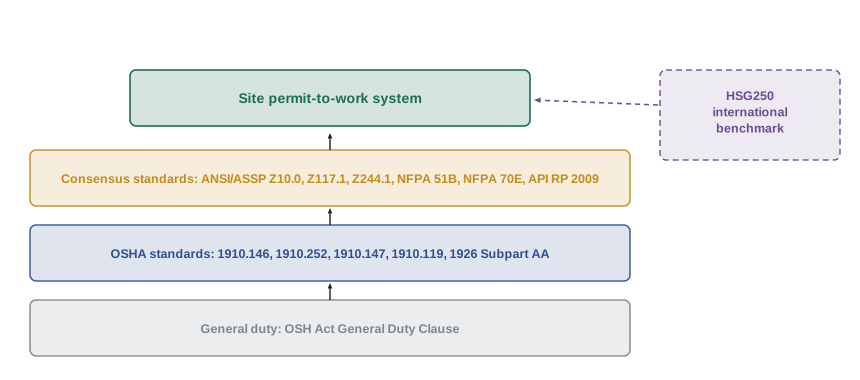
The United States has no single federal regulation requiring a general permit-to-work system. Instead, OSHA requires written permits within specific standards, such as permit-required confined spaces and hot work, and requires written procedures for other hazards, such as hazardous energy control. Process safety management adds requirements for safe work practices at facilities with highly hazardous chemicals. States that run their own OSHA-approved plans, such as California, Washington, Oregon and Michigan, must be at least as effective as federal OSHA and sometimes go further. This lesson maps where permit duties come from, so that you can see why your site's system looks the way it does.
Two kinds of rules shape a permit system. Prescriptive rules say exactly what must be done, for example that an entry permit must list the atmospheric test results and be posted at the entry point. Performance or general-duty rules set an outcome, such as protecting workers from hazards, and leave the method to the employer. A good permit system satisfies the prescriptive rules for each high-risk activity and uses the general duty as the reason to extend permit control to other hazardous work that no specific rule mentions.
General duties in US law
The OSH Act's General Duty Clause, section 5(a)(1), requires each employer to keep the workplace free from recognized hazards that are causing or likely to cause death or serious physical harm. OSHA has used it, together with industry consensus standards, to cite employers for serious hazards that no specific standard covers. Specific standards, discussed below, require permits for some activities. The combination means that, while no rule says 'run a permit system', a site that does dangerous non-routine work without formal control will struggle to show it addressed recognized hazards. Supervisors and managers who direct such work carry real responsibility, and serious cases can lead to criminal prosecution where a willful violation causes a death.
OSHA standards that require permits or written procedures
The clearest permit requirements are in the confined space and hot work rules. For hazardous energy, OSHA requires written energy control procedures rather than permits, but many sites link lockout to their permit system. The table summarizes the main federal sources.
| Hazard | Main OSHA source | What it requires |
|---|---|---|
| Permit-required confined space | 29 CFR 1910.146; 1926 Subpart AA (construction) | Written program, entry permit signed by the entry supervisor, testing, attendant, rescue |
| Hot work | 29 CFR 1910.252(a)(2)(iv); 1926 Subpart J | Area inspected and precautions set out in a written permit before cutting or welding |
| Hazardous energy | 29 CFR 1910.147 | Energy control program, written procedures, periodic inspection, training |
| Process safety | 29 CFR 1910.119(f)(4), (k), (l) | Safe work practices for lockout, confined space, opening equipment and entry control; hot work permits; management of change |
| Electrical work | 29 CFR 1910.333; NFPA 70E | De-energize where feasible; NFPA 70E energized electrical work permit when justified |
Under 1910.146, the employer must document the completion of pre-entry measures on an entry permit that identifies the space, purpose, date and duration, authorized entrants, attendants and the entry supervisor, the hazards, isolation and testing measures, rescue services and communication procedures. The entry supervisor signs the permit, which is posted at the entry, and permits are kept at least one year for program review. For hot work, 1910.252 requires the individual responsible for authorizing cutting and welding to inspect the area and designate the precautions in a written permit. Process safety management at 1910.119 requires hot work permits for work on or near covered processes and requires safe work practices that control entry by maintenance and contract personnel.
Process safety management
OSHA's process safety management standard, 29 CFR 1910.119, applies to processes involving listed highly hazardous chemicals above threshold quantities and to large quantities of flammable liquids and gases. It requires the employer to develop safe work practices to control hazards during operations such as lockout, confined space entry, opening process equipment or piping, and control over entrance into the facility by maintenance, contractor, laboratory or other support personnel. It requires hot work permits for hot work on or near covered processes, and it requires management of change before modifications. These requirements are the main reason refineries and chemical plants in the US run comprehensive permit systems.
Standards and guidance in the US
Several consensus standards and guidance documents support permit systems. ANSI/ASSP Z10.0-2019 and the international standard ISO 45001:2018 set out OHS management system requirements, such as hazard identification, operational controls, management of change and contractor control. ANSI/ASSP Z117.1 covers confined spaces and ANSI/ASSP Z244.1 covers hazardous energy control, including alternative methods. NFPA 51B covers hot work and NFPA 70E sets the requirements for an energized electrical work permit. In petroleum and petrochemicals, the American Petroleum Institute publishes API RP 2009 on safe welding, cutting and hot work (eighth edition, 2022) and API Standard 2015 on safe entry and cleaning of petroleum storage tanks. The Center for Chemical Process Safety (CCPS) publishes guidelines on safe work practices that many process plants use to design their permit systems.
The international benchmark
Wherever you work, the UK HSE's HSG250, Guidance on permit-to-work systems, is the document most often quoted as good practice. It sets out the key elements of a permit system: clear scope, roles and responsibilities, training and competence, a permit form designed for the site, cross-referencing of related permits and isolations, display of permits, handover, suspension, monitoring and auditing. The Energy Institute and other industry bodies in the UK and elsewhere have published further guidance on safe isolation and permits. Multinational companies often build a single global permit standard on HSG250 and then add national requirements in each country.
Worked problem
Mapping duties for a new permit system
A food plant in Ohio, regulated by federal OSHA and not covered by process safety management, plans to launch a site permit system covering confined space entry, hot work, energized electrical work and work at heights. Which sources should the system designer list for each permit type?
Show solution
- Confined space entry: 29 CFR 1910.146 (entry permit, entry supervisor, attendant, testing, rescue) and ANSI/ASSP Z117.1 as guidance.
- Hot work: 29 CFR 1910.252(a)(2)(iv) (written permit after inspection) and NFPA 51B as guidance.
- Energized electrical work: 29 CFR 1910.333 and NFPA 70E, which sets out the energized electrical work permit.
- Work at heights: 29 CFR 1910 Subpart D; the General Duty Clause supports adding a permit where no standard requires one.
- For all types: the General Duty Clause and ANSI/ASSP Z10.0 or ISO 45001 for the management system; HSG250 as good practice.
Answer: Each permit type rests on a hazard-specific rule where one exists, with the general duty and a management system standard tying the whole system together.
Regulators and enforcement
OSHA compliance officers inspect permit programs, ask for permits and training records, and issue citations. Penalties are adjusted for inflation each year; at the time of writing the maximum for a serious violation is about $16,500 and for a willful or repeated violation about $165,500 per violation, using the January 2025 amounts. Willful violations that cause a death can be referred for criminal prosecution. The CSB investigates major chemical incidents and publishes recommendations, but it does not issue fines.
How the duties fit together in practice
Because permit duties are spread across many rules, sites find it useful to build a simple map that shows, for each type of permitted work, which legal requirement applies, which standard is referenced and which part of the site procedure meets it. The map makes audits easier, helps new issuers understand why each precaution is on the form, and shows quickly where a change in the law affects the permit system.
A US site would typically list, for each permit type, the OSHA standard and paragraph, the consensus standard referenced (such as NFPA 51B for hot work, NFPA 70E for electrical work or ANSI/ASSP Z117.1 for confined spaces), any state plan requirement, and the clause of the site procedure that meets it. In the 22 states and territories with OSHA-approved state plans covering private employers, the state rule may be stricter than the federal one, and the map must reflect that.
Regulators rarely accept 'we have a form' as evidence of compliance. Inspectors look at whether permits are actually used as the procedure says, whether people are trained and authorized, whether isolations are verified, and whether the employer checks its own system. Enforcement cases after serious incidents commonly cite failures to follow the permit procedure, inadequate hazard assessment behind the permit, lack of training, and failure to coordinate contractors. A well-documented monitoring program, of the kind described in Lesson 12, is one of the strongest defenses an employer has, because it shows the system is managed rather than merely written.
Finally, the law sets a minimum. Many of the most effective permit practices, such as the joint site visit, face-to-face handover, conflict matrices and independent audits, are not spelled out in any regulation. They come from industry guidance such as HSG250 and from hard experience. Good sites treat legal requirements as the floor and industry practice as the standard to aim for.
Keeping up with change
Laws and standards change. Regulations are amended, sections are renumbered, standards are revised on five-year cycles and new hazards, such as battery energy storage and hydrogen, attract new rules. The permit system owner should track changes through regulator newsletters, standards bodies, industry associations and legal update services, and should review the legal map at least once a year. When a change affects the permit procedure, it should go through management of change, with training for issuers and holders before the new requirement takes effect. Sites that operate in more than one province or state need a map for each jurisdiction, because a permit procedure written for one place may not meet the rules in another.
Workers also have legal rights that affect permit work. In both countries, workers may refuse work they reasonably believe is dangerous, must be told about the hazards of their work, and in many workplaces are represented by a joint health and safety committee or safety representative who can inspect the workplace and review procedures. Involving the committee in reviewing the permit procedure and its audit results is good practice and, in several jurisdictions, an expectation of the regulator.
Common mistakes
MistakeAssuming a permit system is optional because no rule says "permit system".
InsteadSpecific rules require permits for some work, and the general duty requires effective control of other hazardous work.
MistakeCopying a permit form from another province, state or company unchanged.
InsteadBuild the system on the rules that apply where you work and on your own plant hazards.
MistakeRelying on an old edition of a regulation or standard.
InsteadCheck the current version; section numbers and requirements change.
MistakeForgetting process safety management requirements at covered facilities.
InsteadPSM requires hot work permits, safe work practices and management of change at covered processes.
MistakeTreating a standard as optional guidance when a regulation adopts it.
InsteadWhere a regulation references a standard, its requirements become legal duties.
Summary and key terms
- The US has no single permit regulation; OSHA requires permits within specific standards and the General Duty Clause covers other hazards.
- OSHA 1910.146 requires a signed entry permit for permit-required confined spaces.
- OSHA 1910.252 requires a written hot work permit after inspection of the area.
- OSHA 1910.147 requires written energy control procedures rather than permits.
- PSM (1910.119) requires hot work permits and safe work practices at covered processes.
- ANSI/ASSP Z10.0, NFPA 51B, NFPA 70E, API RP 2009 and CCPS guidance support permit design.
- HSG250 is the international benchmark for permit system design.
- General duty
- A broad legal obligation on employers to protect workers from hazards.
- Prescriptive rule
- A rule that specifies exactly what must be done.
- Performance rule
- A rule that sets an outcome and leaves the method to the employer.
- Entry permit
- The written authorization for entry into a confined space.
- Process safety management
- A management system, required in the US by OSHA 1910.119, for preventing releases of highly hazardous chemicals.
- Lockout standard
- A standard, such as CSA Z460 or ANSI/ASSP Z244.1, setting out how to control hazardous energy.
- Energized electrical work permit
- A permit, described in CSA Z462 and NFPA 70E, justifying and controlling work on live electrical equipment.
- OHS management system standard
- A standard, such as ISO 45001 and its national adoptions, for managing health and safety systematically.
- Management of change
- A process for reviewing hazards before changes to plant, procedures or people.
- Industry recommended practice
- Guidance developed by an industry body to describe accepted good practice.
Practice problems
Work each problem on paper first, then reveal the answer to check.
Which OSHA standard requires entry permits for permit-required confined spaces?
Show answer
29 CFR 1910.146.
Which OSHA paragraph requires a written hot work permit?
Show answer
29 CFR 1910.252(a)(2)(iv).
Does OSHA 1910.147 require a permit?
Show answer
No. It requires an energy control program and written procedures.
Which standard requires hot work permits at facilities with highly hazardous chemicals?
Show answer
Process safety management, 29 CFR 1910.119(k).
What is the difference between a prescriptive and a performance rule?
Show answer
A prescriptive rule specifies the method; a performance rule sets the outcome.
Name a US consensus standard on OHS management systems.
Show answer
ANSI/ASSP Z10.0.
Which international guidance is the benchmark for permit systems?
Show answer
The UK HSE's HSG250.
What does the General Duty Clause require?
Show answer
Employers must keep the workplace free of recognized serious hazards.
Why should a site check the current version of a regulation?
Show answer
Section numbers and requirements change when regulations are amended.
Which API document covers hot work in petroleum facilities?
Show answer
API RP 2009.
Lesson quiz · 5 questions
Score 60% or more to complete this lesson.
Create a free account to save your progress, take quizzes and earn a certificate.