
HSE-221 · Lesson 6 of 12 · 25 min
Roles, responsibilities and competence
A permit system is only as good as the people who run it. The forms, the boards and the software are tools; the protection comes from knowledgeable people checking the plant, talking to each other and refusing to sign when something is not right. This lesson describes the main roles in a permit system, what each person is responsible for, how people become authorized, and how sites make sure that issuers have enough time to do the job properly.
The main roles
Different industries and companies use different titles, but the same functions appear in almost every permit system. HSG250 and most company standards describe roles along these lines:
- Permit requester or originator: the person who identifies the work and asks for a permit, describing the job, location, equipment and timing. Often a maintenance planner, supervisor or contractor coordinator.
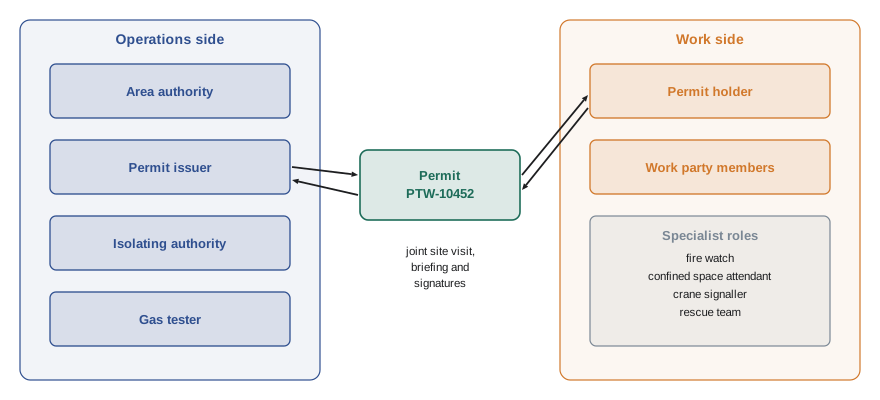
- Permit issuer, sometimes called the performing authority or authorized person: the person who controls the area or plant and who has authority to issue permits there. The issuer decides the precautions, checks that they are in place, explains the hazards to the permit holder and signs the permit. The issuer is responsible for the safety of the plant while the work is done.
- Area authority or area owner: on many sites, the person responsible for an operating area, such as a unit supervisor or control room operator, who must agree that the work can go ahead in that area and that it does not conflict with operations or other work. On smaller sites the issuer and area authority are the same person.
- Permit holder, also called the permit receiver or performing person in charge: the person who accepts the permit on behalf of the work party. The holder makes sure the crew understands the hazards and precautions, keeps the work within the scope, stops work if conditions change, and signs the handback.
- Isolating authority: a competent person who carries out and verifies isolations, often an operator for process isolations and an authorized electrician for electrical isolations. The isolating authority signs the isolation certificate.
- Authorized gas tester: a person trained and authorized to use gas detection equipment, interpret readings and record results.
- Work party members: everyone who works under the permit. Each must be briefed, must sign or otherwise acknowledge the permit, and must follow its conditions.
- Specialist roles: fire watch, confined space attendant, entry supervisor, rescue team, crane operator, signaler and radiation safety officer, as required by the type of work.
- Permit system owner or coordinator: a senior person responsible for the permit procedure itself, its training, its monitoring and its improvement.
Responsibilities in more detail
The heart of every permit system is the relationship between the issuer and the holder. The issuer is responsible for the state of the plant: that it is isolated, drained, purged and tested, that conflicting work has been considered and that the precautions written on the permit are adequate and in place. The holder is responsible for the work: that the crew is competent, briefed and equipped, that the work stays within the permit, and that the site is left safe at the end.
Neither can do the other's job. An issuer who signs a permit without visiting the site is guessing about the plant. A holder who accepts a permit without walking the job with the issuer is guessing about the precautions. For this reason almost every good permit procedure requires a joint site visit before issue, at which the issuer and holder look at the equipment together, check the isolations, review the gas test, agree the scope and identify anything that has been missed.
Managers have responsibilities too. They must provide competent people, enough issuers for the workload, adequate time for permit preparation, training and resources, and they must monitor the system. Under Canadian law, the Criminal Code section 217.1 duty applies to anyone who directs how work is done, and provincial OHS laws make supervisors responsible for ensuring workers follow procedures. In the US, OSHA holds the employer responsible for the program, and process safety management requires the employer to ensure contract employers are informed of and follow safe work practices.
| Role | Key responsibilities | Common failure |
|---|---|---|
| Issuer | Decide precautions, verify plant state, brief holder, sign | Issuing from the control room without a site visit |
| Area authority | Agree work in area, check conflicts with operations and other permits | Not told about work starting in their area |
| Holder | Brief crew, keep within scope, stop if conditions change, hand back | Accepting a permit without understanding it |
| Isolating authority | Apply and verify isolations, sign certificate | Isolating the wrong valve or not verifying |
| Gas tester | Test correctly with a working instrument, record results | Testing only at the opening, not at depth |
| Work party | Understand and follow the permit | Signing without being briefed |
Competence and authorization
People should not be able to issue or accept permits simply because of their job title. They must be trained, assessed and formally authorized for the specific role, the specific area and, often, the specific types of permit. A typical authorization process includes:
- Prerequisites: knowledge of the plant or area, usually a minimum period of experience in operations or maintenance there.
- Classroom or online training in the permit procedure, hazards, isolation principles, gas testing and the site's rules.
- Supervised practice, issuing or accepting permits under the guidance of an experienced authorized person.
- Assessment, including a practical assessment in the field and sometimes a written or oral test.
- Written authorization by a named manager, recorded in a register that shows each person's roles, areas and permit types, and the expiry date of the authorization.
- Periodic reassessment, often every two or three years, and removal of authorization after a period away from the area or after a serious failure.
Permit holders who are contractors present a particular challenge. Many sites require contractor supervisors to attend the site's permit training and pass an assessment before they can hold permits. Some sites issue photo cards or electronic credentials showing a person's permit authorizations, so that issuers can check them at the work site.
Issuer workload
Investigations frequently find that issuers were overloaded. When one person is responsible for issuing dozens of permits during a busy start of shift, site visits are rushed or skipped and checks become superficial. Sites should estimate issuer workload and plan staffing so that each permit gets the time it needs.
Here \( N_{\max} \) is the maximum number of permits one issuer can properly handle in a period, \( T_{\text{avail}} \) is the issuer's time available for permit work in that period and \( t_{\text{permit}} \) is the average time a permit needs, including preparation, site visit, briefing, revalidation and close-out.
Worked problem
How many issuers for a shutdown?
During a two-week maintenance shutdown, a unit expects 90 new permits per day, plus 60 existing permits to revalidate at each of the two shift changes. A new permit needs on average 25 minutes of issuer time, a revalidation 8 minutes and a close-out 10 minutes; about 80 permits are closed per day. Each issuer works a 12-hour shift, but only 8 hours can realistically be spent on permit work because of other duties. How many issuers are needed per day?
Show solution
- New permits: \( 90 \times 25 = 2250 \) minutes.
- Revalidations: two shift changes of 60 each, so \( 120 \times 8 = 960 \) minutes.
- Close-outs: \( 80 \times 10 = 800 \) minutes.
- Total issuer time per day: \( 2250 + 960 + 800 = 4010 \) minutes, or about 66.8 hours.
- Each issuer has 8 hours of permit time per shift, so \( 66.8 / 8 \approx 8.4 \) issuer-shifts per day.
- Round up and add a margin for peaks at shift start: plan for at least 9 to 10 issuer-shifts per day, for example five issuers on each of two shifts.
Answer: About 9 to 10 issuer-shifts per day, such as five issuers on days and five on nights.
This simple calculation often shows that normal staffing is far too thin for a shutdown. Sites respond by bringing in extra authorized issuers, setting up a permit office, staggering the start of work so permits are not all needed at 7 a.m., preparing permits the day before, and using electronic systems to reduce writing time.
Independence and challenge
A permit system works best when anyone can challenge it. A gas tester who gets a strange reading, a fire watch who sees combustibles that were not removed, or a work party member who thinks the isolation is wrong must feel free to stop the work and raise the issue without blame. Many sites write a stop work authority into their permit procedure and back it up with training and visible management support. In both countries, workers also have a legal right to refuse unsafe work: under provincial OHS laws and the Canada Labor Code in Canada, and under OSHA's regulations and section 11(c) protections in the US.
Supervisors in the US are the employer's agents for OSHA purposes, and their knowledge of a violation is usually imputed to the employer. A supervisor who lets work proceed outside a permit exposes the employer to citations and, where a death results from a willful violation, possible criminal referral under the OSH Act.
Specialist roles and contractors
Specialist roles carry their own competence requirements. Fire watches need training in recognizing fire hazards, using extinguishers and raising the alarm; confined space attendants need to know the signs of exposure, how to communicate with entrants and when to summon rescue; gas testers need instrument-specific training and must know how to bump test and interpret readings. Each specialist should be named on the permit or its certificate, so there is never any doubt about who is responsible for the watch, the attendance or the test. When a specialist is replaced during the work, for example at a break, the replacement is briefed and the change recorded.
Competence in practice
Competence is more than a training certificate. An issuer who has passed the course but has never seen a particular unit in operation may not know where its hidden hazards are, such as a dead leg that traps liquid, a valve that is known to pass, or a vent that discharges near a walkway. For this reason many sites authorize issuers area by area and require a period of familiarization in each new area under an experienced issuer. Coaching in the field, where an experienced issuer walks the job with a newer one and talks through what they are looking for, is one of the most effective ways of building real competence and is often more valuable than further classroom training.
Managers should also make sure the authorization register is actually used. Issuers should check a holder's authorization before issuing, permit offices should refuse permits to people not on the register, and the register should be updated promptly when people join, leave or change roles. An out-of-date register gives a false picture of who is competent and undermines the whole authorization system.
Common mistakes
MistakeIssuing permits from the control room without visiting the site.
InsteadMake a joint site visit with the holder before every issue.
MistakeAuthorizing people by job title.
InsteadTrain, assess and formally authorize people for specific roles, areas and permit types.
MistakeLetting crew members sign without a briefing.
InsteadBrief every member of the work party on hazards and precautions before they sign.
MistakeRunning a shutdown with normal issuer staffing.
InsteadEstimate issuer workload and add authorized issuers, a permit office or staggered starts.
MistakeTreating challenges to a permit as a nuisance.
InsteadSupport stop work authority and thank people who raise concerns.
Summary and key terms
- Core roles are requester, issuer, area authority, holder, isolating authority, gas tester and work party.
- The issuer is responsible for the state of the plant; the holder for the work and the crew.
- A joint site visit before issue is essential.
- Authority to issue or hold permits comes from training, assessment and written authorization, not job title.
- Authorizations are specific to roles, areas and permit types and must be renewed.
- Issuer workload must be estimated and staffed, especially during shutdowns.
- Anyone must be able to stop work and challenge a permit without blame.
- Permit issuer
- The authorized person who controls the plant and issues the permit.
- Area authority
- The person responsible for an operating area who agrees to work there.
- Permit holder
- The authorized person who accepts the permit and leads the work party.
- Isolating authority
- The competent person who applies and verifies isolations.
- Authorized gas tester
- A person trained and authorized to test atmospheres and record results.
- Joint site visit
- A visit by issuer and holder to the job site before the permit is issued.
- Authorization register
- A record of who may perform which permit roles, where and until when.
- Work party
- All the people who work under a permit.
- Permit office
- A central location for preparing, issuing and tracking permits, common in shutdowns.
- Stop work authority
- The right and duty of anyone to stop work they believe is unsafe.
Practice problems
Work each problem on paper first, then reveal the answer to check.
Who is responsible for the state of the plant under a permit?
Show answer
The permit issuer.
Who is responsible for keeping the work within scope?
Show answer
The permit holder.
Why is a joint site visit required?
Show answer
So issuer and holder check the plant, precautions and scope together.
List three steps in authorizing an issuer.
Show answer
Prerequisite experience, training, supervised practice, assessment, written authorization, reassessment.
What should each work party member do before starting?
Show answer
Be briefed on the hazards and precautions and sign or acknowledge the permit.
An issuer has 6 hours for permit work and each permit needs 30 minutes. What is \( N_{\max} \)?
Show answer
\( 360 / 30 = 12 \) permits.
Give two ways to manage issuer workload in a shutdown.
Show answer
Extra issuers, a permit office, staggered starts, preparing permits in advance or electronic permits.
Why might a site issue permit authorization cards?
Show answer
So issuers can check a person's authorizations at the work site.
What is stop work authority?
Show answer
The right and duty of anyone to stop work they believe is unsafe.
When should an authorization be withdrawn?
Show answer
After a long absence from the area, a serious failure or when it expires without reassessment.
Lesson quiz · 5 questions
Score 60% or more to complete this lesson.
Create a free account to save your progress, take quizzes and earn a certificate.