
HSE-221 · Lesson 3 of 12 · 25 min
Permit-to-work law and standards in Canada
Canada has no single law that says every workplace must run a permit-to-work system. Instead, permit requirements appear inside the rules for particular hazards, such as confined space entry, hot work and hazardous energy, and inside the general duty of employers to identify hazards and control them. Occupational health and safety is mostly a provincial and territorial responsibility, so the details differ from one jurisdiction to another. Federally regulated workplaces, such as interprovincial pipelines, railways, banks, telecommunications and federal government operations, follow the Canada Labour Code and the Canada Occupational Health and Safety Regulations. This lesson maps where permit duties come from, so that you can see why your site's system looks the way it does.
Two kinds of rules shape a permit system. Prescriptive rules say exactly what must be done, for example that an entry permit must list the atmospheric test results and be posted at the entry point. Performance or general-duty rules set an outcome, such as protecting workers from hazards, and leave the method to the employer. A good permit system satisfies the prescriptive rules for each high-risk activity and uses the general duty as the reason to extend permit control to other hazardous work that no specific rule mentions.
General duties in Canadian law
Every provincial and territorial OHS act places a general duty on employers to take every precaution reasonable in the circumstances to protect workers, and to provide information, instruction and supervision. In Ontario, for example, section 25 of the Occupational Health and Safety Act sets out these duties, and section 27 places duties on supervisors. Alberta's OHS Code Part 2 requires a written hazard assessment before work begins and again when conditions change, which is the natural foundation for a permit. Federally, Part II of the Canada Labour Code and the COHSR set similar duties. Under the Criminal Code, section 217.1 adds a legal duty on anyone who directs work to take reasonable steps to prevent bodily harm, as Lesson 2 explained. A site that does dangerous non-routine work without any formal control system would find it hard to show it took every reasonable precaution.
Hazard-specific rules that require permits or written authorization
The clearest permit requirements in Canada are in confined space rules, but hot work, hazardous energy and other high-risk activities also carry written authorization or procedure requirements in many jurisdictions. The table summarizes typical sources. Section numbers change when regulations are amended, so always check the current version for your province or territory.
| Hazard | Typical Canadian sources | What they require |
|---|---|---|
| Confined space entry | Ontario O. Reg. 632/05; BC OHSR Part 9; Alberta OHS Code Part 5; COHSR Part XI | Hazard assessment, written plan or code of practice, entry permit for each entry, testing, attendant, rescue |
| Hazardous energy | Ontario Reg. 851 s. 42 and O. Reg. 213/91; BC OHSR Part 10; Alberta OHS Code Part 15; COHSR | Isolation and lockout before work, written procedures, verification of zero energy |
| Hot work | National Fire Code Section 5.2 and provincial fire codes; provincial OHS rules on welding and flammable atmospheres | Precautions, fire watch, in some codes a written permit or authorization |
| Electrical work | Provincial electrical and OHS rules; CSA Z462 | De-energize where possible; energized work only when justified and authorized |
| Excavation and ground disturbance | Provincial OHS rules on excavations; locate requirements such as Ontario One Call | Locates before digging, safe digging practices, protection of workers |
In Ontario, for example, the confined spaces regulation requires an entry permit for each entry, issued before entry, specifying the space, the duration, the hazards and controls, and the results of atmospheric testing, and it requires the permit to be kept readily available. British Columbia's rules require a written confined space entry program and entry procedures, with lockout and isolation requirements set out in Part 10. Alberta requires a code of practice for confined spaces and an entry permit system, and Part 15 sets the rules for controlling hazardous energy.
Fire codes
Hot work is also regulated by fire codes. The National Fire Code of Canada, Section 5.2, sets out precautions for hot works, including protection of combustibles and a fire watch, and provinces adopt it with their own amendments in provincial fire codes. Fire code requirements apply alongside OHS rules, so a hot work permit form at a Canadian site usually combines the two. HSE-216 covers hot work in detail.
Standards and guidance in Canada
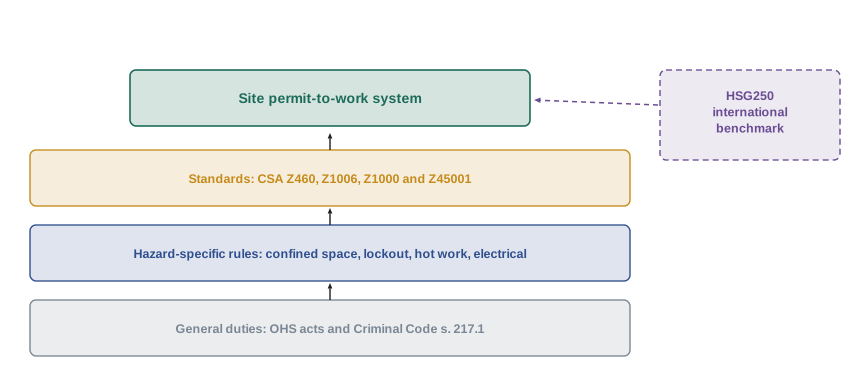
Several CSA Group standards support permit systems. CSA Z460, Control of hazardous energy – Lockout and other methods, sets out lockout principles and when alternative methods may be used after risk assessment. CSA Z1006, Management of work in confined spaces, covers confined space programs, including entry permits. CSA Z1000, Occupational health and safety management, and CSA Z45001, the Canadian adoption of the international standard ISO 45001, set out management system requirements, such as hazard identification, operational control, management of change and contractor control, into which a permit system fits. Regulations sometimes reference particular editions of these standards. In upstream oil and gas, Energy Safety Canada publishes training standards and supports industry-developed recommended practices, and many Alberta and British Columbia operators align their permit forms and training with these shared practices so that contractors see familiar systems from site to site.
The international benchmark
Wherever you work, the UK HSE's HSG250, Guidance on permit-to-work systems, is the document most often quoted as good practice. It sets out the key elements of a permit system: clear scope, roles and responsibilities, training and competence, a permit form designed for the site, cross-referencing of related permits and isolations, display of permits, handover, suspension, monitoring and auditing. The Energy Institute and other industry bodies in the UK and elsewhere have published further guidance on safe isolation and permits. Multinational companies often build a single global permit standard on HSG250 and then add national requirements in each country.
Worked problem
Mapping duties for a new permit system
A food plant in Ontario plans to launch a site permit system covering confined space entry, hot work, energized electrical work and work at heights. Which legal and standard sources should the system designer list for each permit type?
Show solution
- Confined space entry: O. Reg. 632/05 (entry permit for each entry, assessment, plan, testing, attendant, rescue) and CSA Z1006 as guidance.
- Hot work: the Ontario Fire Code, based on NFC Section 5.2, and OHS rules on welding and flammable atmospheres; CSA W117.2 as guidance.
- Energized electrical work: Ontario OHS rules for electrical hazards and the Ontario Electrical Safety Code; CSA Z462 for the energized work permit and justification.
- Work at heights: Reg. 851 and, for construction, O. Reg. 213/91; the general duty under OHSA s. 25 supports adding a permit where the regulation does not require one.
- For all types: OHSA s. 25 and s. 27, Criminal Code s. 217.1, and CSA Z45001 or Z1000 for the management system.
Answer: Each permit type rests on a hazard-specific rule where one exists, with the general duty and a management system standard tying the whole system together.
Regulators and enforcement
Provincial OHS inspectors, the Canadian Energy Regulator for federally regulated pipelines, and federal labour program officers can inspect permit systems, ask for permit records and issue orders. After serious incidents, prosecutions under provincial OHS acts can lead to substantial fines; in Ontario, for example, corporations can be fined up to $2 million per offence under the current act. Courts look closely at whether the employer had a system and whether it was actually followed.
How the duties fit together in practice
Because permit duties are spread across many rules, sites find it useful to build a simple map that shows, for each type of permitted work, which legal requirement applies, which standard is referenced and which part of the site procedure meets it. The map makes audits easier, helps new issuers understand why each precaution is on the form, and shows quickly where a change in the law affects the permit system.
A Canadian site would typically list, for each permit type, the provincial OHS regulation section, the fire code section for hot work, the CSA standard referenced (such as Z460 for lockout, Z1006 for confined spaces or Z462 for electrical work) and the clause of the site procedure that meets it. Where the workplace is federally regulated, such as a pipeline, port or telecommunications site, the Canada Occupational Health and Safety Regulations under the Canada Labour Code apply instead of provincial rules, and the map must reflect that.
Regulators rarely accept 'we have a form' as evidence of compliance. Inspectors look at whether permits are actually used as the procedure says, whether people are trained and authorized, whether isolations are verified, and whether the employer checks its own system. Enforcement cases after serious incidents commonly cite failures to follow the permit procedure, inadequate hazard assessment behind the permit, lack of training, and failure to coordinate contractors. A well-documented monitoring program, of the kind described in Lesson 12, is one of the strongest defences an employer has, because it shows the system is managed rather than merely written.
Finally, the law sets a minimum. Many of the most effective permit practices, such as the joint site visit, face-to-face handover, conflict matrices and independent audits, are not spelled out in any regulation. They come from industry guidance such as HSG250 and from hard experience. Good sites treat legal requirements as the floor and industry practice as the standard to aim for.
Keeping up with change
Laws and standards change. Regulations are amended, sections are renumbered, standards are revised on five-year cycles and new hazards, such as battery energy storage and hydrogen, attract new rules. The permit system owner should track changes through regulator newsletters, standards bodies, industry associations and legal update services, and should review the legal map at least once a year. When a change affects the permit procedure, it should go through management of change, with training for issuers and holders before the new requirement takes effect. Sites that operate in more than one province or state need a map for each jurisdiction, because a permit procedure written for one place may not meet the rules in another.
Workers also have legal rights that affect permit work. In both countries, workers may refuse work they reasonably believe is dangerous, must be told about the hazards of their work, and in many workplaces are represented by a joint health and safety committee or safety representative who can inspect the workplace and review procedures. Involving the committee in reviewing the permit procedure and its audit results is good practice and, in several jurisdictions, an expectation of the regulator.
Common mistakes
MistakeAssuming a permit system is optional because no rule says "permit system".
InsteadSpecific rules require permits for some work, and the general duty requires effective control of other hazardous work.
MistakeCopying a permit form from another province, state or company unchanged.
InsteadBuild the system on the rules that apply where you work and on your own plant hazards.
MistakeRelying on an old edition of a regulation or standard.
InsteadCheck the current version; section numbers and requirements change.
MistakeForgetting the fire code when designing hot work permits.
InsteadCombine fire code and OHS requirements on the hot work permit.
MistakeTreating a standard as optional guidance when a regulation adopts it.
InsteadWhere a regulation references a standard, its requirements become legal duties.
Summary and key terms
- Canada has no single permit law; permit duties sit inside provincial and federal hazard rules and general duties.
- Confined space rules in every jurisdiction require entry permits.
- Hot work is governed by fire codes based on NFC Section 5.2 together with OHS rules.
- Lockout rules require isolation and procedures; CSA Z460 sets the principles.
- CSA Z1006, Z1000 and Z45001 support confined space and management system design.
- Criminal Code s. 217.1 places a duty on everyone who directs work.
- HSG250 is the international benchmark for permit system design.
- General duty
- A broad legal obligation on employers to protect workers from hazards.
- Prescriptive rule
- A rule that specifies exactly what must be done.
- Performance rule
- A rule that sets an outcome and leaves the method to the employer.
- Entry permit
- The written authorization for entry into a confined space.
- Process safety management
- A management system, required in the US by OSHA 1910.119, for preventing releases of highly hazardous chemicals.
- Lockout standard
- A standard, such as CSA Z460 or ANSI/ASSP Z244.1, setting out how to control hazardous energy.
- Energized electrical work permit
- A permit, described in CSA Z462 and NFPA 70E, justifying and controlling work on live electrical equipment.
- OHS management system standard
- A standard, such as ISO 45001 and its national adoptions, for managing health and safety systematically.
- Management of change
- A process for reviewing hazards before changes to plant, procedures or people.
- Industry recommended practice
- Guidance developed by an industry body to describe accepted good practice.
Practice problems
Work each problem on paper first, then reveal the answer to check.
Which Ontario regulation requires confined space entry permits?
Show answer
O. Reg. 632/05, Confined Spaces.
Which code sets the Canadian model rules for hot work?
Show answer
The National Fire Code of Canada, Section 5.2.
What does CSA Z460 cover?
Show answer
Control of hazardous energy by lockout and other methods.
Which part of the Alberta OHS Code requires hazard assessment?
Show answer
Part 2.
What is the difference between a prescriptive and a performance rule?
Show answer
A prescriptive rule specifies the method; a performance rule sets the outcome.
Name a CSA standard on OHS management systems.
Show answer
CSA Z1000 or CSA Z45001.
Which international guidance is the benchmark for permit systems?
Show answer
The UK HSE's HSG250.
What duty does Criminal Code s. 217.1 impose?
Show answer
Those who direct work must take reasonable steps to prevent bodily harm.
Why should a site check the current version of a regulation?
Show answer
Section numbers and requirements change when regulations are amended.
Which standard covers energized electrical work permits in Canada?
Show answer
CSA Z462.
Lesson quiz · 5 questions
Score 60% or more to complete this lesson.
Create a free account to save your progress, take quizzes and earn a certificate.