
HSE-221 · Lesson 9 of 12 · 25 min
Simultaneous operations, interfaces and conflicts
Individual permits can be perfectly prepared and still lead to disaster if they ignore each other. A welding job and a line break planned for the same pipe rack, a crane lift over a scaffold crew, a radiography source near a confined space entry, or a process startup next to a maintenance crew: each permit on its own may look fine, but together they create a hazard that neither permit considered. Managing these interactions is one of the hardest and most important jobs in any permit system. This lesson covers simultaneous operations, interfaces between work parties and operations, and the tools sites use to detect and resolve conflicts.
What simultaneous operations means
Simultaneous operations, often shortened to SIMOPS, are two or more activities carried out at the same time and close enough together that one could affect the safety of the other. The term began in offshore oil and gas, where drilling, production, construction and diving often happen on the same installation, but the problem exists everywhere. Typical combinations include:
- Hot work near work that could release flammable material, such as a line break, tank cleaning, sampling or vessel opening.
- Overhead work, including crane lifts and scaffolding, above people working at ground level.
- Radiography or other radiation work near any other crew.
- Confined space entry near activities that could change the atmosphere in the space, such as purging, vehicle exhaust or chemical deliveries.
- Maintenance work beside operating equipment, especially during startup, shutdown or abnormal operations.
- Excavation near work that depends on buried services, or near heavy equipment that could collapse trench walls.
- Electrical switching that could re-energize equipment someone else is working on.
Lesson 2 showed how failure to manage interfaces contributed to major accidents, including Texas City in 2005, where people working in temporary trailers close to a unit undergoing startup were killed when a release ignited.
Detecting conflicts
Conflicts must be spotted before permits are issued, not discovered at the job site. Sites use several overlapping tools:
- Planning meetings: a daily permit coordination meeting, often the afternoon before, where operations, maintenance, contractors and the permit office review all planned work for the next day and identify interactions.
- Area plot plans and permit boards: a map of the plant on which every live and planned permit is marked by location and type, so that clusters and clashes stand out. Some sites use magnetic boards in the control room; others use electronic maps.
- Conflict matrices: tables that list which types of work must never be done at the same time in the same area, which may be done together only with extra controls, and which are compatible.
- Area authority sign-off: the person responsible for an area must agree to every permit there, which gives one person an overview of everything happening in that area.
- Electronic permit systems that flag permits overlapping in location and time, or that combine incompatible work types.
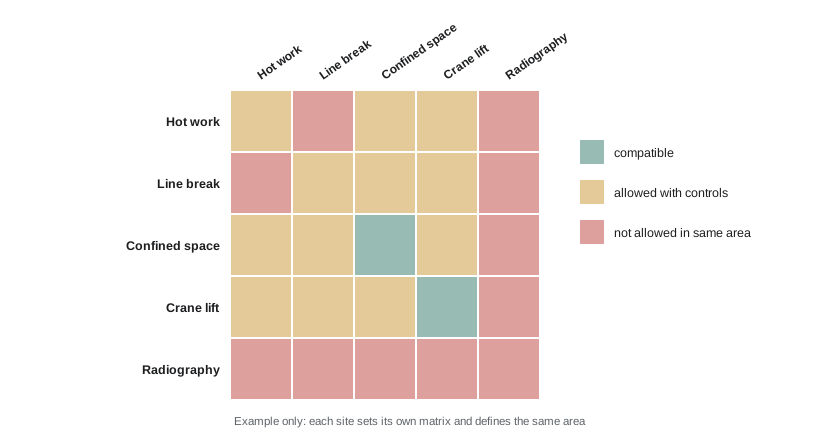
Conflict matrices in practice
A conflict matrix turns experience into a simple rule. Each pair of work types is classed as compatible, compatible with controls, or prohibited in the same area or within a set distance. The matrix should be specific to the site and should define what 'the same area' means, for example the same process unit, within 15 meters, or within the drop zone of a lift. Controls for amber combinations might include continuous gas monitoring, a dedicated standby person, sequencing the work so that one finishes before the other starts, physical barriers, or a single permit holder coordinating both crews.
Some sites score combinations to help decide when to escalate. A common approach is to assign each pair a conflict score and add the scores for all work planned in the same area during the same period. If the total exceeds a threshold, the work must be reviewed by a more senior person or resequenced.
Worked problem
Scoring a busy day on a pipe rack
A site scores pairs of activities in the same area: 0 for compatible, 2 for compatible with controls and 5 for prohibited. Any area with a total of 5 or more needs review by the operations superintendent, and any single prohibited pair must be resequenced. Tomorrow, four permits are planned on the same pipe rack during the day shift: hot work (welding a pipe support), a line break on a hydrocarbon line, a crane lift of a new spool and scaffold erection. The matrix gives: hot work and line break 5; hot work and crane lift 2; hot work and scaffold 0; line break and crane lift 2; line break and scaffold 2; crane lift and scaffold 2. What is the total, and what must happen?
Show solution
- List all six pairs: \( 5 + 2 + 0 + 2 + 2 + 2 \).
- Total: \( 13 \), well above the review threshold of 5.
- The hot work and line break pair scores 5, which is a prohibited combination, so those two jobs must not happen at the same time on the same rack.
- One solution: do the line break in the morning, reinstate and leak test the line, then start welding in the afternoon after a fresh gas test. The crane lift is scheduled when no one is under the load path, and scaffolders are moved clear during the lift.
- After resequencing, the hot work and line break no longer overlap, and the remaining pairs are managed with controls agreed at the coordination meeting.
Answer: Total 13; the superintendent must review, and the hot work and line break must be resequenced so they do not overlap.
Interfaces with operations
Some of the most serious conflicts are not between two maintenance jobs but between maintenance and operations. Changes in plant operation, such as startup, shutdown, draining, sampling, switching or relief valve testing, can create hazards for nearby work. The area authority must know about any planned operational change and consider its effect on live permits. Many sites suspend all permits in a unit during startup or shutdown, or limit work to that directly needed for the startup, because these are the periods when releases are most likely.
Operators must also know exactly where people are working. A control room operator who sees an alarm and sends someone to open a drain, start a pump or vent a vessel must first check whether any permitted work could be affected. Permit boards in the control room and electronic permit displays help, but only if operators look at them before acting.
Coordination meetings and permit boards
The daily permit coordination meeting is the main defense against conflicts. An effective meeting has a fixed time, usually the afternoon before the work, and a fixed attendance: the area authority, permit issuers, maintenance supervisors, contractor supervisors and anyone planning operational changes. The meeting reviews every planned permit on a plot plan, checks the conflict matrix, agrees sequencing and identifies any permits that need more senior review. Decisions are recorded and passed to the next shift.
A permit board, physical or electronic, then shows the current state of all permits: planned, live, suspended and closed. Many sites use color codes, such as green for live, amber for suspended and red for areas where no new permits may be issued. The board should be the first thing an issuer checks before issuing a new permit and the first thing an operator checks before making an operational change.
| Tool | What it catches | Weakness if used alone |
|---|---|---|
| Coordination meeting | Planned conflicts, sequencing needs | Misses work added after the meeting |
| Plot plan or permit board | Clusters and overlaps by location | Only as good as its last update |
| Conflict matrix | Incompatible work types | Needs clear definition of same area |
| Area authority sign-off | Everything in one area | Overload when many permits arrive at once |
| Electronic clash detection | Overlaps in space and time | Depends on accurate locations being entered |
Contractors and multiple employers
Large sites often have several contractors working at once, each with its own supervisors and procedures. Interfaces between contractors are a common source of conflict, because each contractor sees only its own work. The host employer must coordinate all of them through a single permit system. Contractor supervisors should attend the coordination meeting, and contractors should never issue their own permits for work in the host's operating areas.
In the US, OSHA's multi-employer citation policy can hold the controlling employer responsible for hazards that affect other employers' workers, and the process safety management standard, 1910.119(h), requires host employers to inform contractors of hazards and control their entry into covered areas, so a single, site-wide permit system is the normal way of meeting these duties.
Emergency response and SIMOPS
Simultaneous operations also complicate emergency response. When several crews are working in one area, everyone must know the alarm signals, the muster point and the escape routes, and the area authority must be able to account for every person under every permit. Some sites keep a headcount on the permit board, updated as crews arrive and leave. Rescue plans for confined spaces and work at height must consider whether other work in the area could block access or create additional hazards for rescuers. A useful question at the coordination meeting is: if something goes wrong on this job, who else will be affected, and can they get out?
When plans change during the day
Coordination does not end when the meeting closes. Breakdowns, urgent repairs, weather and delays all change the plan during the shift. Any permit added after the coordination meeting should go through the same conflict check, usually by the area authority, before it is issued. If a planned job slips into the time slot of another, the area authority must decide whether they can now overlap safely. Sites that allow late additions without a check find that their coordination meetings protect only the work that was planned, which is often not the work that goes wrong.
A worked look at distance rules
Many conflict matrices use a distance rule rather than a named area. For example, hot work might be prohibited within 15 meters of any opened hydrocarbon system unless continuous gas monitoring is in place and the area authority approves. To apply such a rule, issuers need a plot plan with a scale and the exact location of every live permit. Electronic systems can draw circles of the chosen radius around each permit and highlight overlaps automatically, but on paper systems the issuer must measure. Either way, the rule only works if locations are recorded precisely: 'Unit 3' is not enough when the rule depends on 15 meters.
Finally, SIMOPS management should be reviewed after every significant job or shutdown. A short debrief asking which conflicts were found in time, which were found late, and which were missed altogether gives the information needed to improve the conflict matrix, the coordination meeting and the permit board for the next time.
Common mistakes
MistakeChecking each permit only on its own merits.
InsteadCheck every new permit against all other live and planned work in the area.
MistakeHolding no coordination meeting, or holding it the morning work starts.
InsteadHold a daily coordination meeting the afternoon before, with all key parties.
MistakeLeaving "same area" undefined in the conflict matrix.
InsteadDefine area by unit, distance or drop zone so everyone applies the matrix the same way.
MistakeMaking operational changes without checking live permits.
InsteadCheck the permit board before any startup, draining, venting or switching.
MistakeLetting each contractor run its own permits in operating areas.
InsteadCoordinate all employers through one site-wide permit system.
Summary and key terms
- SIMOPS are activities close enough in time and space that one can affect the safety of another.
- Hot work near line breaks, overhead work and radiography are classic conflicts.
- Coordination meetings, plot plans, conflict matrices and area authority sign-off detect conflicts.
- Conflict matrices class pairs as compatible, compatible with controls, or prohibited.
- Operational changes such as startup and draining must be checked against live permits.
- Permit boards show the current state of all permits and should be checked before acting.
- All employers on a site should work under one coordinated permit system.
- SIMOPS
- Simultaneous operations: activities that could affect each other's safety.
- Conflict matrix
- A table showing which work types are compatible, conditional or prohibited together.
- Plot plan
- A plant map used to mark the location of permits and work.
- Permit board
- A physical or electronic display of planned, live and suspended permits.
- Coordination meeting
- A daily meeting to review planned work and resolve conflicts.
- Interface
- A point where one party's work affects another's safety.
- Sequencing
- Arranging work in time so incompatible tasks do not overlap.
- Drop zone
- The area beneath a lift where a dropped load could fall.
- Controlling employer
- The employer with overall control of a multi-employer site.
- Area authority
- The person who must agree to all work in an operating area.
Practice problems
Work each problem on paper first, then reveal the answer to check.
What does SIMOPS stand for?
Show answer
Simultaneous operations.
Give three classic conflicting combinations.
Show answer
Hot work and line break, crane lift over workers, radiography near other crews, entry near purging.
When should the coordination meeting be held?
Show answer
Usually the afternoon before the work.
What are the three classes in a typical conflict matrix?
Show answer
Compatible, compatible with controls, prohibited.
Why must "same area" be defined?
Show answer
So everyone applies the matrix consistently.
Pairs score 2, 2 and 0 in an area with a review threshold of 5. Is review needed?
Show answer
No; the total is 4.
Why are startup and shutdown periods dangerous for permitted work?
Show answer
Releases are more likely during these operational changes.
What should an operator check before opening a drain in response to an alarm?
Show answer
Whether any live permit could be affected.
Name one weakness of a permit board used alone.
Show answer
It is only as good as its last update.
Why should contractors not run their own permits in operating areas?
Show answer
Each sees only its own work; one coordinated system is needed.
Lesson quiz · 5 questions
Score 60% or more to complete this lesson.
Create a free account to save your progress, take quizzes and earn a certificate.