
HSE-221 · Lesson 2 of 12 · 25 min
History and major accident lessons
Permit-to-work systems are written in the language of lessons learned. Almost every box on a modern permit form, every rule about shift handover and every requirement to display permits in the control room can be traced back to an incident in which people died because one of those things was missing. This lesson looks at how permit systems developed and at several major accidents in which failures of permits, isolations or handover played a central part. The aim is not to memorize dates but to recognize patterns, because the same failures keep returning in new places and new industries.
From local practice to formal systems
Early industrial sites controlled dangerous maintenance work informally. A foreman told a fitter which valve was safe, a chargehand chalked a warning on a vessel, or a padlock was hung on a switch. These arrangements worked tolerably well in small plants where everyone knew each other and the plant changed slowly. As plants grew larger, more complex and more continuous, informal methods broke down. Shifts changed several times a day, contractors arrived for shutdowns, and the people who isolated equipment were no longer the people who worked on it.
By the middle of the twentieth century, written permit systems were common in chemical plants, refineries, shipyards and mines, often developed by large companies and shared through industry associations. Different companies used different forms, names and colors, which caused confusion when contractors moved between sites. From the 1970s onward, regulators and industry bodies began to publish general guidance on what a good permit system should contain. In the United Kingdom, the Health and Safety Executive's 1997 publication on permit-to-work systems, revised in 2005 as HSG250, became the most widely cited reference. In North America, permit requirements appeared mainly inside specific regulations for confined spaces, hot work and process safety, as Lesson 3 explains.
Piper Alpha, 1988
Piper Alpha was an oil and gas production platform in the UK sector of the North Sea. On the night of 6 July 1988, a series of explosions and fires destroyed it and killed 167 people, 165 on the platform and two crew members of a rescue vessel. It remains the deadliest offshore oil and gas disaster.
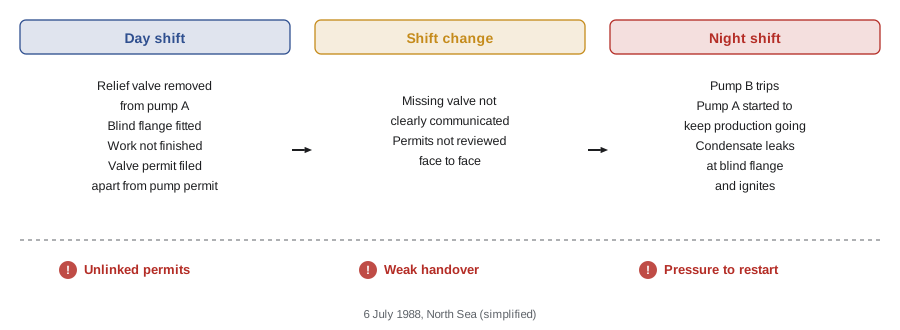
Earlier that day, a pressure safety valve had been removed from one of two condensate injection pumps for routine maintenance. The open pipework was sealed with a blind flange that was only hand tight and not designed to hold full pressure. The work was not finished by the end of the day shift. The permit for the valve work was returned to the control room but was filed separately from the permit for the pump itself, and the night shift was not clearly told that the valve was missing. When the other condensate pump tripped late in the evening, the night crew, under pressure to restore production, checked the paperwork they could find, did not realize the relief valve was off, and started the pump. Condensate leaked from the blind flange and ignited.
The initial explosion was followed by fires fed by oil and, later, by the rupture of high-pressure gas risers connected to other platforms that kept supplying fuel. Firewalls were designed for fire, not blast, and the deluge system was in manual mode because divers had been working nearby. Many workers waited in the accommodation block for instructions that never came.
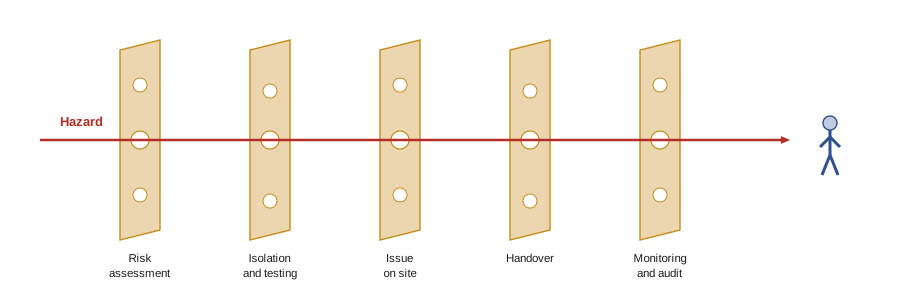
The public inquiry, led by Lord Cullen and reported in 1990, found serious weaknesses in the permit system. Among its findings were that operators and maintenance staff did not fully understand the system, that permits for related work were not cross-referenced, that the condition of plant was not clearly communicated at shift handover, and that monitoring and auditing of the permit system were inadequate. The inquiry's recommendations led to a goal-setting safety case regime offshore in the United Kingdom, and they reshaped permit practice internationally. Cross-referencing of related permits, formal shift handover of permits and regular audits of the system all trace back, at least in part, to Piper Alpha.
Texas City, 2005
On 23 March 2005, an explosion and fire at the BP Texas City refinery in Texas killed 15 people and injured about 180. During the startup of an isomerization unit, a distillation tower was overfilled for hours, and hydrocarbon liquid flowed to a blowdown drum and stack that vented directly to the atmosphere. A geyser of flammable liquid and vapor was released and ignited, probably by an idling vehicle nearby.
The US Chemical Safety and Hazard Investigation Board (CSB) investigated. Most of the people killed were contractors working in temporary trailers placed near the unit. The trailers had been sited there without proper assessment of the risk from the operating unit, and the people inside were not told about the startup. The CSB found failures in procedures, instrumentation, staffing, fatigue, communication at shift change and the company's safety culture, and it also highlighted the danger of putting occupied buildings and non-essential people near hazardous operations. For permit systems, Texas City is a lesson about simultaneous operations and about the people who are not doing the work but are close enough to be harmed by it. Lesson 9 returns to that theme.
Deepwater Horizon, 2010
On 20 April 2010, a blowout on the Deepwater Horizon drilling rig in the Gulf of Mexico caused explosions and a fire that killed 11 workers and led to the largest marine oil spill in US history. The causes were complex and centered on well design, cement and pressure testing decisions and the failure of the blowout preventer. Investigators, including a presidential commission and the CSB, described poor communication between companies on board, unclear lines of authority and weaknesses in how changes and risks were managed. Although it was not mainly a permit failure, it shows how complex operations with several organizations, each with its own procedures, can lose a shared picture of risk. Permit systems are one of the tools that keep that picture shared.
Westray, 1992, and Canadian law
On 9 May 1992, a methane and coal dust explosion at the Westray coal mine in Plymouth, Nova Scotia, killed 26 miners. A public inquiry led by Justice Peter Richard found that the mine had been operated with a disregard for basic safety practices and that regulators had failed to enforce the law. Westray was not mainly a permit failure, but its legacy shapes how Canadian law treats the people who direct work. In 2004, Parliament amended the Criminal Code, adding section 217.1, which places a legal duty on everyone who directs, or has authority to direct, how another person does work to take reasonable steps to prevent bodily harm arising from that work. Organizations can also be held criminally liable for the conduct of their senior officers. For anyone who issues permits or supervises permitted work, this is a reminder that the role carries legal weight.
Smaller incidents with the same lessons
Major disasters attract attention, but the same failures cause many smaller incidents every year. Investigations by regulators such as WorkSafeBC, provincial ministries, OSHA and the CSB, and reports shared through industry bodies, repeatedly describe events like these:
- A fitter opens a flange on a line that was isolated on paper but not drained, and is sprayed with hot or corrosive liquid.
- A welder starts work on a tank that was gas tested the previous day, but vapors have since built up from residue or a leaking valve.
- A worker enters a vessel while another crew, working under a different permit, opens a nitrogen purge line to the same vessel.
- A crane lift is made over a pipe rack where another crew is working, because the two jobs were permitted separately by different people.
- Equipment is restarted at shift change because the incoming operator does not know a permit is still open on it.
| Recurring failure | Example | Permit system control |
|---|---|---|
| Unlinked permits | Piper Alpha valve and pump permits filed apart | Cross-reference related permits and isolations |
| Weak handover | Night shift unaware of missing valve | Formal shift handover of open permits, face to face |
| Changing conditions | Vapor builds up after yesterday's gas test | Repeat and continuous gas testing; time limits on validity |
| Conflicting jobs | Purge line opened during entry | SIMOPS review, coordination meetings, permit display |
| People near the hazard | Contractor trailers near a unit in startup | Area control, notifications and exclusion zones |
| Paper without checks | Boxes ticked, valve never closed | Site verification by issuer and holder; audits |
Worked problem
Reading an incident report for permit lessons
A short incident summary reads: 'Night shift operator restarted transfer pump P-12 after a high-level alarm. A mechanical fitter had removed the pump coupling guard under permit 4471 issued on day shift. The permit was in the maintenance office, not the control room. The fitter had left for the night, intending to return. No injuries; guard damaged.' Identify at least three permit system weaknesses.
Show solution
- Location of the permit: it was in the maintenance office rather than displayed in the control room, so the operator could not see that work was open on P-12.
- Handover: open permits were not reviewed at shift change, so the night shift did not know about permit 4471.
- Isolation: the pump could be started while a guard was removed, so either it was not locked out or the lockout was not linked to the permit.
- Suspension: the job was left overnight without the permit being formally suspended and the plant made safe.
Answer: Display open permits where operators see them, review all open permits at handover, link isolations to permits so equipment cannot be started, and formally suspend unfinished work. The pattern is Piper Alpha on a smaller scale.
Learning without the disaster
The value of studying incidents is that it lets an organization learn without paying the price itself. Good permit systems include a habit of reading and discussing incident reports, both from inside the company and from published investigations, and asking whether the same thing could happen here. Lesson 12 discusses how near misses and audit findings feed into improvements.
Common mistakes
MistakeSeeing major accidents as rare events with no relevance to small sites.
InsteadThe same failures, such as weak handover and unlinked permits, cause small incidents everywhere.
MistakeBlaming only the last person who acted.
InsteadLook for the system weaknesses, such as missing cross-references or poor handover, that set them up to fail.
MistakeAssuming a gas test from yesterday is still valid.
InsteadConditions change; repeat tests as the permit requires and test continuously where needed.
MistakePermitting nearby jobs in isolation from each other.
InsteadReview simultaneous operations and coordinate permits in the same area.
MistakeTreating permit audits as a paperwork exercise.
InsteadAudit what happens in the field, as the Cullen inquiry urged.
Summary and key terms
- Formal permit systems replaced informal practices as plants grew larger, more continuous and more dependent on contractors.
- HSG250 (2005) is the leading international guidance; North American rules embed permits in specific regulations.
- At Piper Alpha (1988), a pump was restarted without its relief valve because permits were unlinked and handover failed; 167 died.
- Texas City (2005) showed the danger of people and occupied trailers near hazardous operations they were not told about.
- Deepwater Horizon (2010) showed how several organizations can lose a shared picture of risk.
- Westray (1992) led to Criminal Code section 217.1, a duty on those who direct work.
- The same failures recur: unlinked permits, weak handover, changing conditions, conflicting jobs and paper without checks.
- Cullen inquiry
- The public inquiry into Piper Alpha, led by Lord Cullen, which reported in 1990.
- Blind flange
- A solid plate bolted over a pipe opening to seal it.
- Pressure safety valve
- A valve that opens automatically to relieve excess pressure.
- Blowdown drum
- A vessel that receives liquid and vapor released from process equipment during upsets.
- CSB
- The US Chemical Safety and Hazard Investigation Board, which investigates chemical incidents.
- Safety case
- A structured argument, accepted by a regulator, that a facility's risks are controlled.
- Section 217.1
- The Criminal Code provision imposing a duty on those who direct work to prevent bodily harm.
- Swiss cheese model
- A model of accidents as gaps lining up in several layers of defense.
- Simultaneous operations
- Two or more activities in the same area at the same time that may affect each other.
- Lessons learned
- Findings from incidents and near misses used to improve systems.
Practice problems
Work each problem on paper first, then reveal the answer to check.
How many people died in the Piper Alpha disaster?
Show answer
167.
What maintenance had been done on the pump that was restarted at Piper Alpha?
Show answer
Its pressure safety valve had been removed and replaced with a hand-tight blind flange.
Name two permit failures the Cullen inquiry found.
Show answer
Unlinked permits for related work, weak shift handover, poor understanding of the system and inadequate auditing.
What was the main lesson of Texas City for people not doing the work?
Show answer
Occupied buildings and non-essential people near hazardous operations must be controlled and informed.
What legal duty did Westray lead to in Canada?
Show answer
Criminal Code s. 217.1, requiring those who direct work to take reasonable steps to prevent bodily harm.
What does the Swiss cheese model suggest about accidents?
Show answer
They happen when gaps in several layers of defense line up.
Why must open permits be visible in the control room?
Show answer
So operators know which equipment has work open on it before they start anything.
Give one example of a changing condition that defeats an old gas test.
Show answer
Vapor released from residue or a leaking valve after the test.
What is the value of studying incidents from other companies?
Show answer
It lets you learn and fix weaknesses without suffering the incident yourself.
Which UK publication is the leading permit guidance?
Show answer
HSG250, Guidance on permit-to-work systems.
Lesson quiz · 5 questions
Score 60% or more to complete this lesson.
Create a free account to save your progress, take quizzes and earn a certificate.