
HSE-210 · Lesson 3 of 12 · 24 min
OSHA lockout/tagout and the law in the US
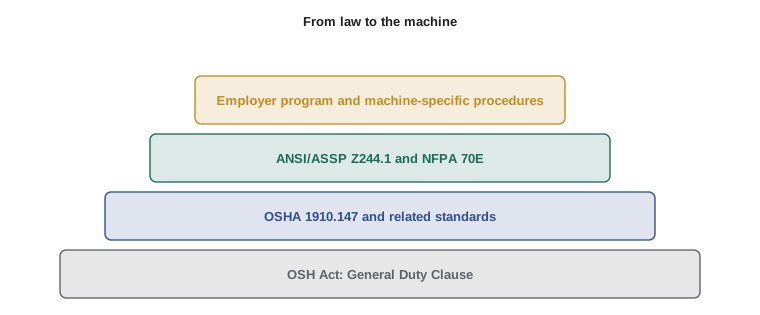
In the United States, the Occupational Safety and Health Act of 1970 gives the federal Occupational Safety and Health Administration (OSHA) authority to set and enforce workplace standards. About half the states run their own OSHA-approved state plans, which must be at least as effective as federal OSHA and sometimes go further. The key federal rule for hazardous energy is 29 CFR 1910.147, The control of hazardous energy (lockout/tagout), first published in 1989. This lesson gives an overview of the standard, related rules and the voluntary consensus standard ANSI/ASSP Z244.1.
The general duty and the OSH Act
Section 5(a)(1) of the OSH Act, the General Duty Clause, requires each employer to provide a workplace free from recognized hazards likely to cause death or serious physical harm, and section 5(a)(2) requires compliance with OSHA standards. Where a specific standard applies, as 1910.147 does to most general industry servicing and maintenance, OSHA cites the standard. Where no standard applies, OSHA can sometimes use the General Duty Clause. Employees also have duties under section 5(b), but OSHA enforces against employers.
The scope of 1910.147
Section 1910.147 applies to the servicing and maintenance of machines and equipment in general industry where the unexpected energization or start-up of the machines or equipment, or the release of stored energy, could cause injury. Servicing and maintenance include constructing, installing, setting up, adjusting, inspecting, modifying, maintaining, cleaning, lubricating, and clearing jams. Normal production operations are covered only when an employee must remove or bypass a guard or safety device, or place any part of their body into the point of operation or another danger zone.
- Construction (covered instead by rules such as 1926.417 for electrical circuits), agriculture, maritime and oil and gas well drilling and servicing are outside its scope.
- Exposure to electrical hazards from work on, near or with conductors or equipment in electrical installations is covered by the electrical safety-related work practices in Subpart S (1910.331 to 1910.335), especially 1910.333(b)(2).
- Electric power generation, transmission and distribution installations are covered by 1910.269, which has its own hazardous energy rules.
- Work on cord-and-plug connected equipment is excluded when unplugging controls the hazard and the plug is under the exclusive control of the employee doing the work.
- Hot tap operations on pressurized pipelines are excluded when specific conditions are met.
Minor tool changes and adjustments and other minor servicing during normal production are not covered if they are routine, repetitive and integral to production, and the work is performed using alternative measures that provide effective protection. Lesson 10 looks at this exception closely.
What 1910.147 requires
The standard sets out a set of program elements. The table below summarizes them with their paragraph numbers.
| Paragraph | Requirement | Key points |
|---|---|---|
| (c)(1) | Energy control program | Procedures, employee training and periodic inspections |
| (c)(2), (c)(3) | Lockout or tagout | Lockout if the device can be locked; tagout only with full employee protection; new or modified equipment since 1990 must accept a lock |
| (c)(4) | Energy control procedures | Written, specific procedures with scope, purpose, rules and steps |
| (c)(5) | Protective materials and hardware | Durable, standardized, substantial and identifiable; provided by the employer |
| (c)(6) | Periodic inspection | At least annually, by an authorized employee not using the procedure; certified |
| (c)(7) | Training and communication | Authorized, affected and other employees; retraining; certification |
| (c)(8), (c)(9) | Who applies lockout; notification | Only authorized employees; affected employees notified before and after |
| (d), (e) | Application and release | The six-step application sequence; release steps and lock removal |
| (f) | Additional requirements | Testing and positioning, outside personnel, group lockout, shift changes |
The standard is performance-oriented: it tells employers what results to achieve and leaves room to design the program to fit the workplace. OSHA's enforcement directive for the standard, CPL 02-00-147, explains how inspectors interpret it, and OSHA has published many letters of interpretation on specific questions such as group lockout and minor servicing.
Related OSHA standards
Several other OSHA standards contain lockout requirements. The electrical work practices in 1910.333(b)(2) require de-energized parts to be locked and tagged, with specific steps for verification by a qualified person. In construction, 1926.417 requires controls that are deactivated during work on energized or de-energized equipment to be tagged, and 1926.702(j) covers lockout on concrete equipment. Power generation and distribution work falls under 1910.269(d) and (m). Specific industries have further rules, such as 1910.217 for mechanical power presses. NFPA 70E, Standard for Electrical Safety in the Workplace, sets out an electrically safe work condition procedure that many employers follow.
Enforcement and penalties
OSHA inspectors cite violations and propose penalties. Maximum civil penalties are adjusted for inflation each year; as of January 2025 the maximum was $16,550 for a serious or other-than-serious violation and $165,514 for a willful or repeated violation. Check the current amounts, because they change. Lockout/tagout is consistently one of OSHA's most cited standards, ranking fourth in fiscal year 2025 with 2,562 violations. Willful violations that cause a death can also be prosecuted criminally under section 17(e) of the OSH Act.
Worked problem
Maximum proposed penalties
Using the January 2025 maximums, what is the largest total penalty OSHA could propose for (a) four serious lockout violations, and (b) two willful violations?
Show solution
- (a) \( 4 \times 16\,550 = 66\,200 \).
- (b) \( 2 \times 165\,514 = 331\,028 \).
- Actual penalties are often reduced for employer size, good faith and history, but repeat and willful violations are penalized heavily.
Answer: (a) $66,200; (b) $331,028, as maximums before any adjustments.
State plans and consensus standards
State plans adopt standards at least as effective as federal OSHA's. California's Cal/OSHA, for example, has its own lockout rules in Title 8 of the California Code of Regulations, including section 3314. ANSI/ASSP Z244.1, Control of Hazardous Energy: Lockout, Tagout and Alternative Methods, is the voluntary consensus standard; its current edition, published in December 2024, gives alternative methods the same standing as lockout when a risk assessment supports them, and adds guidance on topics such as cybersecurity and zoned machines. OSHA does not enforce Z244.1 directly, but it can be used as evidence of recognized good practice.
Putting it together
For a worker, the legal details matter less than the shared core: isolate and lock every energy source, control stored energy, verify the zero energy state and keep control of your own lock. For employers, the details matter a great deal: inspectors will ask to see written procedures, the annual periodic inspection certifications and training certifications, and they will check that procedures match the actual equipment.
What OSHA inspectors look for
In a lockout inspection, OSHA compliance officers typically ask to see the written energy control program and the procedures for the machines in use, the certifications of the annual periodic inspections, and the training certifications. They interview authorized and affected employees, ask them to explain or demonstrate the procedure for a specific machine, and check whether the procedure matches the machine. They look at whether operators clear jams or clean equipment without lockout and, if the employer relies on the minor servicing exception, whether the alternative measures really provide effective protection. Common citations include missing or generic procedures, no periodic inspection, incomplete training and failure to apply lockout during servicing.
Employee rights
Workers have rights that support lockout. Section 11(c) of the OSH Act protects employees from retaliation for raising safety concerns, reporting injuries or filing complaints with OSHA. OSHA regulations at 29 CFR 1977.12 describe a limited right to refuse work where there is a reasonable belief of imminent danger of death or serious injury, there is no time to get the hazard corrected through normal channels, and the employer has refused to fix it. Being told to reach into a running or unisolated machine can meet that test. Many collective agreements and employer programs go further, giving every worker the authority to stop work when lockout is not in place.
Recordkeeping and reporting
Hazardous energy injuries often meet OSHA's recordkeeping criteria in 29 CFR 1904. Employers must also report to OSHA within 8 hours any work-related fatality, and within 24 hours any in-patient hospitalization, amputation or loss of an eye, under 1904.39. Amputations are among the most common outcomes of lockout failures, so a single incident can trigger a report and an inspection. Many employers also track near misses such as failed verifications internally, even though they are not recordable, because they reveal weaknesses before someone is hurt.
For a worker, these rules mean you can expect a written procedure, the right hardware and training, and protection if you raise concerns. For a supervisor, they mean that allowing employees to work on equipment without proper energy control exposes the employer to citations and, in the worst cases, exposes workers to amputation or death.
OSHA's approach to cleaning and jam clearing
OSHA has repeatedly made clear that cleaning, unjamming and adjusting are servicing activities. If an employee must remove or bypass a guard, or place any part of the body into an area where they could be caught by moving machine parts, the lockout standard applies unless the minor servicing exception is met with effective alternative protection. In practice, this means that operators who routinely reach into machines to clear jams need either lockout or engineered safeguards such as interlocked guards designed for the task. Simply stopping the machine with a stop button is not enough, because the button does not isolate the energy and the machine can be restarted by someone else or by its controls. Employers who rely on the exception should be able to show, task by task, that the work is routine, repetitive and integral to production and how employees are protected.
Multi-employer worksites
On worksites with more than one employer, such as a plant with contractors, OSHA's multi-employer citation policy can hold more than one employer responsible for the same hazard. A host employer that creates or controls the hazard, a contractor whose employees are exposed, and an employer responsible for correcting the hazard can each be cited. This is one reason 1910.147(f)(2) requires host and outside employers to exchange information about their lockout programs before work begins. A contractor cannot assume the host's program protects its workers, and a host cannot assume the contractor knows the host's procedures. Clear written agreements, joint briefings and shared group lockouts reduce both the legal exposure and, more importantly, the risk to workers.
Common mistakes
MistakeAssuming ANSI/ASSP Z244.1 replaces OSHA 1910.147.
InsteadOSHA enforces 1910.147. Z244.1 is voluntary guidance that can show recognized good practice.
MistakeThinking the rules only apply to maintenance departments.
InsteadThey apply to any servicing, including cleaning, adjusting and clearing jams, by anyone.
MistakeIgnoring state plan rules where they apply.
InsteadCheck whether a state plan applies and whether it has additional requirements.
MistakeBelieving a written program alone shows compliance.
InsteadInspectors check that procedures match the equipment and that training and reviews actually happen.
MistakeTreating electrical lockout as identical to machine lockout.
InsteadElectrical work has additional rules for qualified persons and verification of de-energization.
Summary and key terms
- OSHA 29 CFR 1910.147 governs hazardous energy control for servicing and maintenance in general industry.
- The standard excludes construction, agriculture, maritime and some electrical and utility work covered by other rules.
- Key elements are the program, procedures, hardware, annual periodic inspections, training and the application and release sequences.
- Related rules include 1910.333(b)(2), 1926.417, 1910.269 and NFPA 70E.
- Lockout/tagout ranked fourth among OSHA's most cited standards in fiscal year 2025.
- Maximum penalties are adjusted annually; check current amounts.
- Procedures must match both the regulation and the actual equipment.
- 1910.147
- The OSHA standard for the control of hazardous energy (lockout/tagout).
- General Duty Clause
- Section 5(a)(1) of the OSH Act, requiring a workplace free from recognized serious hazards.
- State plan
- An OSHA-approved state occupational safety and health program.
- CPL 02-00-147
- OSHA's enforcement directive for the lockout/tagout standard.
- ANSI/ASSP Z244.1
- The voluntary US consensus standard on lockout, tagout and alternative methods.
- NFPA 70E
- The consensus standard for electrical safety in the workplace.
- Servicing and maintenance
- Work such as setting up, adjusting, cleaning, lubricating and clearing jams.
- Willful violation
- A violation committed with intentional disregard of, or plain indifference to, the law.
- Letter of interpretation
- An OSHA letter explaining how a standard applies to a specific question.
- Minor servicing exception
- The limited exclusion for routine, repetitive tasks integral to production with effective alternative protection.
Practice problems
Work each problem on paper first, then reveal the answer to check.
Which OSHA standard covers lockout in general industry?
Show answer
29 CFR 1910.147.
Name two work areas outside the scope of 1910.147.
Show answer
Construction, agriculture, maritime, oil and gas well drilling, or utility work under 1910.269.
How often must periodic inspections be done?
Show answer
At least annually.
Since what year must new or modified equipment accept a lockout device?
Show answer
1990 (equipment installed or modified after January 2, 1990).
What is CPL 02-00-147?
Show answer
OSHA's enforcement directive for the lockout/tagout standard.
Where did lockout/tagout rank on OSHA's FY2025 top 10?
Show answer
Fourth, with 2,562 violations.
What is the maximum for three serious violations at the January 2025 maximum?
Show answer
3 × $16,550 = $49,650.
Which standard covers electrical lockout for electrical work in general industry?
Show answer
1910.333(b)(2).
Is ANSI/ASSP Z244.1 enforced by OSHA?
Show answer
Not directly; it is a voluntary consensus standard that can show recognized good practice.
When is normal production covered by 1910.147?
Show answer
When a guard is removed or bypassed, or a body part enters the point of operation or danger zone.
Lesson quiz · 5 questions
Score 60% or more to complete this lesson.
Create a free account to save your progress, take quizzes and earn a certificate.