
HSE-210 · Lesson 4 of 12 · 29 min
The energy control program: procedures, roles and training
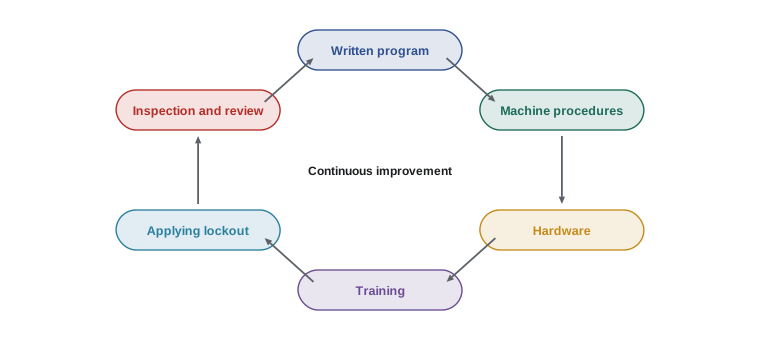
Lockout is not something individual workers invent on the spot. It works because the workplace has a planned system behind it: a written program that sets the rules, machine-specific procedures that say exactly what to do on each piece of equipment, standard hardware, defined roles, training, and regular checks that the system is working. This lesson looks at that system as a whole. Later lessons go into the details of devices, the lockout sequence, verification, group lockout, removal, alternative methods and audits.
OSHA's 1910.147(c)(1) requires an energy control program consisting of energy control procedures, employee training and periodic inspections. ANSI/ASSP Z244.1 describes a broader program that also covers design, risk assessment and alternative methods. Many employers build it into a wider safety management system, such as one based on ANSI/ASSP Z10 or ISO 45001.
What the written program contains
The program document is usually short and general. It applies to the whole site and points to machine-specific procedures for the details. A typical program covers:
- purpose and scope: which sites, equipment and activities it covers, and the commitment that hazardous energy will be controlled before servicing and maintenance;
- definitions of key terms such as energy-isolating device, lockout, tagout, zero energy state and the roles of authorized, affected and other persons;
- responsibilities of management, supervisors, authorized persons, affected persons, contractors and the health and safety committee;
- general rules: when lockout is required, the personal lock rule, what to do when a procedure does not match the equipment, and the ban on using another person's lock;
- the general sequence of lockout and release (lessons 6 and 9);
- hardware: standard locks, tags, hasps and devices, how they are issued and identified (lesson 5);
- special situations: group lockout, shift changes, contractors, testing and positioning, abandoned locks and emergencies (lessons 8 and 9);
- alternative methods and exceptions, with the risk assessment process for approving them (lesson 10);
- training, retraining and records;
- periodic inspection, auditing and program review (lesson 11);
- enforcement: what happens when rules are broken, applied fairly and consistently.
Machine-specific procedures
The program says what the rules are; the procedure says how to apply them to one machine. A good machine-specific procedure lists every energy source with its identifier and location, the type of isolating device, the lockout device needed, how to release stored energy, and how to verify a zero energy state. Many workplaces post these as placards on or near the machine, with photographs showing each isolation point. Lesson 11 covers how to write and maintain them, and the capstone in lesson 12 asks you to draft one.
OSHA requires procedures to clearly and specifically outline the scope, purpose, authorization, rules and techniques for controlling hazardous energy, including the steps for shutting down, isolating, blocking and securing machines; the steps for placing, removing and transferring lockout devices; and the requirements for testing to verify effectiveness. A single procedure may cover a group of similar machines with the same type and magnitude of energy and the same isolation methods. A written procedure is not needed only in the narrow case where all eight conditions in the note to (c)(4)(i) are met, such as a single readily identified energy source with no stored energy.
The three roles in more detail
Standards in both countries use the same three groups. Your role determines what you can do and what training you need.
Authorized persons lock out equipment and perform servicing or maintenance on it. They must be able to recognize hazardous energy sources, know the type and magnitude of energy at their workplace, and know the methods and means for isolation and control. Only authorized persons apply locks for servicing work. Typical authorized persons include maintenance technicians, millwrights, electricians, and operators or sanitation workers who have been trained and authorized to lock out for cleaning or jam clearing.
Affected persons operate or use the equipment, or work in the area where servicing is done. They must recognize that energy control is in use, understand its purpose, and know that they must never try to restart, re-energize or remove locks from locked-out equipment. They must be notified before equipment is locked out and before it is restarted.
Other persons work in the facility where energy control may be used but do not operate or service the equipment, such as office staff, quality inspectors and many contractors on unrelated work. They must know enough to recognize a lock and tag and to leave them alone.
The same person can hold different roles at different times. An operator is an affected person while maintenance works on their machine, and becomes an authorized person if they are trained and authorized to lock out the machine themselves for cleaning.
| Role | What they do | Core training |
|---|---|---|
| Authorized person | Applies locks and performs servicing or maintenance | Energy types and magnitudes, isolation methods, procedures, devices, verification, group lockout, removal |
| Affected person | Operates or works near the equipment | Purpose and use of energy control; never restart or remove locks; notification |
| Other person | Works in the facility | Recognize locks and tags; never attempt to restart locked or tagged equipment |
Training and competence
Training must fit the role and the equipment. Classroom or online material, such as this course, can teach the concepts. Authorized persons also need practical, hands-on training on the actual machines and devices they will lock out, and someone competent should observe them performing lockout before they are authorized to do it alone.
Training for authorized persons typically covers the energy sources at the site and their magnitude, how to read and follow machine-specific procedures, how to use each type of lockout device, how to release stored energy, how to verify zero energy (including test-before-touch for electrical work, where the person is qualified), group lockout and shift change procedures, what to do when a procedure does not match the equipment, and how locks are removed.
Where tagout is used, OSHA requires authorized, affected and other employees to be trained in the limitations of tags (lesson 5). Retraining is required whenever there is a change in job assignments, machines, equipment or processes that presents a new hazard, or a change in procedures, and whenever a periodic inspection or other information shows deviations or inadequacies in an employee's knowledge or use of procedures. The employer must certify that training has been done, with each employee's name and the dates of training.
Records
Records show that the program exists and works. Typical records include the written program, the current version of each machine-specific procedure with its review date, training records for each person with their role and the equipment they are authorized on, records of periodic inspections, lock issue and assignment records, logs of locks removed under the abandoned lock procedure, and incident and near miss reports. These records are also the employer's evidence of due diligence if something goes wrong.
Worked problem
Planning training hours
A plant has 18 authorized persons, 60 affected persons and 40 other persons. Initial training is 8 hours for authorized persons (including hands-on practice), 1 hour for affected persons and 30 minutes for other persons. (a) How many training hours are needed in total? (b) At an average loaded labor cost of $45 an hour, what is the labor cost of the training time?
Show solution
- Authorized: \( 18 \times 8 = 144 \) hours.
- Affected: \( 60 \times 1 = 60 \) hours.
- Other: \( 40 \times 0.5 = 20 \) hours.
- Total: \( 144 + 60 + 20 = 224 \) hours.
- Labor cost: \( 224 \times 45 = 10\,080 \) dollars.
Answer: 224 hours, about $10,080 of paid time, a small cost compared with a single amputation.
Worked problem
Tracking procedure coverage
A site has 58 machines that need machine-specific procedures. Written, reviewed procedures exist for 46 of them. (a) What percentage of machines are covered? (b) If the team can complete and field-test three procedures a week, how many weeks will it take to reach full coverage?
Show solution
- (a) \( 46 \div 58 \approx 0.793 \), about 79 percent.
- (b) Missing procedures: \( 58 - 46 = 12 \).
- Weeks: \( 12 \div 3 = 4 \) weeks.
Answer: About 79 percent coverage now; four weeks to cover the remaining 12 machines, with interim controls in the meantime.
Worked problem
When is retraining needed?
Decide whether retraining is needed in each case: (a) a new hydraulic accumulator is added to a press; (b) a periodic inspection finds an authorized worker skipped the verification step; (c) an affected operator moves to an identical machine on another line; (d) the site changes its standard lock color from red to blue.
Show solution
- (a) Yes: a new stored energy source changes the procedure and the hazard.
- (b) Yes: the inspection shows a deviation in the worker's use of the procedure.
- (c) Usually no formal retraining if the equipment, hazards and procedure are the same, but a short orientation is good practice.
- (d) Yes, at least a briefing for everyone, because people must recognize the new locks.
Answer: Retrain in (a), (b) and (d); (c) needs at most an orientation.
Supervisors and managers
Supervisors have a special role. They plan work so that time is available for lockout, ensure workers have locks and procedures, check that lockout is done, and stop work that bypasses the procedure. A supervisor who says 'just clear it quickly' undermines the whole program. Managers set the tone by funding hardware, procedures and training, by including lockout in production planning, and by responding to reports constructively. Health and safety committees and worker representatives help review procedures, take part in inspections and investigate incidents.
Designing for easier lockout
The best programs also look upstream at equipment design. Machines that have one clearly labeled, lockable disconnect for all their electrical energy, a single lockable dump valve for all their air, built-in bleed valves and gauges, and mechanical locking points for raised parts are much easier and faster to lock out correctly. When equipment is bought or modified, the purchasing specification should require lockable isolating devices, clear labeling, and a manufacturer-supplied energy isolation procedure. Making lockout easy is one of the most effective ways to make sure it happens.
Involving workers
The people who use and maintain equipment know where the procedures do not fit reality. A strong program asks them to help write and test procedures, encourages them to report mismatches and near misses, and responds visibly when they do. Health and safety committees or worker representatives can review the program, take part in periodic inspections and help investigate incidents. When workers see that their reports lead to better procedures, devices and schedules, they are more likely to follow the program when no one is watching.
Common mistakes
MistakeWriting one generic procedure that says only "lock out all energy sources".
InsteadWrite machine-specific procedures that list each source, its isolation device, stored energy control and verification.
MistakeAuthorizing workers to lock out after classroom training alone.
InsteadAdd hands-on training on the actual equipment and observe them before authorization.
MistakeForgetting to train affected and other persons.
InsteadEveryone who may see a lock or tag must know what it means and that they must never remove it.
MistakeTreating training as a one-time event.
InsteadRetrain after changes to equipment, procedures or roles, and when inspections reveal gaps.
MistakeLeaving lockout time out of production schedules.
InsteadPlan time for lockout so supervisors and workers are not tempted to skip it.
Summary and key terms
- An energy control program combines a written program, machine-specific procedures, hardware, training and periodic inspection.
- The program sets site-wide rules; procedures say how to lock out each machine.
- Authorized persons lock out and service equipment; affected persons operate or work near it; other persons work in the facility.
- Training must match the role, include hands-on practice for authorized persons, and be repeated when things change.
- Records of procedures, training, inspections and lock removals support due diligence.
- Supervisors and managers make lockout possible by planning time and resources.
- Designing equipment for easy isolation makes correct lockout more likely.
- Energy control program
- The site-wide system of rules, procedures, hardware, training and inspection for controlling hazardous energy.
- Machine-specific procedure
- Written steps for isolating and verifying all energy sources on a particular machine.
- Placard
- A posted version of a procedure, often with photographs of isolation points.
- Other person
- Someone who works in the facility but does not operate or service the equipment.
- Hands-on training
- Practical training on the actual equipment and devices.
- Retraining
- Repeated training after changes or when gaps are found.
- Authorization
- Formal approval for a trained person to lock out specific equipment.
- Competent person
- A person qualified by knowledge, training and experience to do a task safely.
- Training record
- A record of who was trained, on what, when and by whom.
- Purchasing specification
- Requirements written into equipment orders, such as lockable isolating devices.
Practice problems
Work each problem on paper first, then reveal the answer to check.
Name four elements of a written energy control program.
Show answer
For example scope, definitions, responsibilities, general rules, hardware, special situations, training, inspection and enforcement.
What is the difference between the program and a procedure?
Show answer
The program sets site-wide rules; a procedure gives the steps for one machine.
Who may apply locks for servicing work?
Show answer
Only authorized persons.
What must affected persons never do?
Show answer
Try to restart, re-energize or remove locks from locked-out equipment.
Why is hands-on training needed?
Show answer
Workers must practice on the actual machines and devices, which classroom training cannot replace.
Give two triggers for retraining.
Show answer
New equipment or hazards, changed procedures, new job assignments, or inspection findings showing gaps.
A plant has 10 authorized persons needing 6 hours each and 30 affected persons needing 1 hour each. Total hours?
Show answer
60 + 30 = 90 hours.
Why keep lock removal logs?
Show answer
To show that abandoned lock removals followed the procedure and to spot patterns.
How can supervisors undermine lockout?
Show answer
By pressuring workers to skip it, or not planning time for it.
Give one design feature that makes lockout easier.
Show answer
A single lockable disconnect, a lockable dump valve, built-in bleed valves and gauges, or mechanical locking points.
Lesson quiz · 5 questions
Score 60% or more to complete this lesson.
Create a free account to save your progress, take quizzes and earn a certificate.