
HSE-210 · Lesson 1 of 12 · 24 min
Hazardous energy and why lockout matters
Every machine, process and building system at work runs on energy. Electricity drives motors, compressed air moves cylinders, hydraulic oil lifts presses, steam heats vessels and gravity holds a raised load in place. That energy is what makes the equipment useful. It is also what injures people when it is released while someone is cleaning, adjusting, repairing, unjamming or maintaining the equipment. A conveyor that starts while a worker is reaching in to clear a jam, a press ram that drifts down when hydraulic pressure bleeds off, a valve that opens and releases hot liquid into a vessel where someone is working: these are classic hazardous energy incidents, and they tend to cause amputations, crushing injuries, burns, electrocution and death.
Lockout/tagout, usually shortened to LOTO, is the main way workplaces prevent these incidents. In the United States the federal rule is OSHA's standard for the control of hazardous energy, 29 CFR 1910.147, and the national consensus standard is ANSI/ASSP Z244.1. In this course we explain both the general principles and how US law and standards apply them.
This first lesson sets out what hazardous energy is, why ordinary on-off switches and good intentions are not enough, how lockout works in principle, and how the rest of the course is organized. It is an awareness course. It explains the ideas behind energy control so that you can recognize hazards, follow procedures and take part in your workplace program. It does not authorize you to lock out equipment: that requires training by your employer on the specific machines, procedures and devices at your site.
What we mean by hazardous energy
Hazardous energy is any energy that could cause harm if it is released, or if equipment starts or moves unexpectedly, while people are working on or near it. The word unexpected matters. Most hazardous energy injuries happen not because people do not know a machine is dangerous, but because they believe it is safe at that moment: it has been switched off, it has stopped moving, someone said it was shut down, or it was idle when they reached in.
Energy can be present in many forms, and one machine usually has several. A typical packaging line might have electrical power to its motors and controls, compressed air for its cylinders, a hydraulic unit for a lifting table, springs in its guards and tensioners, gravity acting on raised parts, and heat in a sealing bar. Lesson 2 looks at each type in detail, including stored and residual energy, which remains after the main supply is disconnected.
How hazardous energy injuries happen
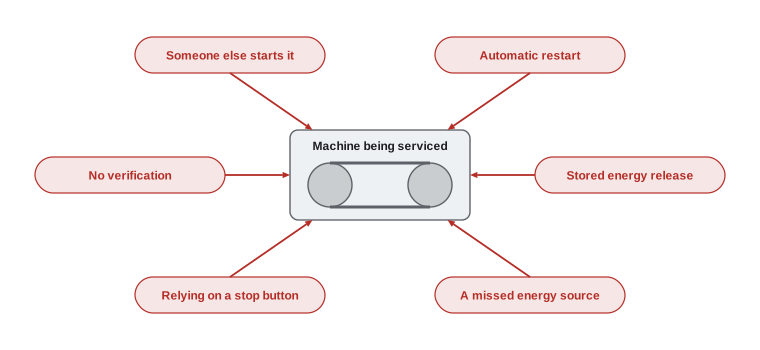
Investigators who study these incidents see the same patterns over and over. The most common are:
- someone starts the equipment while another person is inside it or reaching into it, often because they cannot see the other person or do not know they are there;
- the equipment starts by itself because of an automatic control, a timer, a sensor or a programmable controller resuming its sequence once a jam is cleared;
- stored energy is released: a spring, a raised load, trapped air or hydraulic pressure, a charged capacitor or a spinning flywheel;
- the wrong energy source is isolated, or one source is missed, because the equipment is fed from more than one place;
- a worker relies on a control circuit device, such as a stop button, an emergency stop, an interlocked guard or a selector switch, instead of isolating the energy itself;
- lockout is done but not verified, so a failed disconnect or a mislabeled breaker goes unnoticed;
- a lock is removed, or the equipment is restarted, before everyone is clear.
Several of these involve people doing something that seems reasonable at the time. Pressing the stop button and reaching in feels safe. The point of lockout is to make safety independent of memory, line of sight and assumptions.
Why a stop button is not enough
Most machines have stop buttons, emergency stops, interlocked doors or light curtains. These are important safety devices, but they are part of the control system, not energy isolation. A control system device tells the machine to stop. It does not physically disconnect the power. If the control system fails, is bypassed, is programmed to restart after a delay, or is operated by someone else, the machine can start while you are inside it.
Energy isolation means physically preventing the transmission or release of energy: opening a disconnect switch, removing a plug, closing and blocking a valve, inserting a blank in a pipe, blocking a raised part so it cannot fall. An energy-isolating device is a mechanical device that does this. Push buttons, selector switches and other control circuit devices are specifically not energy-isolating devices under lockout standards in both Canada and the United States.
| Control device (not isolation) | Energy-isolating device |
|---|---|
| Stop or start push button | Manually operated electrical disconnect switch |
| Emergency stop button | Circuit breaker that can be locked in the off position |
| Selector switch or key switch on a control panel | Plug removed from the outlet and kept under control |
| Interlocked guard or light curtain | Line valve closed and locked, or a blank or blind flange |
| Programmable logic controller output | Mechanical block or pin preventing movement |
The basic idea of lockout
Lockout combines a few simple principles into a reliable routine:
- identify every source of energy that could cause harm, including stored energy;
- shut the equipment down in an orderly way;
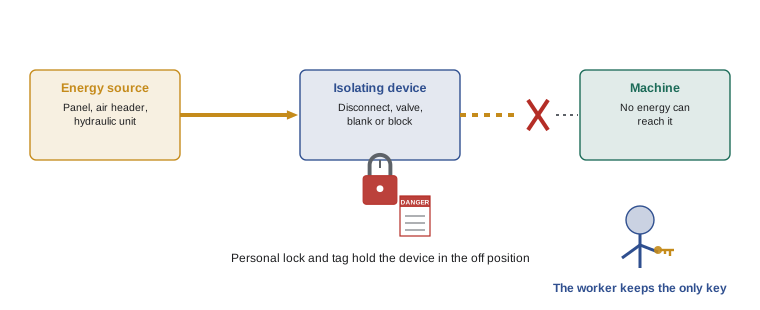
- isolate each source with an energy-isolating device;
- apply a lock to each isolating device so it cannot be operated until the lock is removed, and attach a tag that identifies who applied it and why;
- release, restrain or dissipate stored energy;
- verify that the equipment is at a zero energy state before work starts, usually by trying to start it and by testing;
- keep control of your own lock and key until the work is done and everyone is clear.
The personal lock is the heart of the system. Each worker who could be exposed applies their own lock, and only they hold the key. As long as that lock is on, no one can energize the equipment without physically removing it. This puts each worker in control of their own safety. Lesson 6 walks through the full sequence, and lessons 7 to 9 cover verification, group lockout and safe removal.
Lockout and tagout
OSHA's standard is called the control of hazardous energy (lockout/tagout). It recognizes two methods: lockout, which uses a lock, and tagout, which uses a prominent warning tag alone. Tagout is permitted only where an isolating device cannot accept a lock, or where the employer can show that a tagout program gives full employee protection equal to lockout. Since 1990, new or substantially modified equipment must be designed so that it can accept a lockout device. Lesson 5 explains the limits of tags.
Who is involved
Energy control involves three groups of people, and the same three groups appear in the regulations and standards of both countries, although the names vary slightly:
- authorized persons, who lock out equipment and do the servicing or maintenance work;
- affected persons, who operate or use the equipment, or work in the area, and must recognize when lockout is in use and never try to restart locked-out equipment;
- other persons, who work in the facility and need to know what lockout is and that they must not interfere with it.
Lesson 4 explains these roles and the training each group needs. For now, the key idea is that energy control is not just a maintenance task. Operators, supervisors, cleaners, contractors and visitors all need to know what a lock and tag mean.
What the course covers
Here is the path through the remaining lessons:
- lesson 2: the types and sources of hazardous energy, with calculations showing how much energy can be stored in springs, raised loads, accumulators, capacitors and flywheels;
- lesson 3: the OSHA lockout/tagout standard, related OSHA standards, ANSI/ASSP Z244.1 and enforcement;
- lesson 4: the energy control program, its procedures, roles and training;
- lesson 5: locks, tags, hasps and other devices;
- lesson 6: the lockout sequence step by step;
- lesson 7: verifying zero energy and controlling stored energy;
- lesson 8: group lockout, shift changes and contractors;
- lesson 9: restoring equipment and removing locks safely;
- lesson 10: alternative methods, minor servicing and exceptions;
- lesson 11: machine-specific procedures, placards, inspections and audits;
- lesson 12: incident case studies and a capstone in which you draft a machine-specific procedure.
Two related topics have their own courses. Electrical safety, including arc flash, approach boundaries and the work of qualified electrical workers, is covered in HSE-214. Machine guarding, which protects people during normal production, is covered in HSE-215. Lockout protects people during servicing and maintenance, when guards are often removed or bypassed. The two work together.
The scale of the problem
Lockout/tagout is consistently one of OSHA's most frequently cited standards. In fiscal year 2025 (October 2024 to September 2025), 29 CFR 1910.147 ranked fourth on OSHA's list of the 10 most cited standards, with 2,562 violations. OSHA has long estimated that compliance with the lockout/tagout standard prevents about 120 deaths and 50,000 injuries each year, and its fact sheet notes that workers injured by hazardous energy lose an average of 24 workdays to recover. Those figures are older estimates, but they show why the standard matters.
Behind every statistic is a predictable sequence: an assumption that the equipment was safe, a missed energy source, or a step skipped to save a few minutes. The good news is that hazardous energy incidents are among the most preventable injuries at work. A reliable lockout routine, understood by everyone, prevents almost all of them.
A culture of zero energy
Lockout works best when it is part of how the workplace thinks, not a rule followed only when a supervisor is watching. Signs of a strong energy control culture include:
- people lock out even for quick jobs, because they know that most injuries happen during short, routine tasks;
- supervisors plan lockout time into maintenance and cleaning schedules rather than treating it as a delay;
- equipment is labeled clearly, and each machine has a written procedure posted where it is needed;
- workers feel free to stop and ask when a procedure does not match the equipment;
- near misses, such as a missed energy source found during verification, are reported and used to improve procedures;
- no one ever removes another person's lock outside the formal removal procedure.
The rest of this course gives you the knowledge to recognize good practice and to spot gaps.
Common mistakes
MistakePressing the stop button or emergency stop and reaching into the machine.
InsteadStop buttons are control devices. Isolate the energy with an energy-isolating device and lock it out.
MistakeAssuming a machine is safe because it is not moving.
InsteadIdle equipment may be waiting for a sensor, timer or controller to restart it. Lock it out and verify.
MistakeSkipping lockout for a quick job such as clearing a jam.
InsteadShort, routine jobs cause many injuries. Lock out unless a recognized exception or alternative method applies.
MistakeThinking only maintenance staff need to understand lockout.
InsteadOperators, cleaners, supervisors and contractors must all recognize and respect locks and tags.
MistakeTreating this awareness course as authorization to lock out equipment.
InsteadAuthorized persons need site-specific training on the actual machines and procedures.
Summary and key terms
- Hazardous energy is any energy that can injure people if equipment starts or energy is released unexpectedly during servicing or maintenance.
- Most incidents involve someone else starting the machine, automatic restart, stored energy, a missed source, reliance on control devices or no verification.
- Stop buttons, emergency stops and interlocks are control devices, not energy-isolating devices.
- Lockout identifies, isolates, locks, releases stored energy and verifies a zero energy state before work.
- Each exposed worker applies a personal lock and keeps the key, which puts them in control of their own safety.
- Authorized, affected and other persons each need training suited to their role.
- Lockout is among the most preventable causes of serious injury when everyone follows the routine.
- Hazardous energy
- Energy that could cause harm if released or if equipment starts unexpectedly during work.
- Lockout
- Placing a lock on an energy-isolating device so the equipment cannot be operated until the lock is removed.
- Tagout
- Placing a warning tag on an energy-isolating device to show that it must not be operated.
- Energy-isolating device
- A mechanical device that physically prevents the transmission or release of energy, such as a disconnect switch or line valve.
- Control circuit device
- A push button, selector switch or similar device that signals a machine to stop or start but does not isolate energy.
- Zero energy state
- The condition in which all hazardous energy has been isolated, released or restrained and verified.
- Stored energy
- Energy that remains in equipment after it is isolated, such as in springs, raised parts or capacitors.
- Authorized person
- A person trained and permitted to lock out equipment and perform servicing or maintenance.
- Affected person
- A person who operates or works near equipment that is locked out.
- Personal lock
- A lock assigned to one worker, who alone holds its key.
Practice problems
Work each problem on paper first, then reveal the answer to check.
Give three forms of energy that might be present on one packaging machine.
Show answer
For example electrical, pneumatic (compressed air) and gravity, plus possibly hydraulic, springs and heat.
Why is an emergency stop button not an energy-isolating device?
Show answer
It acts through the control system and does not physically disconnect or block the energy.
Name two examples of energy-isolating devices.
Show answer
A lockable disconnect switch, a lockable circuit breaker, a line valve, a blank flange, a removed plug or a mechanical block.
What is the purpose of a personal lock?
Show answer
It prevents anyone from operating the isolating device while the worker who holds the only key is exposed.
Why do many injuries happen during short jobs?
Show answer
People skip lockout because the task seems quick, so the equipment can start or release energy while they are exposed.
Who are affected persons?
Show answer
People who operate or work near equipment that is being locked out.
What does verification check?
Show answer
That the equipment really is at a zero energy state before anyone starts work.
Which course covers arc flash and electrical approach boundaries?
Show answer
HSE-214 Electrical Safety Awareness.
How does machine guarding differ from lockout?
Show answer
Guarding protects people during normal production; lockout protects them during servicing and maintenance.
Does completing this course authorize you to lock out equipment?
Show answer
No. Authorized persons need employer training on the specific equipment and procedures.
Lesson quiz · 5 questions
Score 60% or more to complete this lesson.
Create a free account to save your progress, take quizzes and earn a certificate.